Receptors and Cell Signaling
 Call Kai
 Learn
Learn Practice Test
 Spaced Repetition
 Match
Match Flashcards
 Knowt Play
1/65

There's no tags or description
Looks like no tags are added yet.
Name | Mastery | Learn | Test | Matching | Spaced | Call with Kai | Chat |
|---|
No analytics yet
Send a link to your students to track their progress
66 Terms
Signal Transduction
- A series of molecular changes that converts a signal on a target cell's surface to a specific response inside the cell.
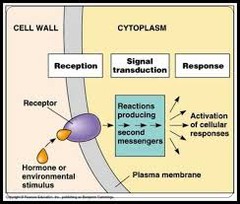
What happens after a receptor detects a "message"?
- Intracellular signaling pathways carry out command → leads to cellular response
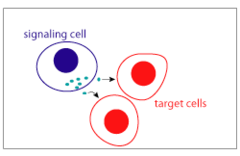
Paracrine Signaling
- Secreted molecules diffuse locally and trigger a response in neighboring cells
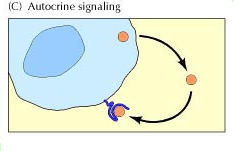
Autocrine Signaling
- The target cell is also the secreting cell
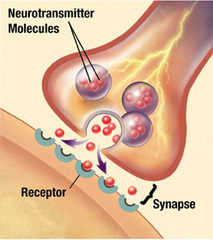
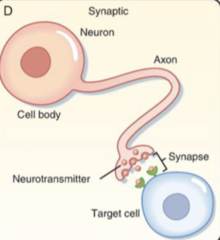
Synaptic/Neurotransmitter Signaling
- Signal released into synapse → binds to receptors
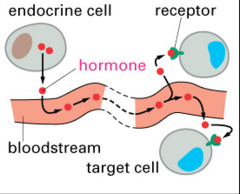
Endocrine Signaling
- Signal is released into bloodstream and acts on a distant target cell
- Hormones
Exosomes
- Small vesicles that contain proteins, lipids, and nucleic acids that are released via exocytosis → interstitium → blood → bind receptors at various tissues throughout the body
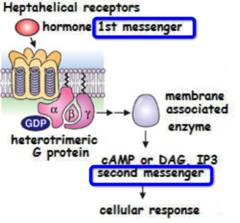
First Messenger
- Ligand (binds to receptors)
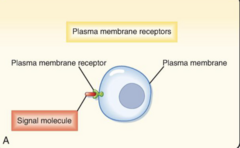
Plasma Membrane Receptor
- Bind to water-soluble ligands, does not cross plasma membrane
- Requires activation of second messenger system to carry out an intracellular response
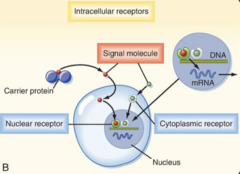
Intracellular Receptor
- Signaling molecule crosses plasma membrane & binds to cytosolic or nuclear receptors
Intracellular Receptor: The signaling molecule/receptor complex acts as what?
- A transcription factor to regulate protein expression
Stages of Signal Transduction
1. Reception: Signaling molecule binds to receptor at target cell → conformational change that activates the receptor
2. Transduction: Activation of associated intracellular processes, second messengers → signal amplification may occur
3. Response: Cellular response occurs, specific to the signaling molecule
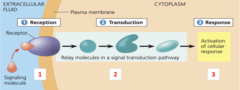
Which type of signaling involves a cell releasing a molecule into the bloodstream, where it travels to distant target cells throughout the body?
- Endocrine Signaling
A Hormone receptor is defective. Which steps of the signal transduction process are likely affected?
- Reception, Signal transduction, cellular response
Amines: Properties, Precursors, Secretion
- Properties: Hydrophilic
- Precursor: Tyrosine
- Secretion: Exocytosis upon stimulation
Important Amines
Catecholamines:
- Norepinephrine
- Epinephrine
- Dopamine
Thyroid Hormones (T3/T4)
How do Norepinephrine/Epinephrine bind to target cells?
- They are hydrophilic → unable to pass through plasma membrane → bind at cell surface receptors
Peptides/Proteins: Properties and Secretion
- Properties: Most hormones are in this class; single gene codes for each peptide hormone; Hydrophilic
- Secretion: Exocytosis upon stimulation
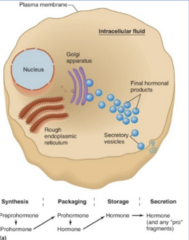
Steroids: Properties, Precursors, Secretion
- Properties: Lipophilic
- Precursors: Synthesized from cholesterol w/in adrenal cortex, gonads, corpus lute, placenta
- Secretion: Diffusion (lipophilic can pass through membrane)
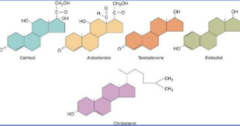
Amines: Transport in blood
- Hydrophilic → bound to plasma proteins (Albumin)
Amines: Target Receptors
- T3/T4: Intracellular receptors
- Catecholamines: Adrenergic receptors on plasma membrane
Peptides: Transport in Blood
- Circulates as "free" hormones, not bound to plasma proteins
Peptides: Target Receptors
- On Plasma membrane
Steroids: Transport in blood
- 99% Bound to carrier proteins (albumin)
Steroids: Target Receptors
- Intracellular receptors
What binds to plasma membrane receptors? Where are they located?
- Hydrophilic ligands like peptide hormones
- Most receptors are on cell surface
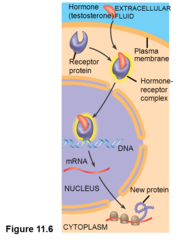
What binds to intracellular receptors? Where are they located?
- Hydrophobic (lipophilic) ligands such as thyroid and steroid hormones
- Located inside cell, w/in nucleus or cytoplasm
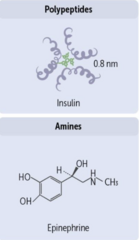
Are Insulin and Epinephrine hydrophobic or hydrophilic?
- Hydrophilic (Water-Soluble)
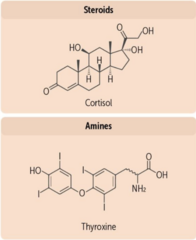
Are Cortisol and Thyroxine hydrophobic or hydrophilic?
- Hydrophobic (Lipid-Soluble)
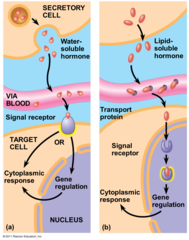
Key Water Soluble Hormones
- Insulin
- Glucagon
- ADH
- Epinephrine
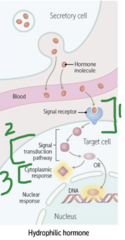
Water Soluble Hormones: Transport in blood and location of receptor
- Transport: Travels freely in bloodstream, no carrier proteins
- Receptor: Cell Membrane
Water Soluble Hormones: MOA
- Signal transduction via second messengers
Key Lipid Soluble Hormones
- Steroids (cortisol, testosterone, ADH, vitamin D)
- Lipid-soluble amines (Thyroxine-T4)
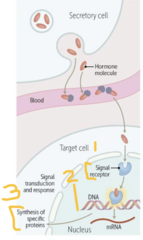
Lipid Soluble Hormones: Transport in blood and receptor location
- Transport: Requires carrier proteins to reach target tissues
- Receptor location: Intracellular
What do lipid soluble hormones form? Its MOA?
- Hormone:Receptor complex → acts as a transcription factor
- MOA: Gene regulation
Where are plasma carrying proteins synthesized?
- Liver
Cortisol/Thyroxine/Estrogen/Testosterone binds what in plasma?
- Cortisol: Corticosteroid-binding globulin (CBG)
- Thyroxine: Thyroxine-binding globuline (TBG)
- Estrogen/Test: Sex hormone binding globulin (SHBG)
Why do lipid-soluble signaling molecules, such as cortisol, affect only target cells despite crossing the membranes of all cells?
- Only target cells have intracellular receptors for cortisol
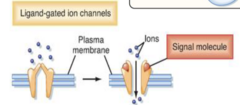
When a neuron responds to a particular neurotransmitter by opening gated ion channels, the NT is serving as which part of the signal pathway?
- Signal Molecule
Ligand Gated Ion Channel Receptors
- Opens when specific molecule binds, allowing ions to pass through the membrane
Influx vs Efflux
- Influx → INTO the cell
- Efflux → OUT of the cell
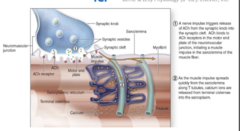
Nicotinic Receptors: Ligand, Location, Response
- Ligand: Acetylcholine
- Exciting neurons → skeletal muscle
- Response: Na+ Influx
Glutamate Receptors: Ligand, Exciting/Inhibitory, Response
- Ligand: Glutamate
- Exciting neuron
- Response: Ca2+ and Na+ Influx
GABA Receptors: Ligand, Exciting/Inhibitory, Response
- Ligand: GABA
- Inhibiting neuron activity
- Response: Cl- ion influx
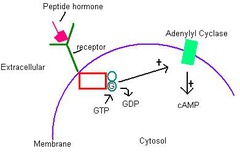
G Protein Coupled Receptor (GPCR): Structure
- 7 transmembrane alpha helices
- Outside: Receptor
- Inside: Heterotrimeric G-Protein (γ, α, β)
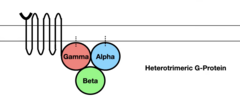
G Protein Coupled Receptor (GPCR): What happens after receptor binds?
1. Signal binds to extracellular receptor → conformational change in the trimeric g-protein (γ, α, β)
2. γ and β stay associated with membrane, α dissociates
3. GTP binds to α subunit → active
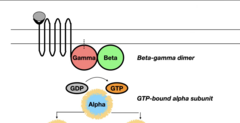
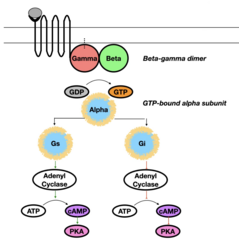
G Protein Coupled Receptor (GPCR): What happens when α is activated?
Depending on ligand signal, pathway can be stimulatory or inhibitory:
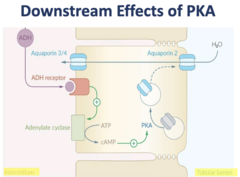
- Gs: Activates Adenyl Cyclase → ↑ cAMP → activates PKA
- Gi: Inhibits Adenyl Cyclase → ↓ cAMP → inhibits PKA
PKA has further downstream secondary messenger effects
G Protein Coupled Receptor (GPCR): Gq Pathway
1. α still activated (bound to GTP)
2. Gq signal activates Phospholipase C
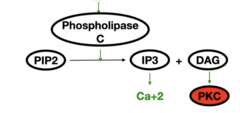
3. PLC converts PIP2 → IP3 + DAG
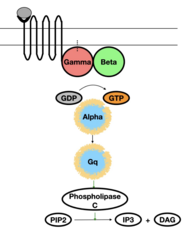
What are the roles of IP3 and DAG in Gq pathway?
- IP3: Releases Ca2+
- DAG: Activates protein kinase C
Both lead to downstream secondary messenger effects
In the following pathway: epinephrine → G protein-coupled receptor → G protein
→ adenylyl cyclase → cAMP, what component acts as the second messenger?
- cAMP
Not Adenylyl cyclase bc it is a membrane bound enzyme, cAMP first free floating part of signal sequence
How does Antidiuretic Hormone interact with GPCRs?
- Binds GPCR → ↑ cAMP → PKA activated → ↑ Aquaporin Channels
How does Glucagon Interact with GPCRs
- Binds GPCR → ↑ cAMP → PKA activated → PKA phosphorylates enzymes involved in glycogen breakdown → ↑↑ Blood sugar
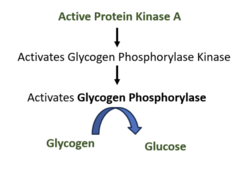
Glucagon: Synthesized where? Where are its target receptors? Result?
- Synthesized: Pancreas
- Target: GPCRs on Hepatocytes
- Result: Raises blood [glucose]
![<p>- Synthesized: Pancreas</p><p>- Target: GPCRs on Hepatocytes </p><p>- Result: Raises blood [glucose]</p>](https://assets.knowt.com/user-attachments/0f7df8fb-594f-4135-a89e-58fa971ac5ef.png)
How are signals terminated in GPCR Pathway?
1. GTP on Gα hydrolyzed → GTP → inactivates subunit
2. cAMP broken down by PDE
3. Phosphatases remove phosphate groups from target proteins → reverses effects of protein kinases
Inhibiting Phospholipase C would result in what?
- Blocks the release of Ca2+ from ER
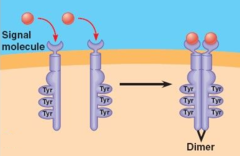
Receptor Tyrosine Kinase: Structure
- Contains messenger-binding site, transmembrane segment, and enzymatic site
- Tyrosine kinases phosphorylate tyrosine amino acids on target proteins
Receptor Tyrosine Kinase: Steps of Dimerization
1. Growth factors or local signaling molecules bind to receptor site
2. 2x RTKs dimerize → the RTKs cross phosphorylate one another → creates SH2 domain (binding site for intracellular enzymes)
Receptor Tyrosine Kinase: RAS Pathway
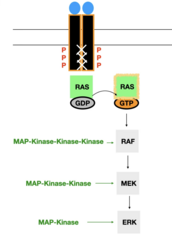
1. RTKs are dimerized → form SH2 domain
2. RAS (inactive, GDP bound) binds to this SH2 domain → GDP is switched out for GTP → RAS activated
3. RAS starts off complex pathway: RAS → RAF → MEK → ERK
4. Complex pathway AMPLIFIES initial signal
All enzymes in pathway are MAP-Kinases (n-1)
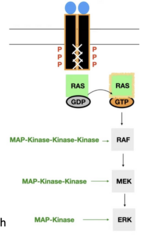
RAS Pathway: Function of ERK
- Modifies gene expression
- Influences cell growth and differentiation
Growth factors bind to what receptor? What if it is dysregulated?
- RTKs → influences gene expression
- Dysregulation can lead to uncontrolled cell proliferation
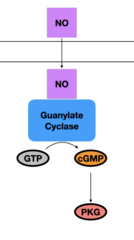
cGMP Pathway: Steps
1. Nitric Oxide (NO) passes through membrane
2. NO interacts w/ Guanylate Cyclase → activates GC
3. Guanylate Cyclase converts GTP → cGMP
4. cGMP activates Protein Kinase G (PKG)
Insulin: Where is it synthesized? Where are its target receptors? What is its response?
- Synthesized: β cells in pancrease
- Receptors: RTKs in skeletal muscle, adipose tissue, and liver
- Response: Nutrient uptake at target tissues, glycogen synthesis
Insulin Resistance
The inability of the cells to respond to insulin, via:
- Receptor binding
- Receptor activation
- Intracellular signaling
Insulin Resistance causes what to GLUT-4?
- Reduced GLUT-4 translocation to plasma membrane and subsequent reduction in cellular glucose uptake → high blood glucose bc cannot enter cells (hyperglycemia)
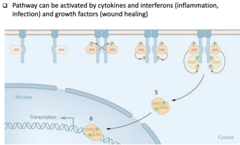
JAK/STAT Pathway
- A signal transduction pathway that transfers the signal directly from the cell surface receptor to the nucleus. It is usually activated by cytokines that bind receptors associated with tyrosine kinases (referred to as JAKs). On receptor dimerization, JAKs phosphorylate themselves, the receptors, and another set of proteins called STATs, which then dimerize and translocate to the nucleus where they induce the expression of a series of genes.
A patient with metastatic cancer is found to have excessive production of vascular
endothelial growth factor (VEGF), leading to abnormal blood vessel formation.
VEGF primarily exerts its effects through activation of which receptor type?
- RTKs