oat physics unit 5
 Call Kai
 Learn
Learn Practice Test
 Spaced Repetition
 Match
Match Flashcards
 Knowt Play
1/14

Earn XP
Description and Tags
two microphones and a turntable
Name | Mastery | Learn | Test | Matching | Spaced | Call with Kai | Chat |
|---|
No analytics yet
Send a link to your students to track their progress
15 Terms
work
product of the magnitude of the displacement and the parallel component of the force.
W = Fpara x d
Fpara = Fcosθ
power
the rate at which work is done or at which energy changes.
P = E/t = W/t = Fv
Units: Joules/second (J/s), watts (W), or horsepower (hp)
efficiency of energy
e = Wout / Ein
kinetic energy
the energy a body possesses due to its motion. It depends on the mass and speed of the object.
KE = ½mv2
work energy theorem
The net work done on an object is equal to the change in kinetic energy.
Wnet = ½mvf2 - ½mvi2
gravitational potential energy
the energy contained within an object due to its elevation or vertical position.
Object near surface of Earth: PE = mgh
Object far from surface of Earth: PE = -GmM/R
G = Newton’s gravitational constant
M/m = mass of planet and object
R = distance from object to center of planet
elastic potential energy
The energy stored by stretching or compressing something.
Us = ½kx2
k = spring constant
x = distance compressed
total mechanical energy
the sum of kinetic and potential energy of a system. TME is constant.
momentum
the quantity of motion that an object has. It is the vector product of mass and velocity.
p = mv
Fnet = Δp / Δt
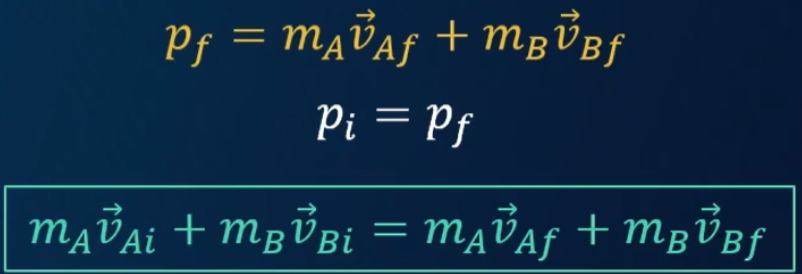
conservation of momentum
If the net force in a system is zero, the linear momentum before and after an interaction are equal.
elastic collision
total kinetic energy is conserved after collision.
inelastic collision
total kinetic energy is not conserved after collision (some energy is lost).
Perfectly inelastic = objects stick together after collision.
impulse
the change in momentum
I = Δp = FnetΔt
Area under curve for force vs time
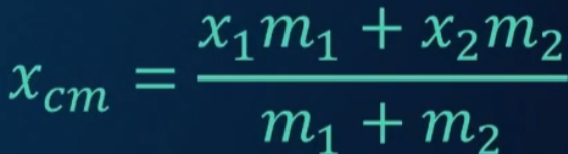
center of mass
The point where all the mass of an object or system of objects is concentrated.
how now brown cow get in my mouth right now
where the fucks my god damn server oh there you are now give me fuckin cheeseburger