(2) signal transduction mechanisms
 Call Kai
 Learn
Learn Practice Test
 Spaced Repetition
 Match
Match Flashcards
 Knowt Play
1/62

Earn XP
Description and Tags
neurophysiology 2: cellular signal transduction mechanisms, ionotropic receptors, g protein coupled receptors (GPCRs), tyrosine kinase linked & nuclear receptors
Name | Mastery | Learn | Test | Matching | Spaced | Call with Kai | Chat |
|---|
No analytics yet
Send a link to your students to track their progress
63 Terms
what are ionotropic receptors also known as, how are they controlled?
aka ligand gated ion channel
they are integral membrane proteins that open an ion conduction pathway whne activated by a ligand signal/chem ligand binding
somewhat ion-selective
what are 4 major ionotropic receptors and their plasma membrane?
nicotinic ACh receptor (Cholinergic)
AMPA receptor (Glutamatergic)
NMDA receptor (Glutamatergic)
GABA receptor (GABAergic)
what is cholinergic ionotropic receptor? (what receptor does it use, what neurotransmitter/activator it use, and what conducting ions)
uses nicotinic acetylcholine receptor
activated by acetylcholine/nicotine
lets inward flow of Na+ and Ca2+ across plasma membrane
EXCITATORY (+ in)
what is glutamatergic ionotropic receptor? (what receptor does it use, what neurotransmitter/activator it use, and what conducting ions)
use AMPA or NMDA receptor
activated by glutamate and/or glycine (both for NMDA)
inward flow of Na+ and Ca2+ across plasma membrane
EXCITATORY
what is GABAergic ionotropic receptor? (what receptor does it use, what neurotransmitter/activator it use, and what conducting ions)
uses GABA receptor
activated by gamma-aminobutyric acid (GABA)
inward flow of Cl- across plasma membrane
INHIBITORY (let - in)
what are nicotinic acetylcholine receptors (nAChRs) and how do they work?
pentamer
acetylcholine or nicotine (similar shape as ACh) binds to receptor, OPENING conduction pathway to let major Na+ flow INSIDE
result in FAST depolarization/EXCITATORY signals
how do muscarinic acetylcholine receptors (mAChRs) work
acetylcholine binds to receptor
G-protein coupled receptor (GPCR) mediate enzymatic reaction, causing intracellular chemical signal cascade with downstream effector target
SLOWer response than nAChRs
what are the two general receptor themes of glutamate receptors? give examples
ionotropic : AMPA, NMDA (learning & memory; neuron excitotoxicity; depression)
metabotropic: mGLuR GPCRs
describe AMPA glutamate receptor (description, requirements for activation, how it activates, what pathway it opens)
tetramer
need at least 2 ligand mc (usually glutamate NT) for activation
binding changes shape in ligand binding, leads to shape change in transmembrane, leads to activation
opens clear Na+ conduction pathway
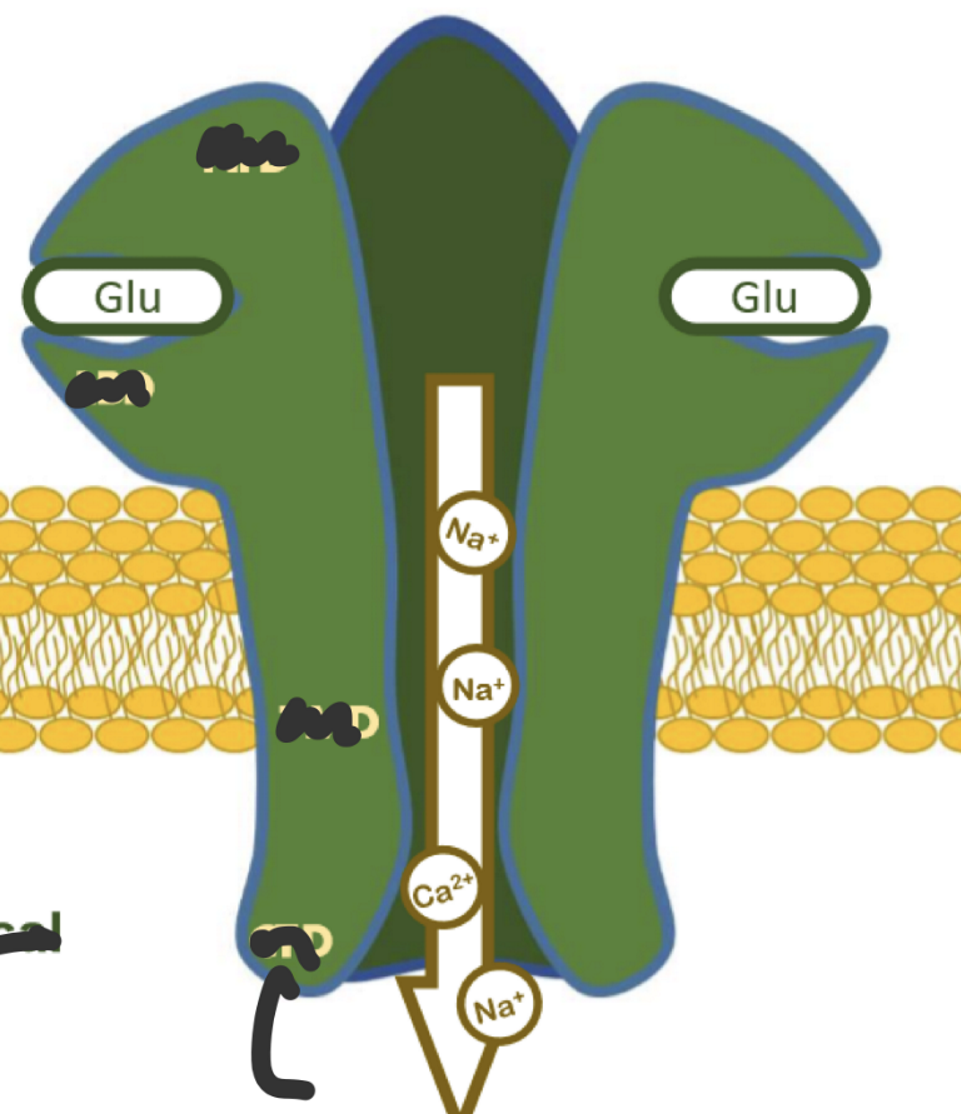
name and locate the receptor domains: NTD, LBD, TMD, CTD
NTD: N-terminal (top one)
LBD: ligand-binding (second one next to Glu)
TMD: transmembrane (near yellow membrane)
CTD: C-terminal (bottom)
describe NMDA glutamate receptor (description, requirements for activation, how it , what pathway it opens)
tetramer
requires binding of glutamate AND glycine for activation
Mg2+ will sit in pore to BLOCK conduction pathway at -70 mV
Mg2+ is pushed OUT once cell depolarizes due to AMPARs
opens the Ca2+ conduction pathway
what are the two general receptor themes of GABA receptors
ionotropic: GABAA receptors
metabotropic: GABAB receptors
what are GABAA receptors are how do they work (binding, what pathway, what flow)
pentamer like nAChR
GABA binding activates receptor
opens Cl- conduction pathway
inward Cl- flow promotes INHIBITION (hyperpol) and make potential MORE NEG
where are acetylcholine receptors found
cholinergic, nicotinic, and muscarinic synapses
synapses have the respective receptors that receive ACh from the neurons
acetylcholinesterase is near receptor to break down ACh, stopping signal
what are the 4 steps of ionotropic receptor at the post synaptic neuron
action potential arrives in presynaptic signal, causing
neuron to RELEASE NeuroTransmitters across synapse
NTs reach and bind postsynaptic ionotropic receptor, inducing POSITIVE ion conducting pathway (Na, Ca) - EXCITATORY
POSITIVE charge diffuses down more + membrane, activating other voltage-gated ion channels to create another AP and so on…
how many times does the serpentine receptor go in and out of the cell membrane
7 times - aka 7-transmembrane (7TM) receptor
what are the 2 GPCR-based drugs focused on in class? name the drug, the GPCR target and disease
drug: Zyprexa ; GPCR: serotonin receptor ; disease: schizophrenia
drug: Plavix ; GPCR: ADP receptor ; disease: stroke
what accounts for the diversity of metabotropic responses and why
GPCR because it has many active sites
what is a G protein? describe its structure and how its activated/inactivated
heterotrimeric protein
subunits are α, β, γ
alpha subunit is activated by GTP binding, inactivated by GDP
not as diverse as receptor
what is a guanine nucleotide exchange factor (GEF) and what does it do
separate regulatory protein
attaches to G proteins to promote GDP dissociation and GTP binding
turns signals ON
for Ga are activated cell surface receptors
what is a GTPase activating protein (GAP) and what does it do
separate regulatory protein
promotes hydrolysis of GTP to GDP by binding to G protein
turns signal OFF
intrinsic to the Ga protein itself (Ga protein performs it itself)
how is protein kinase A activated in the cAMP pathway (6)? name the 1st and 2nd msngr
neurotransmitter(1st msngr) binds to specific receptor (GPCR)
occupied receptor cause replacement (GEF) of GDP bound to Gs by GTP, activating Gs
Gs (alpha subunit) activates adenylyl cyclase
adenylyl cyclase catalyze formation of ATP to cAMP (2nd msngr)
cAMP activates PKA
PKA phosphorylate other proteins and ion channels
go through the calcium/IP3 pathway (Gq) , underline the two 2nd msngrs and where they go
signal binds to 7TM G-protein linked receptor on cell outside
Gq a-subunit is activated by swapping GDP for GTP (GEF func)
Gq a-subunit activates PLC, which CUTS PIP2 into
IP3: leaves membrane and floats into cytoplasm twd ER
DAG: stays inside cell membrane
ER releases Ca2+ from IP3-gated Ca release channel
Protein kinase C is activated by released Ca2+ and DAG
what specific trigger causes the store-operated Ca2+ channels (SOCs) on the plasma membrane to open
the depletion of Ca stores inside the ER sends signal up to plasma membrane
ER membrane MOVES UP to interact directly with channel on plasma membrane to open it
Extracellular Ca rushes in to refill the ER
What physiological condition can occur in T-cells if SOC activation fails?
immunodeficiency
what regulated responses do Gq, Gs, and Gi GPCR carry out
Gq INCreases Ca2+
Gs INCreases cAMP
Gi DECreases cAMP
diff G proteins plug in to diff receptors to give distinct signal functions
steps of Gi pathway (4)
inhib. NT (dopamine) binds to GPCR
Gi-alpha is activated by GEF, separates to bind and inhibit adenylyl cyclase
decrease cAMP, decrease PKA activity
Gi-beta gamma subunits can also bind to ion channels like K+ channels to polarize cell (inhib membrane responsivity)
what is the primary cellular effect of activating presynaptic Gi-coupled receptors
it decreases cAMP and opens K+ channels, causing K+ efflux, hyperpol, and inhibited neurotransmitter release
how does activating postsynaptic Gs-coupled receptors lead to enhanced excitability
increases cAMP, activating PKA, which phosphorylates cation channels to allow Na+ influx (depol)
what NTs bind to adrenergic receptors
epinephrine and norepinephrine
what receptors are adrenergic and what G pathway are they involved in
α1 (Gq blood vessel contraction)
α2 (Gi brain relaxation)
β1,2,3 (Gs increase cAMP)
what receptors are muscarinic and what do they do
M1,3,5 (Gq excitatory, activate PKC)
M2,4 (Gi lower cAMP)
what do M1, M3, M5 muscarinic receptors do
couple to Gq to release Ca2+ from ER
activate PKC with DAG and Ca2+
what do M2, M4 muscarinic receptors do
couple to Gi to decrease cAMP
decrease PKA activity and inhibit Ca2+ channels
what do α1 adrenergic receptor do
couple to Gq to activate PLC that converts to IP3 and DAG
IP3 releases Ca2+ that activate PKC with DAG
what do α2 adrenergic receptors do
couple to Gi that inhibits adenylyl cyclase, DECrease cAMP
decrease PKA activity and inhibit Ca2+ channels
INCrease K+ conductance - decrease excitation
what do β1-3 adrenergic receptors do
couple to Gs to increase cAMP
increase PKA activity that increase Na+ and Ca2+ channels
explain the actions of α1 adrenergic receptor
norepinephrine binds to α1 receptor
bound receptor activates Gq-alpha
activated Gq-alpha activates PLC
PLC cuts PIP2 to IP3 & DAG
IP3 induces ER Ca2+ release
DAG + Ca2+ binds to activate PKC
Ca2+ release and activated PKC cause smooth muscle CONSTRICTION in blood vessels (sympathetic vasoconstriction)

how do adrenergic and muscarinic GPCR oppose each other in cardiac contraction
norepinephrine will bind to β1 receptor to activate Gs protein → activate PKA and Na+ and Ca2+ channels = sinoatrial contractions
acetylcholine will bind to M2 receptor to activate Gi protein → inhibit AC → decrease cAMP → inactivate Na+ Ca2+ channels = INHIBIT sinoatrial contractions

what is receptor desensitization
reduce cell response to a receptor signal
control signal duration to prevent abnormal cell response from excess signaling
what are two main ways a cell shuts off GPCR signaling
blocking interaction between GPCR and its G-protein
removing (internalizing) the receptor from the plasma membrane
how does G-protein-linked receptor kinase (GRK) and arrestin desensitize GPCR
1. GRK detects activated GPCR
2. GRK phosphorylates multiple sites on GPCR
3. arrestin is attracted to phosphorylated GPCR and binds
4. arrestin provides steric block -> G protein physically blocked from interacting with GPCR
how does arrestin shut down receptor signaling further
arrestin internalizes GPCR (pulls GPCR into cell)
- receptor is pulled in using endocytic vesicle
- arrestin eventually falls off and GPCR is either degraded or recycled for future use by cell
how is the β adrenergic receptor desensitized
1. epinephrine binds to β-adrenergic receptor -> Gs-betagamma dissociates
2. Gs-betagamma recruits β-adrenergic receptor kinase (βARK) to phosphorylate receptor
3. β-arrestin (βarr) binds to phosphorylated receptor (BLOCKS signal)
4. receptor-arrestin is pulled inside cell by endocytosis
5. arrestin eventually dissociates and receptor is dephosphorylated or recycled back to cell surface
how does arrestin participate in g protein-independent signaling and what concept does this lead to in GPCR actions
βarr serves as a "scaffolding" protein aka docking site for other proteins to bind to activate alternate signaling pathway
happens after it pulls in GPCR by endocytosis
leads to idea of balanced or biased agonism
what is G protein independent signaling
GPCR sends signals without using heterotrimeric G protein in its pathway
what happens to the traditional second messenger pathways (cAMP, Ca2+) when arrestin binds to the GPCR
they are BLOCKED bc arrestin physically blocks G proteins from interacting with the receptor
what is the difference between a balanced agonist and a biased agonist
a balanced agonist EQUALLY activates both G-protein and β-arrestin pathways
a biased agonist FAVORS activating one pathway over the other and ignores the other (G or βarr)
how is biased agonism applied to drugs like opiod receptors or GLP-1 receptors?
1. opiod receptors: find agonists that bind to opioid receptors with bias to amplify pain relieving effects (G-protein signaling) while avoiding addictive βarr effects
2. GLP-1R agonists biased towards G protein signaling to increase insulin secretion for type 2 diabetes
what is the μ-opioid receptor (MOR)
GPCR that binds to opioids and is coupled to Gi protein
what are the 3 different signaling processes for the MOR (μ-opioid receptor)
1. G-protein-dependent (primary pain relief): Gi is activated to inactivate AC + activate K+ channel to reduce signaling for pain receptors
2. G-protein-independent (arrestin scaffold): receptor is phosphorylated and b-arrestin binds to act as scaffold and induce other signaling pathways
3. Desensitization (shutting down/tolerance): GRK phosphorylates receptor to recruit b-arrestin to decrease G protein signaling (cannot decrease pain sensitivity anymore)
what effect does the G protein pathway cause in MOR (μ-opioid receptor)
analgesia
what effect does the arrestin pathway cause in MOR (μ-opioid receptor)
respiratory depression, tolerance & dependence
what do tyrosine kinase linked receptors mediate and what ligands activates receptor tyrosine kinases
growth control/responses
peptide growth factors and hormones eg insulin, nerve growth factor
why are RTKs and Ras heavily represented in the oncogene family
their main function is to stimulate cell growth and proliferation, so overactivation of this pathway leads to cancer
what is the step by step pathway for a receptor tyrosine kinase (RTK) from ligand binding to cell growth
ligand binding & dimerization: peptide growt factor/hormone BIND to TWO RTK monomer on cell exterior → dimerization (come tgt)
autophosphorylation: kinase enzyme is built directly into RTK (unlike GPCRs)
two receptors phosphorylate eo on their intracellular tail tyrosine residues
adapter & GEF docking: phosphorylated tyrosine act as docking sites for adapter protein (Grb2)
adapter BRINGS a GEF (guanine nucleotide exchange factor; SOS) to membrane surface next to Ras
Ras activation: GEF swaps GDP for GTP on Ras (TURNS Ras ON)
MAP kinase cascade: active Ras trigger downstream kinase cascade (serine/threonine kinases) → activation
Cell growth response: active MAP kinase enter nucleus to change gene exp stimulating cell growth
what are GEFs and GAPs and how do they regulate the activity cycle of the small G-protein Ras
GEF: guanine nucleotide exchange factors
promote exchange of GDP for GTP, turns inactive Ras-GDP to active Ras-GTP → on switch
GAP: GTPase activating proteins
promote hydrolysis of bound GTP to GDP + Pi→ off switch
function: determine how long Ras stay active
what are small g proteins
single subunit monomeric proteins (20kd) such as Ras that are switched “on” for cell division by binding to GTP
why do mutations that block GAP activity or impair Ras’s GTPase function cause cancer
Ras cannot hydrolyze GTP to turn itself off, leading to permanently active Ras and continuous cell growth signaling
what are the step by step events needed following Ras activation - MAPK/Erk kinase cascade (3)
Ras-GTP activates the first kinase, MAPKKK (Raf) through protein-protein interaction
Serine/Threonine kinase
done by direct binding
Raf phosphorylates and activates MAPKK (MEK) -dual-specificity Ser/Thr + Tyr kinase
MEK phosphorylates on Thr and Tyr residues to make MAPK (Erk)
why are proteins in the RTK → Ras→MAPK pathway considered potential oncogenes
bc this pathway directly controls cell proliferation; overactivating mutations cause uncontrolled cell growth
what is the general mechanism of nuclear receptor and how does this work
they diffuse across the membrane
ligands/agonists have a hydrophobic (lipid-soluble) character
bc they are hydrophobic, they diffuse directly across plasma membrane w/o needing a surface receptor
where do nuclear receptors usually reside in and what general function do they perform
inside the cell (cytoplasm or nucleus), where hormones binds to its specific intracellular receptor protein
once bound by a ligand, it acts as transcription factors to regulate gene expression (mRNA transcription)