B. Fixed Oil, Fats, Waxes
 Call Kai
 Learn
Learn Practice Test
 Spaced Repetition
 Match
Match Flashcards
 Knowt Play
1/105

There's no tags or description
Looks like no tags are added yet.
Name | Mastery | Learn | Test | Matching | Spaced | Call with Kai | Chat |
|---|
No analytics yet
Send a link to your students to track their progress
106 Terms
c. Iodine value
Classified according to unsaturation.
a. Saponification value
b. Acid value
c. Iodine value
d. Ester value
a. Iodine value >120
Drying.
a. Iodine value >120
b. Iodine value 100–120
c. Iodine value <100
d. Iodine value 80–100
b. Iodine value 100–120
Semi-drying.
a. Iodine value <100
b. Iodine value 100–120
c. Iodine value >120
d. Iodine value >150
c. Iodine value <100
Non-drying.
a. Iodine value >120
b. Iodine value 100–120
c. Iodine value <100
d. Iodine value =120
a. Drying
“LiCod”
Linseed
a. Drying
b. Semi-drying
c. Non-drying
a. Drying
“LiCod”
Cod Liver Oil
a. Drying
b. Semi-drying
c. Non-drying
b. Semi-drying
“CorCotPeSe”
Corn
a. Drying
b. Semi-drying
c. Non-drying
b. Semi-drying
“CorCotPeSe”
Cotton
a. Drying
b. Semi-drying
c. Non-drying
b. Semi-drying
“CorCotPeSe”
Peanut
a. Drying
b. Semi-drying
c. Non-drying
b. Semi-drying
“CorCotPeSe”
Sesame
a. Drying
b. Semi-drying
c. Non-drying
c. Non-drying
“COA”
Olive
a. Drying
b. Semi-drying
c. Non-drying
c. Non-drying
“COA”
Almond
a. Drying
b. Semi-drying
c. Non-drying
c. Non-drying
“COA”
Coconut
a. Drying
b. Semi-drying
c. Non-drying
d. ↑ unsaturation, ↑ drying
↑ Iodine Value =
a. ↓ drying, ↑ unsaturation
b. ↓ unsaturation, ↓ drying
c. ↓ unsaturation, ↑ drying
d. ↑ unsaturation, ↑ drying
c. more double bonds
↑ Iodine Value =
a. more single bonds
b. fewer double bonds
c. more double bonds
d. more triple bonds
b. Linseed oil
Used in paints & varnishes.
a. Sesame oil
b. Linseed oil
c. Peanut oil
d. Corn oil
c. Linseed oil
Linum usitatissimum
a. Cottonseed oil
b. Peanut oil
c. Linseed oil
d. Sesame oil
c. Linseed oil
Flax aka
a. Cottonseed oil
b. Peanut oil
c. Linseed oil
d. Sesame oil
b. Cod liver oil
Rich in omega-3 (fish oil) = good for the heart.
a. Corn oil
b. Cod liver oil
c. Sesame oil
d. Cottonseed oil
c. Cod liver oil
Medicinal grade: Vit. A & Vit. D.
a. Peanut oil
b. Corn oil
c. Cod liver oil
d. Sesame oil
d. Sodium morrhuate
Sclerosing agent to obliterate varicose veins.
a. Sodium oleate
b. Sodium stearate
c. Sodium alginate
d. Sodium morrhuate
a. Cod liver oil
Gadus morrhua
a. Cod liver oil
b. Corn oil
c. Peanut oil
d. Sesame oil
b. Male sterility
Gossypol is associated with
a. Female infertility
b. Male sterility
c. Hepatotoxicity
d. Nephrotoxicity
b. Cottonseed oil
Halphen-Bevan test is test for
a. Sesame oil
b. Cottonseed oil
c. Peanut oil
d. Corn oil
b. Cottonseed oil
Gossypium hirsutum.
a. Sesame oil
b. Cottonseed oil
c. Linseed oil
d. Corn oil
b. Cottonseed oil
Gossypol is found in
a. Sesame oil
b. Cottonseed oil
c. Linseed oil
d. Corn oil
d. Cod Liver oil
Sodium morrhuate is found in
a. Sesame oil
b. Cottonseed oil
c. Linseed oil
d. Cod Liver oil
b. Corn oil
Zea mays.
a. Peanut oil
b. Corn oil
c. Sesame oil
d. Cottonseed oil
a. Corn oil
For cooking.
a. Corn oil
b. Cod liver oil
c. Linseed oil
d. Cottonseed oil
a. Peanut oil
Arachis hypogaea.
a. Peanut oil
b. Sesame oil
c. Cottonseed oil
d. Corn oil
a. Peanut oil
Aka arachis oil.
a. Peanut oil
b. Sesame oil
c. Corn oil
d. Linseed oil
b. Sesame oil
Sesamum indicum.
a. Cottonseed oil
b. Sesame oil
c. Peanut oil
d. Corn oil
c. Sesame oil
Also Benne oil / Teel oil.
a. Corn oil
b. Peanut oil
c. Sesame oil
d. Linseed oil
b. Synergist to pyrethrin
Sesamolin use
a. Antioxidant
b. Synergist to pyrethrin
c. Preservative
d. Flavoring agent
b. Pyrethrin
Insecticide.
a. Sesamolin
b. Pyrethrin
c. Vitamin A
d. Sodium morrhuate
b. Coconut oil
↑ Lauric acid.
a. Olive oil
b. Coconut oil
c. Castor oil
d. Soybean oil
a. Coconut oil
Low IV= ↓ unsaturation = ↑ saturation
Has Lowest Iodine Value
a. Coconut oil
b. Sesame oil
c. Linseed oil
d. Sunflower oil
b. Coconut oil
Cocos nucifera.
a. Palm kernel oil
b. Coconut oil
c. Olive oil
d. Almond oil
b. Olive oil
Also sweet oil.
a. Castor oil
b. Olive oil
c. Almond oil
d. Sesame oil
b. Olive oil (Olea europaea)
Characterized by a distinct taste due to the C6-OH reaction.
a. Corn oil
b. Olive oil
c. Soybean oil
d. Coconut oil
b. Olive oil (Olea europaea)
Identified by Millon's test.
a. Corn oil
b. Olive oil
c. Soybean oil
d. Coconut oil
c. Extra Virgin (Virgin)
[Types of Olive Oil]
Highest quality grade obtained by gentle pressing.
a. Technical
b. Sulfur
c. Extra Virgin (Virgin)
d. Second Grade
c. Second Grade
[Types of Olive Oil]
Lower quality grade produced by applying greater pressure during extraction.
a. Sulfur
b. Technical
c. Second Grade
d. Tournant
b. Technical
[Types of Olive Oil]
Grade extracted using hot water.
a. Sulfur
b. Technical
c. Virgin
d. Tournant
c. Sulfur
[Types of Olive Oil]
Grade extracted using carbon disulfide (CS₂).
a. Virgin
b. Second Grade
c. Sulfur
d. Technical
d. Tournant
[Types of Olive Oil]
Grade prepared from used refuse olives
a. Technical
b. Virgin
c. Second Grade
d. Tournant
d. Tournant
[Types of Olive Oil]
Decomposing fruits, producing a stronger flavor and darker color.
a. Technical
b. Virgin
c. Second Grade
d. Tournant
c. Almond oil (Prunus amygdalus)
Commonly used as an emollient in cosmetic preparations.
a. Castor oil
b. Coconut oil
c. Almond oil
d. Palm kernel oil
c. Cocos nucifera
Scientific name of coconut oil.
a. Ricinus communis
b. Olea europaea
c. Cocos nucifera
d. Glycine soja
b. Olea europaea
Scientific name of olive oil.
a. Prunus amygdalus
b. Olea europaea
c. Sesamum indicum
d. Ricinus communis
b. Prunus amygdalus
Scientific name of almond oil.
a. Olea europaea
b. Prunus amygdalus
c. Ricinus communis
d. Brassica campestris
b. Castor oil
Contains ricinoleic acid as its main cathartic principle.
a. Soybean oil
b. Castor oil
c. Olive oil
d. Coconut oil
c. Ricinus communis
Scientific name of castor oil.
a. Cocos nucifera
b. Olea europaea
c. Ricinus communis
d. Papaver somniferum
c. Undecylenic acid
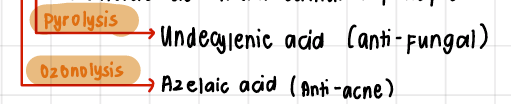
Antifungal compound produced by pyrolysis of castor oil.
a. Azelaic acid
b. Erucic acid
c. Undecylenic acid
d. Linoleic acid
c. Azelaic acid
Anti-acne compound produced by ozonolysis of castor oil.
a. Gamma-linolenic acid
b. Undecylenic acid
c. Azelaic acid
d. Lauric acid
a. Ethiodized oil
Iodine addition product of the ethyl esters of Papaver somniferum.
a. Ethiodized oil
b. Castor oil
c. Soybean oil
d. Olive oil
c. Ethiodized oil
Used as a radiopaque agent in gynecological procedures.
a. Hydrogenated vegetable oil
b. Evening primrose oil
c. Ethiodized oil
d. Palm kernel oil
b. Papaver somniferum
Scientific name of opium poppy.
a. Brassica campestris
b. Papaver somniferum
c. Ricinus communis
d. Oenothera biennis
b. Evening primrose oil
Omega-6= Evening primrose oil
Omega-3= Cod liver oil
Rich source of gamma-linolenic acid (Omega-6).
a. Soybean oil
b. Evening primrose oil
c. Sunflower oil
d. Coconut oil
b. Oenothera biennis
Scientific name of evening primrose.
a. Helianthus annuus
b. Oenothera biennis
c. Carthamus tinctorius
d. Glycine soja
b. Gamma-linolenic acid
Gamma-linolenic acid= Omega 6
Alpha-linolenic acid= Omega 3
Omega-6 fatty acid present in high concentration in evening primrose oil.
a. Alpha-linolenic acid
b. Gamma-linolenic acid
c. Erucic acid
d. Lauric acid
b. Hydrogenated vegetable oil
Identified by Serger's test.
a. Olive oil
b. Hydrogenated vegetable oil
c. Cottonseed oil
d. Soybean oil
b. Canola oil
Rapeseed oil = more than 2% erucic acid
Canola oil = less than 2% erucic acid
Contains less than 2% erucic acid and is considered beneficial for the heart.
a. Rapeseed oil
b. Canola oil
c. Palm kernel oil
d. Coconut oil
c. Brassica campestris
Scientific name of canola.
a. Elaeis guineensis
b. Helianthus annuus
c. Brassica campestris
d. Carthamus tinctorius
d. Rapeseed oil
Rapeseed oil = more than 2% erucic acid
Canola oil = less than 2% erucic acid
Contains more than 2% erucic acid and is considered harmful to the heart.
a. Canola oil
b. Palm kernel oil
c. Soybean oil
d. Rapeseed oil
a. Palm kernel oil
Commonly used for cooking.
a. Palm kernel oil
b. Castor oil
c. Soybean oil
d. Olive oil
b. Elaeis guineensis
Scientific name of palm kernel oil.
a. Glycine soja
b. Elaeis guineensis
c. Helianthus annuus
d. Theobroma cacao
a. Safflower oil
Also known as kasubha or Philippine saffron.
a. Safflower oil
b. Sunflower oil
c. Sesame oil
d. Soybean oil
c. Safflower oil
Claimed to possess anti-lipemic activity.
a. Soybean oil
b. Palm kernel oil
c. Safflower oil
d. Coconut oil
b. Carthamus tinctorius
Scientific name of safflower.
a. Helianthus annuus
b. Carthamus tinctorius
c. Oenothera biennis
d. Glycine soja
b. Helianthus annuus
Scientific name of sunflower.
a. Brassica campestris
b. Helianthus annuus
c. Carthamus tinctorius
d. Elaeis guineensis
a. Soybean oil
Commercial source of stigmasterol.
a. Soybean oil
b. Sesame oil
c. Olive oil
d. Corn oil
b. Soybean oil
Rich source of lecithin (phosphatidylcholine).
a. Palm kernel oil
b. Soybean oil
c. Coconut oil
d. Peanut oil
b. Lecithin
Regulates cholesterol and controls deranged lipid levels.
a. Gamma-linolenic acid
b. Lecithin
c. Erucic acid
d. Lauric acid
c. Glycine soja
Scientific name of soybean.
a. Theobroma cacao
b. Helianthus annuus
c. Glycine soja
d. Ricinus communis
b. Theobroma/Cacao
Source of cacao butter used as a pharmaceutical suppository base.
a. Soybean oil
b. Theobroma/Cacao
c. Palm kernel oil
d. Olive oil
a. Theobroma cacao
Scientific name of cacao.
a. Theobroma cacao
b. Carthamus tinctorius
c. Elaeis guineensis
d. Glycine soja
d. beans → fermented → roasted → nibs → pulverized
Cacao processing sequence
a. nibs → roasted → fermented →pulverized → beans
b. nibs → beans → fermented →pulverized → roasted
c. beans → roasted → fermented →pulverized → nibs
d. beans → fermented → roasted → nibs → pulverized
c. Cacao butter
Pharmaceutical suppository base obtained from cacao.
a. Cocoa powder
b. Cacao nibs
c. Cacao butter
d. Tablea
c. Lanolin (Hydrous wool fat)
Contains approximately 25% water.
a. Lard
b. Suet
c. Lanolin
d. Spermaceti
c. Lanolin
aka Hydrous wool fat
a. Lard
b. Suet
c. Lanolin
d. Spermaceti
b. Anhydrous lanolin (Wool fat)
Contains approximately 0.25% water.
a. Hydrous wool fat
b. Anhydrous lanolin
c. Lard
d. Beeswax
b. Anhydrous lanolin
Wool fat aka
a. Hydrous wool fat
b. Anhydrous lanolin
c. Lard
d. Beeswax
c. Lanolin
Obtained from the wool of sheep.
a. Lard
b. Suet
c. Lanolin
d. Spermaceti
c. Ovis aries
Scientific name of sheep.
a. Sus scrofa
b. Apis mellifera
c. Ovis aries
d. Physeter macrocephalus
c. Suet
Fat obtained from beef tallow or mutton tallow.
a. Lard
b. Lanolin
c. Suet
d. Beeswax
d. Sebo de macho
Pharmaceutical preparation of suet.
a. Adeps lanae
b. Yellow wax
c. Cetyl ester wax
d. Sebo de macho
c. Lard
Fat obtained from pig.
a. Suet
b. Lanolin
c. Lard
d. Spermaceti
b. Sus scrofa
Scientific name of pig.
a. Ovis aries
b. Sus scrofa
c. Apis mellifera
d. Simmondsia chinensis
b. Spermaceti
Obtained from the head of the sperm whale.
a. Beeswax
b. Spermaceti
c. Carnauba wax
d. Jojoba oil
c. Physeter macrocephalus
Scientific name of the sperm whale.
a. Apis mellifera
b. Copernicia prunifera
c. Physeter macrocephalus
d. Simmondsia chinensis
b. Spermaceti
Commonly used as an ointment and cream base.
a. Carnauba wax
b. Spermaceti
c. Beeswax
d. Jojoba oil
b. Spermaceti
Composed primarily of cetyl esters of fatty acids.
a. Beeswax
b. Spermaceti
c. Carnauba wax
d. Lanolin
b. Cetyl ester wax
Synthetic form of spermaceti.
a. Myricyl cerotate
b. Cetyl ester wax
c. Myricyl palmitate
d. Sebo de macho
c. Jojoba oil
The only liquid wax.
a. Spermaceti
b. Beeswax
c. Jojoba oil
d. Carnauba wax
c. Jojoba oil
Used primarily as an emollient.
a. Carnauba wax
b. Beeswax
c. Jojoba oil
d. Spermaceti
b. Simmondsia chinensis
Scientific name of jojoba.
a. Copernicia prunifera
b. Simmondsia chinensis
c. Apis mellifera
d. Physeter macrocephalus
c. Carnauba wax
Preferred commercial wax.
a. Beeswax
b. Spermaceti
c. Carnauba wax
d. Jojoba oil
b. Copernicia prunifera
Scientific name of carnauba.
a. Apis mellifera
b. Copernicia prunifera
c. Simmondsia chinensis
d. Physeter macrocephalus
d. Carnauba wax
Composed primarily of myricyl cerotate.
a. Spermaceti
b. Beeswax
c. Lanolin
d. Carnauba wax