Vases
 Call Kai
 Learn
Learn Practice Test
 Spaced Repetition
 Match
Match Flashcards
 Knowt Play
1/14

Earn XP
Description and Tags
15 Terms
Theatre of Dionysus
Date: 2nd half of the 6th century. First built in stone in 320s by Lycurgus.
Location: Main theatre of Athens. Inbetween South Eastern side of the Acropolis and D’s sanctuary. South side = protected from the winter winds. Leads to the Street of the Tripods.
Capacity: 6,000/17,000
Remodelled: 3rd + 5th century
Theatron: Semi-circular in shape for acoustics. 10 wedges for Athenian tribes, 3 for non-Athenians. Wooden benches facing down, with a prohedria
Orchestra: Semi-circular, 20 metres in diameter, possibly with an altar to D, parados entryways.
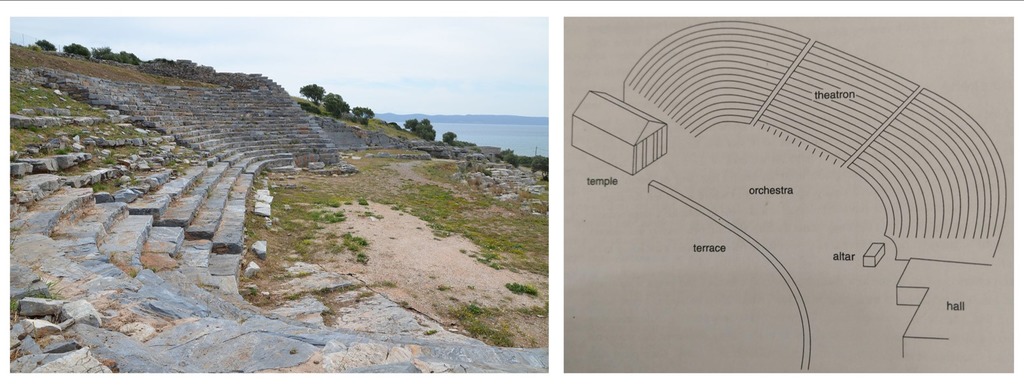
Theatre of Thorikos
Date: Late 6th/Early 5th century
Location: Thorikos, a deme that would have had a rural Dionysia
Capacity: Little over 3,000. Large for a deme theatre.
Theatron: Largely-straight facing, curved at either end.
Orchestra: More rectangular than circular, with a temple and altar at either end.
Skene: Non existent, unlike the one at Athens
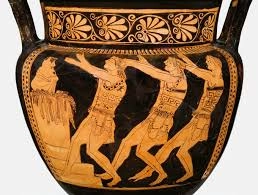
The Basel Dancers Vase (krater) 500 - 490 BC
Dates back to the the fifth century, when tragedy was still a new art-form.
3 pairs of young men dance towards a decorated altar in a choreographed rectangular formation.
Indecipherable letters come out of their mouth to indicate they are singing.
Very similar details on their faces - hair, extended chins, gaping mouths - possibly wearing masks.
Barefoot, norm for choruses. Appearing to be wearing military costume, but with diadems rather than helmets.
The alter is decked out in branches and ribbons, and a figure seems to rise from it or stand behind it.
Could be an actor rising from a tomb as happens in Aeschylus
OR figure is an icon of Dionysus which has been placed on the altar to witness the performance.
Limitations:
Can’t see music
Can’t see the routine
Not a full chorus
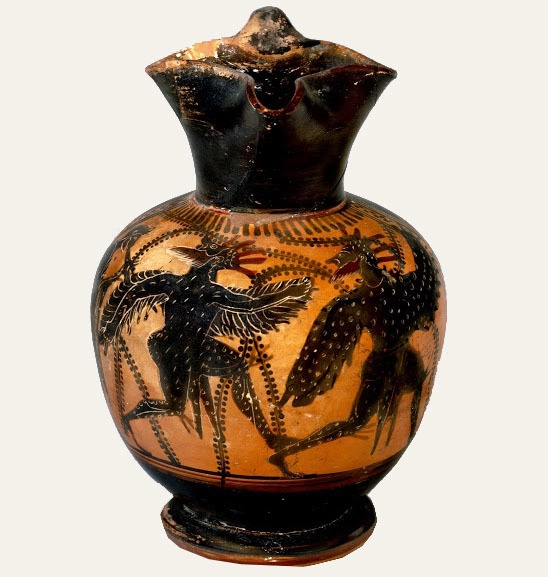
Bird Chorus (wine jug) 480 BC
A vase showing that animal choruses accompanied by musicians were popular in the 5th century.
Auletes playing an Aulos shows that this is a theatrical or choral scene
Bearded figures dressed as birds, purple crested heads, feathers attached to knees, dappled skins, tails hanging down, visible wings.
Vine branches are suggestive of Dionysus
Choruses, even animal choruses, were well established in 5th century, perhaps factoring into the origins of comedy.
Animal choruses predate Aristophanes’ ‘Birds’ by a few decades
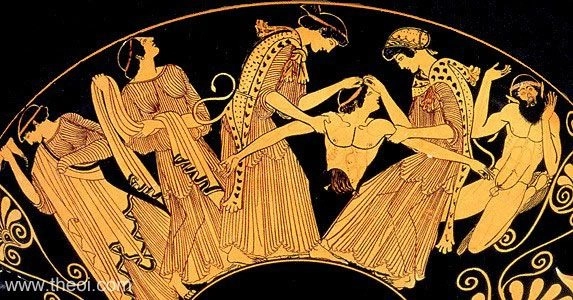
Death of Pentheus (red-figured kylix) 480 BC
Pentheus’ torso has been ripped off, see a bone and internal organs
Two women are preparing to rip his arms off and tear his head
A satyr oversees events, his presence reminds us that this is all under Dionysus’ watch
The panther skins are also emblems of the god, as well as showing the Maenad’s power over wild animals.
Predates Euripides Bacchae by some 75 years, reminding us that Euripides was inspired by the myth.
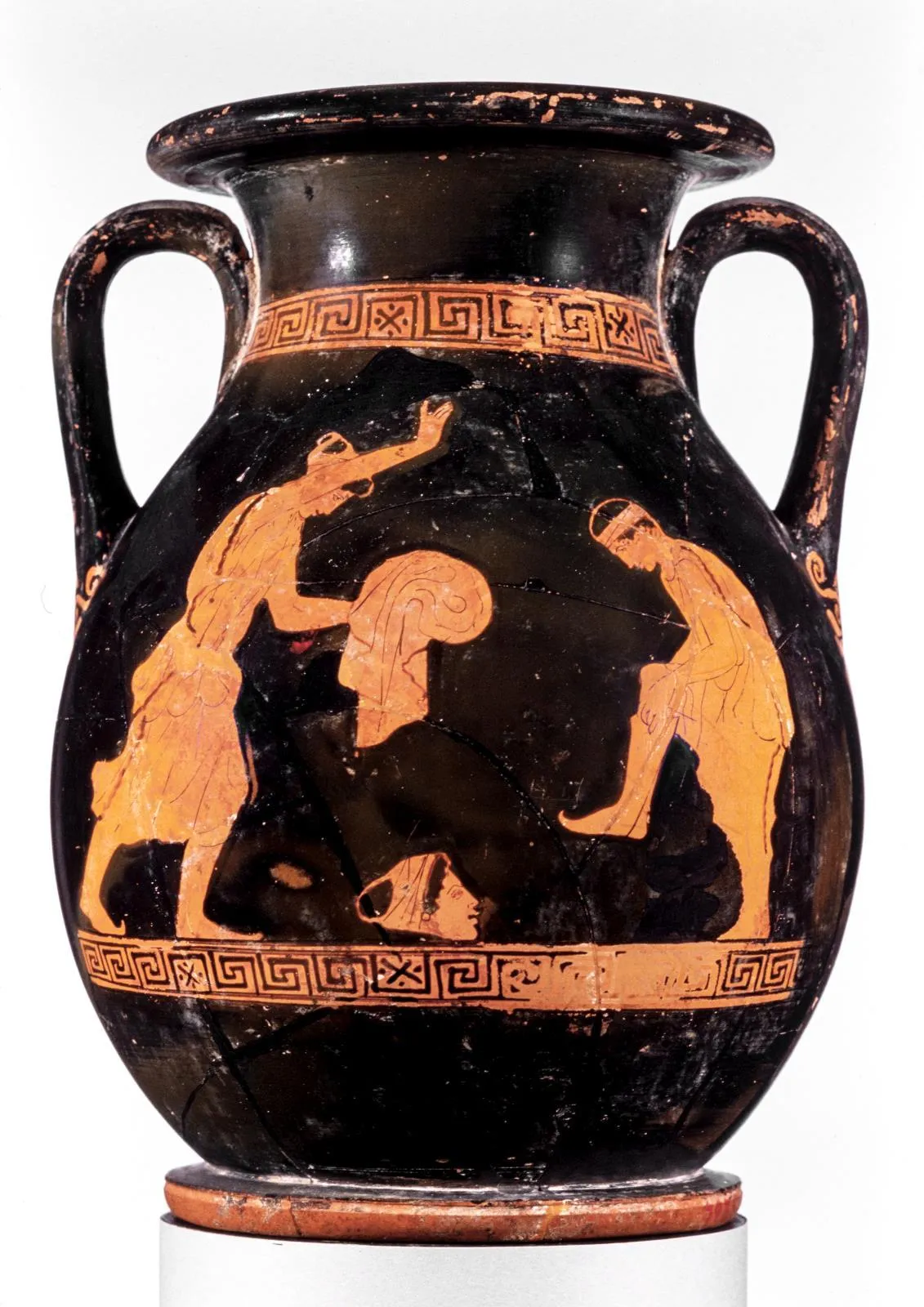
Tragic actors dressing (storage jar) - 450 BC
Two tragic actors or chorus members getting into costume, dressing up as women.
Actor on the left is already in full costume, wearing a mask with a gaping mouth.
Actor on the right is putting on one of his korthonoi, with his life-like mask on the floor. These boots would have thin soft soles and turned up toes that allowed them to move around easily.
Insight into costume and multi-roling
Doesn’t tell us what happened on stage
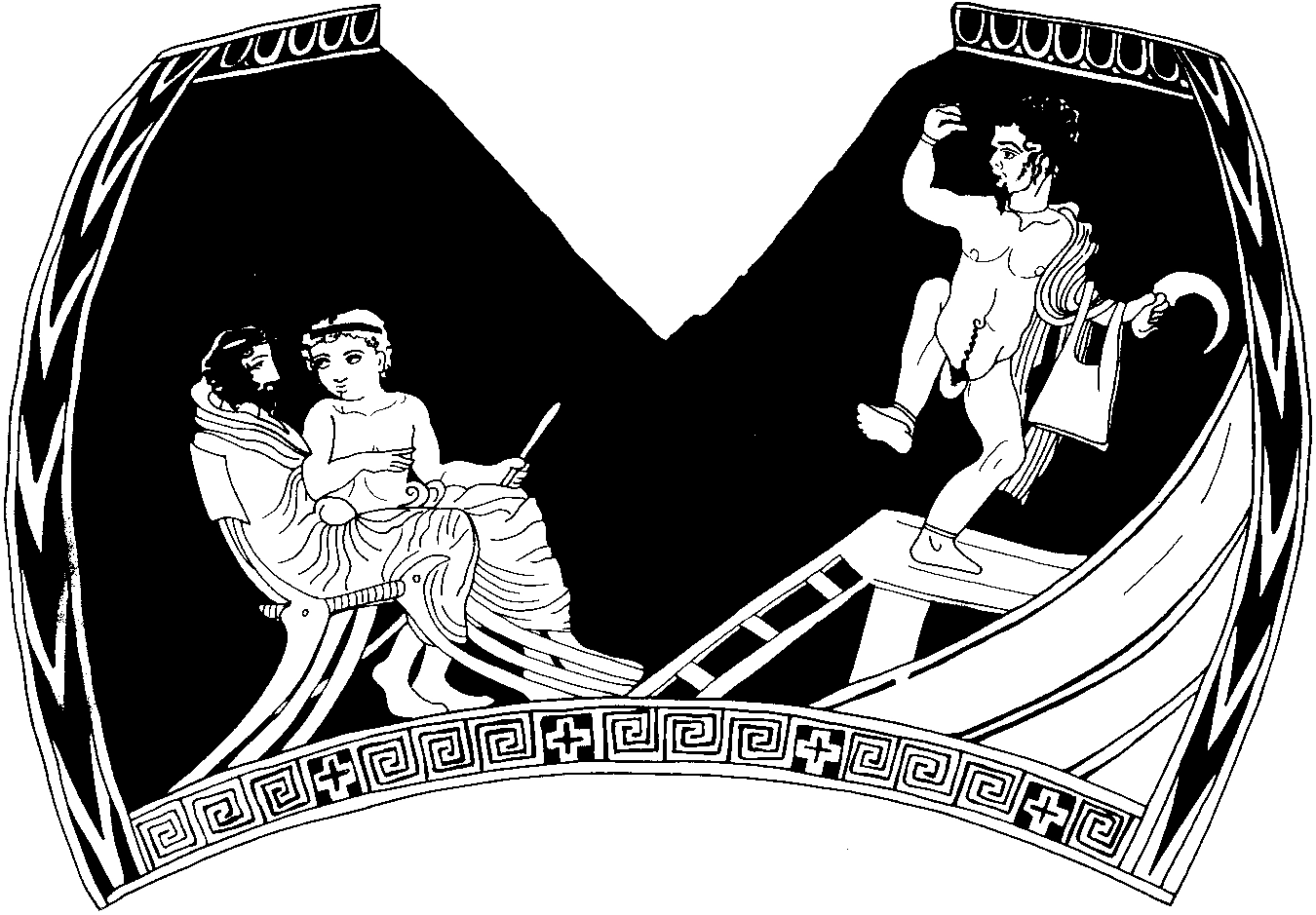
Perseus Dance Vase (chous) 420BC
Only Attic vase to show a stage, and only ancient Greek painting to portray a theatre audience.
P seems to be dancing or pretending to fly, as he does in the play
Lines at his wrists and ankles show ends of his body suit, so he is ‘stage-naked’
Not wearing a mask but has a phallus tied in between his legs
Artist has dispensed the orchestra and brought 2 audience members at the foot of the stage.
In a way they represent the whole audience.
Both are wreathed; one has a beard, it is unsure whether the other is a young man or a woman.
Sitting on Klismoi, wooden chairs at the front of the audience for important people.
Two judges, Priest of D and another priest, Dionysus and his consort Ariadne, or the Choregos and Playwright
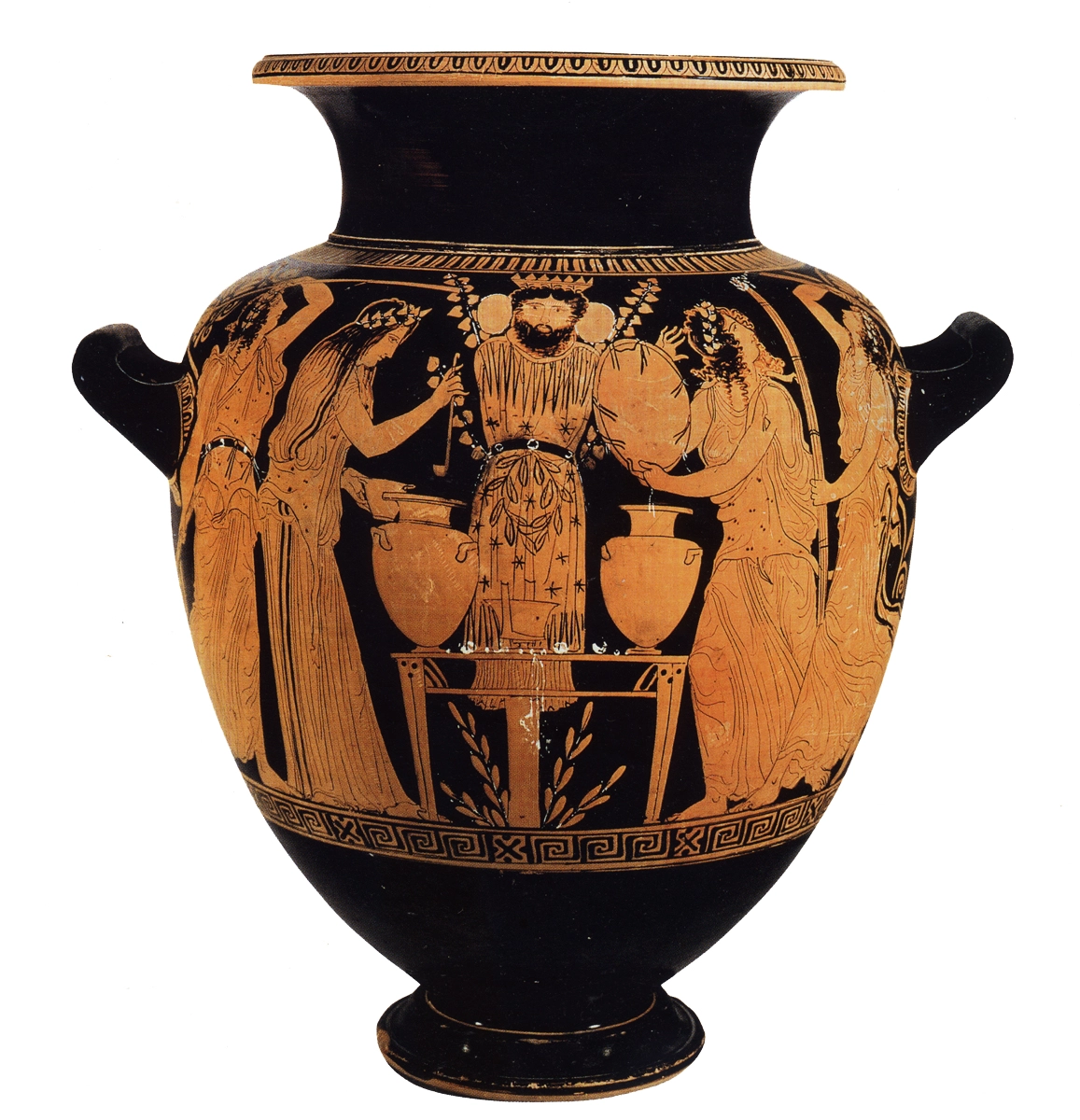
Maenads (wine vessel) - Late 5th century BC
Statue of Dionysus fastened to a pillar and decorated with ivy.
Maenads carry a thyrsus, tambourine, one ladles wine from a drinking vessel into a cup.
Some of the Maenads toss their head in religious ecstasy, losing all inhibition.
The women have loose hair.
The presence of the drinking vessel is a reminder of Dionysus’ role as the god of wine.
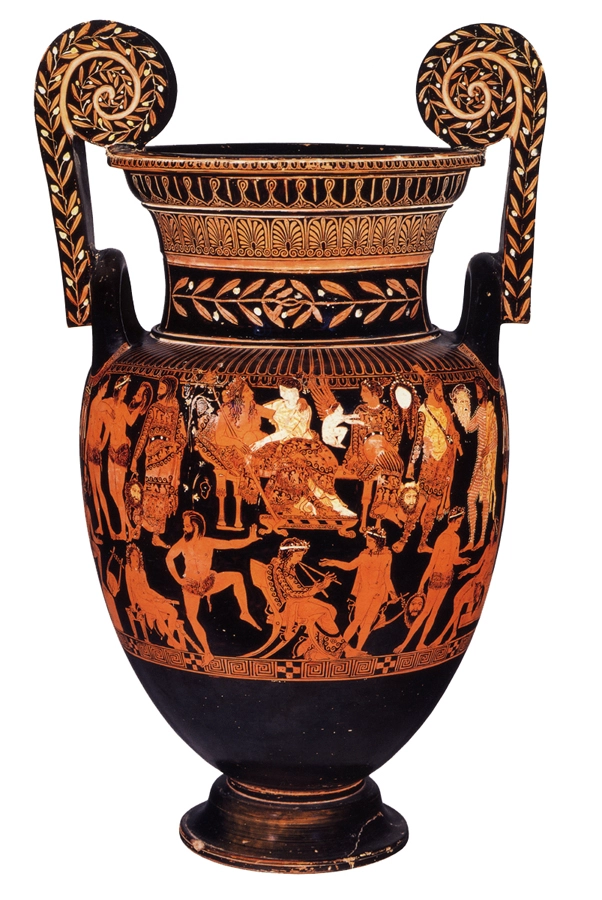
Pronomos vase (krater) 410 BC
A team of tragic actors and chorus members off-stage but in costume for a satyr play
Actors have real-life names inscribed beside them
Pronomos is an aulos player at the centre of the play, one of the most famous musicians of the late 5th century.
Above Pronomos is Dionysus with Ariadne. On his left is Demetrios, the playwright (?) as he holds the scroll.
Along the bench is another female figure carrying a female mask; possible personification of the genre of satyr plays.
Masks and costumes used at the end of the 5th century
Tragic masks at this period were quite plain and not heavily stylised
Costumes show great decoration and intricate design, with patterns of people and animals.
Tightly fitting sleeves - hid the age and gender of the actor, and allowed him to play multiple roles more convincingly.
Lot of unknown people
Not actually on stage
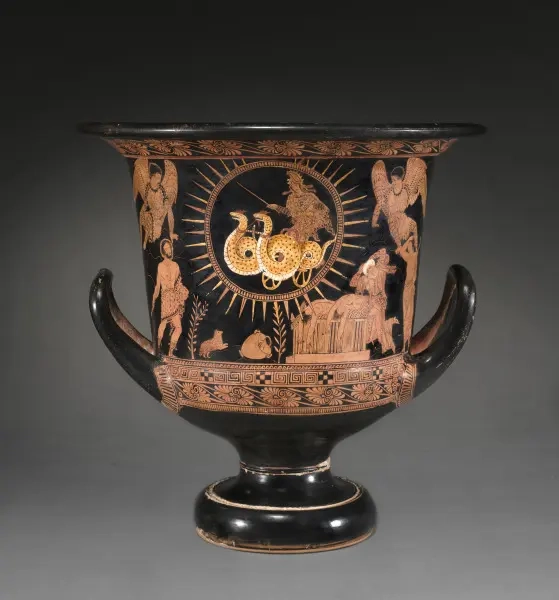
Medea’s escape vase (calyx krater) 400 BC
Medea is suspended above as she makes her escape on a chariot drawn by dragons, evidence of the use of the theatre crane. On either side are hideous winged women, possibly furies. Circled by the sun, a nod to her grandfather.
The sons’ bodies are displayed on the ekyklema, which is decorated to look like an altar. Their tutor, and their nurse, raise their hand in mourning.
Jason is bare chested as a hero, contrasts to the traditional costume in tragedy. He makes eye contact with Medea.
We should not assume that this is an accurate depiction of the play. In the play, there are no furies or dragons, and Medea takes their children with her so Jason cannot bury them.
Could be the artists own interpretation of the play, a different version of the myth, or another version of the play.
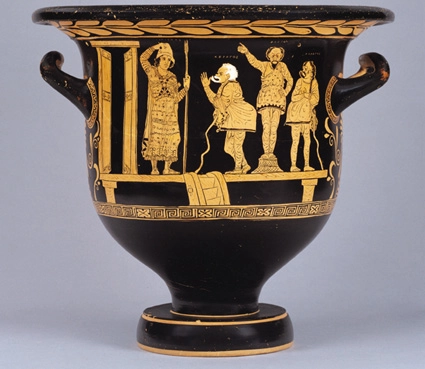
The Choregos Vase (bell krater) 400 - 380 BC
Found at Apulia
Shows both comic and tragic actors. Allows for a direct comparison between their costumes.
Competition between Aegisthus and Pyrrhias, representing tragedy and comedy. Chorus split, older members supporting tragedy, younger members supporting comedy.
Only works if artist has used artistic license to place two chorus members on stage.
Aegisthus - major character in myth of Agamemnon and Clytemnestra
Dressed as a tragic actor - ornate, stylised clothing. Laced korthonoi, serious expression
Comic actors - grotesque masks, Pyrrhias stands on a wool basket pointing, two figures beside him carry the label ‘choregos’, one figure is clearly older than the other
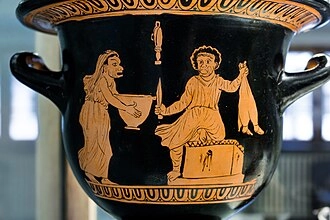
Women at the Thesmophoria (bell krater) 380 - 370 BC
Scene from Aristophanes’ ‘Women at the Thesmophoria’. Found in Southern-Italy, so the play must’ve had reruns.
Play is a parody of a scene from Euripides’ Telephus, suggesting his plays are also known in Southern-Italy
One of Euripides’ relatives infiltrate a woman only festival where they discuss what to do about Euripides, who keeps presenting them badly. His identity is revealed, and he snatches one of the babies as hostage, threatening to kill it. But it is actually a wineskin (women love getting drunk) And so the woman rushes over with a bowl in fear of losing her wine.
The relative’s costume matches up with the grand dressing scene in the play (shaved, dressed as a woman and wearing a woman’s headband.
Relative checks himself in a mirror in this scene, and a mirror is suspended in the centre.
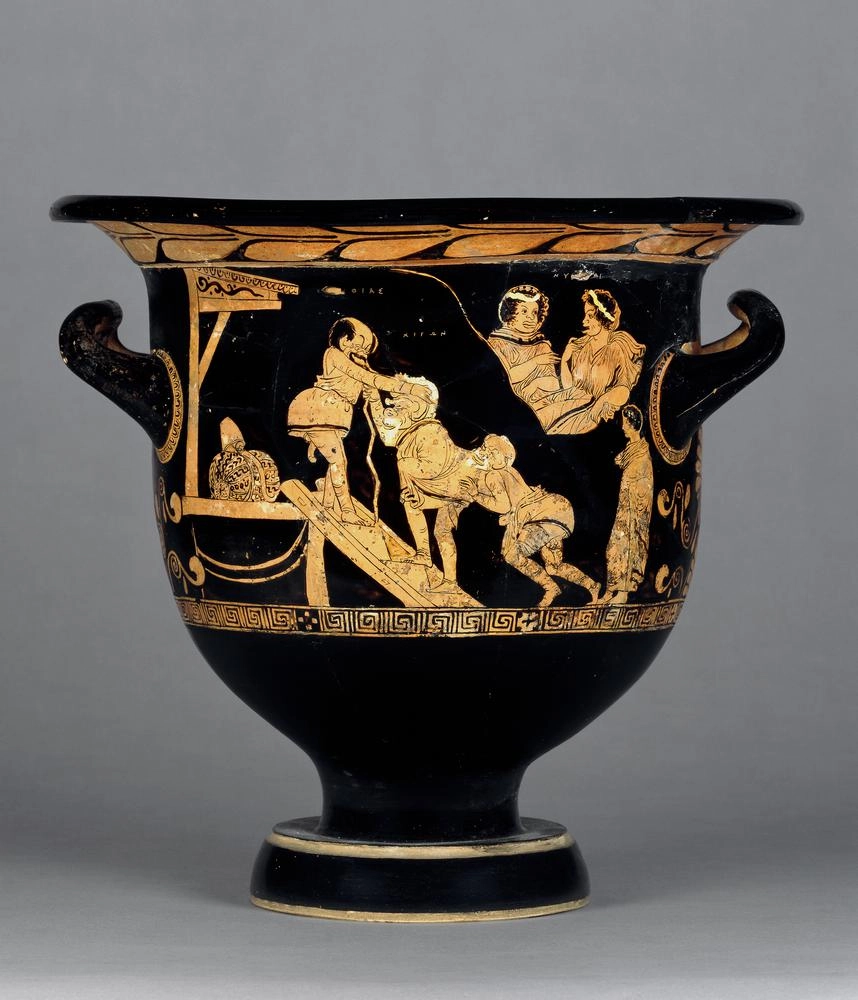
Cheiron Vase (bell krater) 380 - 370 BC
Scene from a comedy where Xanthius helps Cheiron, wounded by an arrow of Heracles, up the stairs - possibly at to the Apollo at Delphi. The person lifting up Cheiron is actually the back half of him.
Xanthias - short bordered tunic, undergarment with sleeves and tights in a 1 piece suit, clearly visible phallus, padded midriff, mask indicated with snub nose and large mouth.
Cheiron - white hair, shaggy eyebrows, eyes close to indicate blindness, staff indicates age.
Achilles - student of Cheiron, sober costume
Nymphs - separate scene up in the air, reflecting how Cheiron bathed in a river sacred to nymphs after he was wounded.
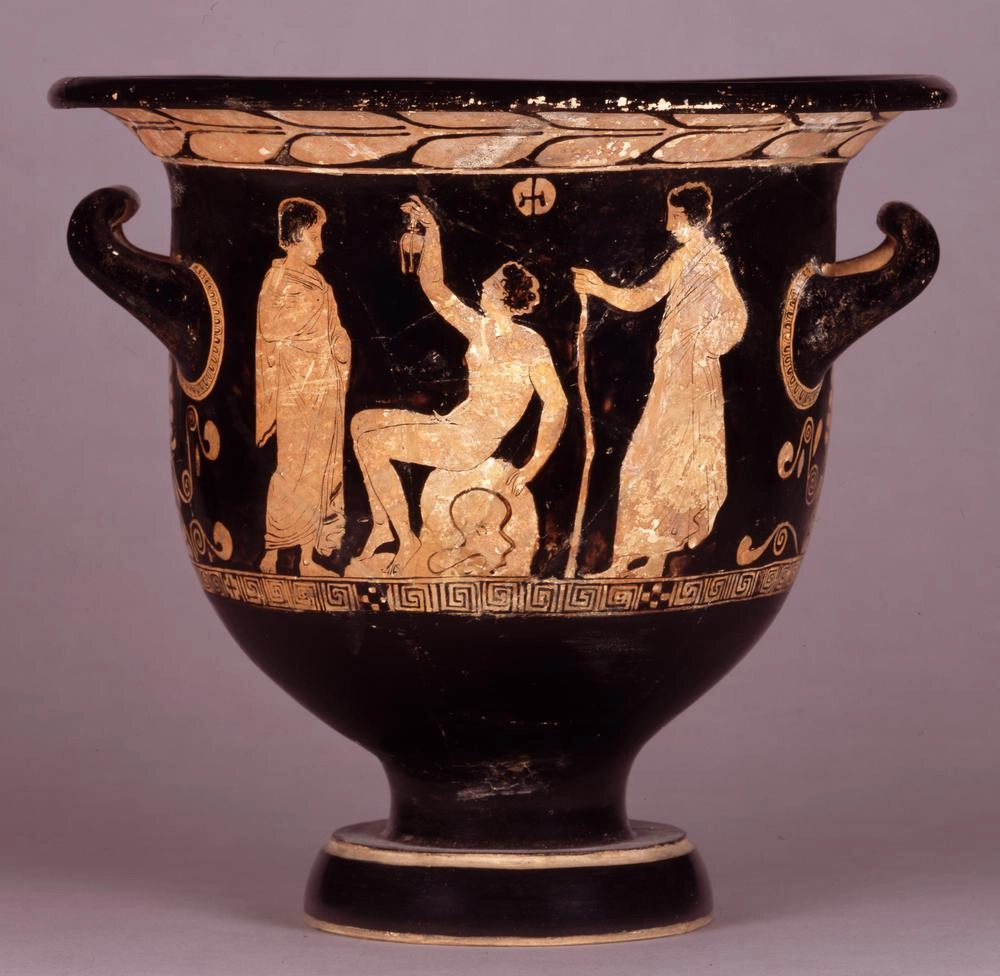
Back of the Cheiron Vase (bell krater) 380 - 370 BC
Athlete in the centre seated on a rock, nude, beardless, holding up an aryballos (small flask for scented oil or perfume.) One either side is youths in a himation, with a staff. Above is a pair of halteres (a weight that helped keep athletes balanced)
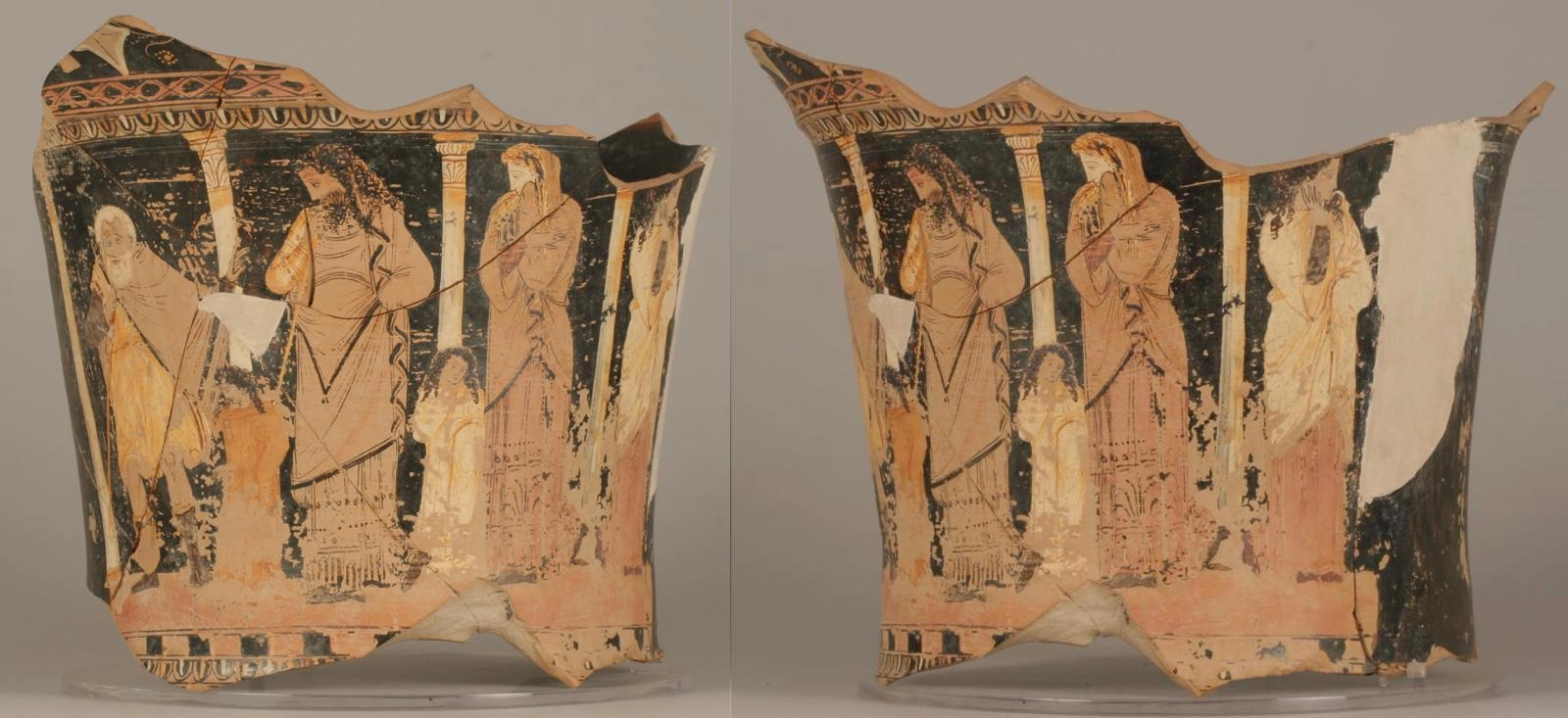
Jocasta and Oedipus the King (calyx krater) 330 BC
Columns in the background represent the skene
Long narrow platform represents the stage
Characteristics of tragic outfits
Oedipus fits Aristotlean tragic hero: bold, tall, brawny and centralised, dominating the scene
The messenger uses theatrical gestures and faces the front as if facing an audience. Naturalistically, the messenger turning away from the king wouldn’t make sense.
It might not even be depicting Oedipus. The children on the pot might not be girls, meaning this scene never happens, at least in Sophocles’ retelling of Oedipus.
They’re not wearing masks.
There are too many people on stage (there should only be 3 actors on stage at a time.)
Jocasta’s cinched waist shows her improper role as a sexualised mother.
She raises her right hand to her chin and left hand to her cheek, a standard gesture in Greek art for grief and worry.