Anatomy 4
 Call Kai
 Learn
Learn Practice Test
 Spaced Repetition
 Match
Match Flashcards
 Knowt Play
1/34

There's no tags or description
Looks like no tags are added yet.
Name | Mastery | Learn | Test | Matching | Spaced | Call with Kai | Chat |
|---|
No analytics yet
Send a link to your students to track their progress
35 Terms
Another name for parotid duct is
Stensen’s duct
A vertical overlap of the maxillary teeth is referred to a/an
overbite
a line angle is
two surfaces that meet
the most commonly used method of annotating teeth adopted by the American dental association is
Universal numbering system
The anatomical tooth is divided into
sixths
A quadrant in an adult mouth is ____ teeth
8
A two-surface cavity on the gingival portion of the right bicuspid is
Class V
The following is NOT a supporting tooth structure
Enamel
The most vital substance of a tooth is the
pulp

In figure 5, the apical foramen is identified by letter
G
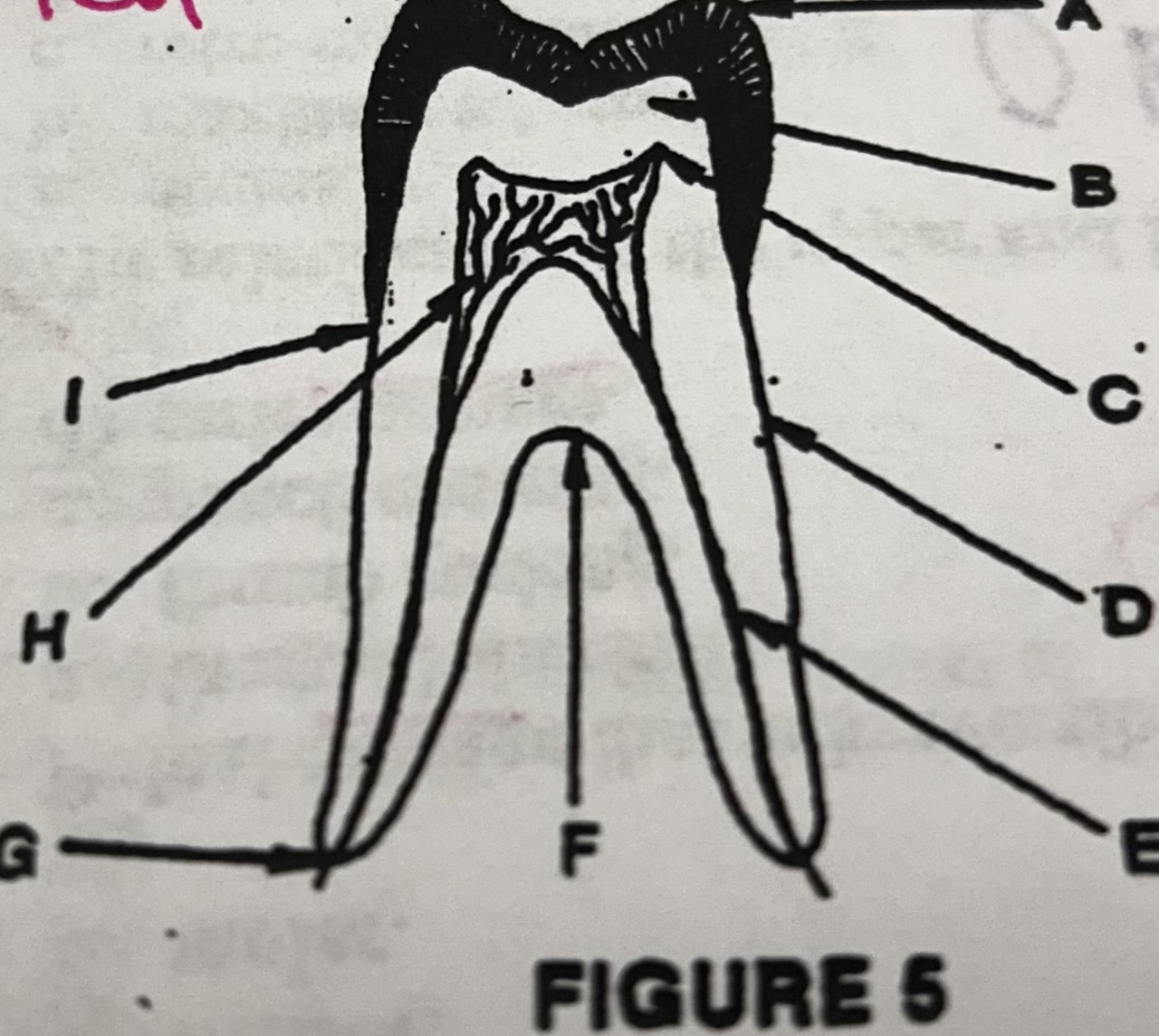
In figure 5, the pulp horn is identified by letter
C
The lingual surface of a tooth lies adjacent to the
tongue
the enamel producing cells are
ameloblasts
The teeth usually supplied by two different nerve is the
maxillary first molar 3 & 14
Which premolar may have three cusps
the mandibular second
For descriptive purposes, each tooth surface is divided into imaginary
thirds
Another name for a cuspid tooth is a/an
canine tooth
A tooth shaped like a shovel with a chisel bevel biting edge is a/an
incisor
Pulpal damage that is irreversible is commonly caused by
carries damage
The relationship of the upper and lower arches is called the
occlusion
A point angle is
three surfaces that meet
Morphology means
structure
The occlusal view of the maxillary first molar contains how many cups?
5

In figure 7, letter “A” identifies which cavity classification?
Class III
The highest concentration of fluoride in the dental enamel is found in the
enamel
Deciduous dentition is composed of ___ teeth
20
Class V carries is located on the ___ third of the clinical crown
cervical
The teeth name describes their functions and inscisor means adapted for
cutting
the clinical crown is divided into
thirds

The parotid duct opens into the mouth from inside the cheek opposite the
maxillary second molar

In figure 6, the uvula is identified by number
35

In figure 6, the labial frenum is identified by number
36

In figure 6, the tonsillar is identified by number
38

In figure 6, the stenson’s duct is identified by number
39
The cusp of carabelli is found on a/an
maxillary first permanent molar 3, 14