Microbiome Techniques Lecture 7
 Call Kai
 Learn
Learn Practice Test
 Spaced Repetition
 Match
Match Flashcards
 Knowt Play
1/40

There's no tags or description
Looks like no tags are added yet.
Name | Mastery | Learn | Test | Matching | Spaced | Call with Kai |
|---|
No analytics yet
Send a link to your students to track their progress
41 Terms
what is nucleic acid hybridization?
Process in which single stranded nucleic acid from different sources but complementary sequences form double stranded molecules (separate and put together again--single strand from one source + single strand from another source but complementary to one another)
nucleic acid hybridization occurs with...
➢ ssDNA with ssDNA
➢ ssDNA with ssRNA
➢ ssRNA with ssRNA
process of nucleic acid hybridization
native state -denaturation-> single stranded denatured state -renaturation-> renatured state
simplified process of nucleic acid hybridization
denature, see if they complement each other, rehybridize (annealing)
if strands bind and there is a signal, it is ______. if there is no signal, it is _______
positive, negative
uses of nucleic acid hybridization
❑ Detect and semi-quantify microbes in a sample
❑ Localize a microbe in a sample
❑ Identify a gene in a sample (e.g. resistance gene).
❑ Detect gene mutations
❑ Study gene expression. (how much is a GOI expressed?)
what is a probe?
A fragment of DNA or RNA of variable length which is used to detect the presence of homologous nucleotide sequences (DNA/RNA target) in a sample
probe types
genomic DNA probes, RNA probes (riboprobes), oligonucleotide probes
which probe type is for long nucleotide sequences?
genomic DNA, RNA (hundreds to thousands of nt)
which probe type is for short nucleotide sequences?
oligonucleotides (15-50 nucleotides)
genomic DNA probes
can be either
➢ Fragment (by PCR or DNA cloning)
➢ Whole genomic (nonspecific)
RNA probes (riboprobes)
➢ By transcription of cloned DNA
oligonucleotide probes
➢ By chemical synthesis (sequence sent to company)
methods of probe labeling
strand synthesis, end-labeling
strand synthesis
DNA or RNA template; DNA or RNA polymerase and labeled nucleotide
end labeling
adding a label to the 5' end of the probe
label types
radioactive and non-radioactive
radioactive labels
frequently used
non-radioactive labels
fluorophores
haptens-biotin and digoxigenin
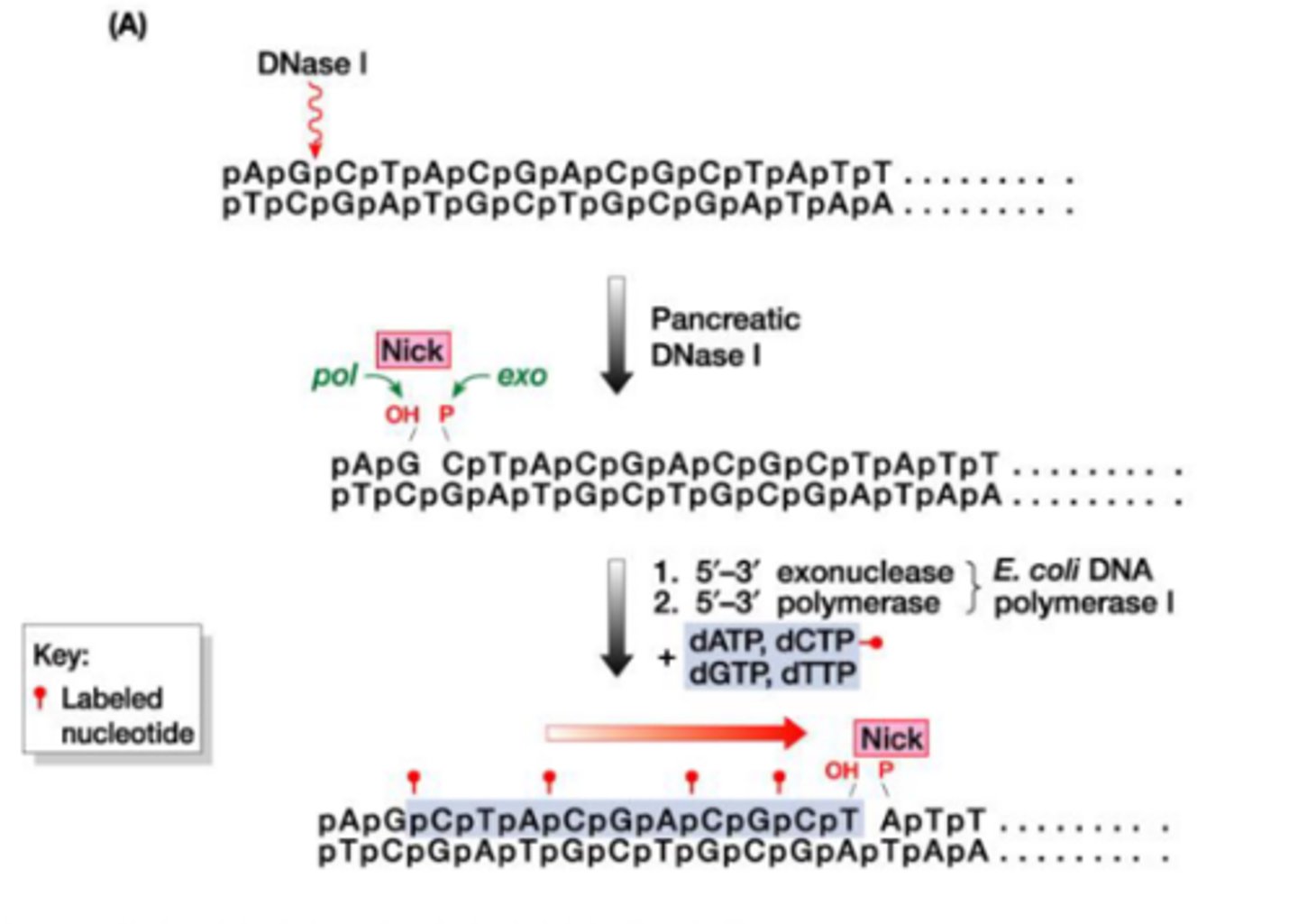
strand synthesis - nick translation
DNAse I's exonuclease/ polymerase domains create a nick, removing nucleotides and adding new ones that are labeled/ complementary to that strand. this fragment is the probe of interest
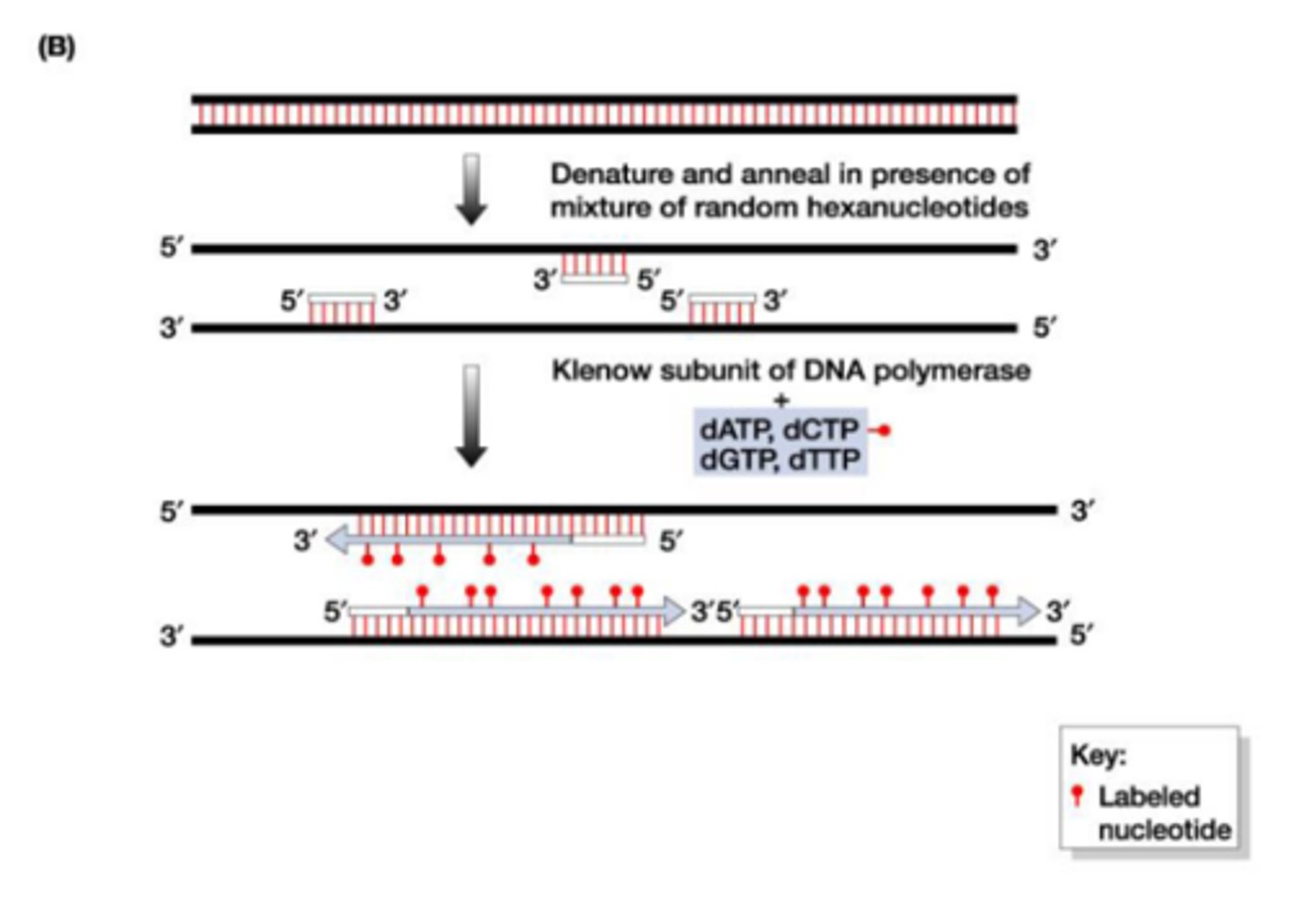
strand synthesis - random primers
random primers bind to RNA templates, adding new labeled nucleotides, amplification with PCR
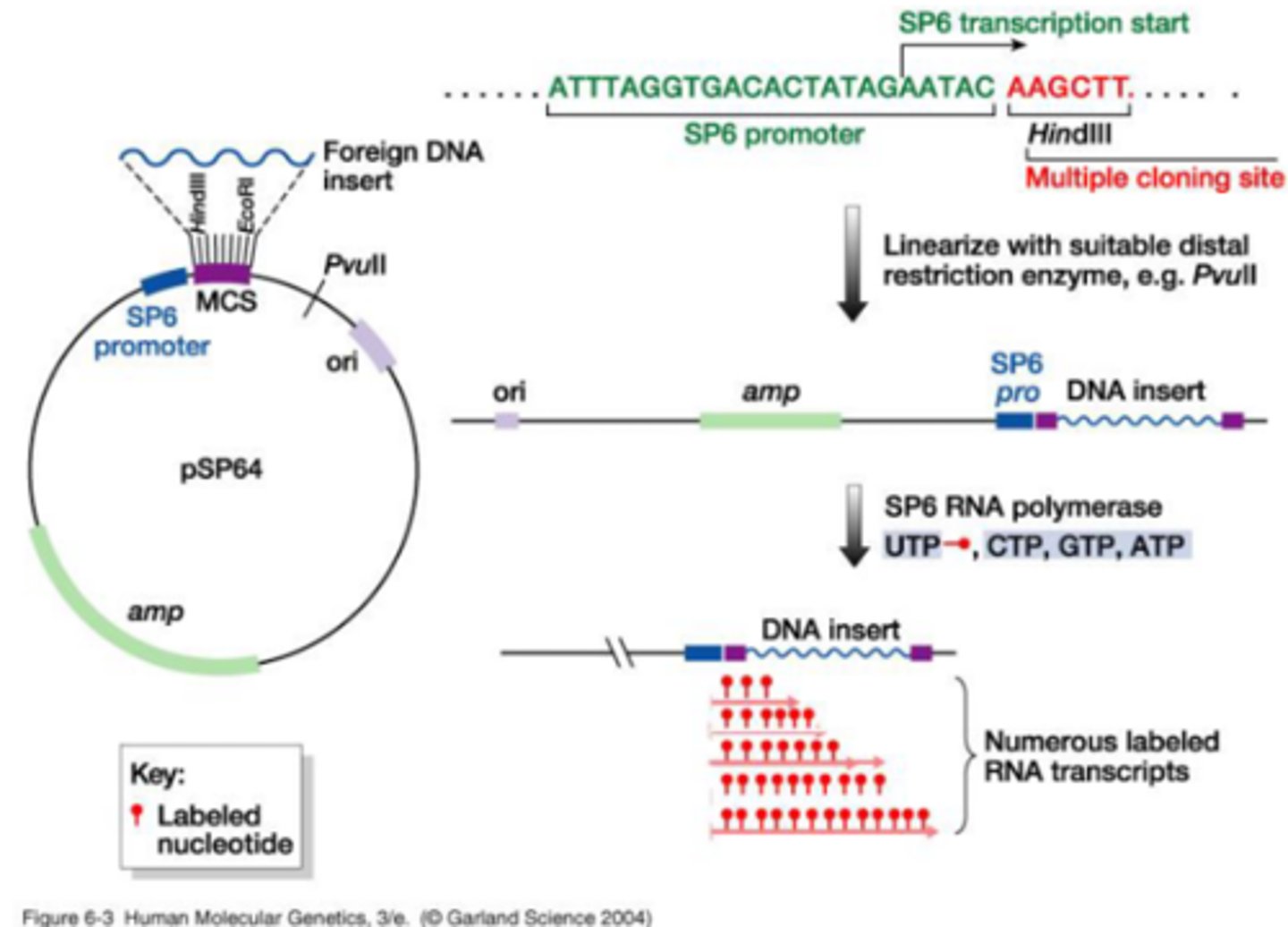
strand synthesis - riboprobes
make a new strand in form of RNA - linearize strand to make vector flat/ linear, then add RNA polymerase
hapten definition
when attached to large carrier molecule acts as "tag" recognized by specific antibodies
fluorophore/ hapten methods
could be conjugated to enzyme that changes color once substrate is added; using a fluorophore to see a signal from the sample
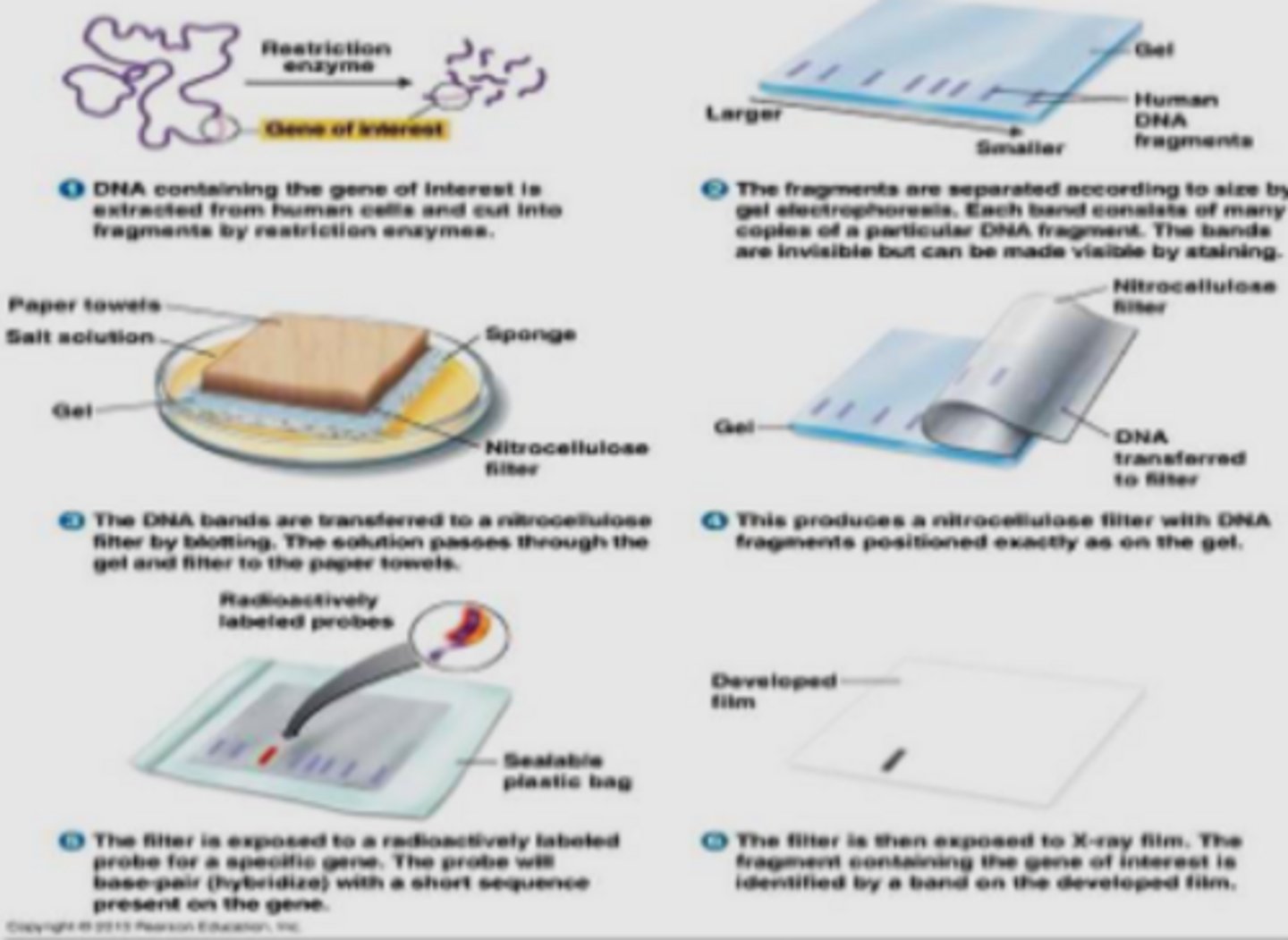
southern blotting
Restriction enzyme breaks GOI into fragments, uses a DNA probe to detect a sequence in a DNA sample and identify the size of the fragment containing it--cross-links UV light exposure, fixes DNA to membrane
southern blot-
probe type:
target type:
sample type:
detects?:
needs electrophoresis?:
details?:
probe type: DNA
target type: DNA
sample type: DNA
detects?: presence, specific sequence, size of fragment sequence
needs electrophoresis?: yes
details?: add basic pH to help strands denature, expose filter to UV light overnight on nylon membrane
northern blotting
Uses a DNA or RNA probe to assess presence and quantity of a mRNA in a sample (gene expression). Based on intensity of signal you can tell if it's low/ high expression
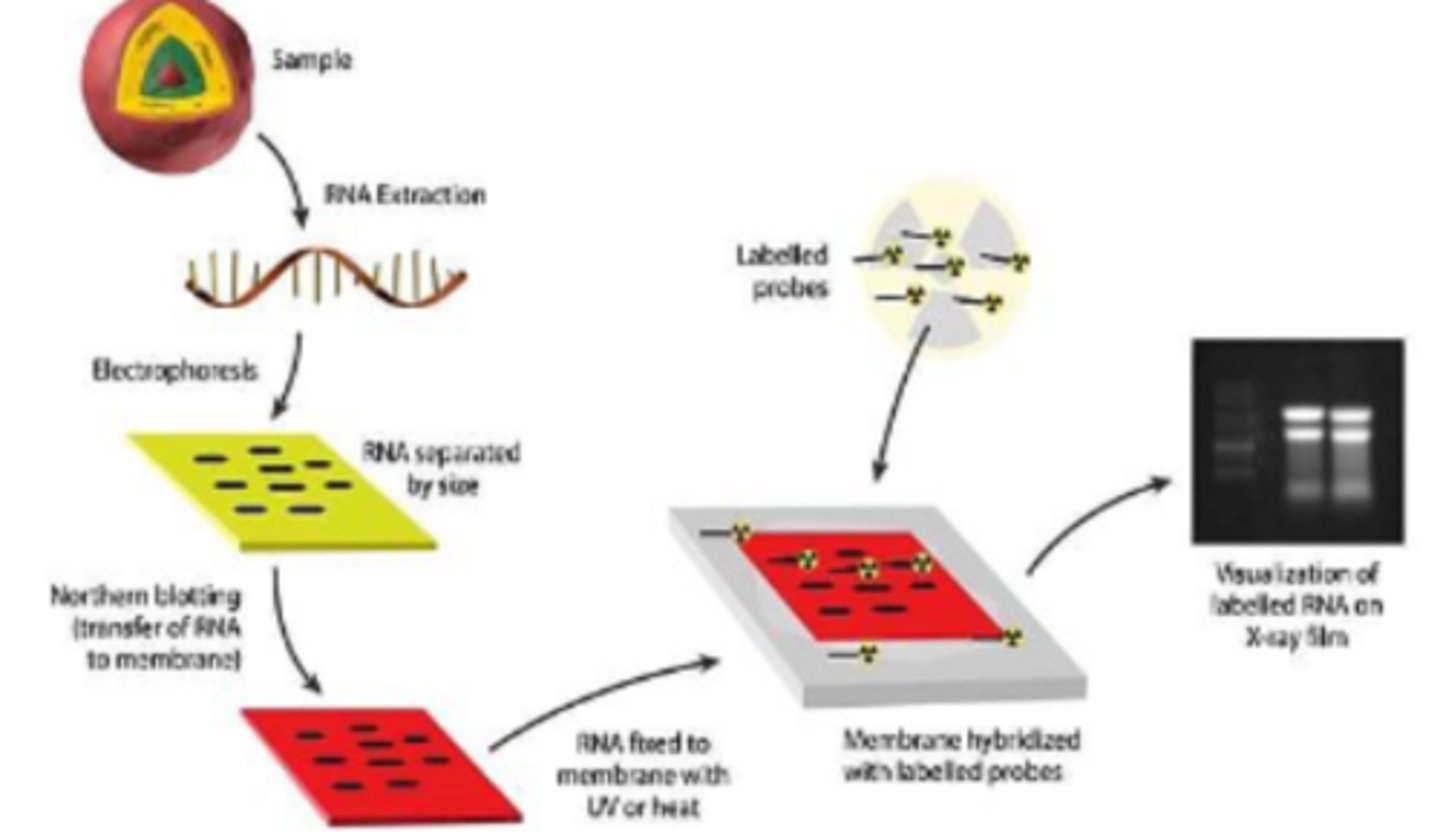
northern blot-
probe type:
target type:
sample type:
detects?:
needs electrophoresis?:
details?:
probe type: DNA/ RNA
target type: mRNA
sample type:
detects?: presence, quantity, gene expression
needs electrophoresis?: yes
details?: gel needs formaldehyde to denature RNA, uses restriction enzyme, nylon membrane
dot blotting
Simpler form of Southern and Northern blots: Detect and semi-quantitate a DNA or mRNA sequence in a sample without separation (electrophoresis)--extract DNA/ mRNA, place samples on membrane, add probe to detect and quantify
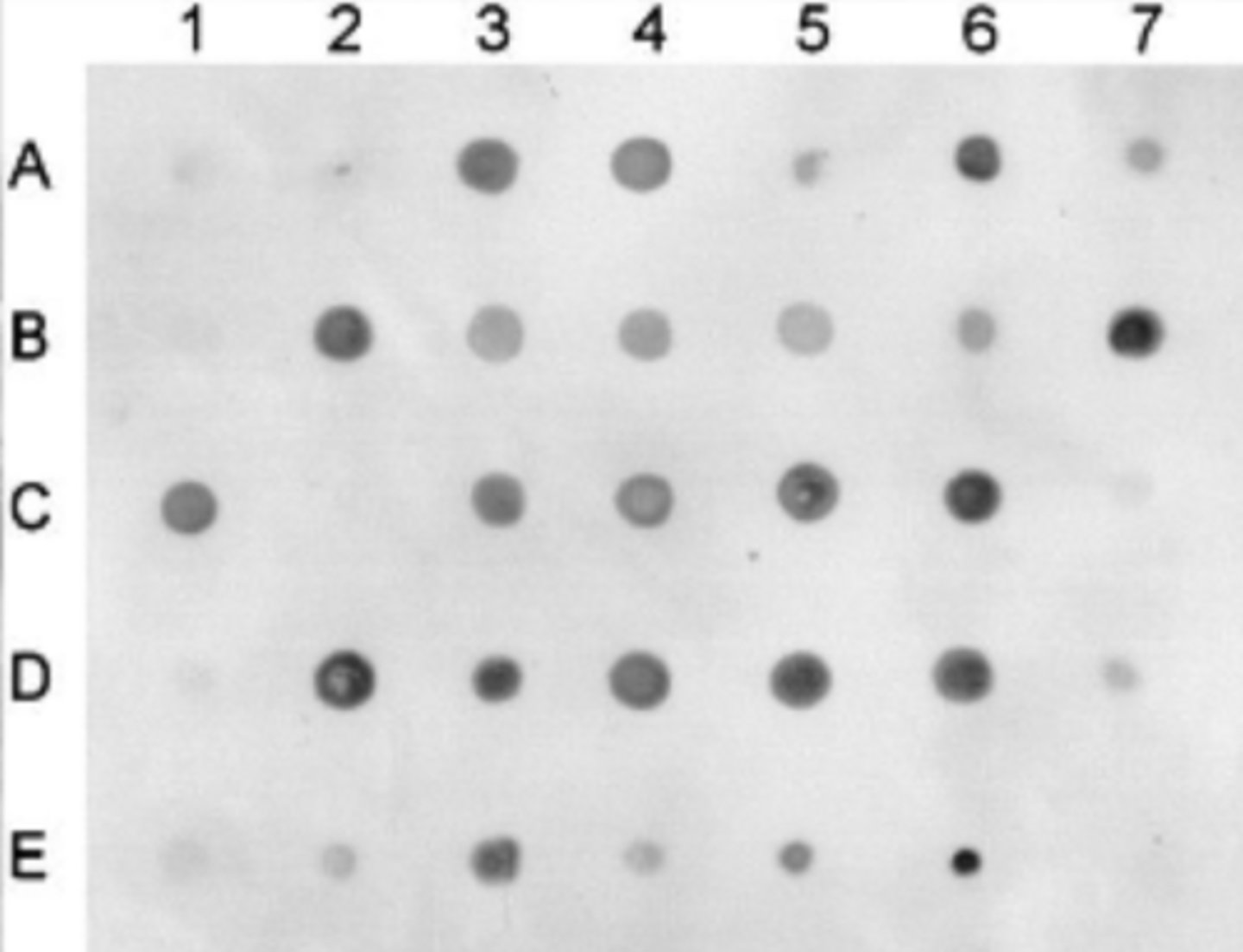
dot blot-
probe type:
target type:
sample type:
detects?:
needs electrophoresis?:
details?:
probe type: DNA or mRNA
target type: DNA or RNA sequence
sample type:
detects?: presence/ semiquantity
needs electrophoresis?: no
details?: simple/ quicker, nitrocellulose membrane
checkboard DNA-DNA hybridization
A high throughput version of dot blot used for analysis of dental samples: Detection and semi-quantification of up to 40 bacterial species in up to 28 dental samples using whole genomic probes. Instead of using blots, uses "lines"
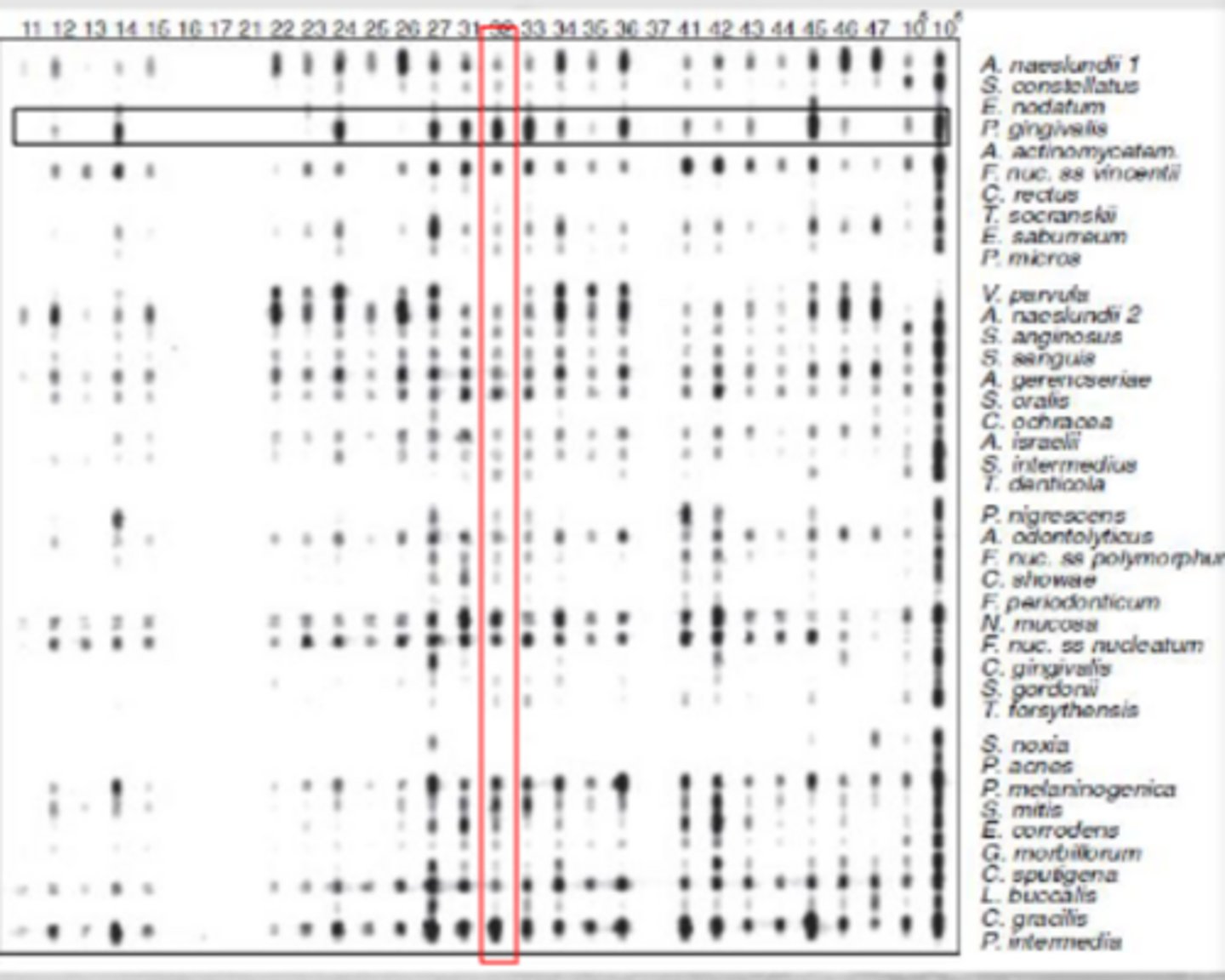
checkboard
probe type:
target type:
sample type:
detects?:
needs electrophoresis?:
details?:
probe type: whole genome
target type: bacterial species
sample type: dental
detects?: presence/ semiquantity
needs electrophoresis?: no
details?: multiple types of bacteria simaltaneously, nylon membrane
in situ hybdrization
Uses a DNA or RNA probe, usually fluorescent, to detect and localize a DNA or mRNA in a tissue or cells instead of membrane. Denature DNA in a tissue and add probe
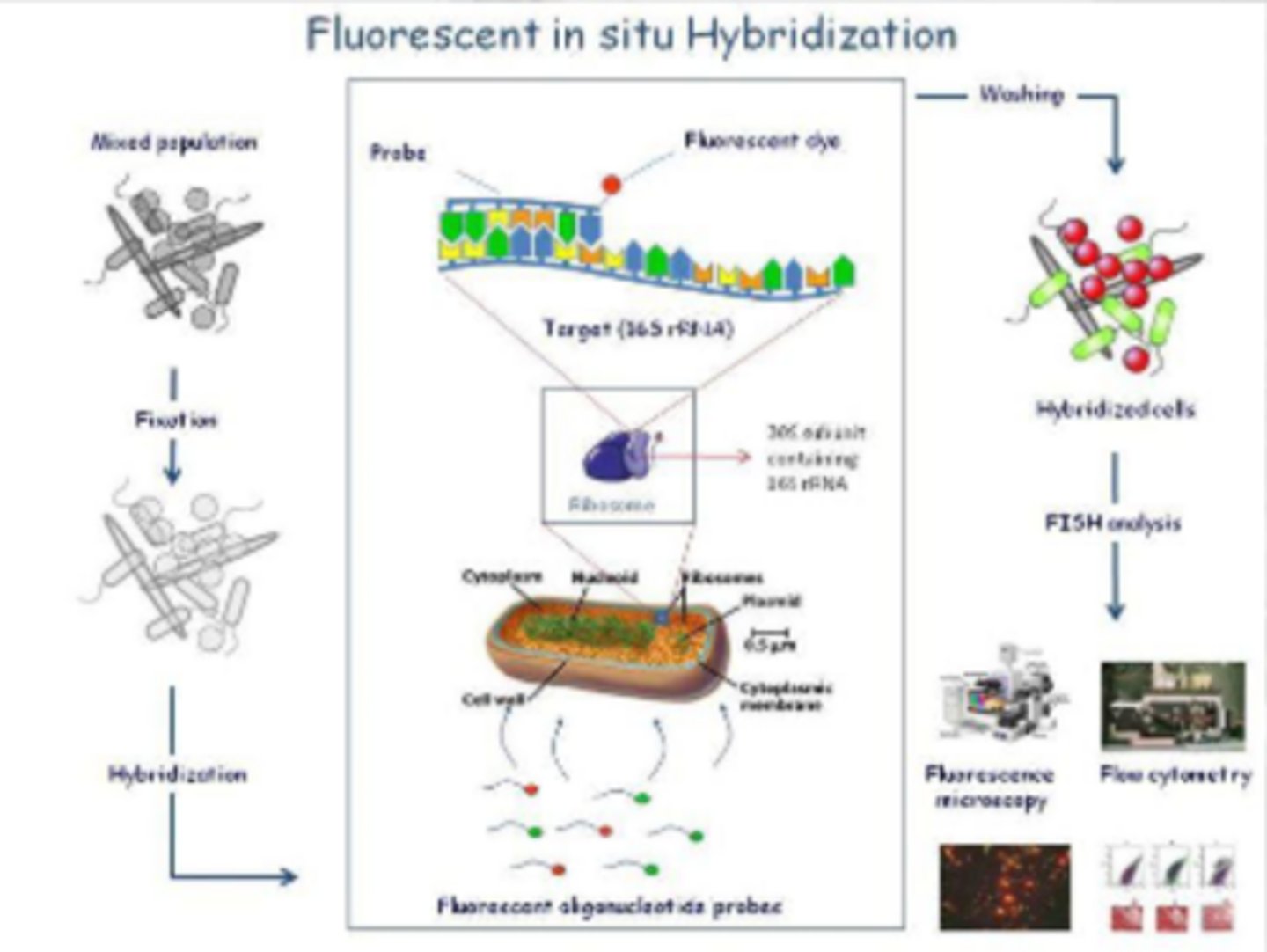
in situ-
probe type:
target type:
sample type:
detects?:
needs electrophoresis?:
details?:
probe type: DNA/ RNA (fluorescent)
target type: DNA or mRNA
sample type: tissue in cell
detects?: presence and location
needs electrophoresis?: no
details?: ONLY way to localize samples in tissues without membrane
Fluorescent in situ hybridization (FISH)
add probe and allow it to hybridize in situ, use heat to denature tissue to allow it to hybridize, shows if positive and where it is located on tissue
DNA microarrays
A glass or silicon chip with thousands of unlabeled DNA probes spotted on it for hybridization with labeled nucleic acids from samples
DNA microarrays-
probe type:
target type:
sample type:
detects?:
needs electrophoresis?:
details?:
probe type: labeled DNA
target type: labeled nucleic acid (DNA or RNA)
sample type: labeled nucleic acid (DNA or RNA)
detects?: presence/ quantification/ gene expression (RNA)
needs electrophoresis?:
details?: glass/ silicon chip, requires colors to tell us what is going on
what is special about DNA microarrays?
sample rather than probe is labeled
uses of DNA microarrays
❑ Detection and quantification of microbes in a sample
❑ Study/compare gene expression
❑ Detect gene mutations (SNPs)
❑ Detect gene copy variations (competitive genomic hybridization)
principle of DNA microarrays
one bacteria treated with antibiotic, one is not. They then bind to complementary genes on chip. Green-control, red-found in gene, yellow-both, black-neither
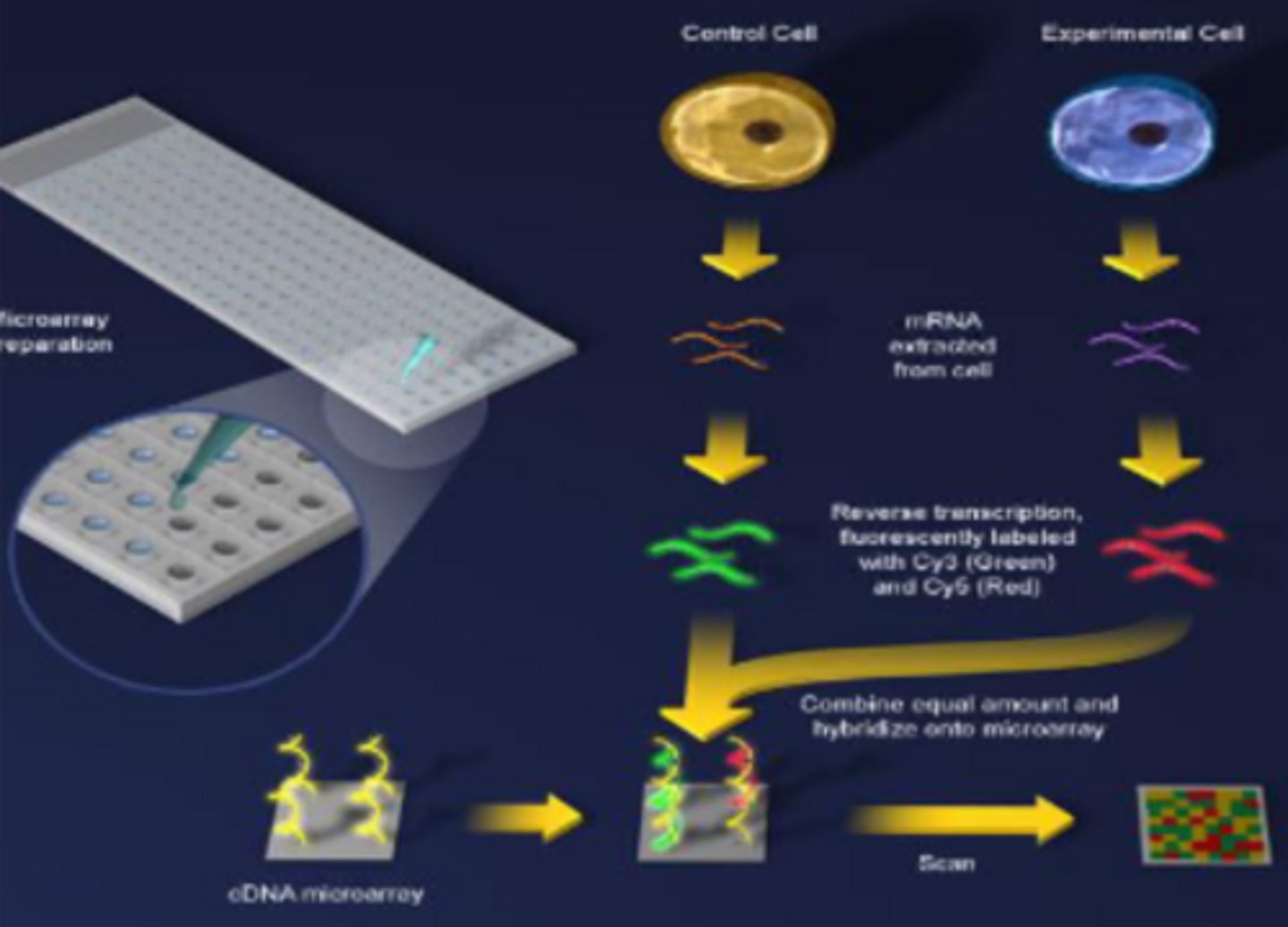
example of DNA microarray
Human Oral Microbiome Identification Microarray (HOMIM): Sample hybridized simultaneously against probes to 300 different species per slide. Indicates what bacteria is in oral microbiome