PHARM 202 - MIDTERM
 Call Kai
 Learn
Learn Practice Test
 Spaced Repetition
 Match
Match Flashcards
 Knowt Play
1/425

There's no tags or description
Looks like no tags are added yet.
Name | Mastery | Learn | Test | Matching | Spaced | Call with Kai | Chat |
|---|
No analytics yet
Send a link to your students to track their progress
426 Terms
What is the main focus of USP Chapter 795?
pharmaceutical compounding - non-sterile preparations
What is the main focus of USP Chapter 1163?
quality assurance in pharmaceutical compounding
What is the main focus of USP Chapter 1191?
stability considerations in dispensing practice
A ——- is any substance composed of chemical elements or obtained by chemical processes.
A ——- is an agent intended for use in the diagnosis, mitigation, treatment, cure, or prevention of disease in humans or animals.
chemical, drug
Syrups, elixirs, suspensions, capsules, tablets, creams, ointments, suppositories, aerosols, parenteral, TTS are all types of ——- ——-.
dosage forms
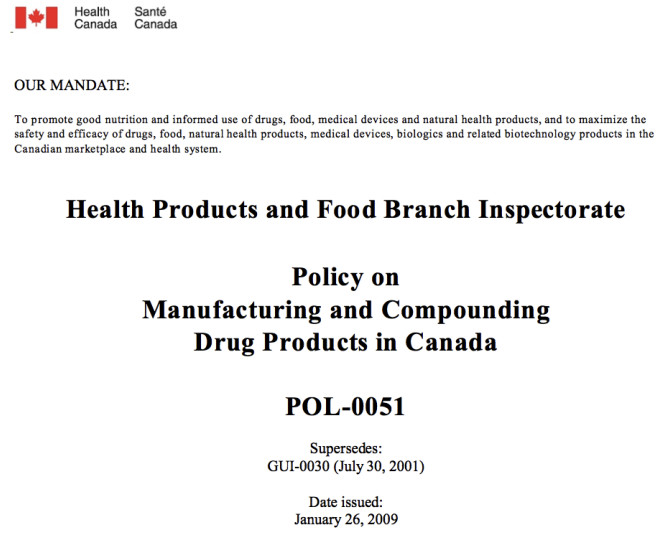
According to Health Canada’s Policy on Manufacturing and Compounding Drug Products in Canada (POL-0051):
Healthcare professionals who provide compounding related services and products to patients/clients must be able to demonstrate that a patient-healthcare professional ——- exists.
Activity is regulated and facility may be inspects by ——- regulatory authorities.
A pharmacy may prepare drugs in very —— quantities, in anticipation of a prescription.
relationship, provincial, limited
What does NAPRA stand for?
National Association of Pharmacy Regulatory Authorities
Which of the following is not apart of NAPRA’s Professional Competencies for Canadian Pharmacists at Entry to Practice regarding compounding?
a) Dispense a product safely and accurately that is appropriate for the patient.
b) Perform pharmaceutical, compounding and patient-specific calculations, including pharmacokinetic and other therapeutic calculations.
c) Develop master compounding formulas.
d) Prepare and compound non-sterile and sterile products according to recognized guidelines and standards of practice.
e) Pharmacists must produce large quantities of the drug made and keep a sample to be sent for inspection by NAPRA.
e
Which of the following criteria must be met when compounding a preparation? (multi-select)
a) Active ingredients are available in a manufactured product.
b) There is a reference formulation to be followed.
c) There is a beyond-use-date (BUD) and relevant stability data.
d) There is a dedicated space for compounding that is clean and uncluttered, and without interruption.
e) All appropriate equipment and ingredients are available to make the compounded preparation.
f) There is another pharmacy with more appropriate facilities, equipment and expertise.
b, c, d, e
Requirements in relation to the compounding formula and preparation process includes:
reputable ——- required for the formula
requirements if no formula is available
written preparation process to be followed
documenting ——- from the written preparation process
approved ingredients to be used in compounding
beyond-use date to be assigned to a compounded drug or blood product
requirements in relation to sterile products
duty regarding final check
These are all established by the —— ——- —— ——- in the —— ——.
source, deviations, Alberta College of Pharmacists, Professional Standards
According to NAPRA’s Professional Competencies for Canadian Pharmacists at Entry to Practice:
—— ——- are the important outcome objectives (i.e. what is to be achieved or performed).
While —— ——- are the sub-elements or main ingredients to achieving the above.
key competencies, enabling competencies
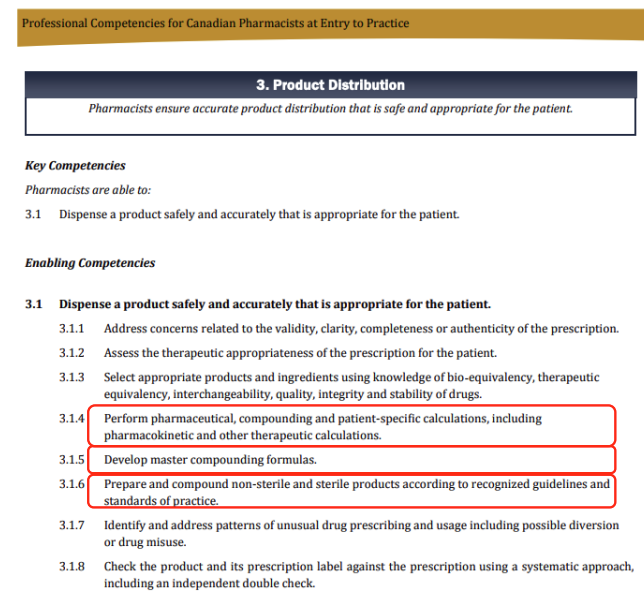
Classify the following as either a key competency or enabling competency.
a) Perform pharmaceutical, compounding and patient-specific calculations, including pharmacokinetics and other therapeutic calculations.
b) Develop master compounding formulas.
c) Prepare and compound non-sterile and sterile products according to recognized guidelines and standards of practice.
d) Pharmacists are able to dispense a product safely and accurately that is appropriate for the patient.
a) enabling
b) enabling
c) enabling
d) key
What does BUD stand for?
beyond-use date
What does CSP stand for?
compounded sterile preparation
What does CS stand for?
compounding supervisor
What does MFR stand for?
master formulation record
What does MSPC stand for?
model standards and guidance document for pharmacy compounding
What does P&P stand for?
policies and procedures
What does SCS stand for?
sterile compounding managers
What does USP stand for?
U.S. Pharmacopeia

USP is a ——— organization that establish standards to ensure the quality of medicines and other health care technologies.
USP also helps to monitor quality and prevent errors in human and veterinary medicine through national ——- programs.
USP is a ——— organization that achieves its goals through the volunteer service of experts representing pharmacy, medicine, other health care professionals, and science.
non-government, reporting, non-profit
In the USP:
Chapters under 1000 contain G—— N——-, m——-, and general chapters with mandatory requirements.
Chapters 1000 to 1999 are considered ——- and are intended to provide information on, give definition to, or describe a particular subject. They contain no mandatory requirements applicable to any official articles.
Chapters numbered above 2000 apply onto to articles that are intended for use as —— ingredients and —— supplements.
General Notices, monograph, interpretive, dietary, dietary
7.20. Rounding Rules
The observed or calculated values shall be rounded off to the number of decimal places that is in agreement with the limit expression. Numbers should not be rounded until the —— —— for the reportable value have been completed.
When rounding is required, consider only —— digit in the decimal place to the right of the last place in the limit expression.
8.20. About
“About” indicates a quantity within ——-%
8.100. Negligible
“Negligible” indicates a quantity not exceeding ——-.
final calculation, one, 10, 0.50 mg
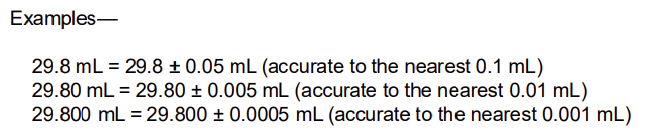
USP 1160
Significant Figures
Expressed values are considered significant to the last digit shown.
A zero in a quantity such as 298.0 mL is a significant figure and implies that the measurement has been made within the limits of —— and ——.
Calculate the possible error =
297.95, 298.05
possible error = (0.05 mL/298.0 mL) x 100% = 0.017%
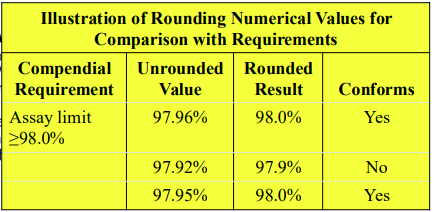
Round the following according to 7.20. Rounding Rules.
a) 97.96%
b) 97.92%
c) 97.95%
The compendial requirement is an assay limit of ≥ 98.0%. For each, also indicate if they confirm to this requirement.
a) 98.0% - yes
b) 97.9% - no
c) 98.0% - yes
What does GMP stand for?
Good Manufacturing Practice
—— ——- (QA) is a system of procedures, activities, and oversight that ensures that the compounding process consistently meets quality standards.
—— —— (QC) is the sampling, testing, and documentation of results that, taken together, ensure that specifications have been met for the CNSP.
quality assurance, quality control
What does USP-NF stand for?
U.S. Pharmacopeia (USP) and National Formulary (NF)
USP 795 - compounding of non-sterile preparations
——- ——- is defined as combining, mixing, diluting, pooling, reconstituting other than as provided in the manufacturer’s labeling, or other altering a drug product or bulk drug substance to create a non-sterile preparation.
non-sterile compounding
What are the possible risk factors that can cause harm in patients during compounding?
excessive microbial contamination
variability from the intended strength of correct ingredients (e.g. ±10% of the labeled strength)
physical and chemical compatibilities
chemical and physical contaminants
use of ingredients of inappropriate quality
Which of the following practices is considered compounding and is required to meet the requirements of USP Chapter 795?
a) non-sterile radiopharmaceuticals
b) reconstitution
c) repackaging of conventionally manufactured drug products
d) preparing vaginal preparations
e) preparation of a single dose for a single patient when administration will begin within 4 hr. This includes crushing a tablet(s) or opening a capsule(s) to mix with food or liquids to facilitate patient dosing.
d
note - e is just administration preparation and is not considered compounding
USP Chapter 795 applies to —— persons who prepare CNSPs and all places where CNSPs are prepared. This includes but is not limited to pharmacists, technicians, nurses, physicians, vets, dentists, naturopaths, and chiropractors.
The compounding facility must designate one or more individuals to be responsible and accountable for the performance and operation of the facility and personnel for the preparation of CNSPs. T/F
T
Which of the following is not a responsibility of the designated person(s)?
a) Overseeing a training program to ensure competency of personnel involved in compounding, handling, and preparing CNSPs.
b) Selecting components
c) Monitor and observing compounding activities and taking immediate corrective action if deficient practices are observed.
d) Compounding every and all CNSPs assigned to the pharmacy.
e) Ensuring that standard operating procedures (SOPs) are fully implemented.
f) Ensure that follow-up is carried out if problems, deviations, or errors are identified.
g) Establishing, monitoring, and documenting procedures for the handling and storage of CNSPs.
d - not all
The designated person(s) must be identified in the facility’s SOPs. T/F
T
If the compounding facility has only one person responsible for all compounding in the facility, then that person is the designated person. T/F
T
All personnel who compound or have direct oversight of compounding CNSPs must be initially ——- and qualified by demonstrating knowledge and competency according to the requirements in this section before being allowed to perform their job functions ——.
Personnel must complete training initially and at least every —— ——- in appropriate compounding principles and practices as described in this section.
trained, independently, 12 months
What are the core competencies that personnel who compound or have direct oversight of compounding CNSPs must demonstrate?
hand hygiene
garbing
cleaning and sanitizing
handling and transporting components and CNSPs
measuring and mixing
proper use of equipment and devices selected to compound CNSPs
documentation Master Formulation and Compounding Records (MFCR)
What steps must be included in the training modules for personnel who compound or have direct oversight of compounding CNSPs?
understand the requirements in USP Chapter 795
understand and interpret SDSs and COA if applicable
read and understand procedures related to their compounding duties
What does COA stand for?
Certificate of Analysis
Training and observation may be performed by the ——- person(s) or an assigned ——-. Personnel must be observed and guided throughout the training process. The personnel will then be expected to ——- the procedures ——— while under the direct supervision of the designated person(s) and/or assigned trainer. Personnel will be permitted to perform the procedure without direct supervision only after independently demonstrating understanding and competency. Upon completion of the training program, the designated person(s) and/or assigned trainer must ——— that personnel have been trained and successfully completed competency assessments.
designated, trainer, repeat, independently, document
In addition to the initial and annual competency training and evaluation described in this section, the designated person(s) should ——- and ——- compounding activities and must take immediate corrective action if deficient practices are observed. Facility ——- must describe procedures for monitoring and observing compounding activities and personnel.
monitor, observe, SOPs
Personnel Preparation
Personnel engaged in compounding must maintain appropriate ——- hygiene and maintain appropriate cleanliness required for the type of compounding performed. Before entering the compounding area. Compounding personnel must remove any items that are not easily cleanable and that might interfere with ——-.
hand, garbing
The use of alcohol-based hand rub alone is sufficient. T/F
F
Hand hygiene
Wash hands with soap and water for at least ——— ——-
Dry hands completely with disposable towels or wipers
Put on gloves
30 seconds
To minimize the risk of cross contaminating other CNSPs and contaminating other objects (e.g., pens and keyboards), gloves should be wiped or replaced before beginning a CNSP that has ——- components.
All gloves must be inspected for holes, punctures, or tears and must be replaced immediately if such defects are detected.
different
What does the acronym GARB stand for in pharmaceutical compounding?
gowning, aseptic technique, respiratory protection, barrier controls
Garb and Glove Requirements
Garb should be removed when ——- the compounding area. When personnel exit the compounding area, garb, except for gowns, should be discarded. Disposable garb must not be laundered. If gowns are worn, they may be reused if not damaged or soiled. If gowns are to be reused, they must remain in the compounding area, and should only be reused during the same shift. The facility’s ——- must describe cleaning and sanitization procedures for reusing goggles, respirators, and other reusable equipment.
leaving, SOPs
If compounding a hazardous drug (HD), appropriate personal protective equipment (PPE) must be worn and disposed of in accordance with USP ——-.
800
Compounding Area
An area must be designated for nonsterile compounding. The method of designation must be described in the facility’s SOPs. Other activities must not be occurring in the compounding area at the same time as compounding. The compounding area must be well lit and must be maintained in a clean, orderly, sanitary condition and in a good state of repair. There should not be ——- in the compounding area.
The area should be designed, arranged, and used in a way that minimizes cross contamination from ——- areas. It must be a dedicated room under —— ——- (outside air can go in, but air inside can’t get out) to the pharmacy; containment device.
carpet, non-compounding, negative pressure
Storage Area
Compounding personnel must monitor temperatures in the storage area(s) either manually at least ——- daily on days that the facility is open, or continuously with a temperature recording device to ensure the temperature remains within the appropriate range for the CNSPs and components. The results of the temperature readings must be documented on a ——- —— or stored in the continuous temperature recording device and must be retrievable. All temperature monitoring equipment must be calibrated or verified for accuracy as recommended by the manufacturer or every ——- ——- if not specified by the manufacturer. The compounding facility must adhere to SOPs to detect and reduce the risk of temperature excursions within the storage area(s).
When it is known that a CNSP or component has been exposed to temperatures either below or above the storage temperature limits for the CNSP or component, personnel must determine whether the CNSP or component integrity or quality has been compromised, and, if so, the CNSP or component must be ——. All CNSPs, components, equipment, and containers must be stored off the —— in a manner that prevents contamination and permits inspection and cleaning of the storage area(s).
once, temperature log, 12 months, discarded, floor
Water Source
A source of hot and cold water and an easily accessible sink must be available. The sink must be emptied of all items unrelated to compounding and must be cleaned if visibly soiled before being used to clean any equipment used in nonsterile compounding. The plumbing system must be free of defects that may contribute to the contamination of any CNSP.
What types of water is appropriate for rinsing equipment and utensils?
purified, distilled, or reverse osmosis water
Cleaning and Sanitizing
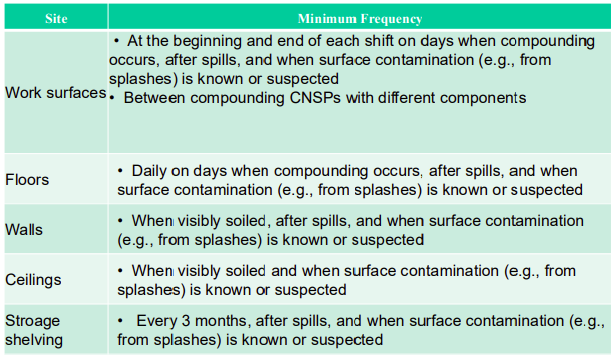
Cleaning and sanitizing the surfaces in the nonsterile compounding area(s) must occur on a regular basis at the minimum frequencies specified in Table 1 or, if compounding is not performed daily, cleaning and sanitizing must be completed before initiating compounding. Cleaning and sanitizing must be repeated when ——- occur and when surfaces are visibly soiled. Applicable cleaning and sanitizing must be ——- daily on days when compounding occurs. Surfaces should be ——- to damage by cleaning and sanitizing agents. Floors in the compounding area should be easily cleanable and should not be ——- or particle generating. Cleaning and sanitizing agents must be selected and used with consideration of compatibilities, effectiveness, and minimal potential to leave ——-. If cleaning and sanitizing are performed as separate steps, ——- must be performed first.
spills, documented, resistant, porous, residues
According to Table 1, when should work surfaces be cleaned?
beginning and end of each shift on days when compounding occurs
between compounding CNSPs with different component
According to Table 1, when should floors be cleaned?
daily on days when compounding occurs
According to Table 1, when should walls and ceilings be cleaned?
when visibly soiled
According to Table 1, when should storage shelving be cleaned?
every 3 months
Equipment and Components: Equipment
Equipment surfaces that contact components must not be reactive, additive, or sorptive, and must not alter the ——- of the CNSP. ——- or dedicated equipment may be used to reduce the chance of bioburden and cross contamination.
Equipment and devices used in the compounding or testing of compounded preparations must be inspected prior to use and, if appropriate, verified for accuracy as recommended by the manufacturer at the frequency recommended by the manufacturer or at least every ——- ——-, whichever is more frequent.
Weighing, measuring, or otherwise manipulating components that could generate airborne chemical particles (e.g., active pharmaceutical ingredients [APIs], added substances, and conventionally manufactured products) must be evaluated to determine if these activities must be performed in a —— ——- —— device to reduce the potential exposure to personnel or contamination of the facility or CNSPs.
quality, disposable, 12 months, closed-system processing
What are examples of closed-system processing devices?
containment ventilated enclosures (CVEs)
biological safety cabinets (BSCs)
single-use containment glove bags
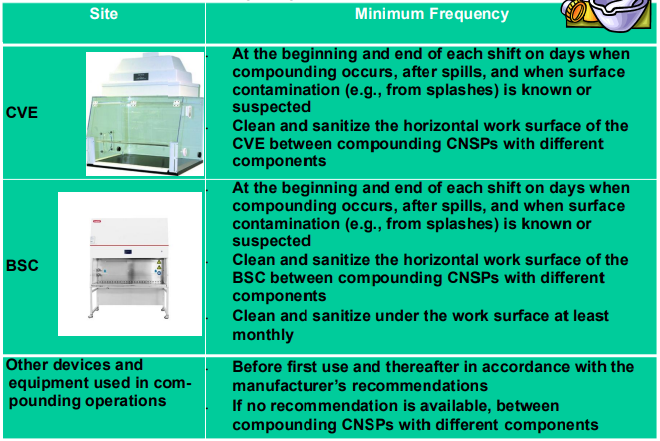
If a CVE or BSC is used, it must be certified at least every ——- ——- according to manufacturer specifications or other laws and regulations of the applicable regulatory jurisdiction. If a BSC, CVE, or other non-disposable device is used, it must be cleaned as described in Table 2.
12 months
According to Table 2, how often should CVEs and BSCs be cleaned?
at beginning of each shift on days when compounding occurs
clean and sanitize the horizontal work surface between compounding CNSPs with different components
Only for BSC:
clean and sanitize under the work surface at least monthly
Equipment and Components: Components
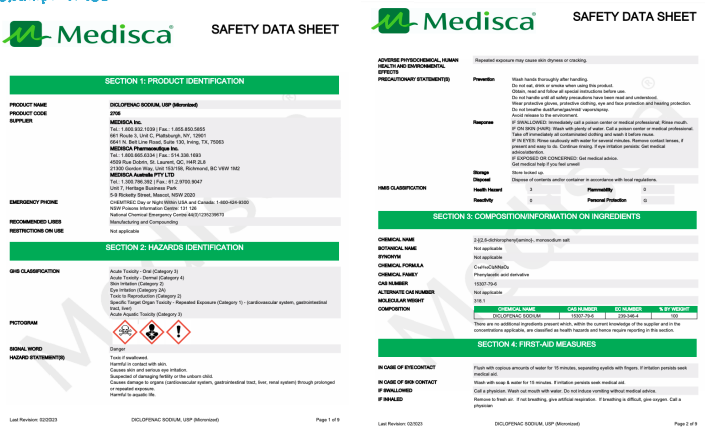
The compounding facility must have written SOPs for the selection and inventory control of all components from receipt to use in a CNSP. ——- must be readily accessible to all personnel working with components located in the compounding facility. Personnel must be instructed on how to retrieve and interpret needed information.
SDS
What is the main difference in the transition between WHMIS 1988 vs. WHMIS 2015?
2015 incorporates GHS (Globally Harmonized System of Classification and Labelling for chemicals)
Who is responsible for selecting components to be used in compounding?
designated person(s)
What are the requirements when selecting the active pharmaceutical ingredient (API)?
must comply with criteria in USP-NF monograph, if one exists
must have a COA (certificate of analysis) with test results that shows the API meets the expected quality
must comply with laws and regulations of the applicable regulatory jurisdiction
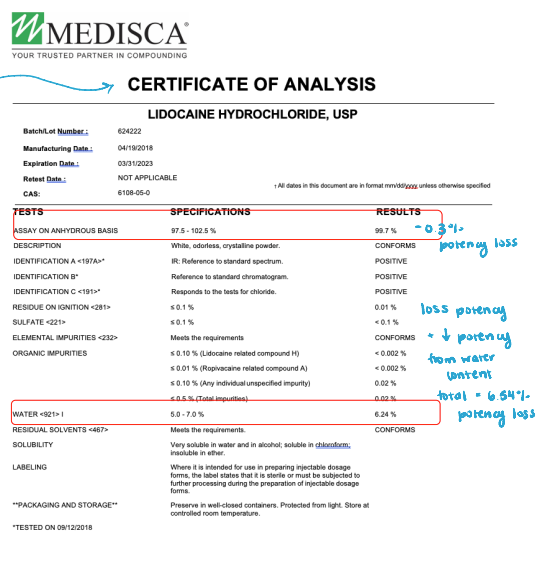
What is the difference between a monograph vs. COA?
monograph - states the specifications of a product
COA (certificate of analysis) - confirms that the particular batch is within the specification
What type of water used for compounding non-sterile drug preparations when formulations indicate the inclusion of water?
purified water or better quality i.e. sterile water for irrigation
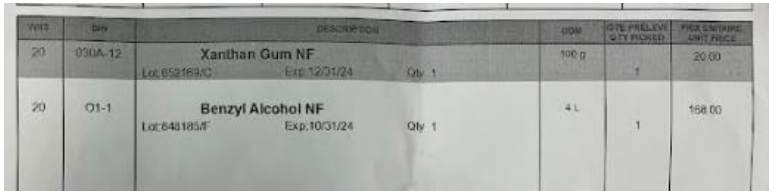
Component receipt
Upon receipt of components other than conventionally manufactured goods, the ——- must be reviewed to ensure that the component has met the acceptance criteria in an appropriate USP-NF monograph, if one exists. What information should be documented?
COA
receipt date, quantity received, supplier name, lot number, expiry date, results of any in-house or third-party testing performed
Component receipt
For all components that lack a vendor expiration date, the date of ——- by the compounding facility must be clearly and indelibly marked on each packaging system. Packaging systems of components (i.e., API and added substances) that lack a vendor’s expiration date must not be used by the compounding facility after ——- ——- from the date of receipt.
A shorter expiration date must be assigned according to Pharmaceutical Compounding—Sterile Preparations <797>, 9.3.2 Component receipt if the same component container is also used in ——- ——- or if the ingredient is known to be susceptible to ——-. Any component found to be of unacceptable quality must be promptly rejected, clearly labeled as rejected, and segregated from ——- ——- to prevent use before appropriate disposal.
receipt, 3 years, sterile compounding, degradation, active stock
Which of the following is red flag that would warrant rejection when evaluating components before use? (multi-select)
a) container breakage
b) loose cap or closure
c) deviation from expected appearance or texture
d) was stored under different conditions that what was indicated by the manufacturer
a, b, c, d
Once removed from the original container, any component not used in compounding (even excess after weighing) should be discarded and not returned to the original container to minimize the risk of contaminating the original container. T/F
T
Component spill and disposal
The management and documentation of non-hazardous component spills and disposal must be described in the facility’s ——-. The facility must have a readily accessible ——- ——- in the compounding area. All personnel who may be required to remediate a spill must receive training in spill management of chemicals used and stored at the compounding facility. Training must be conducted at least every ——- ——- and documented for all personnel who may be required to clean up a spill. Waste of any component must be disposed of in accordance with laws and regulations of the applicable regulatory jurisdiction. For information on the handling of hazardous drugs, see USP ——-.
SOPs, spill kit, 12 months, 800
A ——- ——- ——- (MFR) is a detailed record of procedures that describes how the CNSP is to be prepared.
An MFR must be created for each —— formulation of a CNSP. CNSPs are prepared according to the MFR, and the details of each preparation are documented on a —— ——.
Any changes or alterations to the MFR must be approved and documented according to the facility’s SOP.
master formulation record, unique, compounding record
What is the minimum information required to be on a MFR?
name, strength or activity, and dosage form of CNSP
identities and amounts of all components
container closure system
complete instruction for preparing the CNSP including equipment, supplies, and description of compounding steps
physical description of final CNSP
beyond use date (BUD) and storage requirements
labelling requirements (e.g. shake well)
quality control procedures (pH testing, visual inspection)
Which of the following is false regarding compounding records?
a) A compounding record (CR) documents the compounding of each CNSP. A CR must be created for all CNSPs.
b) Each CR must be reviewed for completeness before the CNSP is released.
c) The name or other unique identifier of the person completing the review and the date of the review must be documented on the CR.
d) The CR must permit traceability of all components in the case of a recall or known quality issue.
e) The MFR can be used as the basis for preparing the CR. For example, a duplicate can be made of the MFR with blank fields for recording the information necessary to complete the CR.
g) The CR should not be a duplicate of the MFR and should look completely different from it.
g
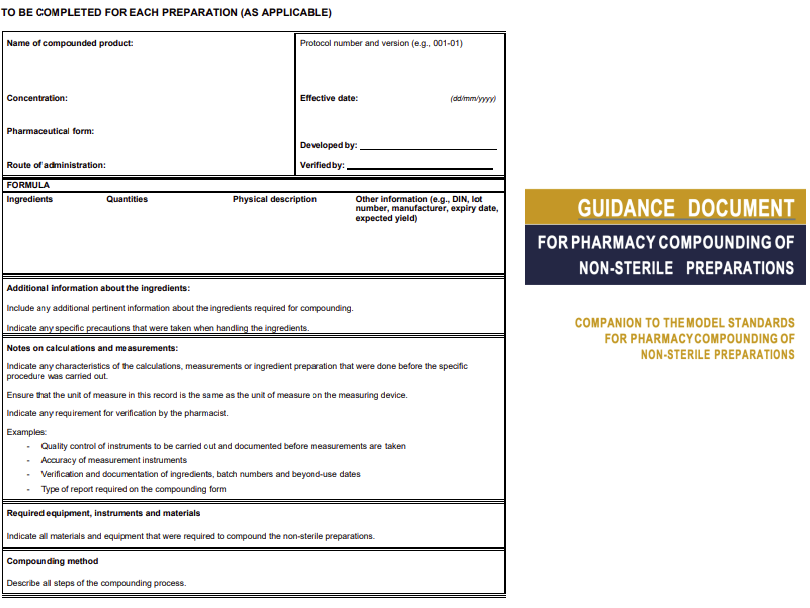
What information is required to be on a CR?
everything on the MFR plus the following:
name, vendor or manufacturer, lot number, and expiration date of each component
weight/measurement of each component
total quantity of CNSP compounded
MDR reference for the CNSP
Visual Inspection
At the completion of compounding, before releasing and dispensing, the CNSP must be ——- ——- to determine whether the physical appearance of the CNSP is as expected (e.g., color, texture, physical uniformity). Some CNSPs, as noted in their MFR, also must be visually checked for certain characteristics (e.g., emulsions must be checked for phase separation). The CNSP must be visually inspected to confirm that the CNSP and its labeling match the CR and the prescription or medication order.
The inspection also must include a visual inspection of ——- ——- integrity (e.g., checking for leakage, cracks in the container, or improper seals). When a CNSP will not be released or dispensed on the day of preparation, a visual inspection must be conducted immediately before it is ——- or dispensed to make sure that the CNSP does not exhibit any defects (e.g., leakage) that could develop during storage. Any CNSP found to be of unacceptable quality (e.g., observed defects) must be promptly rejected, clearly labeled as rejected, and segregated from active stock to prevent use before appropriate disposal.
visually inspected, container closure, released
The term ——- designates all labels and other written, printed, or graphic matter on the immediate container or on or inside any packaging system or wrapper in which the article is enclosed, except any outer shipping container.
The term ——- designates the part of the labeling on the immediate container.
labeling, label
What is required on the label of each container of the prepared CNSP?
assigned internal identification number (e.g. barcode, prescription, order, or lot number)
active ingredient(s), their amount, activity, or concentrations
storage conditions other than room temp
BUD
dosage form
total amount or volume
What is required on the labeling on the dispensed CNSP?
route of administration
indication that the preparation is compounded
special handling instructions, if any (e.g. storage in fridge)
warning statements, if any (e.g. change in formulation from previous)
compounding facility name and contact info
BUDs and expirations dates are the same. T/F
F
What is the difference between BUD vs. expiry date
expiry date - time during which a conventionally manufactured product, API, or added substance can be expected to meet the requirements of a compendial monograph or maintain expected quality
BUD - assigned by pharmacist for a compounded medication that indicates the last safe use after it’s altered or opened
When establishing a BUD for a CNSP, what parameters must a compounder consider that may affect quality?
chemical and physical stability of API and other substances
compatibility to the container closure system
degradation of container closure system
potential microbial proliferation in the CNSP
significant deviations from essential compounding steps that may impact the stability of the formulation
Pharmaceutical ——- are liquid preparations that contain one or more chemical substances dissolved (molecularly dispersed) in a suitable solvent or mixture of mutually miscible solvents.
solutions
Patient, Jen, is an 8-year-old female with a dry, hacking cough. She is not on any medications currently. Cough seems to be aggravated after periods of exertion or exercise.
The mother says she is concerned that some medicines might make Jen tired or drowsy while she is at school, so she would like one that is least likely to produce drowsiness/sedation.
Also, she says that Jen does not like the taste of many medications and is concerned that Jen may not like what is recommended and refuse to take it. Also, she says that Jen prefers strawberry flavors.
What would be your plan?
compound a dextrometorphane liquid formulation with strawberry flavour
JM is a 5 year old who has motion sickness and is leaving for vacation with his family. He does not take tablets.
What would be your plan?
prepare dimenhydrinate liquid formulation
Jacob Stone is an 11-year-old male patient who has undergone multi-visceral organ transplantation. He was originally given hydralazine in powder form to take with soft food. The patient’s mom is asking for a liquid preparation.
prepare a liquid preparation
Ali is an 85-year-old patient who has gone through surgery in his mouth to remove precancerous lesions. He is regularly taking enalapril in tablet form to reduced his high blood pressure. With his surgery, he cannot take the tablet, however.
prepare an oral solution of enalapril
What are some reasons why and when it would be reasons why it is more beneficial to prepare a solution?
special patients - pediatrics, geriatrics
flexible doses - precision medicine
special dosage forms taken by different routes of administration - IV
needed for fast absorption and better bioavailability
What are some disadvantages of a preparing a solution (rather than a tablet/capsule)?
stability problems
solubility problems
taste of drugs
difficulty in transport and storage
inaccurate (even) dosing
need for preservative
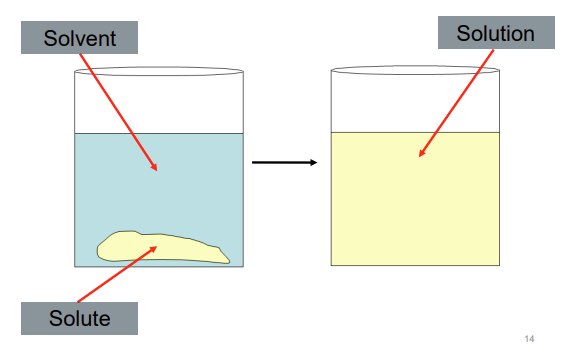
What makes up a pharmaceutical solution?
solute dissolved in solvent
What is the most common solvent used in preparation of pharmaceutical solutions?
water (safest)
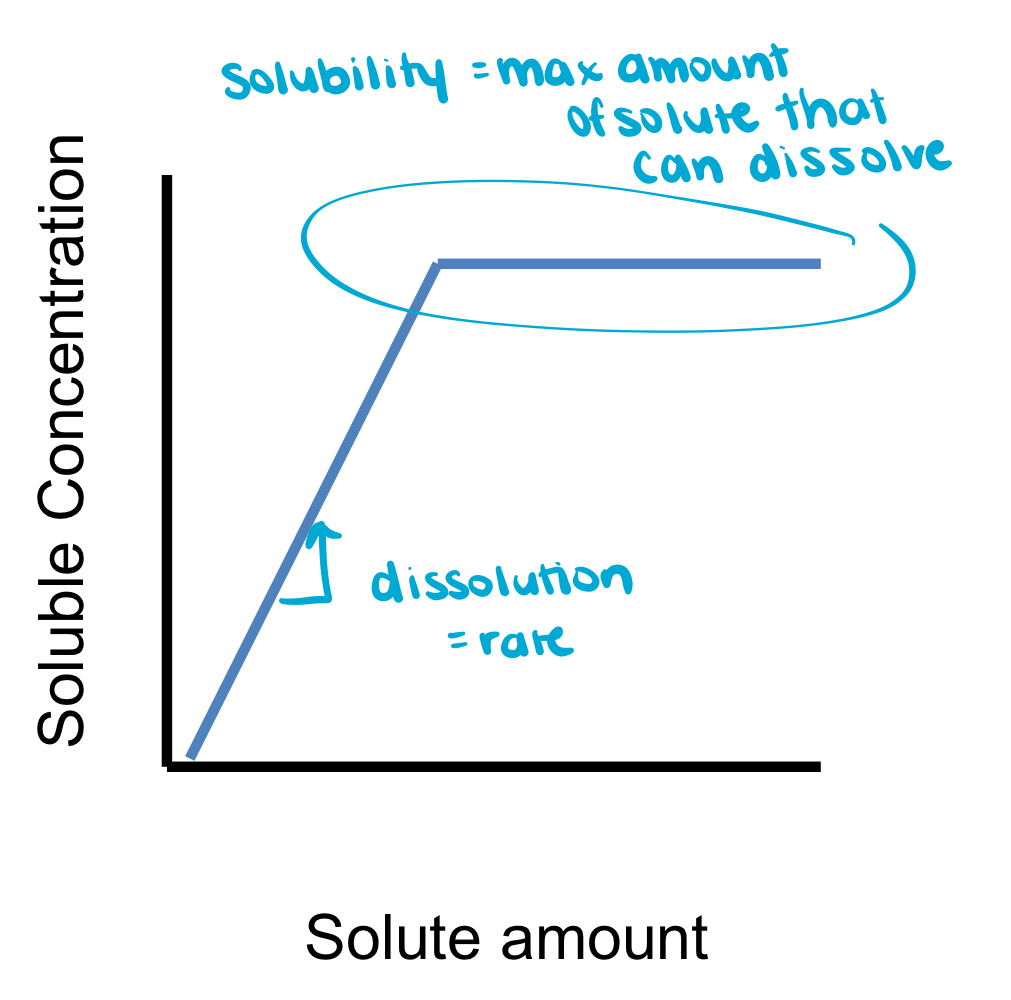
——- is the maximum amount of a solute that can dissolve per unit volume of a given solvent at a certain temperature.
——- is the rate of solubilization.
solubility, dissolution
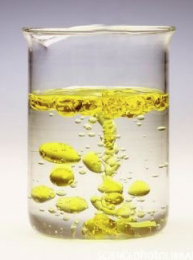
——- is the solubility of liquid in liquids.
miscibility
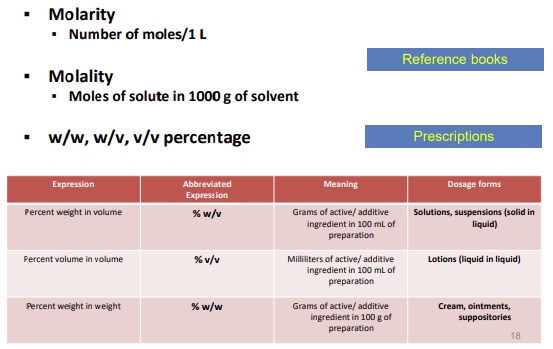
What is the difference between molarity, molality, and w/w, w/v, v/v percentage?
molarity - mol/L
molality - mol/1000 g
w/w - g/100 g
w/v - g/100 mL
v/v = mL/100 mL
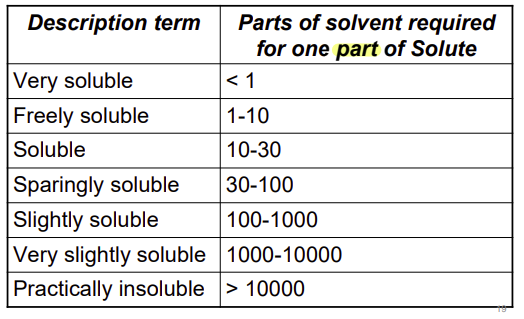
What does 20 (parts of solvent required for one part of solute) say about the solubility of a solute in a particular solution?
a) very soluble
b) freely soluble
c) soluble
d) sparingly soluble
e) slightly soluble
g) very slightly soluble
h) practically insoluble
c
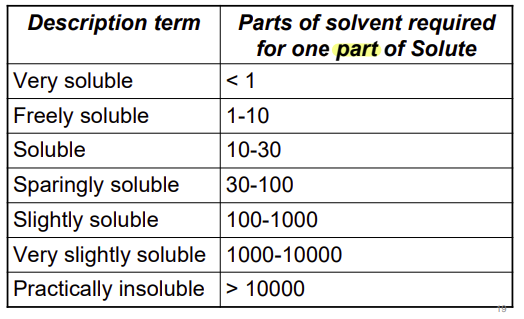
What does 150 (parts of solvent required for one part of solute) say about the solubility of a solute in a particular solution?
a) very soluble
b) freely soluble
c) soluble
d) sparingly soluble
e) slightly soluble
g) very slightly soluble
h) practically insoluble
e
——- is molecular forces keeping like molecules together.
——- is molecular forces keeping unlike molecules together.
cohesion, adhesion

——- forces occur from molecular interactions between solute molecules.
i.e. dipole-dipole, van der Waals forces, H-bonds, electrostatic forces)
cohesion