Texes 181 (Deaf and Hard of Hearing Exam)
 Call Kai
 Learn
Learn Practice Test
 Spaced Repetition
 Match
Match Flashcards
 Knowt Play
1/176

There's no tags or description
Looks like no tags are added yet.
Name | Mastery | Learn | Test | Matching | Spaced | Call with Kai | Chat |
|---|
No analytics yet
Send a link to your students to track their progress
177 Terms
Piaget's stage of cognitive development
A. sensorimotor stage
B. preoperational stage
C. concrete operational stage
D. formal operational stage
Sensorimotor
birth to 2 years old; sensory information from their surrounding environments and motor activities
Preoperational Stage
2 to 7 years old; not yet developed the ability to perform mental operations; egocentric; conservation-the concept that quantities remain constant regardless of shape or appearance.
Animism-attributing human qualities to inanimate objects
Magical thinking-external events to one's internal thoughts
Concrete Operational Stage
7 to 11 years old; the ability to think logically and conduct mental operations with regard to concrete objects. They still have trouble comprehending hypothetical and abstract concepts.
Formal Operational Stage
ability to understand and manipulate completely abstract concepts; the development of logic; deductive reasoning; consider hypothetical situations
Communication of Autism Spectrum Disorders
The children also may show excellent verbal skills in monologues, but they are not able to initiate and maintain conversations and have difficulty with turn-taking.
ADHD
impulse control; emotional self-regulation; sustain attention; interfering with social interactions as much as with academic performance
Three types of hearing loss
conductive, sensorineural, and mixed hearing loss
Chronic Otitis Media
It occurs when fluid remains in the inner ear. This can cause poor balance as fluid fills the Eustachian tubes. The fluid affects balance, which can cause clumsiness. It will make hearing soft sounds difficult.
Conductive hearing
It happens when sound is not efficiently conducted from the outer ear canal to the ear drum. This type can be corrected with surgery. In this type of hearing loss, the person will have trouble hearing faint sounds and also have a reduction in their sound levels.
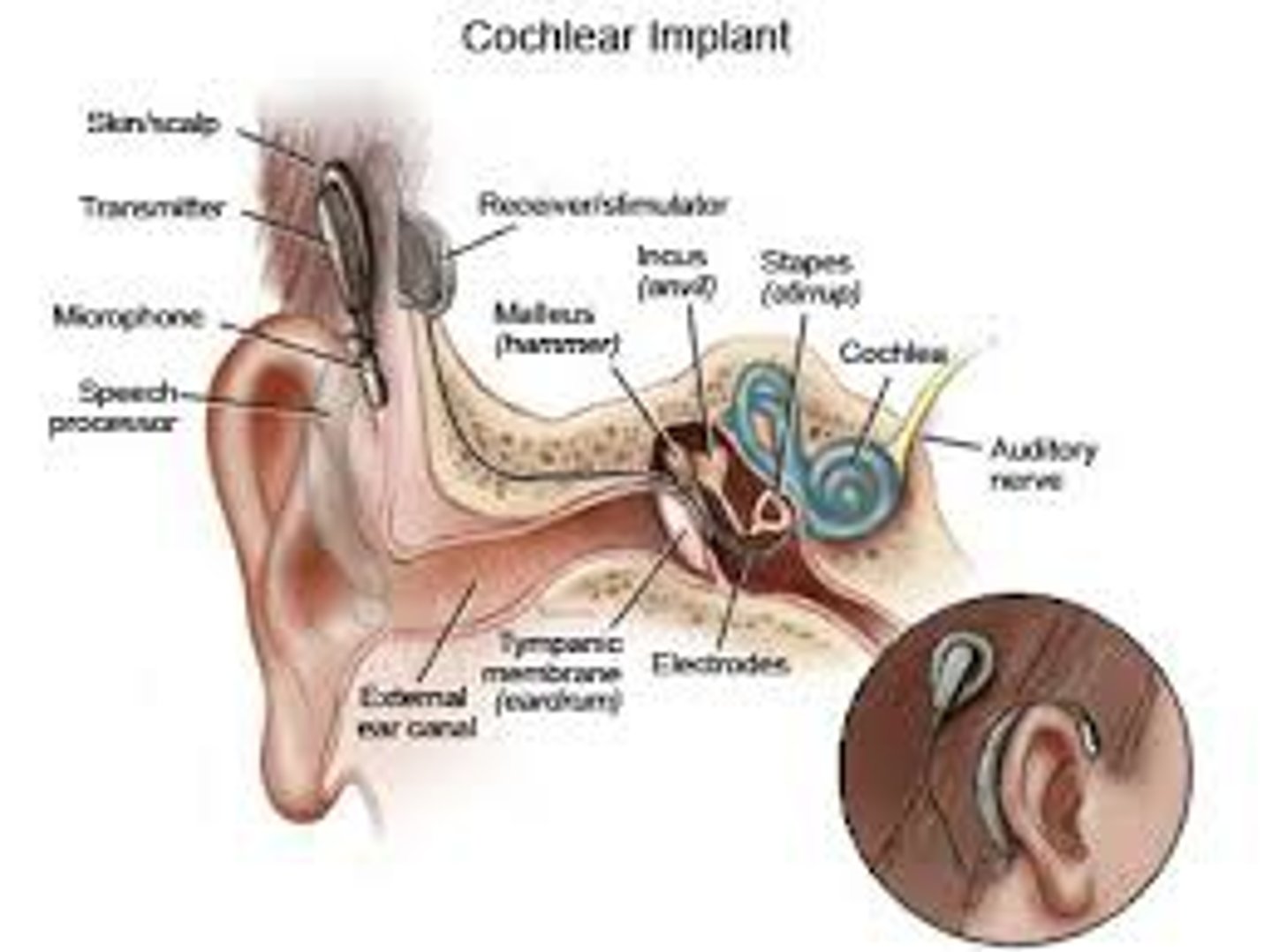
Cochlear Implants
they are small electronic devices that are used to produce hearing sensations for people that are deaf or are severely hard of hearing. It is used to bypass the damaged parts of the ear. They stimulate the auditory nerve.
Pinna
the ear lobe
Wechsler Intelligence Scale
It is useful for eleven years. It is suitable for students between the ages of 6 and 16.
Auditory training
It helps children use residual to develop sound awareness.
Wechsler Preschool and Primary Scale of Intelligence
It is suitable for younger students. Both have alternative supplements because the verbal scales are not suitable for D/HH students.
Student Communication Repair Inventory and Practical Training
helps discover which strategies students use to repair communication. This provides teachers with the opportunity to guide students to the appropriate repair strategies.
Autism Spectrum Disorders
The students also may show excellent verbal skills in monologues but be unable to initiate and maintain conversations and have difficulty with turn-taking.
Receptive Language
the ability to understand spoken and written language
Echolalia
continually repeating what others say is normal in younger children.
Down syndrome
lower/weaker muscle tone/hypotonia
May not develop physical coordination, balance, and proprioception
Oral-motor skills are slower
small noses
short, stubby fingers
short, thick necks
small heads
celiac disease (gluten intolerance)
gastroesophageal reflux
hypothyroidism
hearing and vision problems
Waardenburg Syndrome
associated with sensorineural hearing loss and pigmentary changes of the hair and eyes (white forelock and two different irises) wide space between eyes.
Alport syndrome
X-linked defect in Type IV collagen. Associated with abnormal functions of the kidneys, sensorineural hearing loss and ocular disturbances.
Treacher Collins Syndrome
An inherited genetic disorder with conductive or mixed hearing loss associated with differences of the mid-facial area and external ears
Crouzon Syndrome
Conductive or mixed hearing loss associated with bulging eyes, underdevelopment of mid-face and recessed jaws.
Bronchio-oto-renal Syndrome
Conductive or mixed hearing loss associated with pit formations in front of ears, a cyst under the skin along with side of neck, which is residual of embryonic development and poor development of kidneys.
Autosomal Recessive Hearing Loss
Both parents may have normal hearing and there is a 25% chance the offspring will develop a hearing loss. HL may not be present in all generations.
Usher Syndrome
Hearing loss associated with pigmentation changes in the retina of the eye and visual abnormalities, including blindness. There are 5 types.
Jervell-Lange-Nielsen Syndome
Hearing loss associated with cardiac abnormalities
Pendred Syndrome
Genetic autosomal recessive disorder that can lead to congenital bilateral sensorineural hearing loss associated with enlarged thyroid
Nonsyndromatic hearing loss
hearing loss with no other organ abnormalities, present in 2/3 children with genetic hearing loss.
Autosomal Dominant Hearing Loss
At least one parent as a hearing loss and there is a 50% change that the offspring will acquire a hearing loss. Ex: Connexin 26 Gene Defect, Familial Delay Onset Progressive Sensorineural Hearing Loss.
Classification of Hearing Loss
1) based on the location of the Disease within the Ear
-Conductive HL -SNHL -Mixed HL -Auditory Neuropathy
2) Based on the onset of hearing loss in relationship to speech development -Prelingual -Postlingual
3) Based on the cause of the hearing loss
-Genetic Hearing Loss -Nongenetic Hearing Loss
Neurofibromatosis II
Associated with bilateral tumors of the auditory nerve and nodular growths on the skin, sensorineural hearing loss.
Accommodations for blind students
braille, computer text-to-speech software, orientation and mobility specialists,
Orientation and Mobility Specialists
teach blind students how to get around in indoor and outdoor settings.
Activities of Daily Living
self-feeding, toileting, walking
Rubric
used to describe an assessment tool that provides performance level categories and descriptors for ranges of performance in each category.
Observation-based assessment
enables the evaluator to see the student's performance in a variety of contexts.
Depakote
an anticonvulsive prescribed to control seizures.
Pulmozyme
a medicine for a patient who has cystic fibrosis. It makes the lung secretions thinner and thus less likely to obstruct breathing, and also decreases the patient's risk of respiratory tract infections.
Pure-tone audiometry
is used to measure hearing sensitivity thresholds.
Overgeneralizing
naming many objects with one word like calling all vehicles
What is the difference between deaf and hearing students?
Deaf students rely on exclusively on visual cues like facial expressions, gestures, and body language; and in ASL while hearing students rely on auditory input.
Progressive Disabilities
dementia, degenerative arthritis
Relapsing Disabilities
cancer epilepsy- require less continual care but more ability to shift suddenly from normal to crisis mode and rapidly activate resources
Congenital Disabilities
shape the identity and life of a child, so the child and family are not required to adjust to a sudden loss of function.
Spina bifida
the neural tube that will become the baby's brain, spinal cord and enclosing tissues does not close completely. Treatment: surgery, exercises preparing for later assisted walking.
Muscular dystrophy
a genetic condition, makes muscle fibers
unusually vulnerable to damage, causing progressive weakness, breathing/swallowing difficulties/ limb contractures.
Cystic fibrosis
a genetic defect that makes normally thin, slippery secretory juices become thick and sticky. These fluids, which normally lubricate the tissues, when thicken obstruct passage ways, ducts, and tubes, particularly in the lungs and pancreas. Treatment: antibiotics, muscus thinning meds, bronchodilators, vibrating vests, breathing exercises, nutritional counseling, energy-conserving techniques, and oxygen therapy.
reliability
consistency of an assessment and instruments' data across repeated administrations of the tests.
validity
whether a test measures what it claims and intends to measure. Various validities: content validity, construct validity, criterion validity, concurrent validity, predictive validity.
Generalizability
the consistency of the test scores over repeated administrations, but it moverover refers to the specific features of a certain test.
compensatory grading
the practice of balancing out tower performance in one area or subject with higher performance in another
Noncompensatory grading
does not permit such balancing but requires a similar standard of achievement in each area or subject.
Standard deviation
measures variability within a set of numbers. In interpreting assessment results. It measures how much scores among a group of test-takers vary around the mean/average.
Domain
the identified scope of expected learning to be assessed.
Item Response Theory
posits that performance on a test item is attributed to three influences: the item itself, the test taker, and the interaction between two.
Prereferral interventions
are a frequent practice intended to better the process of identifying students with disabilities by decreasing referrals to special education services and give regular education teachers more assistance and advice.
Child Find
each U.S. state is held responsible for locating, identifying, and evaluating all children in that state as having disabilities and in need of special education and related services.
Independent Education Evaluation
If parents disagree with evaluation results, they have the right under the IDEA to arrange on IEE to request payment for this evaluation by the school system.
Triennial
the student must be reevaluated at least every three years.
LRE
students with disabilities must be educated together with students without disabilities to the maximum degree possible and fitting.
Pure-tone audiometer
presents simple sound signals or pure tones through headphones. Common frequencies are 125, 250, 500, 1000, 2000, 3000, 4000, and 8000 Hz
Conductive hearing loss
is caused by some problems in the outer and/ or middle ear-wax buildup foreign objects, and otitis media.
Sensorineural hearing loss
the inner ear/nerves/brain caused by cochlear hair cells, mechanical cochlear dysfunction, auditory nerve damage.
air-conduction audiometry
uses over- the- ear headphones or in-ear phones or buds
-can diagnose sensorineural, conductive, or mixed hearing loss.
bone-conduction testing
places a vibrator on the temporal bone forehead using a headband.
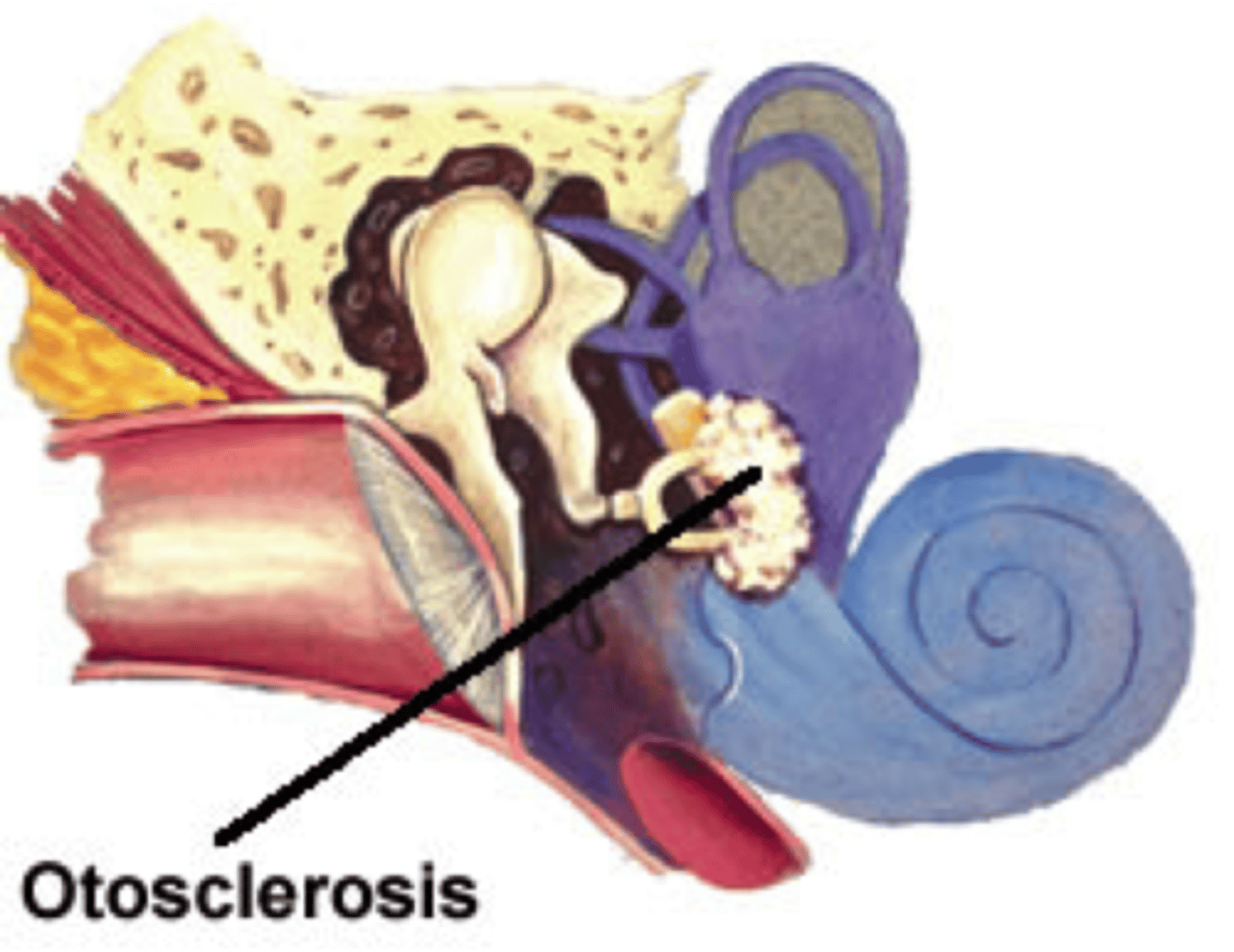
otosclerosis
genetic abnormal overgrowth of bone conductive hearing loss. It can be treated with surgery.
Meniere's disease
affects the vestibular system, causing balance problems, vertigo, tinnitus, and hearing loss, tends to cause changes in hearing levels over short times.
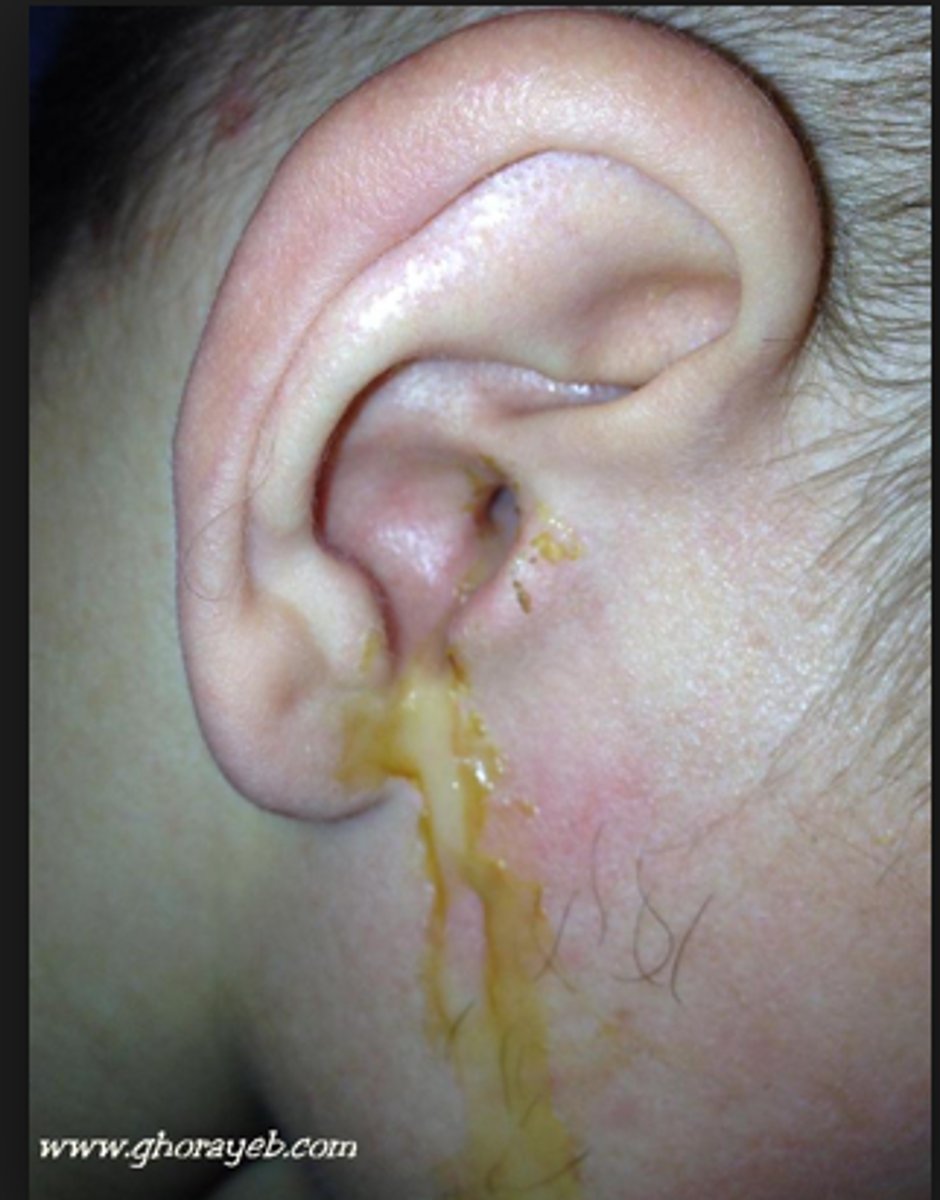
Otorrhea
is discharge coming out of the ear (s). It can consist of mucus, pus, blood, or cerebrospinal fluid.
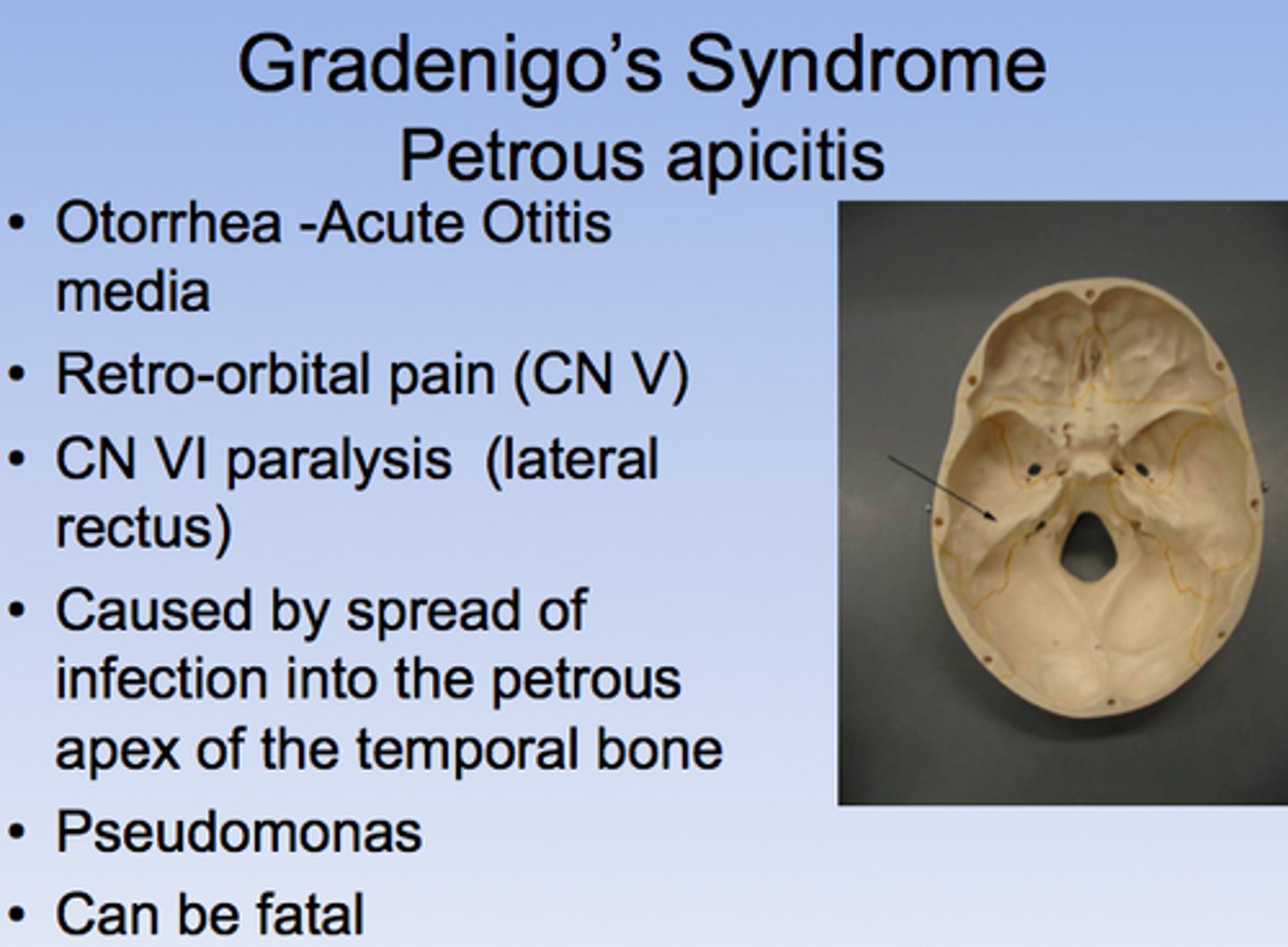
Gradenigo's syndrome
a group of symptoms including ear pain, discharge from the ear that hurts and double vision.
Cued speech
an alternative system of visual communication for deaf and hard of hearing people.
-a way of encoding the English language.
combines speech's mouth movements with hand shapes and placements to make speech sounds appear more distinctively different from one another.
8 handshapes near the face.
Total communication
oral speech, sign language, speech reading, body language, and the use of amplification.
Manually coded English
is a "constructed" system of signing that uses signs taken from ASL to represent words in spoken or written English sentences.
uses the syntactic structure of English
-Signed English
-Signed Essential English
-Seeing Essential English
Speech reading
lip reading
40 % of speech phonemes can be seen on the lips.
Otology
is the medical name for the study and care of the ear.
Total physical response
is the name of the language-learning approach that emphasizes the connection between language and its representations in the external world.
Peer-assisted learning
learning strategies promotes community in the classroom.
CASE
Which version of Manually Coded English presents in the grammatical structure of Signed English?
What is the name for the hearing assessment procedure in which only the inner ear is stimulated?
bone conduction testing
Normal Range
0dB to 20 dB
Mild Loss
20 dB to 40 dB
Moderate Loss
40 dB to 60 dB
Severe Loss
60 dB to 80dB
Profound Loss
80 dB to more
Unilateral
hearing loss in one ear
Bilateral
Hearing loss in both ears
Symmetrical
degree and configuration are the same in both ears
Asymmetrical
degree and configuration are different in each ear.
progressive
hearing is lost over a period of time.
sudden
loss that is acute and quick; usually requires immediate medical attention.
Bilingual-bicultural educational approach
is modeled upon educational programs for students learning English as a second language or English language learners.
Cochlear Implants
uses electrodes that are surgically implanted in the cochlea, which are stimulated by signals they are sent by a connected outer device placed behind the ear (s).
Autism spectrum disorders, aphasia, and learning disabilities
all of which can cause difficulties with both spoken and written language- can benefit from using ASL as a supplement to their primary communication methods.
Acoustic immittance testing
is used to measure how much resistance, or impedance, exists in the ear's conductive mechanisms.
Bekesy audiometry
automated and do not require an examiner to present pure tones
diagnosing sensorineural hearing loss, as a single test is indicative for a variety of factors such as thresholds, patterns and tone decays often eliminating the need for multiple test batteries.
Acoustic Reflex Test
measurement that is part of impedance testing is the middle ear muscle. measures an involuntary response of the brain and middle ear muscle that occurs in response to loud sounds if the child has hearing within normal limits. No reflex indicates a hearing loss due to middle ear fluid, hearing loss in the inner ear, or a hearing problem in the brain.
Acoustic reflex
the stapedius reflex to protect the hearer from hearing loss caused by sudden, overly loud sounds.
tympanometry
compares air pressure in the ear canal to middle ear impedance. Tells how well sound reaches the inner ear.
Acoustic reflex testing
if testing yields a higher than normal threshold, a loss of cochlear sensitivity.