BSC2010 Exam 4 USF
 Call Kai
 Learn
Learn Practice Test
 Spaced Repetition
 Match
Match Flashcards
 Knowt Play
1/145

There's no tags or description
Looks like no tags are added yet.
Name | Mastery | Learn | Test | Matching | Spaced | Call with Kai | Chat |
|---|
No analytics yet
Send a link to your students to track their progress
146 Terms
chromosome theory of inheritance
-Mendelian genes have a specific loci (Positions) on chromosomes
- Chromsomes undergo segregation and independent assortment
law of segregation
Alleles for each gene separate during gamete formation.
law of independent assortment
the law that states that genes separate independently of one another in meiosis
Thomas Hunt Morgan
Bred fruit flies, and supported the the theory of chromosomal inheritance by finding that a specific gene is carried on a specific chromosome
wild type
the phenotype for a character most commonly observed in natural populations
mutant
traits alternative to the wild type, We call them mutants because presumably these different forms arose from mutations, or changes, in the genetic material.
SRY gene
sex determining region of the Y chromosome, codes from protein that directs the development of anatomical features
Human Y chromosome
The Y chromosome is much smaller and simpler than the X chromosome, containing only 78 genes, compared to the 1,100 of the X chromosome.
Ovum
Carry X chromosome
Sperm
Carry X or Y chromosome, male determines sex
X-0 system
in grasshoppers, cockroaches, and other insects; males have only 1 sex chromosome (X) and female have 2 (XX); sex of the offspring is determined by whether the sperm cell contains an X chromosome or no sex chromosome
The Z-W System
The sex chromosome inheritance system in species in which the male is homogametic (ZZ) and the female is heterogametic (ZW). Mother determines sex
haplo-diploid system
A sex determination system in most species of bees and ants in which there are no sex chromosomes. Females develop from fertilized eggs (diploid) and males develop from unfertilized eggs (haploid).
sex-linked gene
gene located on the X or Y chromosome
Y-linked genes
genes found on the Y chromosome, theres few of these, Has mainly genes related to sex determination
X-linked genes
genes found on the X chromosome;
- X chromosome has many characters unrelated to Sex determination.
- For a recessive trait, a female needs two copies of the allele(XX), while males need one (XY)
- Males attract more X-linked gene disorders
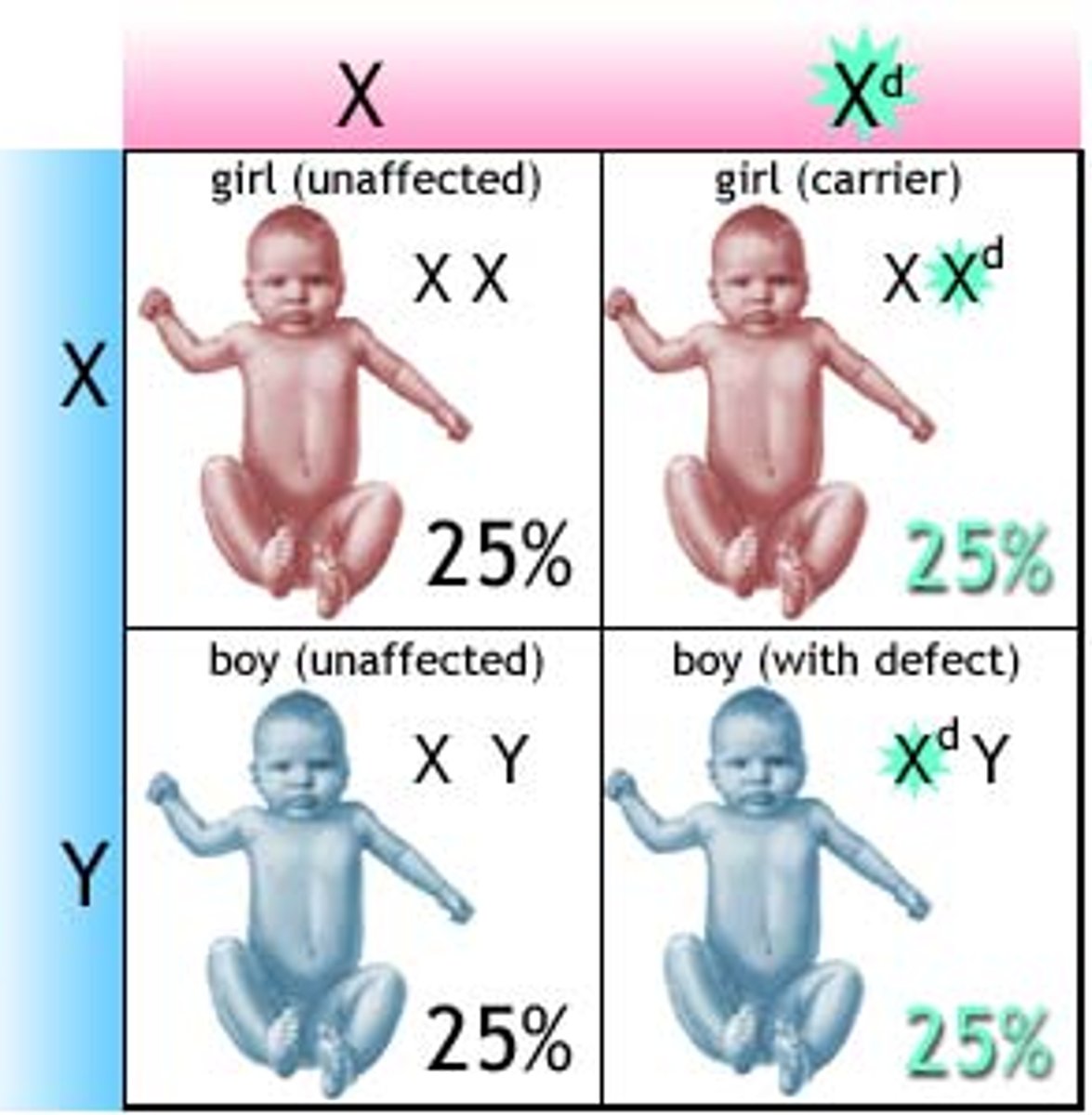
X-linked disorders
hemophilia, colorblindness, duchenne muscular dystrophy
Duchenne muscular dystrophy
A human genetic disease caused by a X-linked recessive allele; characterized by progressive weakening and a loss of muscle tissue.
Hemophilia
x-linked recessive disorder, affects mostly men
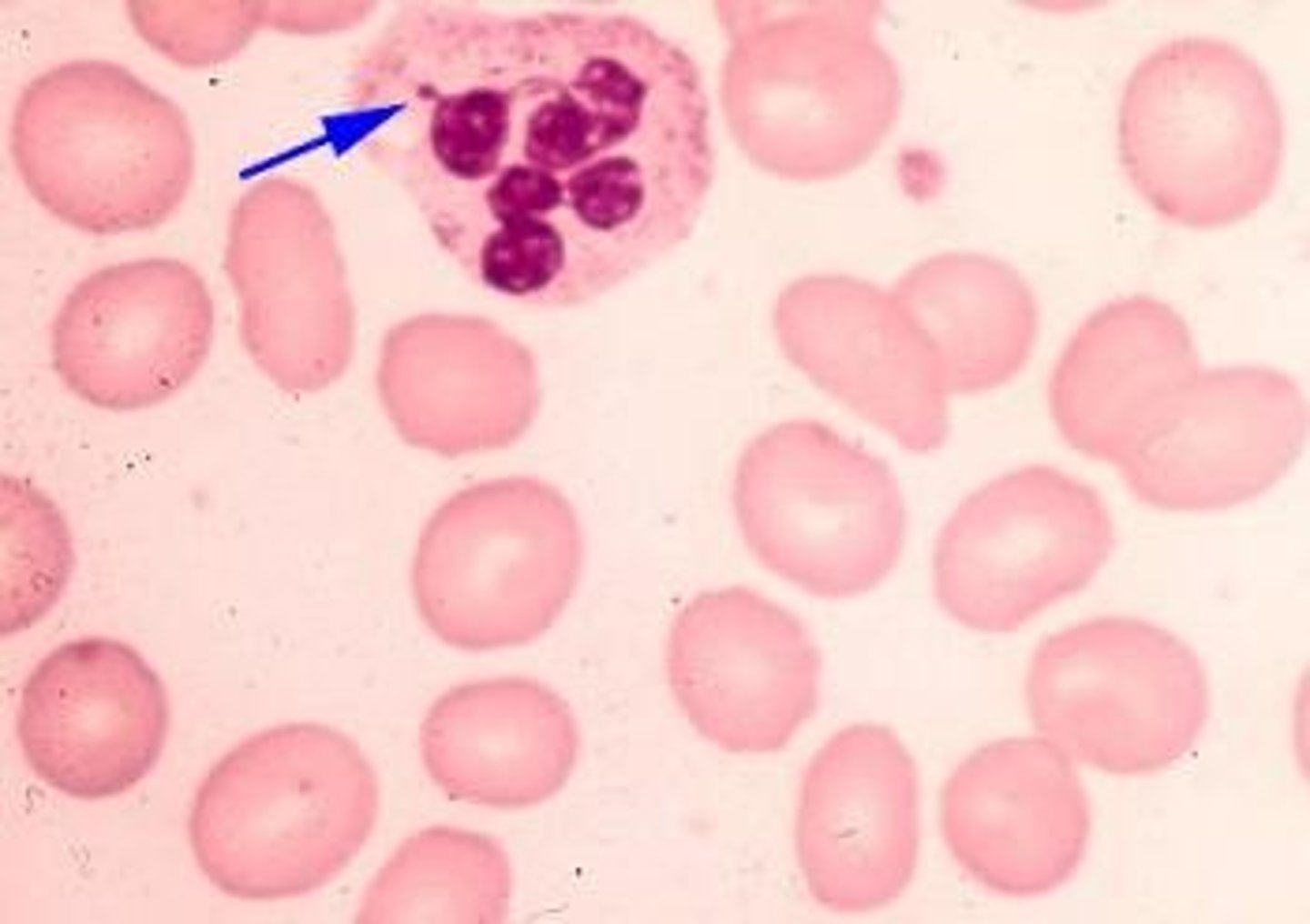
Barr Body (Drumstick Body)
A dense body formed from a deactivated X chromosome. Females therefore have a 50% chance of producing a gene if heterozygous for it
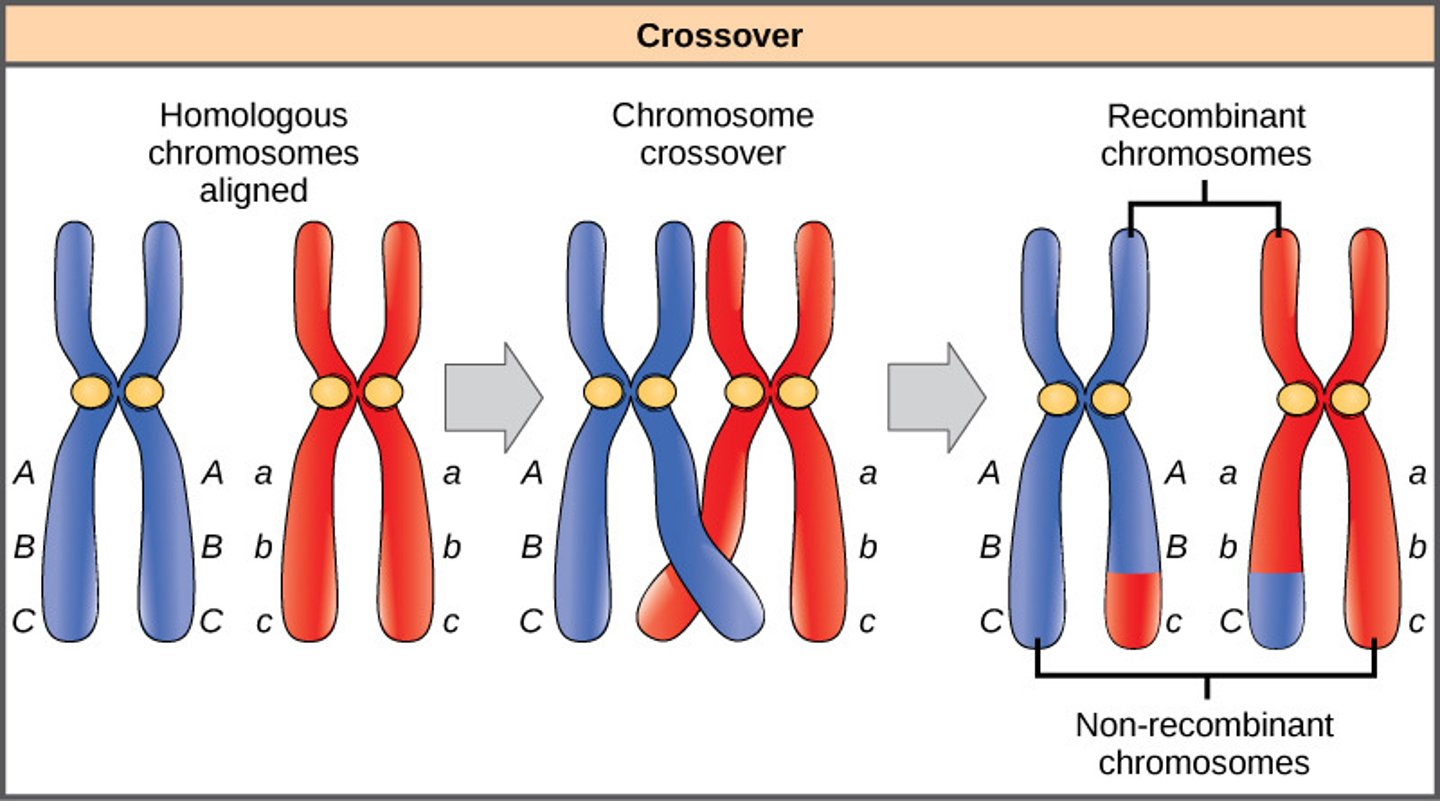
linked genes
Genes located on the same chromosome that tend to be inherited together in genetic crosses.
- Closely located genes tend to appear together when crossing, whether recessive or dominant.
- Do not separate independently.

genetic recombination
The regrouping of genes in an offspring that results in a genetic makeup that is different from that of the parents.
parental type offspring
Look exactly like one of the two parents, 50% chance
crossing over
the mechanism that breaks linked genes, genes close together travel together
-
random fertilization
increases even further the number combinations that can be produced
- ground work for natural selection, whichever recombinant trait confers a survival advantage will be passed on to more generations
Nondisjunction
Error in meiosis in which homologous chromosomes fail to separate. One gamete receives two of the same type of chromosome while another gamete receives no copy
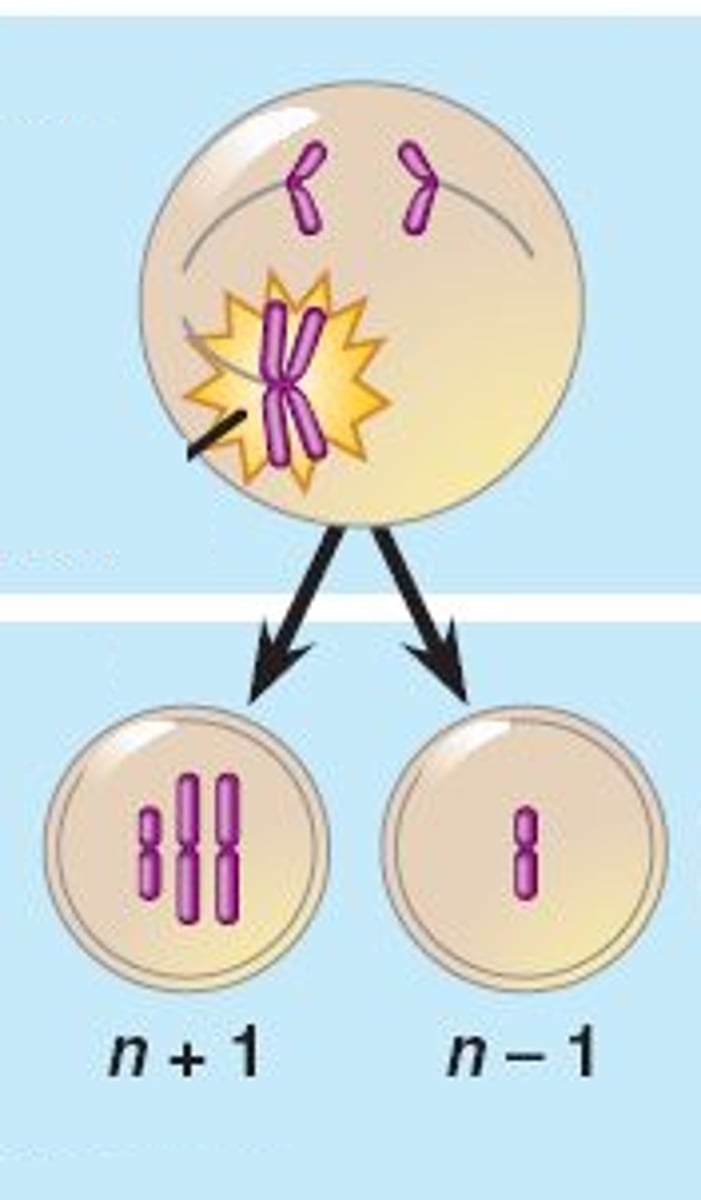
Aneuploidy
Abnormal number of chromosomes due to nondisjunction in gamete formation.
Either short or has extra chromosome. Main reason for miscarriage.
Aneuploidy can also occur in mitosis. If this occurs in early embryonic development, the effects will be similar to nondisjunction in meiosis I or meiosis II.
monosomic zygote
has only one copy of a particular chromosome
trisomic
A chromosomal condition in which a particular cell has an extra copy of one chromosome, instead of the normal two it has three. Ex. Down Syndrome
Polyploidy
condition in which an organism has extra sets of ALL chromosomes.
Normal occurrence in plants, not animals.
triploid
3n
Tetreploid
4n
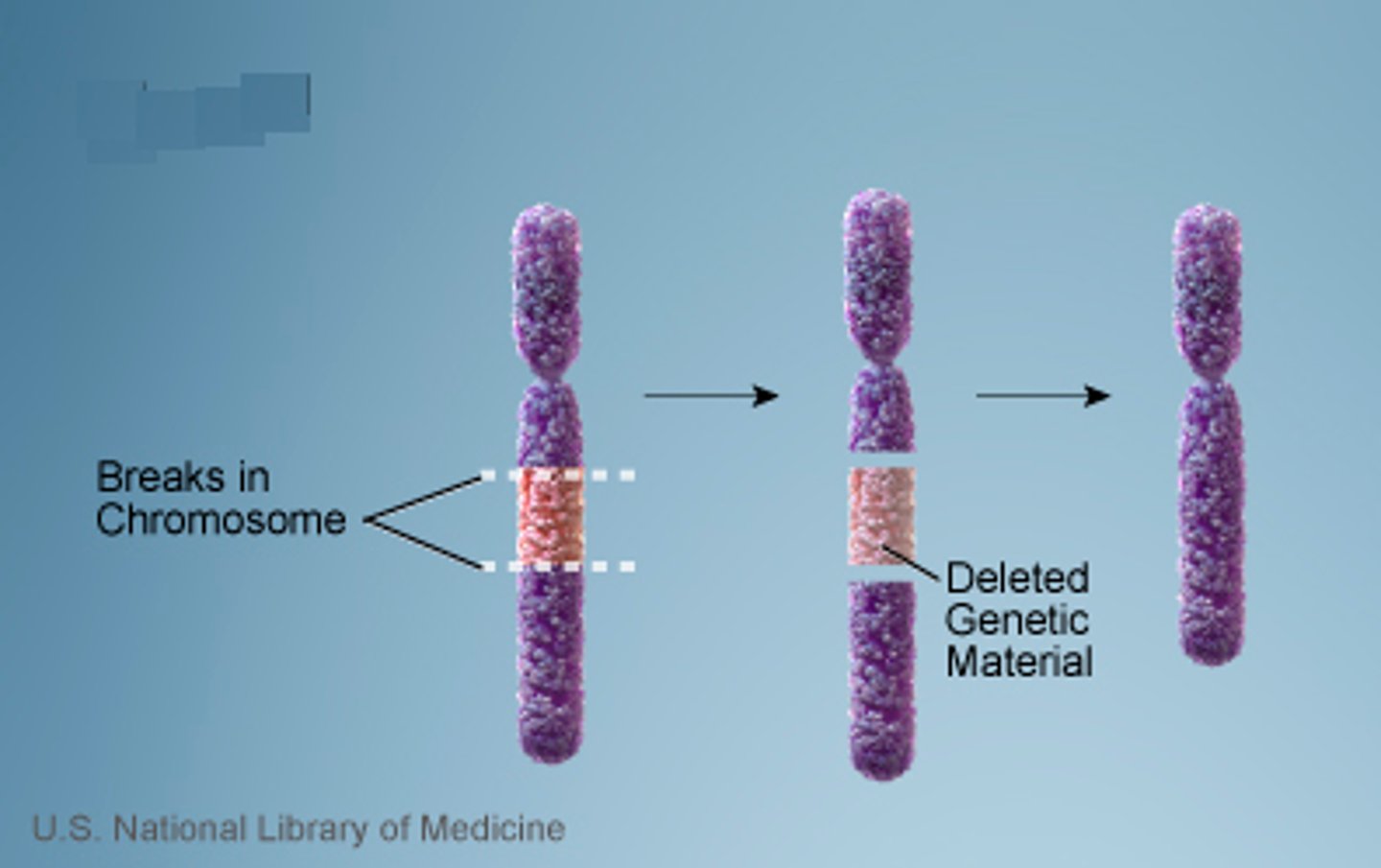
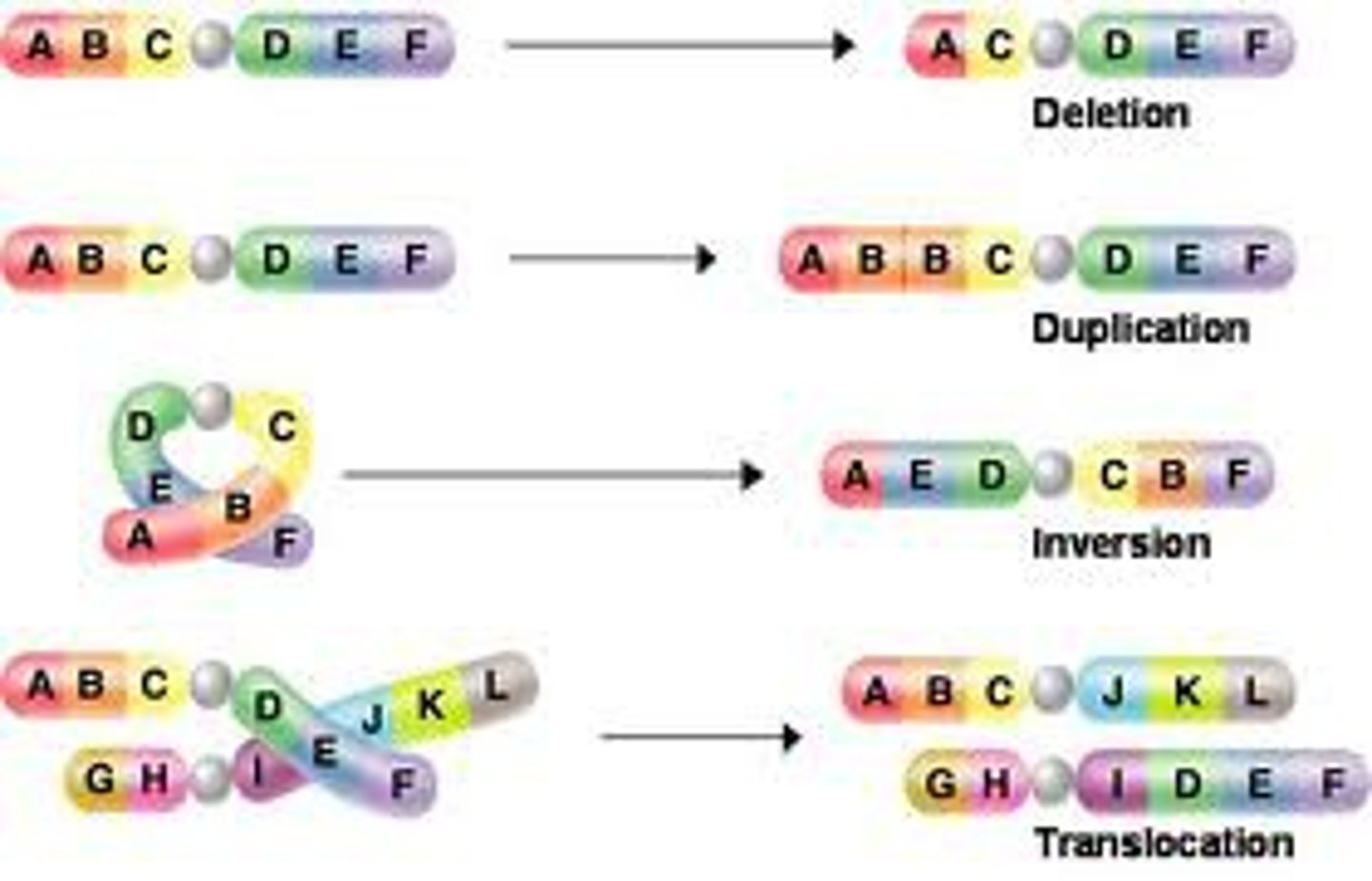
Deletion
A change to a chromosome in which a fragment of the chromosome is removed.
Duplication
repeats a segment

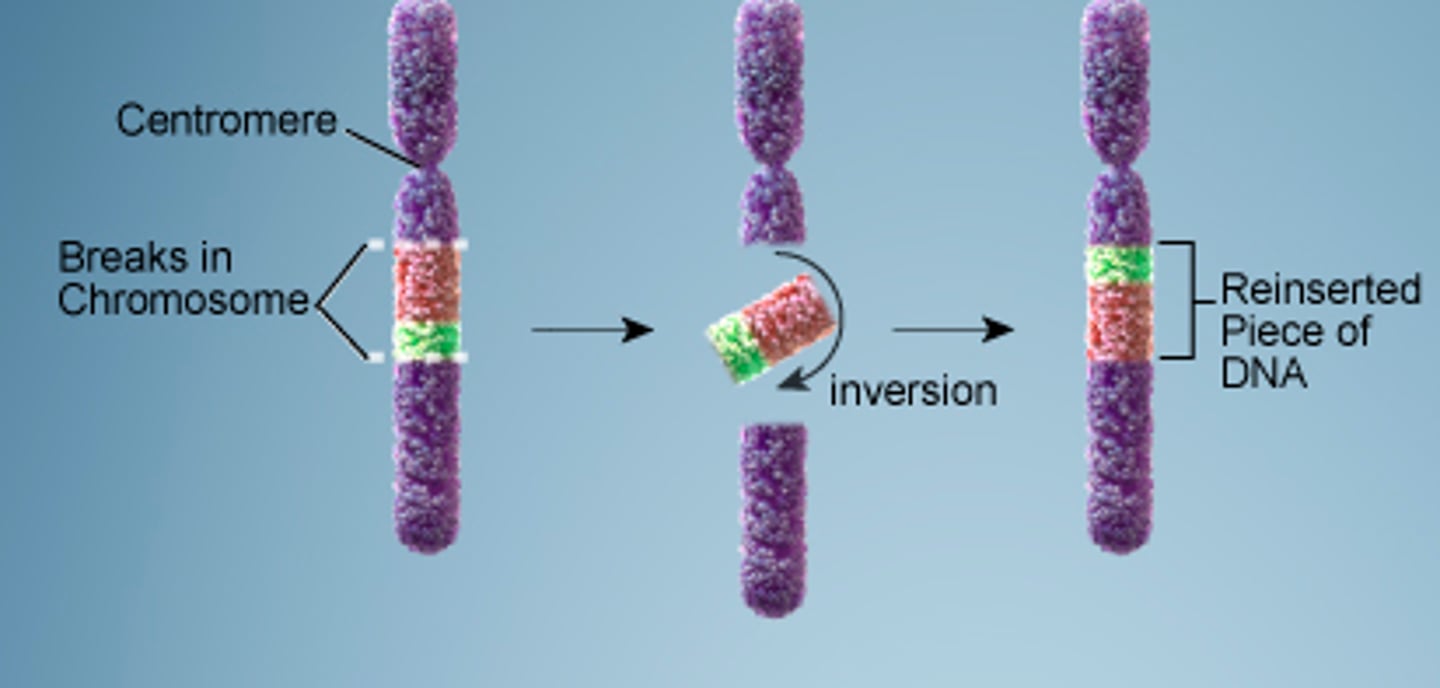
Inversion
reverses orientation of a segment within a chromosome
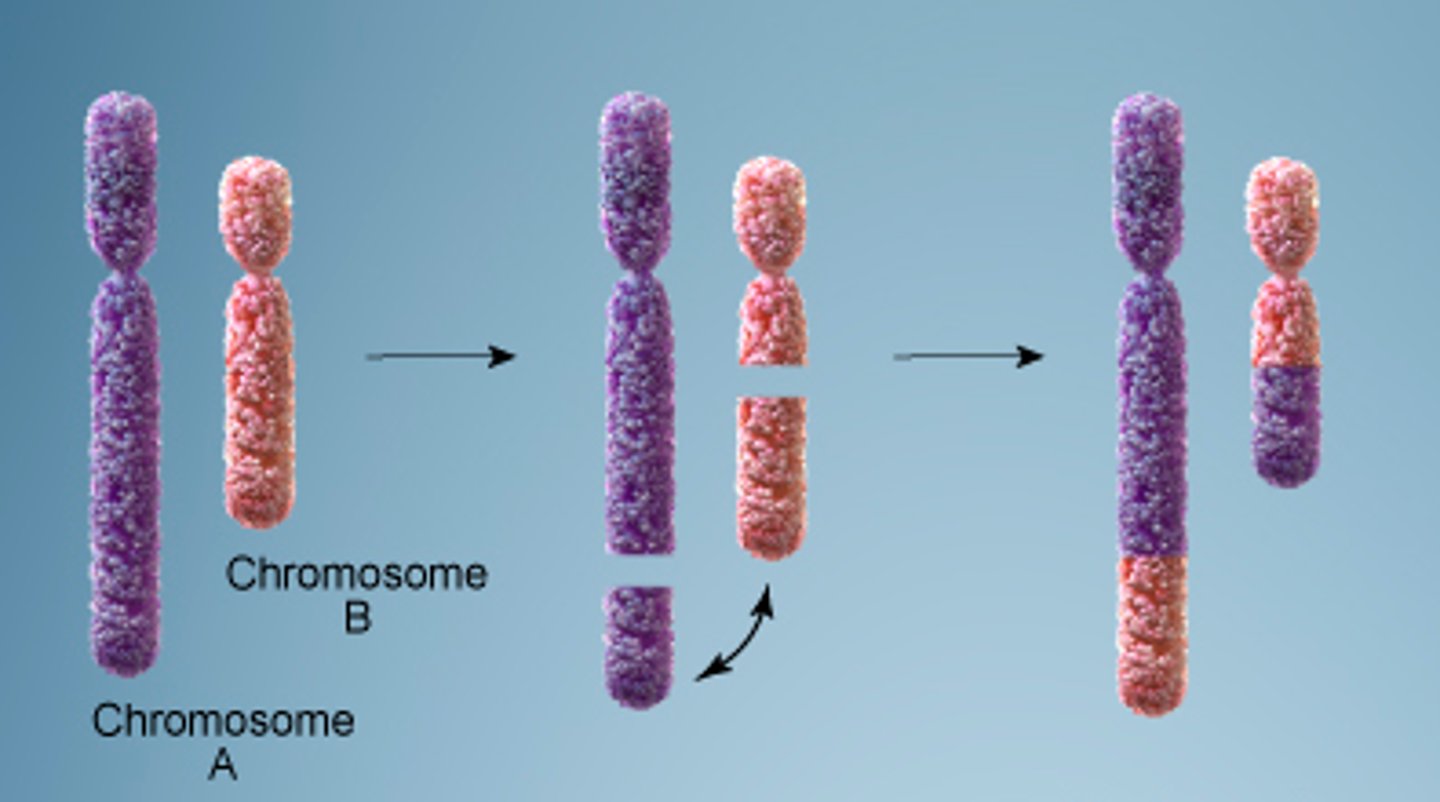
Translocation
Change to a chromosome in which a fragment of one chromosome attaches to a nonhomologous chromosome.
alterations of chromosome structure
These types of errors may be caused by radiation damage, toxin exposure, or errors in meiosis.
syndrome
A group of symptoms typical of a particular disease or condition
Down Syndrome
•an aneuploid condition that results from three copies of chromosome 21
Klinefelter syndrome
•result of an extra chromosome in a male, producing XXY individuals, Sterile, Sub-normal IQ, female Sex characters
Turner Syndrome
A chromosomal disorder in females in which either an X chromosome is missing, making the person XO instead of XX, or part of one X chromosome is deleted. Makes females sterile because sex organs never mature.
Cri du chat syndrome
deletion of short arm of chromosome 5, mentally retarded, cry like a cat
Chronic Myelogenous Leukemia (CML)
caused by translocations of chromosomes 9 and 22, cells are stimulated to divide and soon overwhelm the normal blood components.
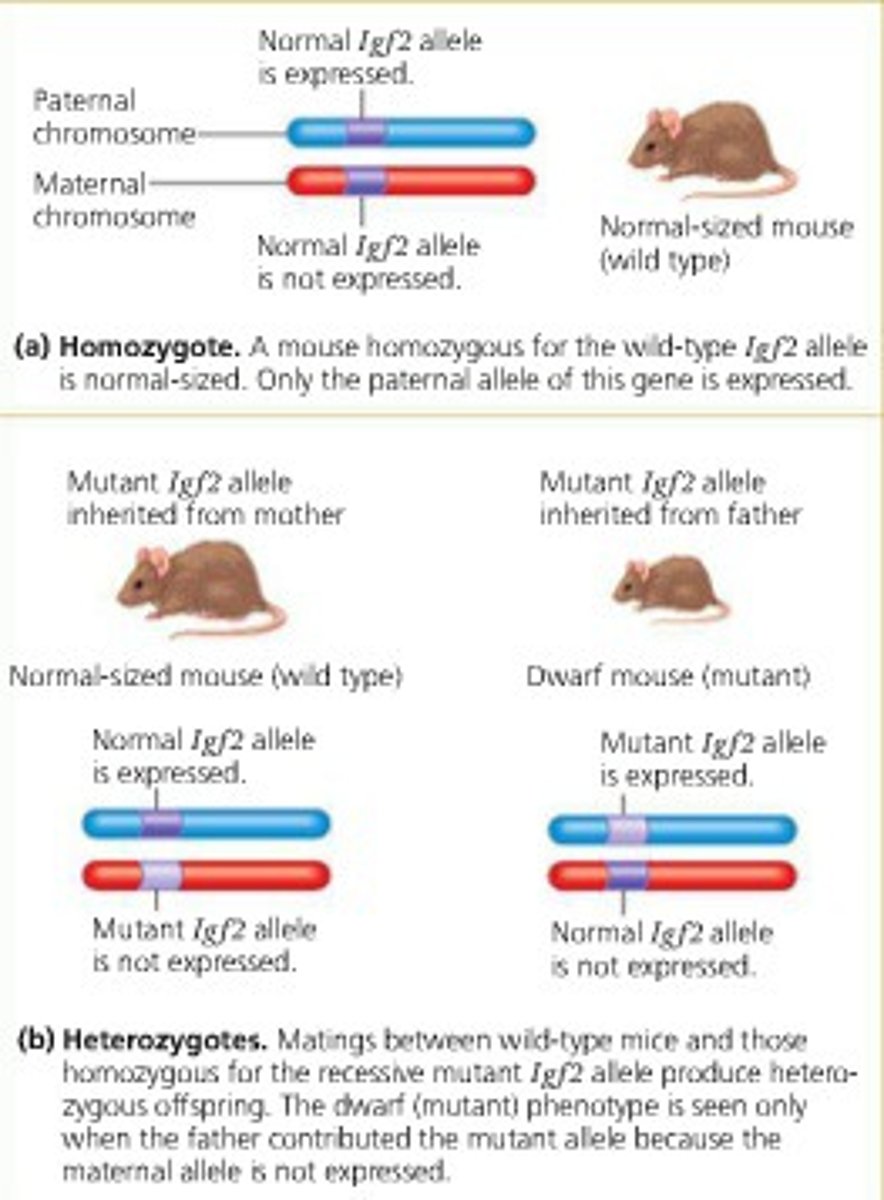
genomic imprinting
a phenomenon in which expression of an allele in offspring depends on whether the allele is inherited strictly from either the male or female parent.
Result of methylation (addition of CH3)
extranuclear genes
Genes outside the nucleus, in the mitochondria and chloroplasts, comes from the egg
Extranuclear caused diseases
Mitochondrial myopathy( Muscle Deterioration)
Leber's hereditary optic neuropathy (Sudden blindness)
- Muscular and nervouse system are affected by abnormal ATP production
Gleevac (Imatinib mesylate)
•Gleevacis a drug that targets this aberrant protein kinase
•Blocks ATP binding on kinase and prevents activation
•90% of CML patients treated with Gleevacshow complete remission of disease
Hemophilia
An X-linked recessive disorder in which blood fails to clot properly, leading to excessive bleeding if injured.
James Watson and Francis Crick
introduced double-helical model for DNA, recognized pattern that Franklin provided
viruses and bacteria
Used to discover the role of DNA, cheap and easy to work with
Transformation
process in which one strain of bacteria is changed by a gene or genes from another strain of bacteria
- a change in genotype and phenotype due to assimilation of foreign DNA
Federick Griffith
Found that some chemical factor from heat- killed bacteria of one strain could change the inherited characteristics of another strain
bacteriophages (phages)
viruses that exclusively infect bacteria
Alfred Hershey and Martha Chase
used radioactive markers in experiments to show that DNA was the genetic material in cells (Sulfur- Protein, phosphurus- DNA)
Chargaff's Rule
- [A]=[T] and [G]=[C], they pair up across from one another forming two strands also called base pairing.
- Base composition of DNA varies between species.
Rosalind Franklin
- Woman who generated x-ray images of DNA, she povided Watson and Crick with key data about DNA
- Deduced the sugar-phosphate was on the outside, whilst the nitrogenous bases were on the inside
- deduced Purines paired with pyrimidine
Chargaff rule in action
If we find that a particular DNA strand has 36% As, then by Chargraff'sRules, we know it must also have 36% Ts.
36% + 36% = 72%
100%-72% = 28%, meaning that there must be 14% Gs and 14% Cs.
semiconservative replication
Method of DNA replication in which parental strands separate, act as templates, and produce molecules of DNA with one parental (old)DNA strand and one new DNA strand
antiparallel strands
The structure of DNA is antiparallel, which means there are to strands parallel to each other going in opposite directions.
DNA polymerases add nucleotides only to free 3' end of a growing strand
origins of replication
Site where the replication of a DNA molecule begins, consisting of a specific sequence of nucleotides. Opens up a replication "bubble".
Eukaryotic cells may have 100s or 1000s of origins of replication.
Prokaryotic cells usually have 1. Proceeds in both directions.
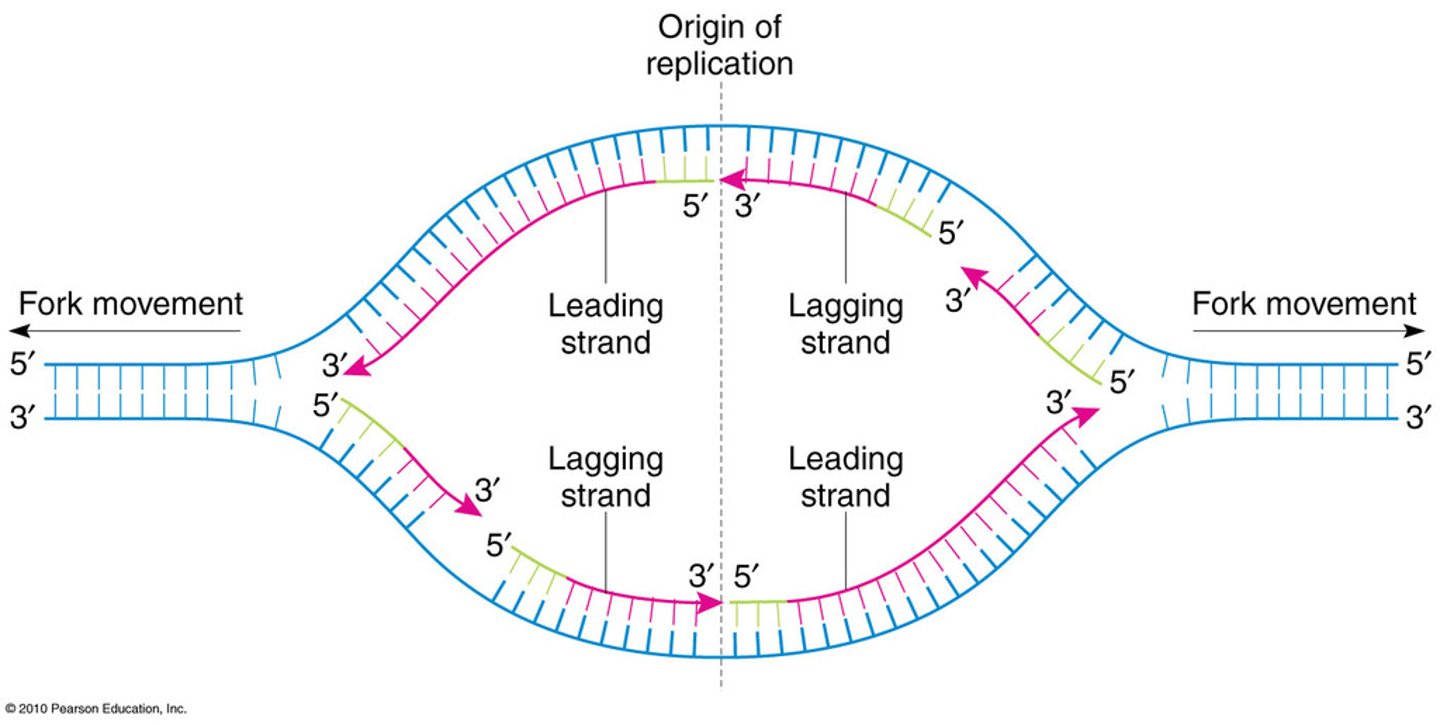
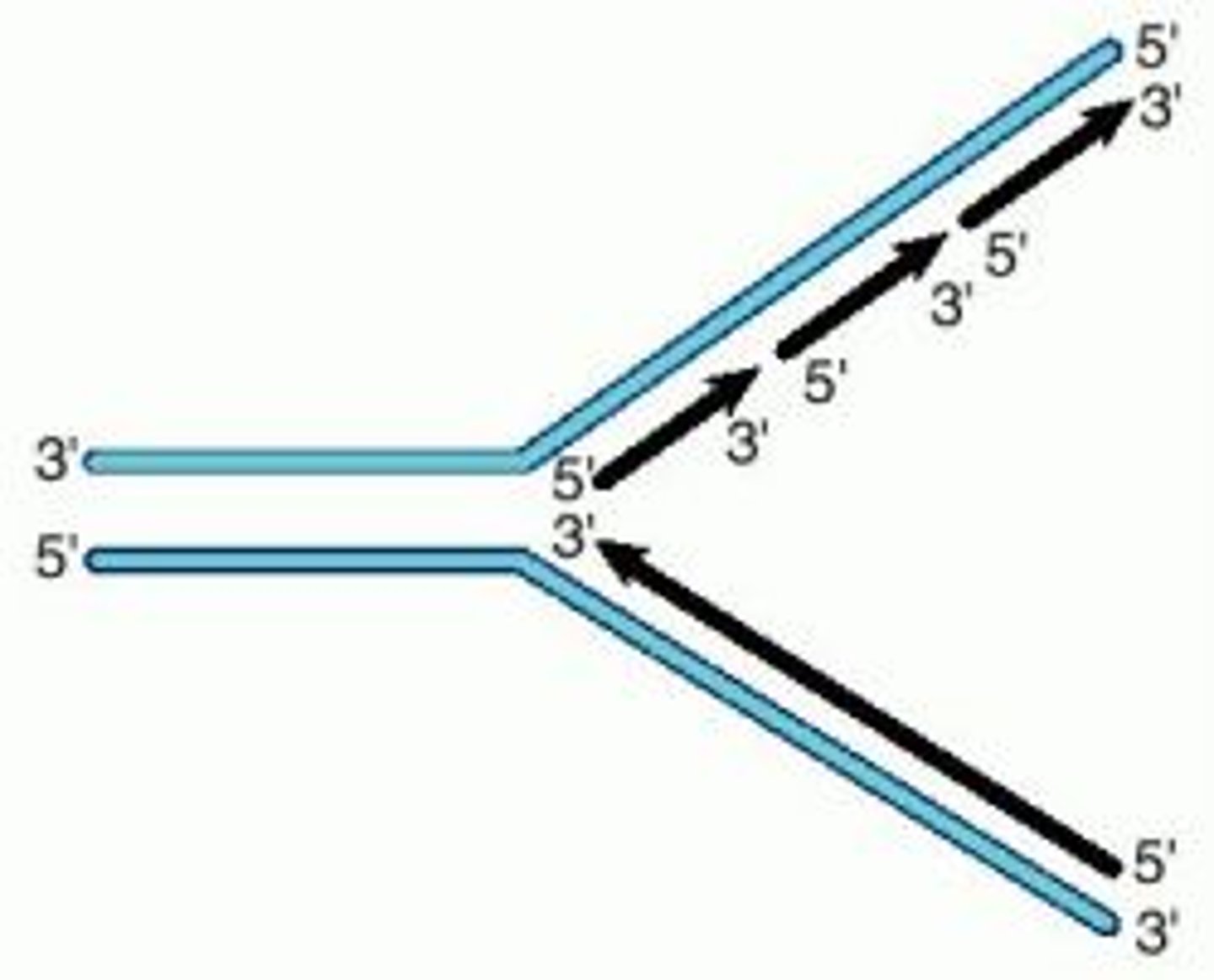
replication fork
A Y-shaped region on a replicating DNA molecule where new strands are growing.
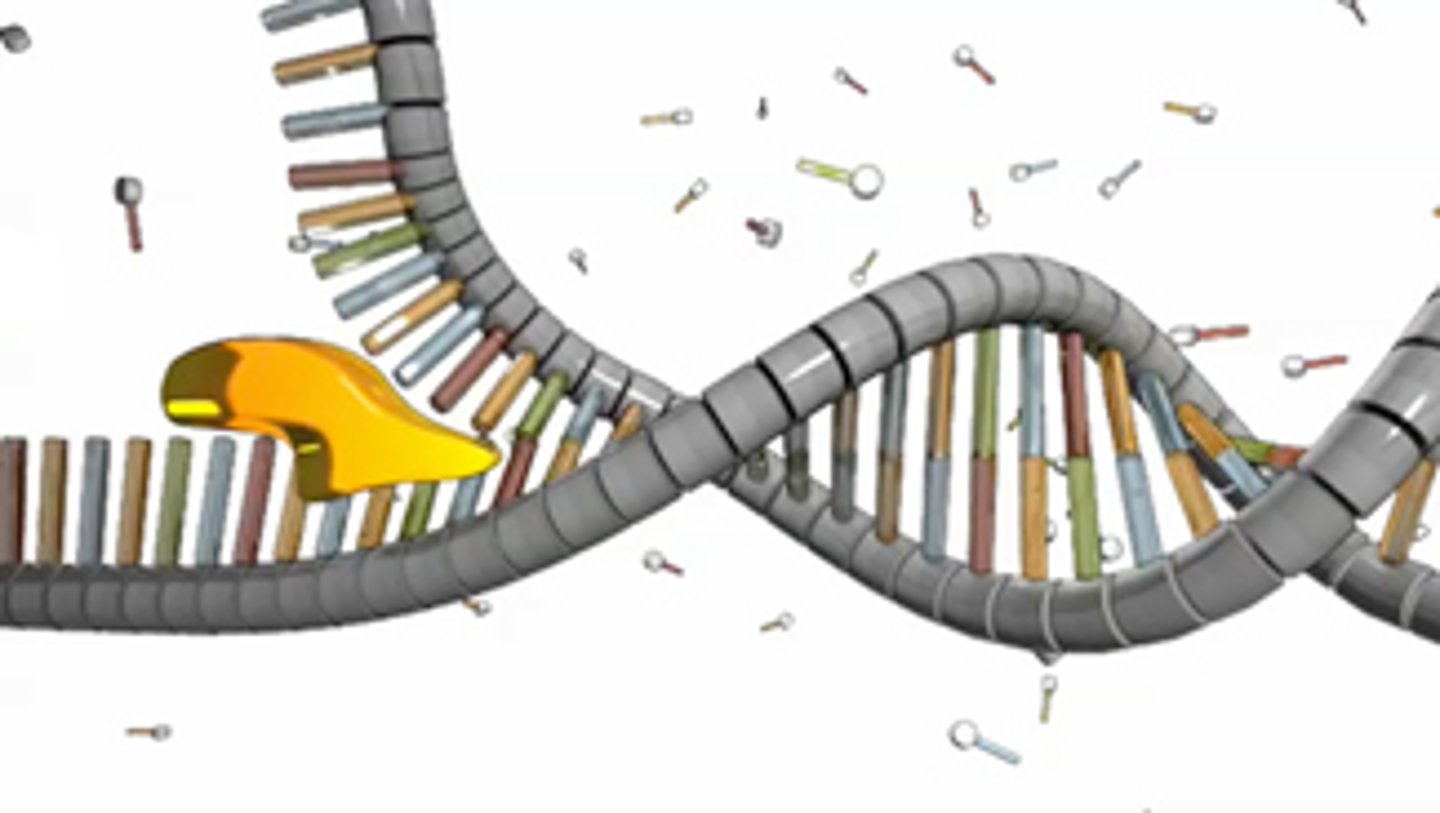
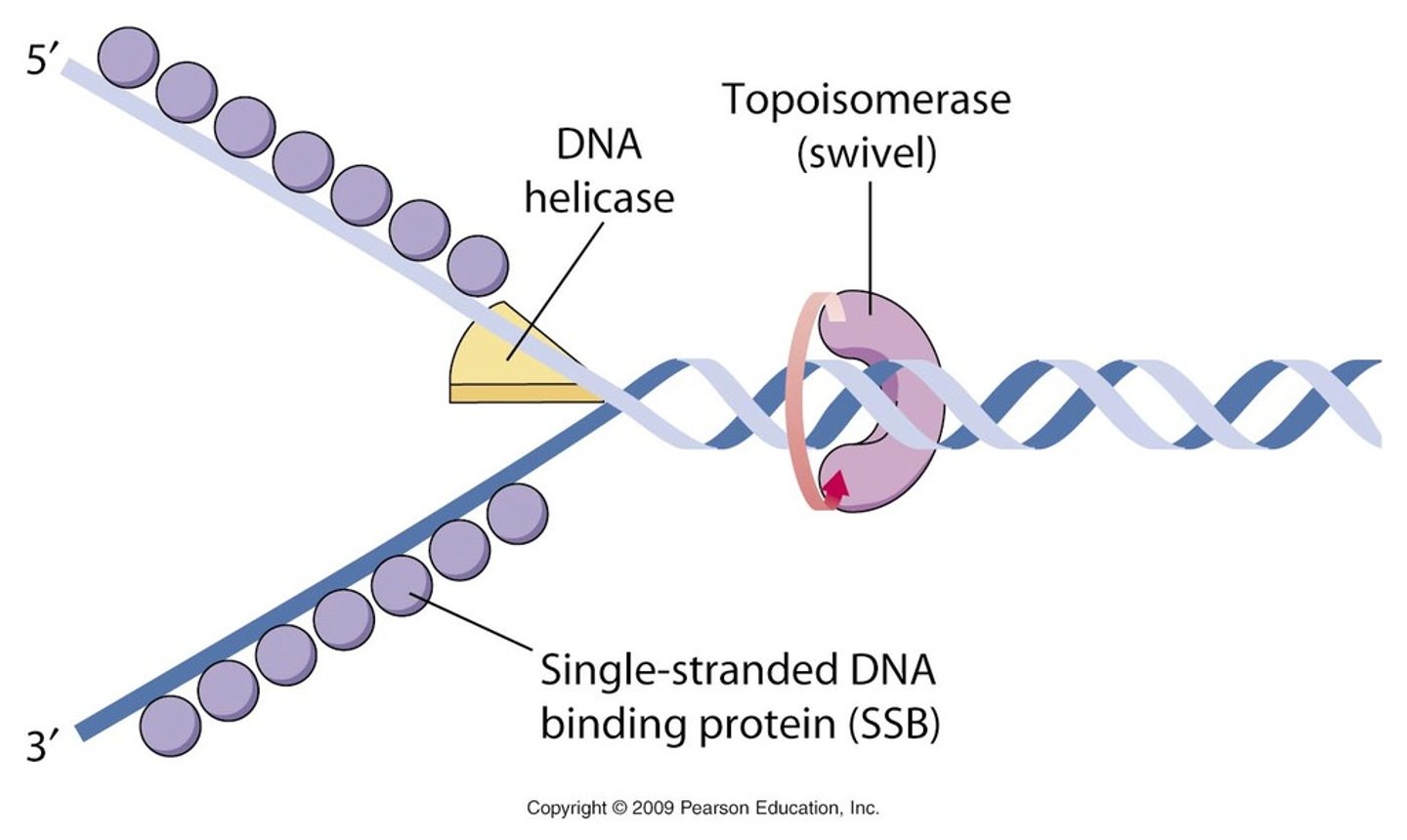
Helicases
An enzyme that untwists the double helix of DNA at the replication forks, separating the two strands and making them available as template strands.
single strand binding proteins
bind to and stabilize single-stranded DNA
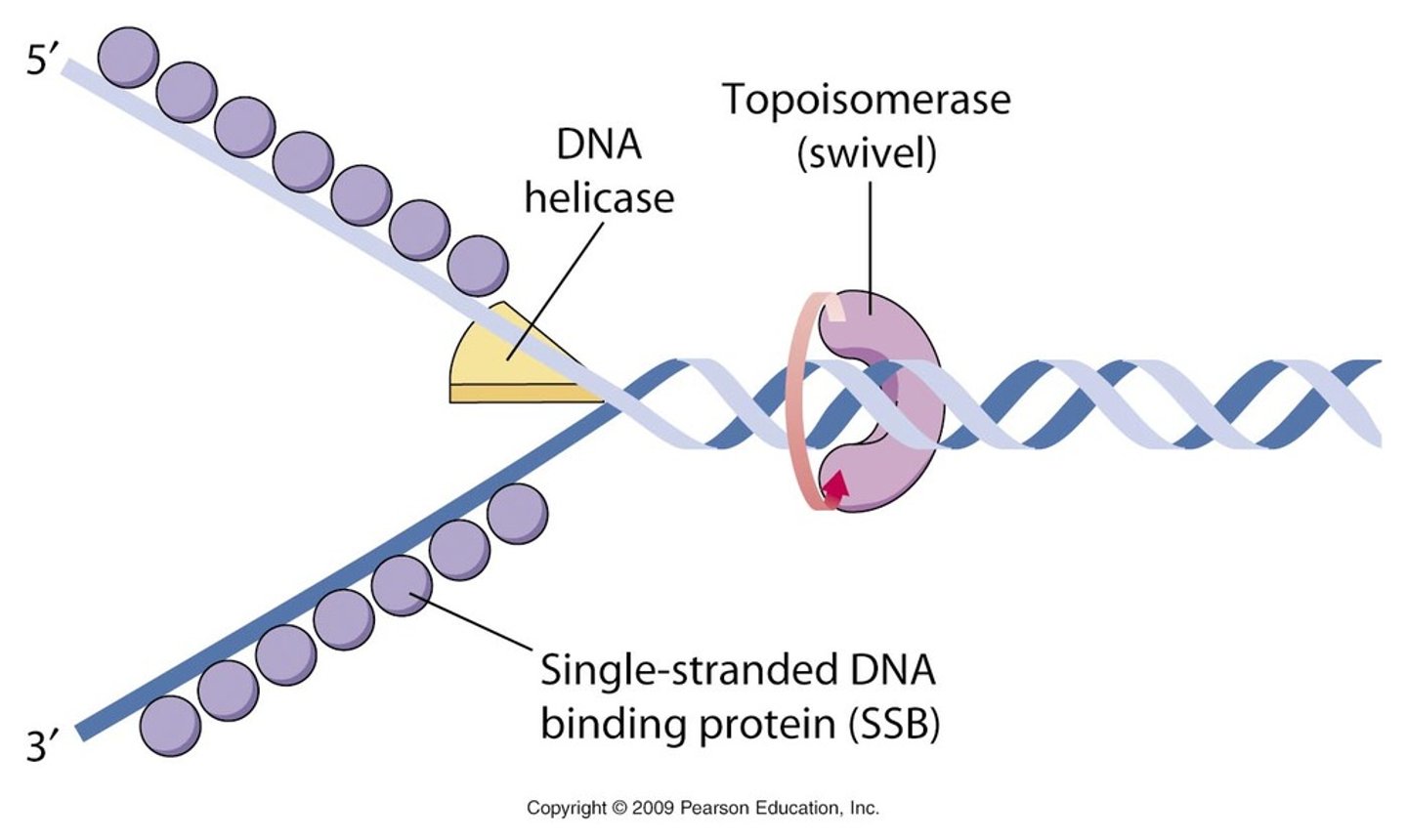
Topoisomerase
corrects "overwinding" ahead of replication forks by breaking, swiveling, and rejoining DNA strands. Without them, DNA would break at random locations and cause errors.
short RNA primer
The initial nucleotide strand is a_______. C
DNA polymerase
Enzyme involved in DNA replication that joins individual nucleotides to produce a DNA molecule.
- Cannot start, only add on to existing chain
-Bacteria produce faster but have more errors
- Human cells are slower but more accurate, and roughly equivalent due to the multiple replication sites.
Primase
An enzyme that joins RNA nucleotides to make the primer using the parental DNA strand as a template. makes starting point for DNA polymerase. RNA uses U instead of T
leading strand
The new continuous complementary DNA strand synthesized along the template strand in the mandatory 5' to 3' direction.
lagging strand
The strand that is synthesized in fragments using individual sections called Okazaki fragments. Primer still needed. DNA polymerase starts later in fork because there is no room closer. Repetitively used RNA primer. Primer is removed later and replaced with DNA
Okazaki fragments
Short fragments of DNA that are a result of the synthesis of the lagging strand during DNA replication. Joined together by DNA ligase.
DNA ligase
A linking enzyme essential for DNA replication; catalyzes the covalent bonding of the 3' end of a new DNA fragment to the 5' end of a growing chain.
DNA replication machine
may be stationary during the replication process
Proofreading
mispaired nucleotide is replaced by DNA polymerase. First level
mismatch repair
The cellular process that uses specific enzymes to remove and replace incorrectly paired nucleotides. Second level.
Nucleotide Excision Repair (NER)
a nuclease cuts out and replaces damaged stretches of DNA
nuclease
A DNA cutting enzyme that excises damaged DNA.

Mutation
When errors aren't fixed during proofreading in DNA. Ground work for natural selection. If negative, will most likely be eliminated from population because it makes offspring less fit to live, so they can't reproduce.
end replication problem
RNA primer at end cannot be replaced with polymerase--> DNA is lost. Gets shorter and shorter.
Telomeres
Repeated DNA sequences at the ends of eukaryotic chromosomes that prevent the loss of genes. Shortening of telomeres pertains to aging.
Telomerase
An enzyme that catalyzes the lengthening of telomeres in eukaryotic germ cells. Helps maintain the length unlike in humans. In cancer cells to help them keep growing.
Nucleoid
A dense region of DNA in a prokaryotic cell. DNA is "supercoiled"
Chromatin
Clusters of DNA, RNA, and proteins in the nucleus of a cell, eukaryotic cells
Chromatin Packaging in Eukaryotic Chromosome:
First Level
Due to histones, special proteins that associate with the DNA double helix; have strong positive charge so they are highly attracted to the negative charge of DNA
Chromatin Packaging in Eukaryotic Chromosome:
Second level
nucleosomes; consist of a core of 8 histone proteins, around which a segment of DNA is wrapped twice. resemble beads, which is why models are called beads on a string
Chromatin Packaging in Eukaryotic Chromosome:
third Level
30-nm fiber result of the histone tails of the 10-nm fiber and adjacent linker DNA.
Chromatin Packaging in Eukaryotic Chromosome:
Fourth Level
300-nm fiber, This is formed as the 30-nm loops around a protein scaffold consisting of mostly histones and topoisomerase.
metaphase chromosome
the most compact and highest level of packaging. Somehow the 300-nm fibers loop and fold around one another in a very precise manner, such that genes always end up in the same location on the chromosome. How this occurs is still a mystery.
At interphase
•some chromatin is organized into a 10-nm fiber, but much is compacted into a 30-nm fiber, through folding and looping
Euchromatin
The less condensed form of eukaryotic chromatin that is available for transcription. Active.
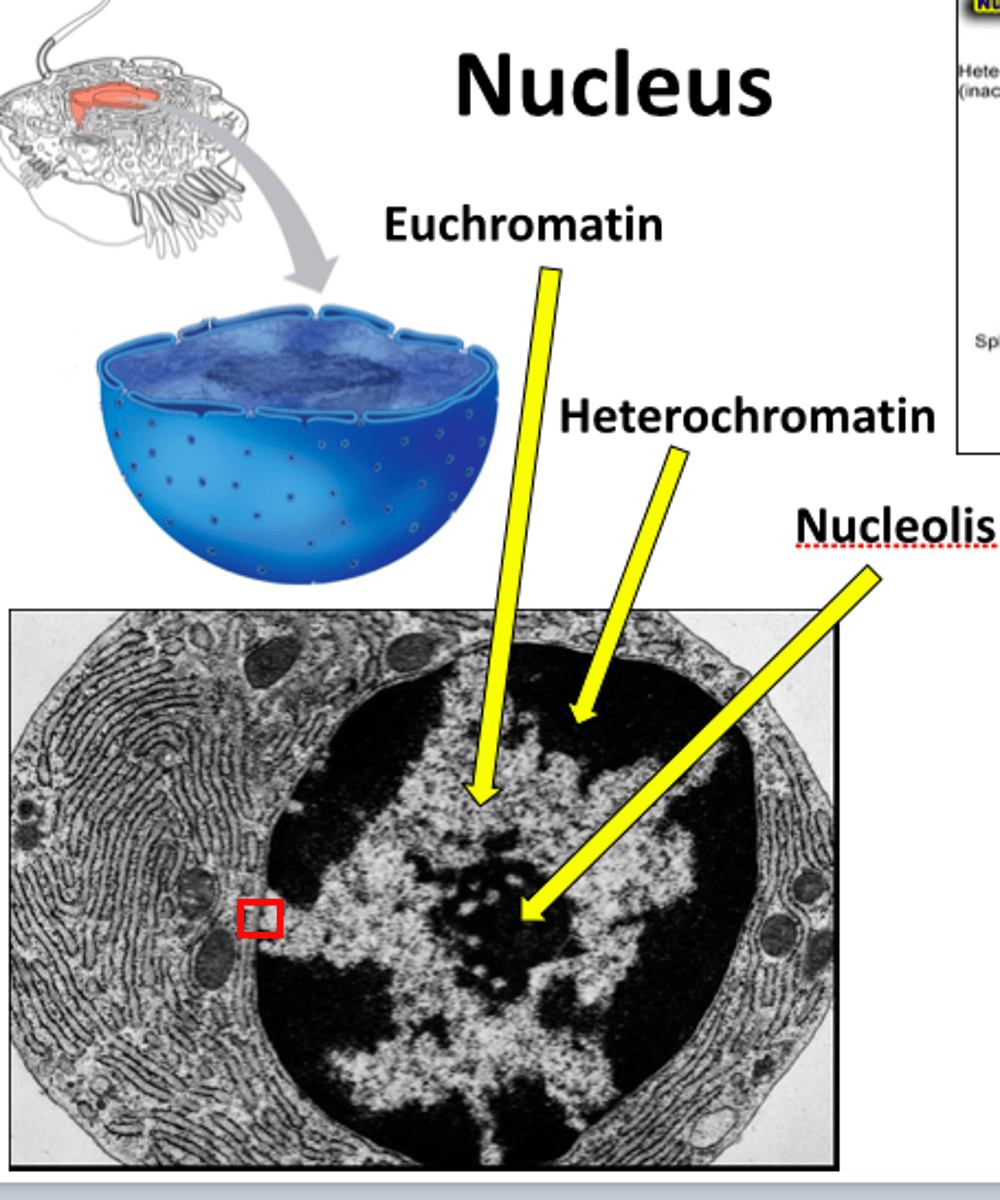
Heterochromatin
Eukaryotic chromatin that remains highly compacted during interphase and is generally not transcribed. makes it difficult for the cell to express genetic information coded in these regions.
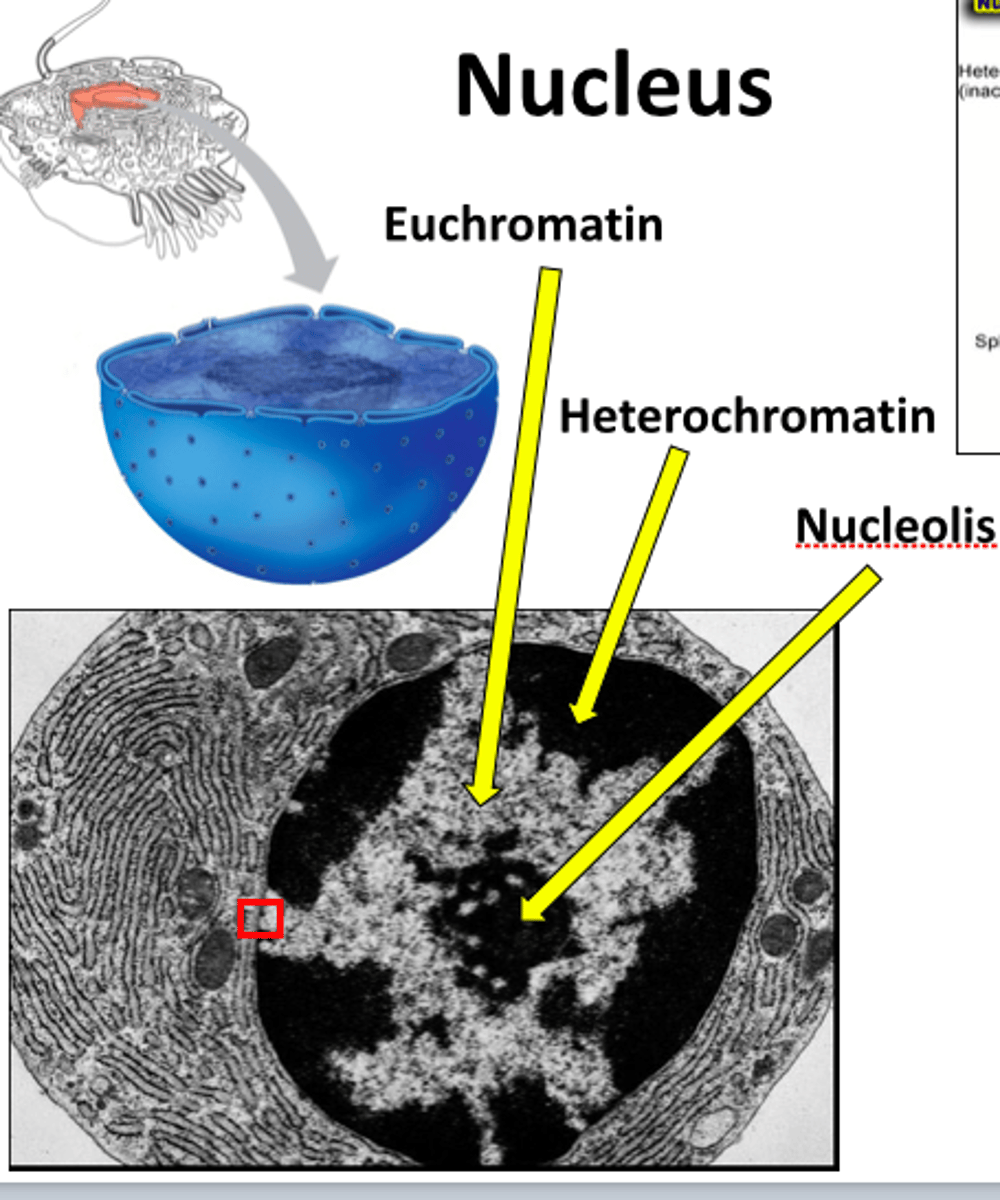
Histones
•Histones can undergo chemical modifications that result in changes in chromatin organization
•These changes can result in changes in gene expression
•Histones are very important not just for packaging DNA, but also for regulating how genes are expressed
gene expression
the process by which DNA directs the synthesis of proteins
Transcription
synthesis of an RNA molecule from a DNA template
- Produces messeger RNA(mRNA)
- First stage of gene expression
Translation
synthesis of a polypeptide, using information in the mRNA
Archibald Garrod
first suggested that genes dictate phenotypes through enzymes that catalyze specific chemical reactions
- Inborn errors of metabolism; symptoms of inherited disease reflect an inability to synthesize a certain enzyme
one gene-one polypeptide hypothesis
The premise that a gene is a segment of DNA that codes for one polypeptide.
Messenger RNA (mRNA)
A type of RNA, synthesized from DNA and attached to ribosomes in the cytoplasm; it specifies the primary structure of a protein. Carries information from DNA to protein. (Construction foreman)
Ribosomes
site of translation (Construction site)
- free ribosomes synthesize protein that function in cytosol
- bound ribosomes mostly synthesize proteins that are secreted from cell
Central Dogma
theory that states that, in cells, information only flows from DNA to RNA to proteins
primary transcript
An initial RNA transcript from any gene; also called pre-mRNA when transcribed from a protein-coding gene.