3.2.5/6 Transition metals & reactions of ions
 Call Kai
 Learn
Learn Practice Test
 Spaced Repetition
 Match
Match Flashcards
 Knowt Play
1/81

There's no tags or description
Looks like no tags are added yet.
Name | Mastery | Learn | Test | Matching | Spaced | Call with Kai | Chat |
|---|
No analytics yet
Send a link to your students to track their progress
82 Terms
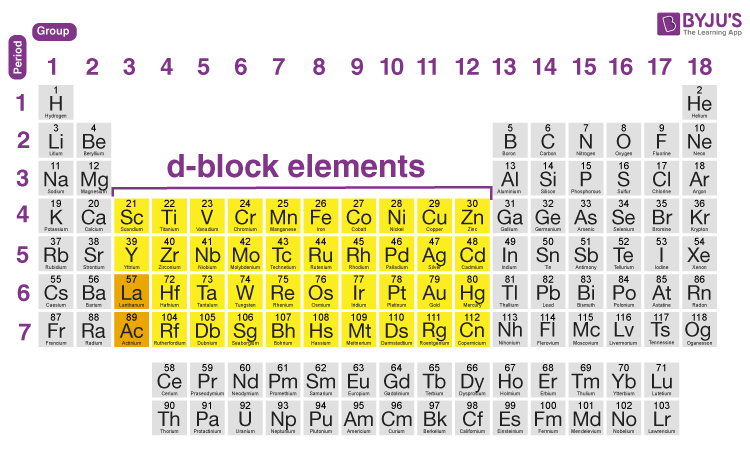
What is the definition of a transition element?
A d-block element that can form at least one stable ion with a partially filled d-subshell
Where are the transition metals located in the periodic table?
d block
Which electrons do transition metals lose first when forming ions?
4s orbital first, then 3d orbital
Why is scandium not a transition element?
It forms only 1 stable ion of Sc3+
Sc3+ has an empty d-subshell (1s22s22p63s33p64s03d0), so is not partially filled

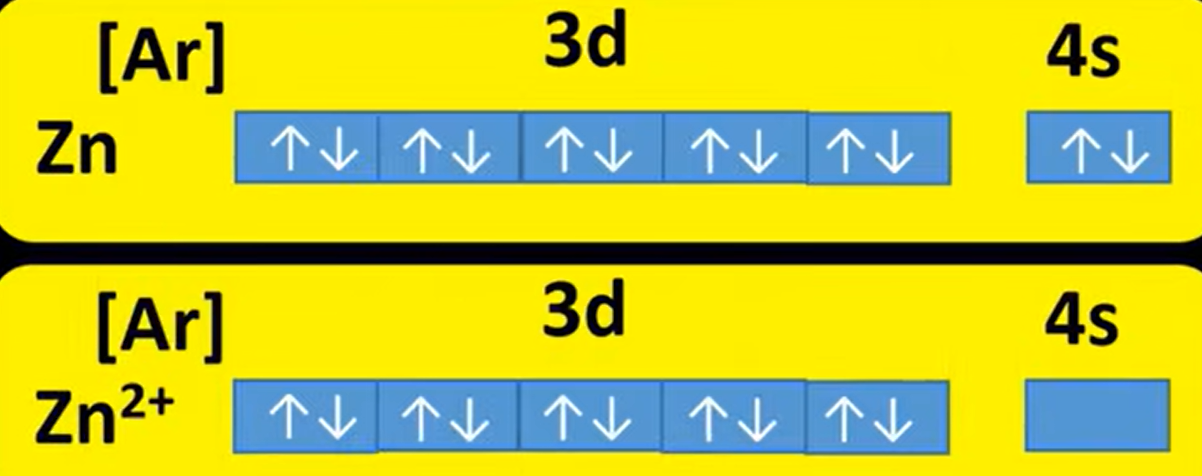
Why is zinc not a transition element?
It only forms 1 stable ion of Zn2+
Zn2+ has a full d-subshell (1s22s22p63s23p64s03d10), so is not partially filled
What are the physical properties of transition metals?
High density, melting & boiling points
Hard, strong & shiny
Good conductors of heat & electricity
Similar ionic radii & fairly unreactive
What are some of the uses of transition metals?
Iron & steel alloys: used in buildings & transport, as it is very strong
Copper: used in water pipes & wires, as it is unreactive & conducts electricity
Titanium: used in nuclear reactors & jet engines, as it has a very high melting point
What are the chemical properties of transition metals?
They form complex & coloured ions
They are good catalysts
iron (used in the Haber process to make ammonia)
manganese (used in the decomposition of hydrogen peroxide)
They can exist in variable oxidation states
What is the definition of a complex ion?
A central transition metal ion surrounded by ligands that are bonded by dative covalent bonds to it
What is the definition of a ligand?
An ion or molecule with at least one lone pair of electrons, that donates them to a transition metal ion to form a co-ordinate bond & so, a complex ion
What is the definition of a monodentate ligand?
A ligand that forms one co-ordinate bond to the central metal ion (one lone pair to donate). Examples include:
H2O:
:NH3
:Cl-
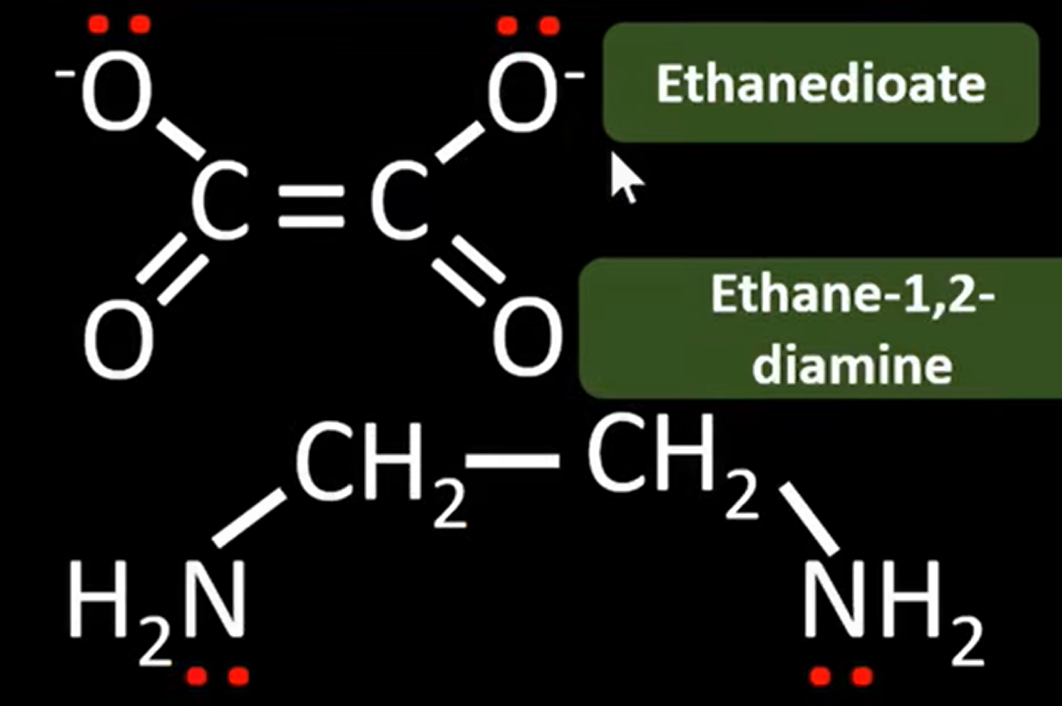
What is the definition of a bidentate ligand?
A ligand that forms two co-ordinate bonds to the central metal ion (2 lone pairs to donate). Examples include:
ethanedioate
ethane-1,2-diamine (shortened name → en)
What is the definition of a polydentate ligand?
A ligand that forms three or more co-ordinate bonds to the central metal ion. For example:
EDTA4- → can form 6 dative covalent bonds with the central metal ion

What is the definition of co-ordination number?
The number of co-ordinate bonds the central metal ion has formed to surrounding ligands
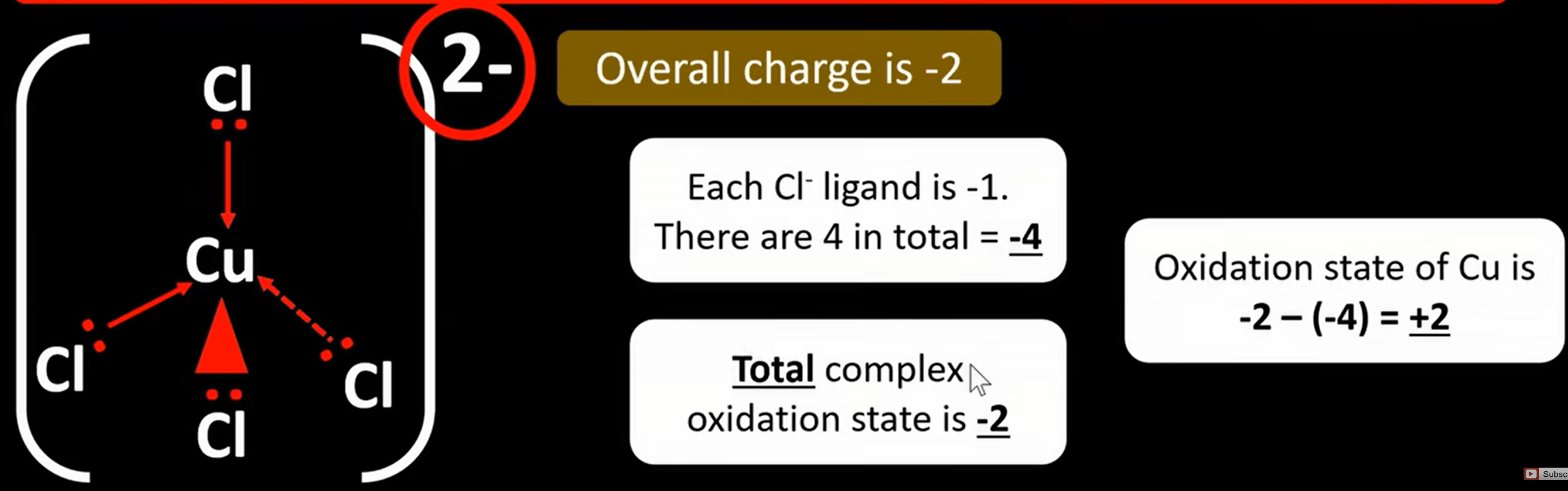
How is the oxidation state of a metal ion with a complex calculated?
Oxidation state of the metal ion = total charge of the complex - total oxidation state of ligands
What is the Chelate effect?
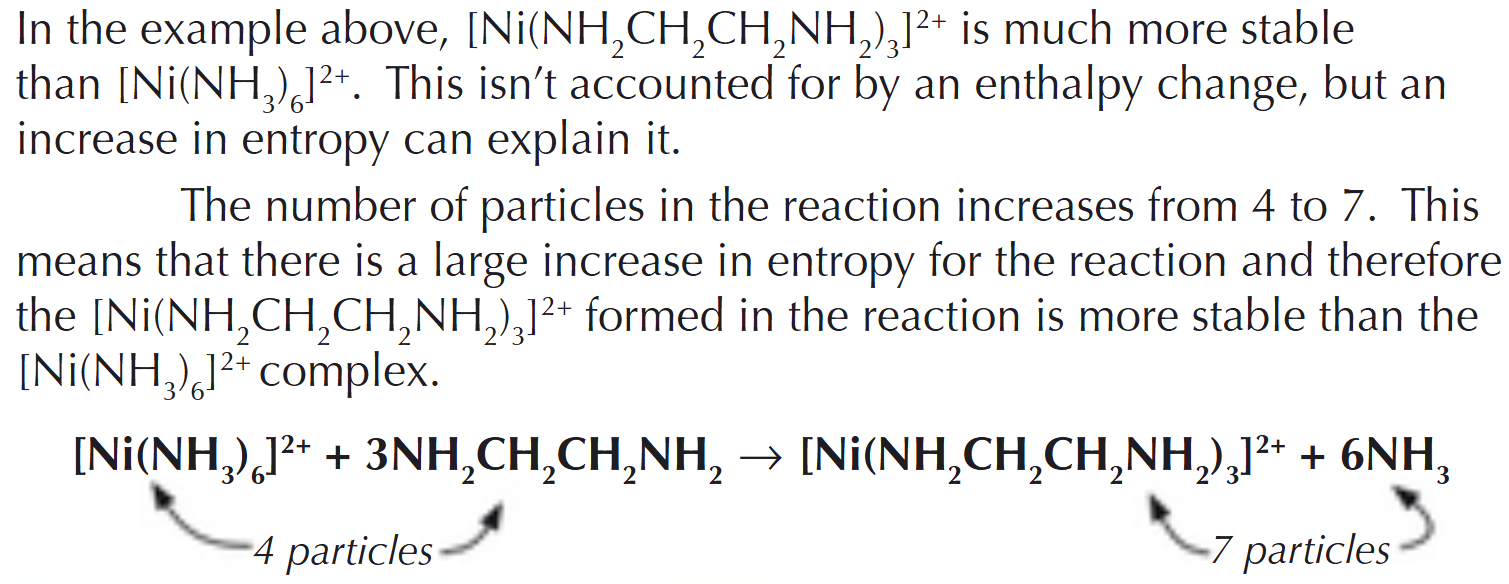
When bidentate/polydentate ligands replace monodentate ligands, to form a more stable complex because there is an increase in entropy
Explain the Chelate effect in terms of entropy & the reaction that is occurring
Number of molecules increases with bidentate/polydentate ligands (e.g. EDTA4- displaces ligands that form fewer co-ordinate bonds per molecule)
Significant increase in entropy (Gibbs’ free energy change < 0) → feasible reaction
A more stable complex ion is formed
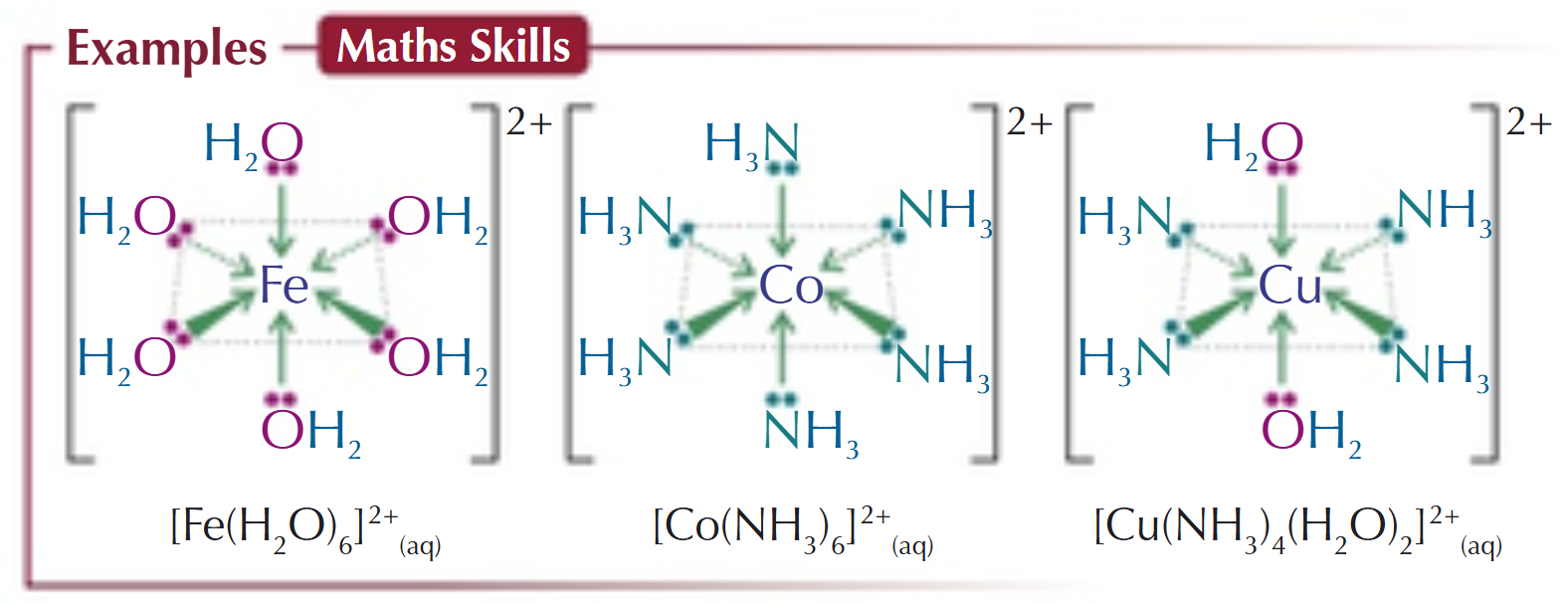
What ion is usually formed when a transition metal compound is dissolved in water & what shape is it?
Aqua ion
6 H2O ligands around the central metal ion → octahedral complex ion is formed

If a transition metal ion has 2 ligands, what shape is it usually?
Linear shape (180° bond angle)

If a transition metal ion has 4 ligands, what shape is it usually?
Tetrahedral (109.5° bond angle)

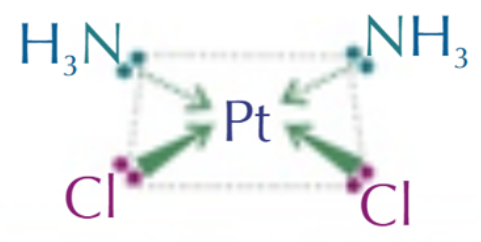
What is an exception to the general rule that ions with 4 ligands is generally tetrahedral. What shape is it?
Platin is square planar shape → forms cisplatin (90° bond angle)
What shape is a complex ion if it has 6 ligands?
Octahedral shape (90° bond angle)
How are transition metals complexes named?
State the number of ligands (e.g. di- , tetra- , hexa-)
Name the ligand(s) in alphabetical order
Name the central atom identifying the overall charge on the complex
for cations or neutral complexes → the metal name is normal (e.g. copper, silver)
for anions → use the suffix -ate & the metal is usually referred to by its Latin name (e.g. Cu - cuprate, Ag - argentate & Fe - ferrate)
Show the oxidation number of the metal in Roman numerals
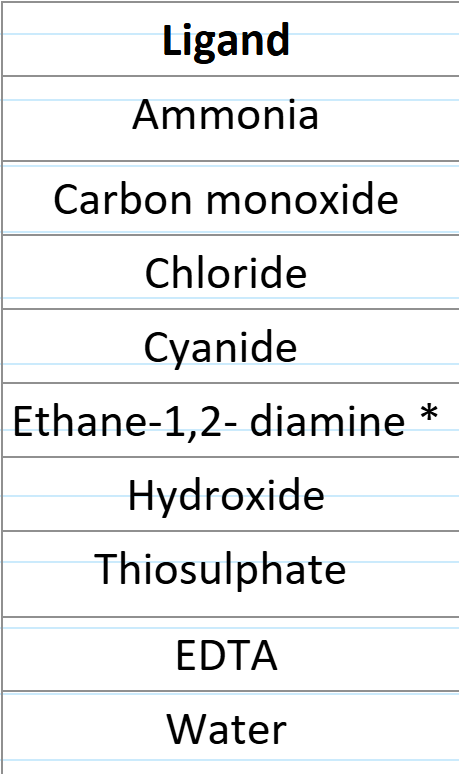
What are the formulas, charges & names for the following ligands?

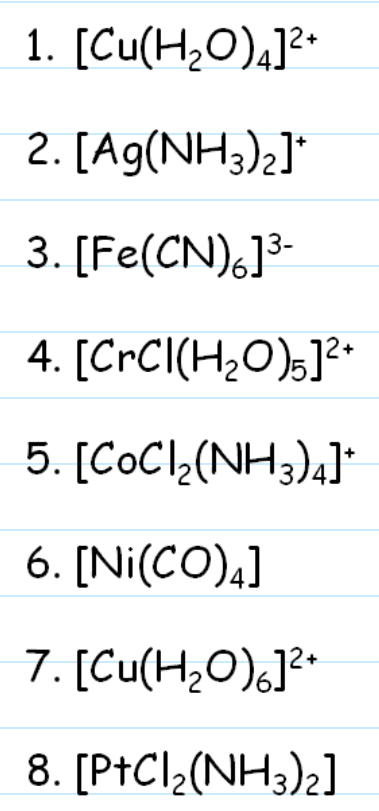
What are the names for the following complexes?
Tetraaquacopper(II)
Diamminesilver(I)
Hexacyanoferrate(III)
Pentaaquachlorochromium(III)
Tetraamminedichloridocobalt(III)
Tetracarbonylnickel(0)
Hexaaquacopper(II)
Diamminedichloridoplatinum(II)
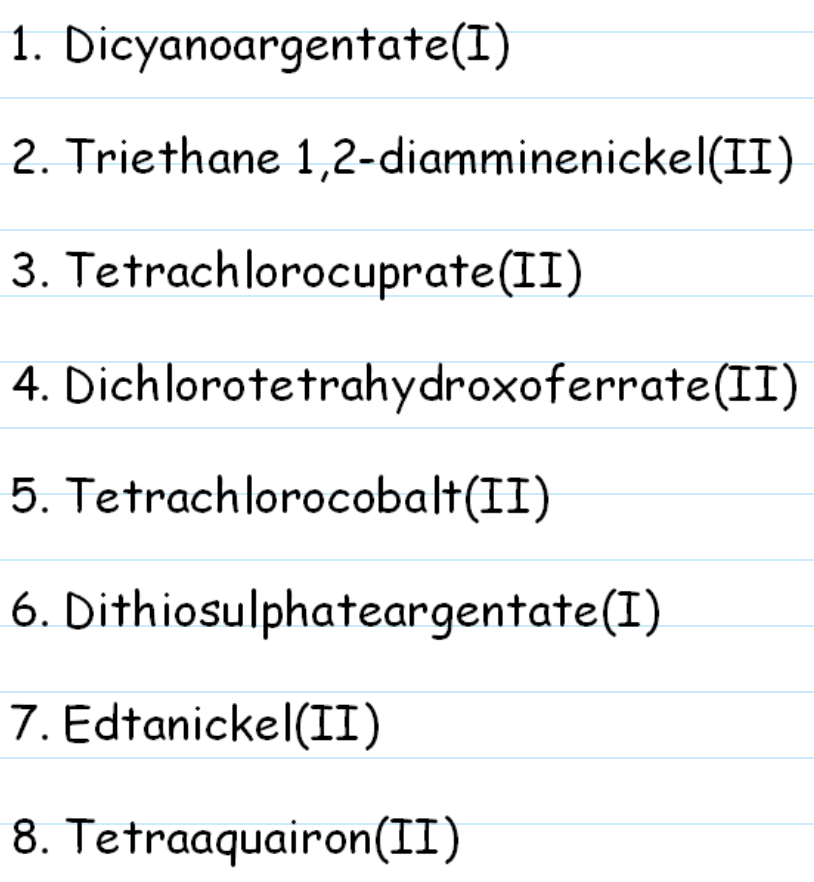
What are the formulas for the following named complexes?
[Ag(CN)2]-
[Ni(en)3]2+
[CuCl4]2-
[FeCl2(OH)2]2-
[CoCl4]2-
[Ag(S2O3)2]3-
[Ni(EDTA)]2-
[Fe(H2O)2]2+
How can complex ions display E-Z/cis-trans isomerism & what shapes of ion does this apply to?
Ligands differ in the way they are arranged in space:
2 ligands of the same type can be on the same side of the metal ion → Z (cis) isomer
2 ligands of the same type can be on the opposite sides of the metal ion → E (trans) isomer
Applies to square planar & octahedral complex ions
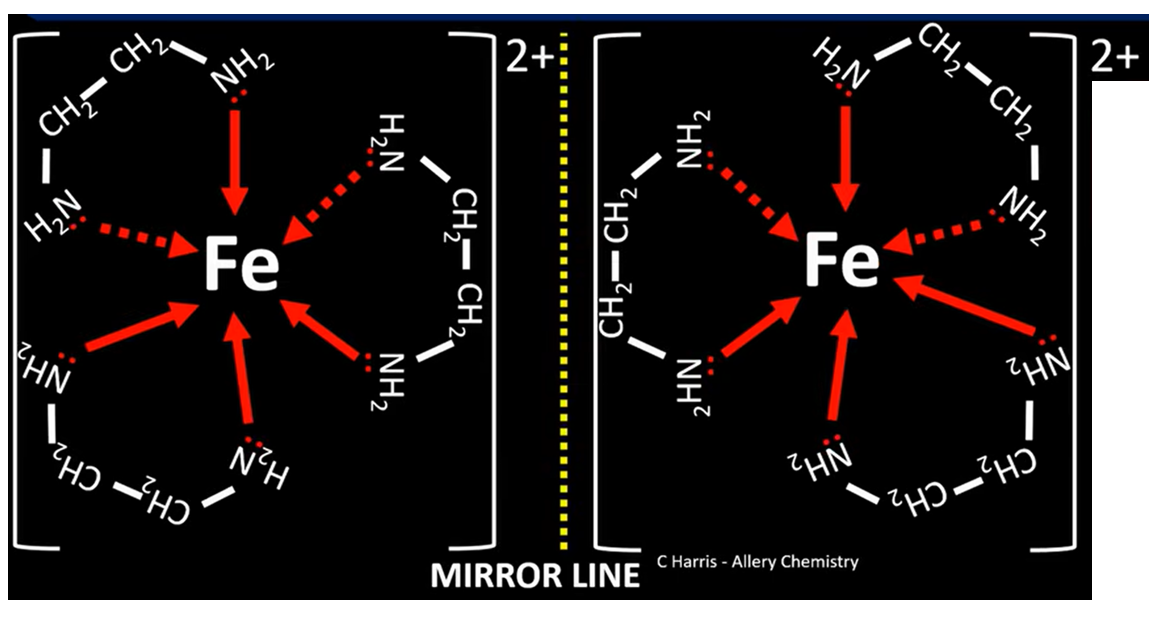
What conditions are needed for a complex ion to display optical isomerism?
Usually applies to octahedral molecules with 2 or more bidentate ligands, so that the mirror images are non-superimposable
What happens to Co2+, Cu2+ & Fe3+ co-ordination numbers when Cl- ligands replace NH3 or H2O ligands?
Decreases from 6 to 4, as Cl- is a much larger ligand than H2O & NH3
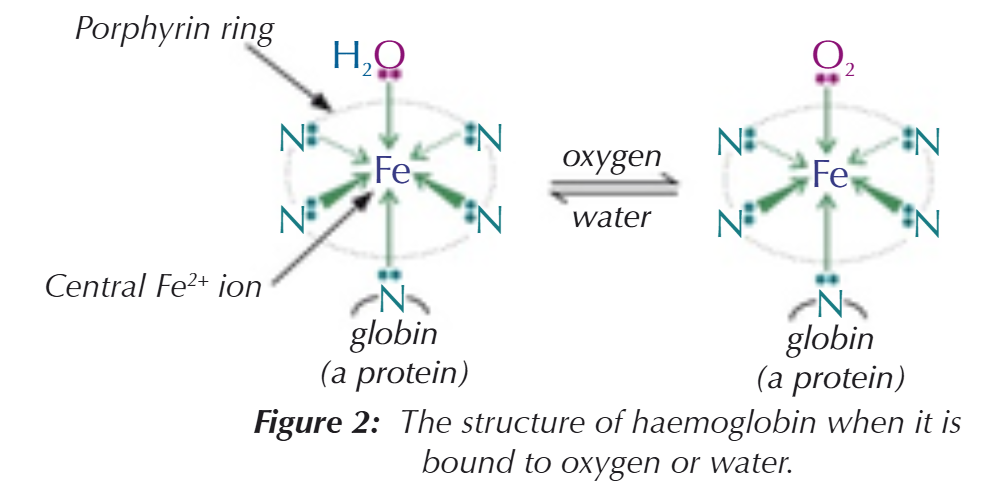
What is haem, its metal ion, co-ordination number & ligands?
A molecule that makes up protein chains, with an Fe2+ central metal ion, which has a co-ordination number of 6
4 of these bonds are to a ring system called porphyrin
1 is to the nitrogen of a globin (protein) molecule & 1 is to an oxygen in an O2 molecule
How does haemoglobin transport oxygen?
In the body, both water & oxygen bind to Fe2+ ions as ligands:
in the lungs (high O2 concentration), water ligands are substituted for oxygen molecules → forms oxyhaemoglobin, which is carried in the bloodstream
in respiring cells (low O2 concentration), the oxygen molecules are exchanged for water molecules → forms deoxyhaemoglobin
the haemoglobin then returns to the lungs & the whole process starts again

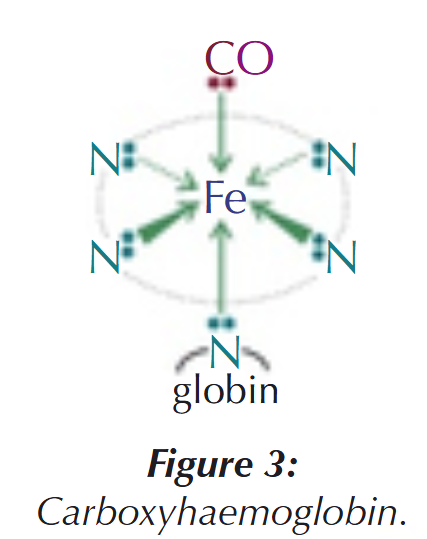
Why is carbon monoxide toxic?
CO also co-ordinately bonds to Fe2+ & is a better ligand, so bonds more strongly than O2
This stops O2 from bonding to haemoglobin, so O2 cannot be transported around the body
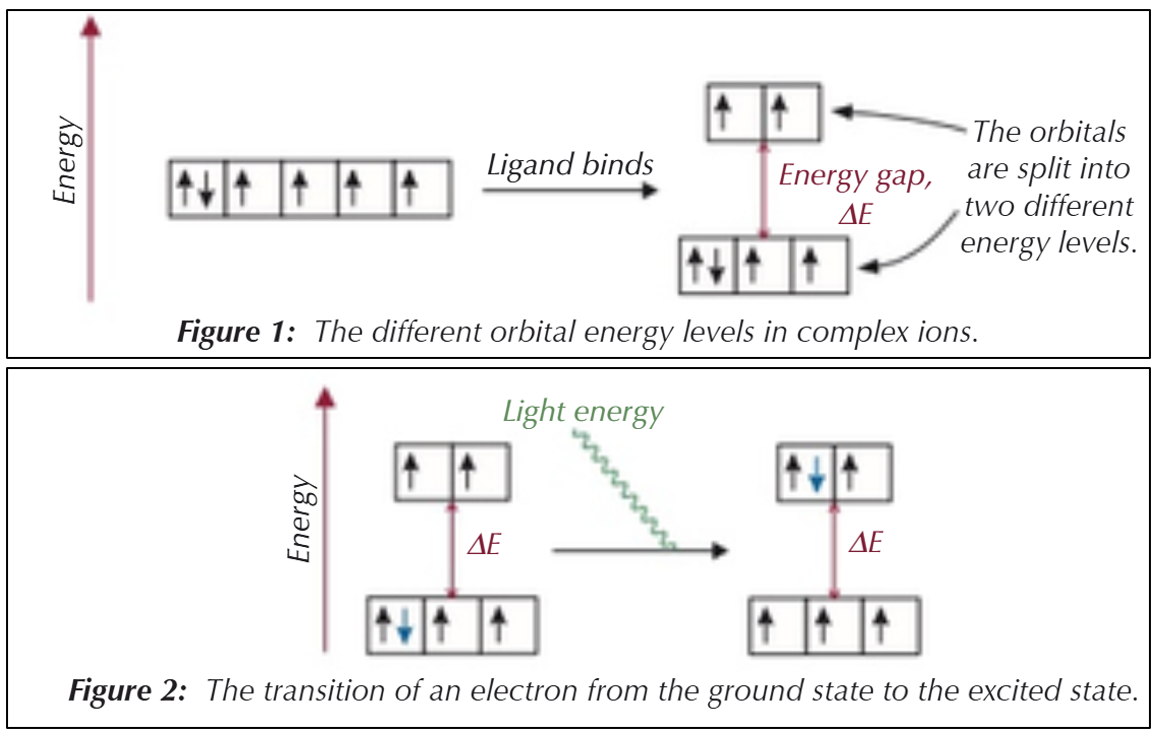
Why are transition metal compounds coloured?
When ligands bond to transition metal ions, some orbitals are given more energy than others, splitting the 3d orbitals into different energy levels
Electrons tend to occupy the lower orbitals (ground state) & to jump up to higher orbitals (excited state), they need energy equal to the energy gap (ΔE) → they get this energy from visible light
They then transmit this energy as visible light (only 1 colour is transmitted)
for complexes with a full or empty 3d sub-shell, no electrons can migrate to the higher orbital, so complexes are seen as colourless or white
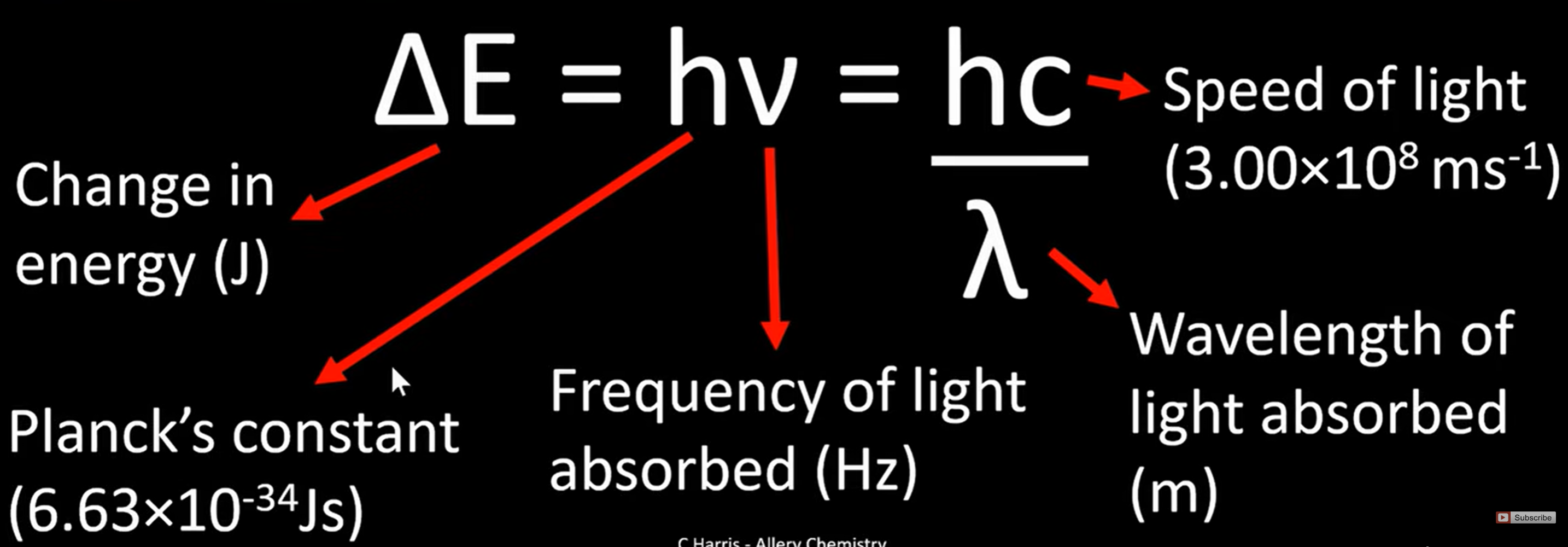
What is the equation to calculate the energy absorbed when electrons jump up?
What factors affect the colour of complexes?
Changes in the oxidation state of a transition metal in a complex ion
Changes in the co-ordination number of a transition metal in a complex ion
Changes in the type of ligand → ligands have different crystal field strengths (i.e. amount of energy given out) & will split the d orbitals by differing amounts
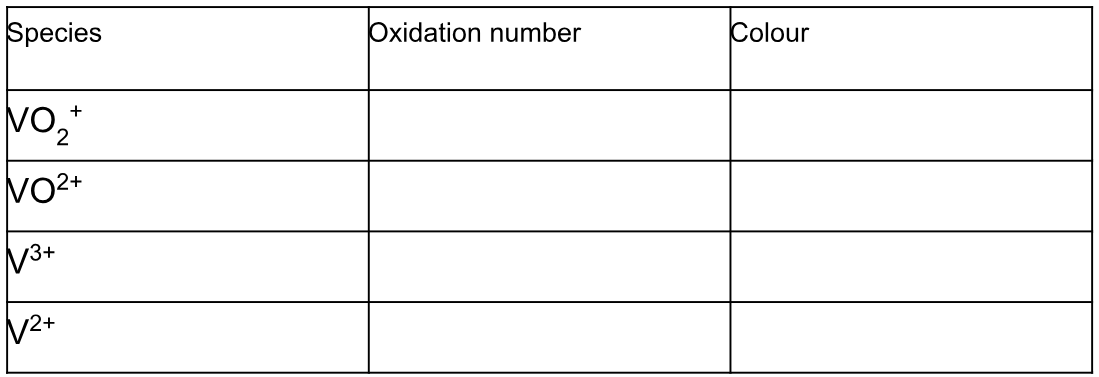
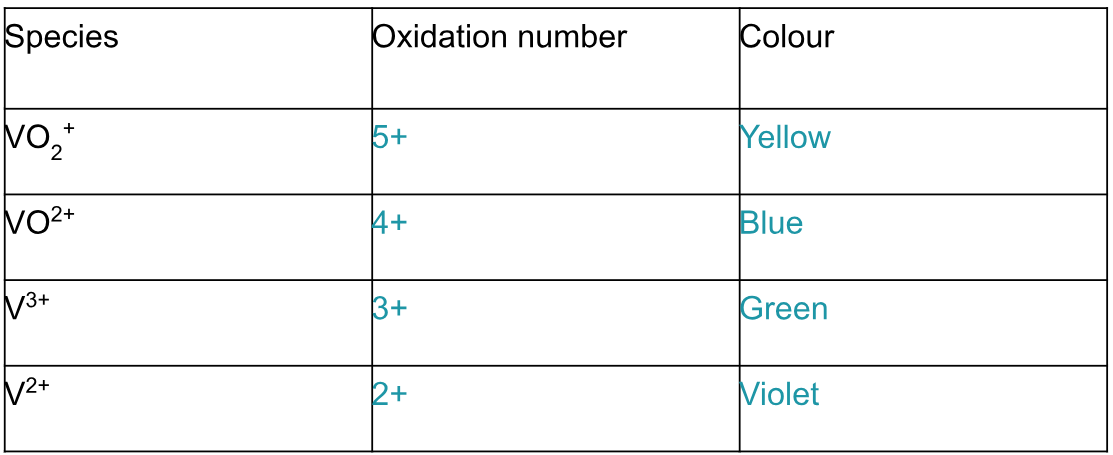
Fill in this table for Vanadium species:
(how to remember → “You Better Get Vanadium”)
What is used to reduce Vanadium?
Zinc

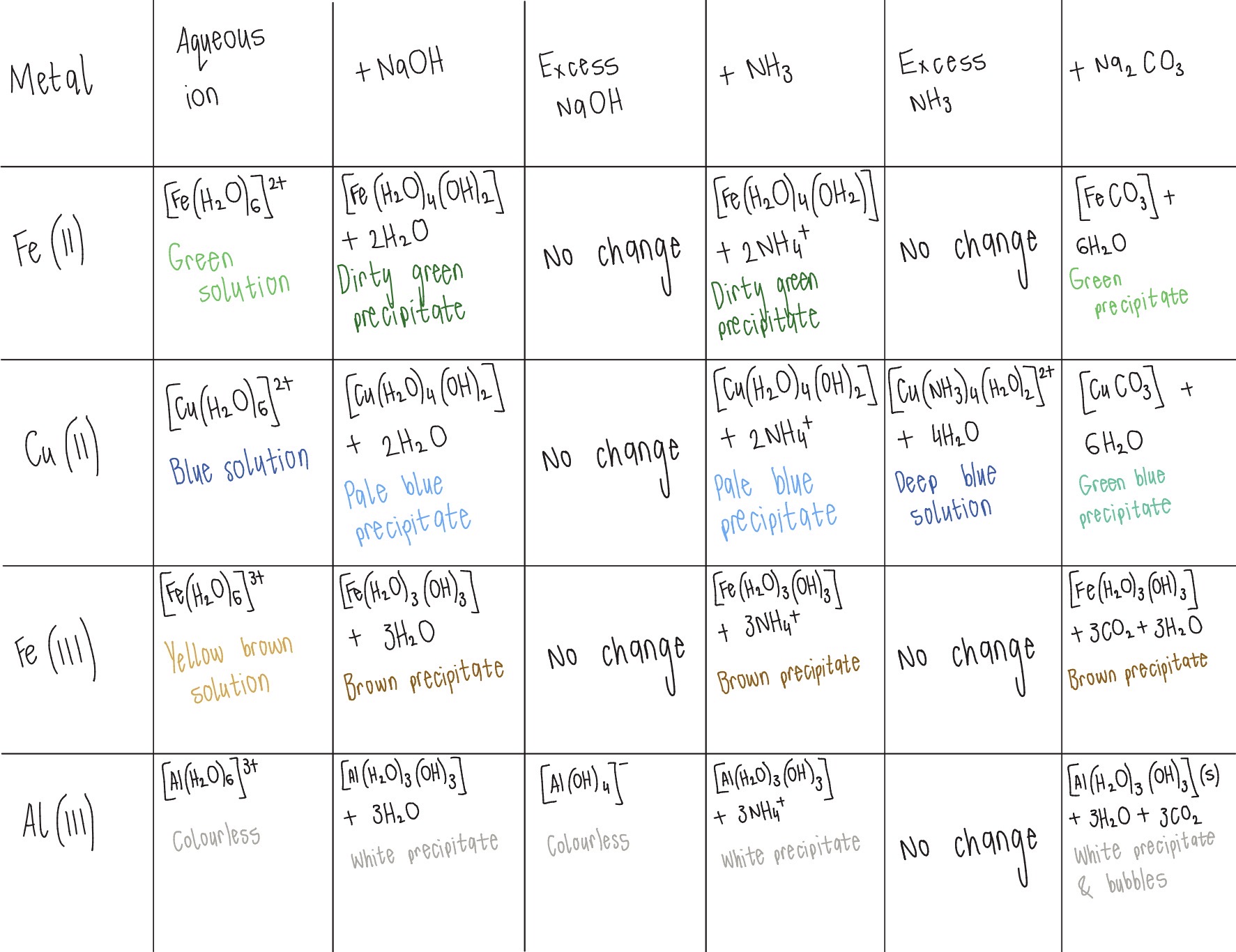
Complete this table of the complex ion colours
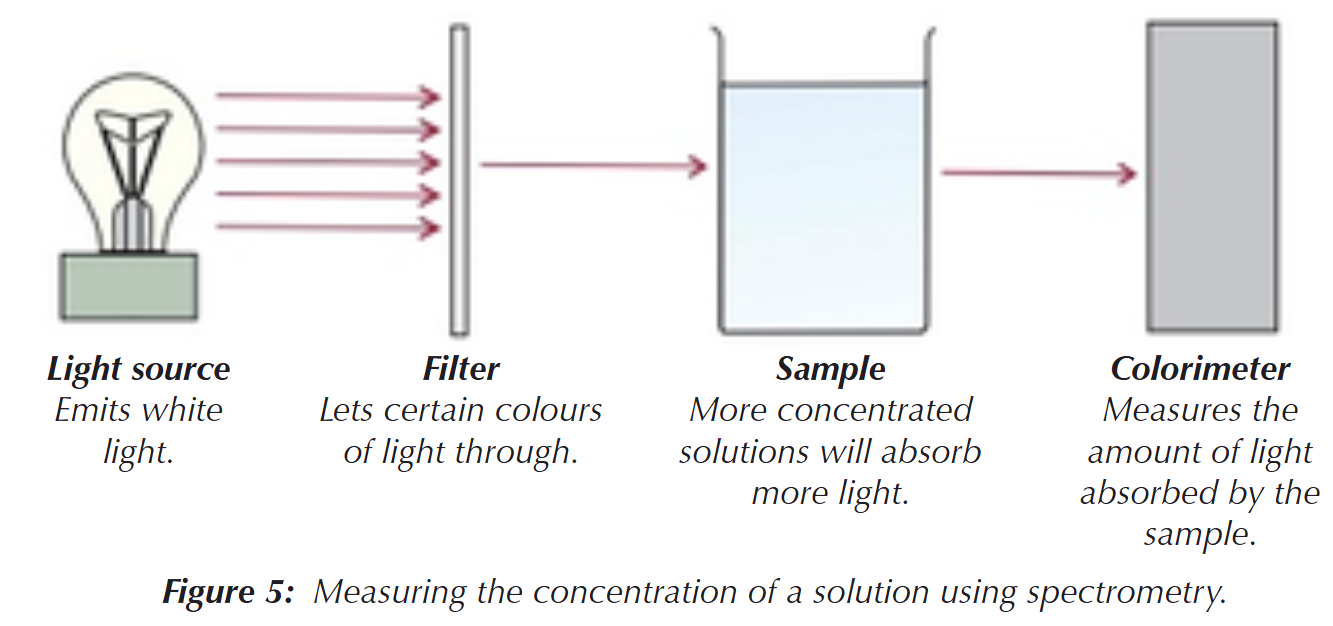
What is spectroscopy used for & how does it work?
To determine the concentration of a solution by measuring how much light it absorbs:
white light is shone through a filter, which is chosen to only let the colour of light through that is absorbed by the sample
the light then passes through the sample to a colorimeter, which shows how much light was absorbed by the sample → the more concentrated a coloured solution is, the more light it will absorb
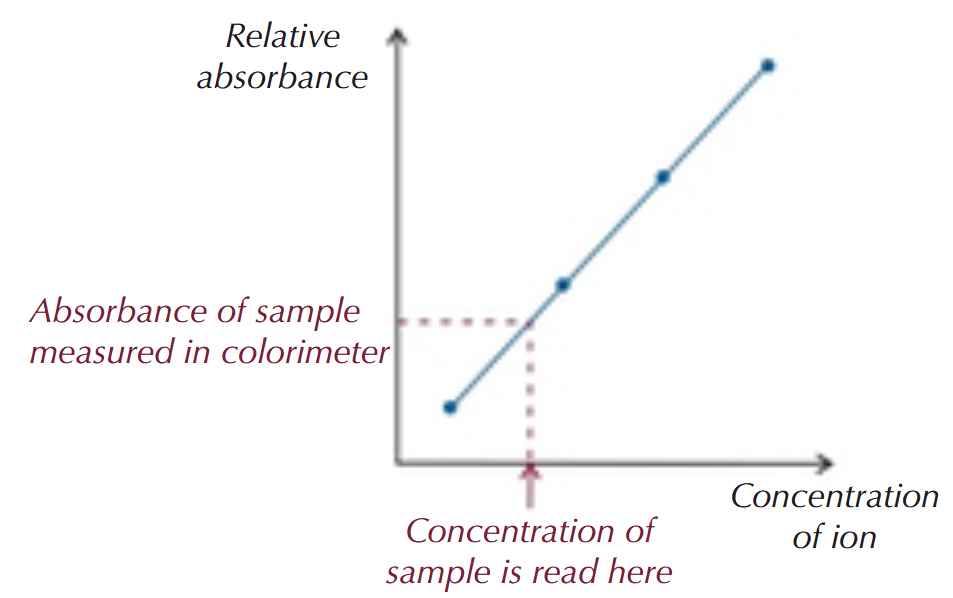
In calorimetry, what has to be done before the unknown concentration of a sample is found?
A calibration graph/curve has to be produced:
involves measuring the absorbencies of unknown concentrations of solutions & plotting the results on a graph
once this is done, the absorbance of the sample is measured & its concentration is read off the graph
Why can transition metals have variable oxidation states?
They have partially filled d-orbitals, so can lose 4s & 3d electrons
Which oxidation states do all transition metals have (except Sc) & why?
+2 due to loss of electrons from 4s orbital
When the oxidation state is high, do transition metals exist as simple ions?
No, after the oxidation state of about +3, metal ions covalently bond to other species
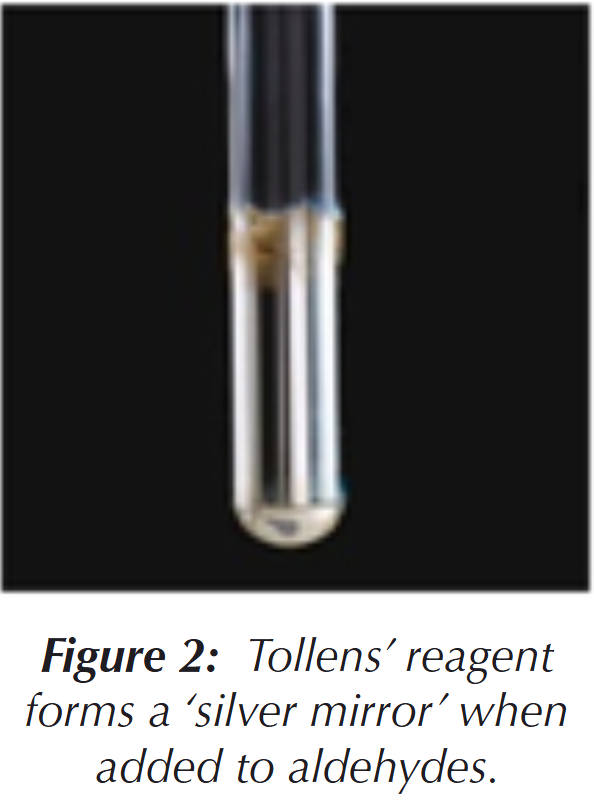
What is the use of the complex [Ag(NH3)2)]+ ion?
Tollens’ reagent to test for aldehydes/ketones:
silver mirror formed with aldehyde
no visible change with ketone
What colour is:
MnO4-
Mn2+
Deep purple
Pink
Write a half equation for the reduction of MnO4- to Mn2+
MnO4- + 8H+ + 5e- → Mn2+ + 4H2O
Why are redox titrations with transition metal compounds said to be self-indicating?
They usually involve a colour change as the metal is changing oxidation state (sometimes an indicator is still needed/useful)
What colour is:
Cr2O72-
Cr3+
Orange
Green
Write a half equation for the reduction of Cr2O72- to Cr3+
Cr2O72- + 14H+ + 6e- → 2Cr3+ + 7H2O
What happens to aqua metal ions in acidic, alkaline & neutral conditions?
Acidic conditions: they get reduced
Alkaline conditions: they get oxidised
Neutral conditions: no change
What does whether reduction or oxidation occurs & the readiness of the reaction depend on?
E° values (standard electrode potential)
What can change E° values?
pH & the ligands involved
What is the definition of a catalyst?
A substance that increases the rate of a reaction by providing an alternative pathway with a lower activation energy & is not used up
Why are transition metals good catalysts & why are group 1, 2 & 3 metals not as good catalysts?
Transition metals can exist in variable oxidation states (due to partially filled d sub-shells), so can provide alternative pathways easily
Group 1, 2 & 3 metals only exist in one oxidation state
What is advantage of using a catalyst for a reaction?
Allows reactions to proceed at lower temperatures & pressures → saves valuable energy, money, time & resources
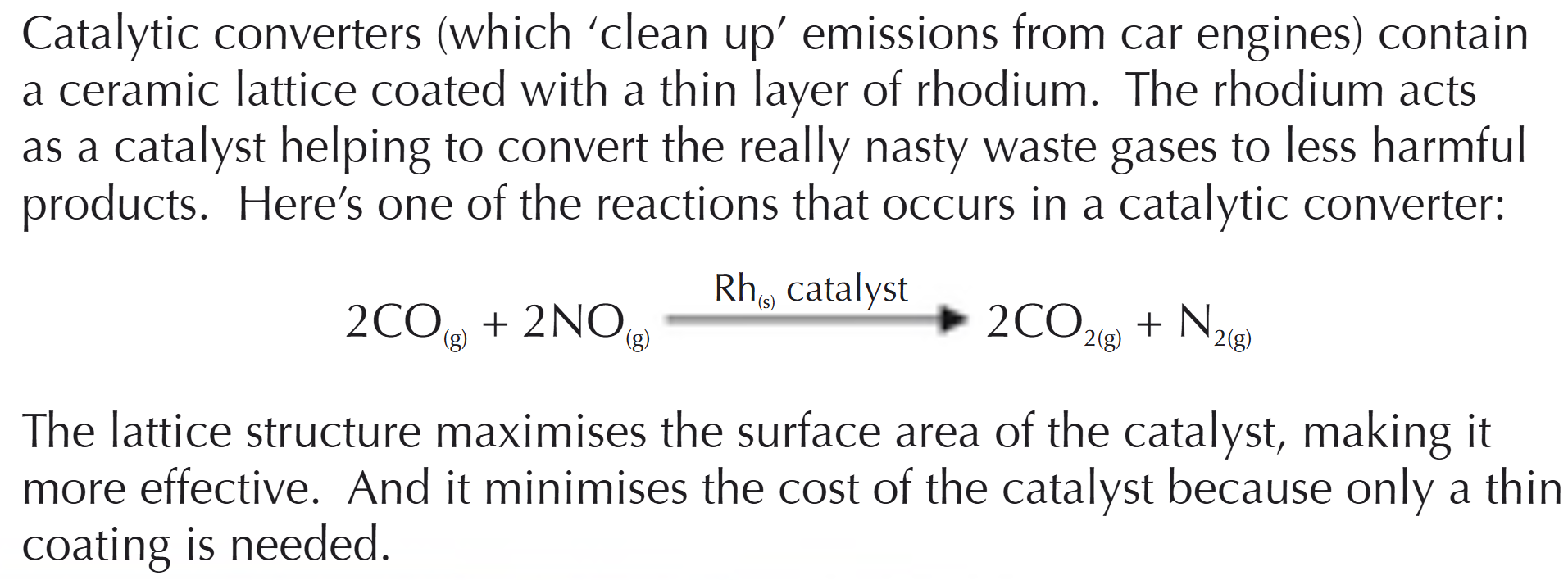
What is the definition of a heterogenous catalyst?
A catalyst that is present in the reaction in a different phase to the reactants (usually a solid, with gas/liquid reactants):
catalytic activity occurs on the solid surface as the reactants pass over it
no need for separation of products from catalyst
How do heterogenous catalysts work?
Reactants adsorb (stick to) the catalyst’s surface at active sites
This weakens the bonds within the reactants & holds reactants close together on the surface &/or in the correct orientation to react
Once the reaction has occurred, products desorb from the active sites
What properties do catalysts need to have to make it a good catalyst?
Can’t adsorb too strongly, otherwise the products will not desorb
Can’t adsorb too weakly as reactants would not be held in place for long enough & bonds would not be sufficiently weakened
need a good balance between desorption & adsorption
How can you increase the efficiency of heterogenous catalysts?
Increase the surface area to increase the number of active sites that are present
Spread onto an inert support medium (e.g. ceramic) to increase the surface/mass ratio → use ceramic honeycomb/mesh/sponge
What is catalyst poisoning?
Unwanted impurities adsorb to the catalyst’s active sites & do not desorb, which blocks the active sites on the catalyst’s surface
What effect does catalyst poisoning have on the catalytic activity?
Decreases the effectiveness of the catalyst over time
Aside from catalyst poisoning, how else can a catalyst be degraded?
Finely divided catalysts can be gradually lost from their support medium
What is the Haber process & what catalyst is used?
Makes ammonia & uses iron (Fe) catalyst
N2(g) + 3H2(g) → 2NH3(g)
What size/shape is the Fe catalyst for the Haber process?
Pea sized lumps to increase the surface area
How long does the catalyst last for the Haber process & what is it poisoned by?
About 5 years
Poisoned by sulfur impurities in the gas streams
What is the Contact Process & what catalyst is used?
2SO2(g) + O2(g) → 2SO3(g)
used industrially to make sulfuric acid (H2SO4)
catalysed by vanadium (V) oxide (V2O5)
What are the two reactions that are involved in the Contact process?
SO2 + V2O5 → SO3 + V2O4
V2O4 + 1/2O2 → V2O5
What is a vanadium a good catalyst in the case of the Contact process?
It can change oxidation state from +5 to +4 & back to +5 (so can be used again)
What is the definition of a homogenous catalyst & how do they work?
A catalyst that is in the same phase/physical state as the reactants:
form intermediates to give a different reaction pathway with a lower activation energy
What is the reaction between S2O82- ions & I- ions?
S2O82- (aq) + 2I- (aq) → I2 (aq) + 2SO42- (aq)
Why does the reaction between between S2O82- ions & I- ions have a high activation energy in normal conditions?
Two negative anions are reacting, meaning they repel each other, so the activation energy is high
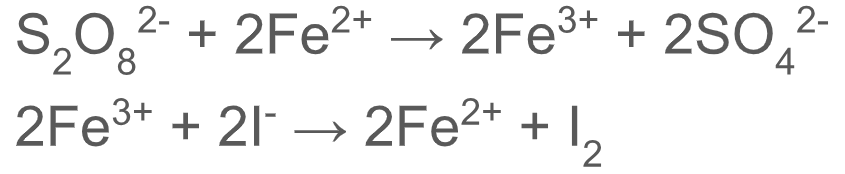
Which transition metal ion catalyses the reaction between S2O82- ions & I- ions? Write two equations to show how
Fe2+
What is the definition of autocatalysis?
When the product of a reaction is also a catalyst for that reaction
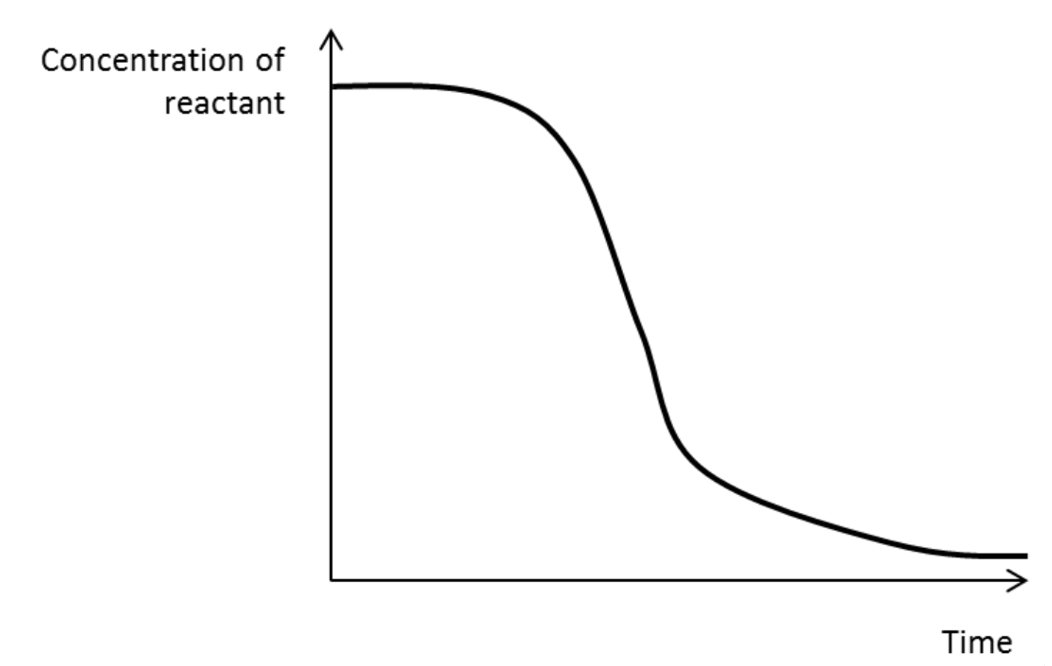
Draw a concentration of reactant against time graph for an autocatalysed reaction & explain each stage
The rate if reaction is initially slow & uncatalysed, as not much of the catalyst has been formed
The rate increases as the catalyst is made (catalysed reaction is faster)
The rate slows down as the reactants are used up
Write a half equation for the conversion of C2O42- ions into CO2
C2O42- → 2CO2 + 2e-
Write an equation for the reaction between C2O42- ions & MnO4- ions. How does Mn2+ autocatalyse this reaction?
2MnO4- + 16H+ + 5C2O42- → 10CO2 + 2Mn2+ + 8H2O
1st stage: MnO4- + 4Mn2+ + 8H+ → 4H2O + 5Mn3+
2nd stage: 2Mn3+ + C2O42- → 2CO2 + 2Mn2+
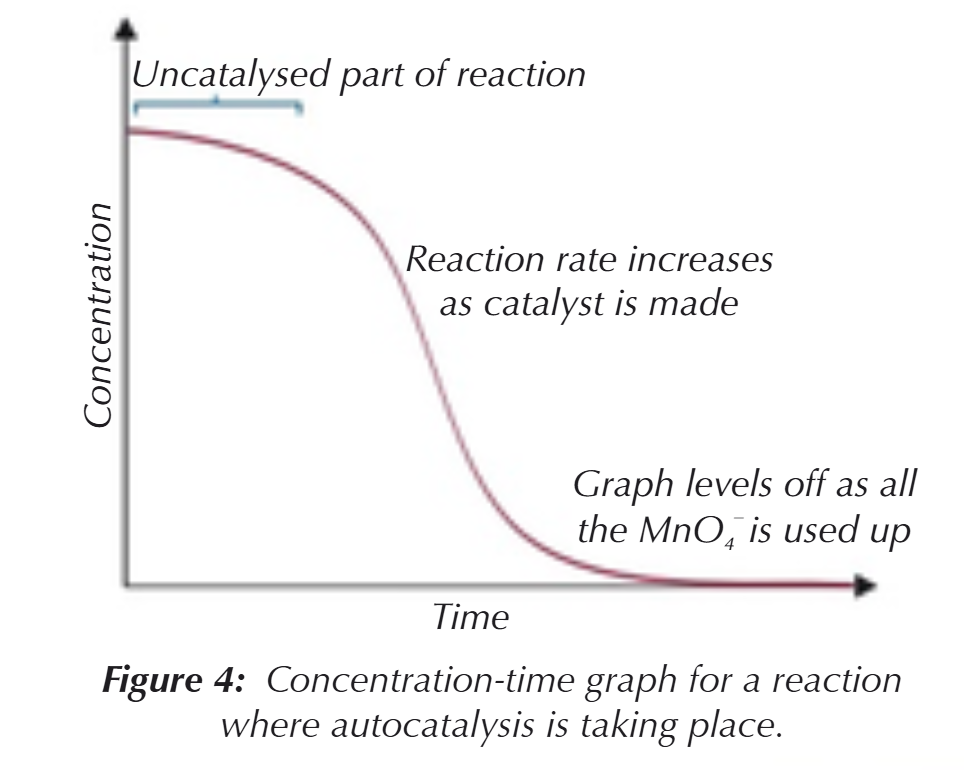
How can you monitor the concentration of MnO4- ions?
Using a colorimeter
Are 2+ ions or 3+ ions more acidic in solution & why?
3+ ions:
they are smaller & more highly charged, so have a higher charge density
they attract the electrons from the oxygen of the ligands much more strongly
this weakens the O-H bonds, so the complex readily releases a H+ ion into the solution, making it acidic
Write an equation for the hydrolysis of [Fe(H2O)6]3+ to release a proton
[Fe(H2O)6]3+ (aq) ⇌ [Fe(H2O)5(OH)]2+ (aq) + H+(aq)

What kind of acid is the complex ion acting as & why?
Bronsted-Lowry → donates a proton
What is acting as the Lewis acid & base during the formation of complex ions?
The metal ion is acting as the Lewis acid (electron pair acceptor) & the ligands as Lewis bases (electron pair donor)
What is the order of ligand strength between ammine, chloride & aqua ligands?
Chloride (strongest)
Ammine
Aqua (weakest)