Unit 2 PE Biomechanics
 Call Kai
 Learn
Learn Practice Test
 Spaced Repetition
 Match
Match Flashcards
 Knowt Play
1/63

There's no tags or description
Looks like no tags are added yet.
Name | Mastery | Learn | Test | Matching | Spaced | Call with Kai | Chat |
|---|
No analytics yet
Send a link to your students to track their progress
64 Terms
What are the 4 factors influencing motion?
Force: A push or a pull (N)
Mass: Amount of matter of an object (kg)
Velocity: The rate that an object moves position (m/s)
Inertia: A body’s reluctance to change its current state of motion.
Inertia is directly proportional to its mass, heavier an object- greater it’s inertia
How do you define momentum? What does it describe?
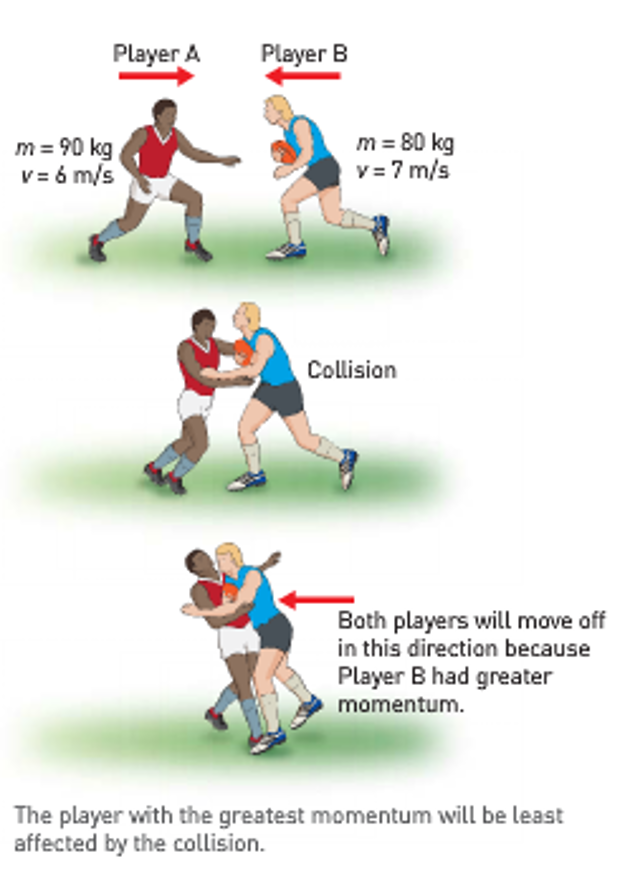
Definition: The amount of motion an object has and its resistance to changing that motion
Formula: Momemtum = mass x velocity
Measured in kgm/s
Objects with greater mass have greater momentum and therefore require larger force to stop
Hence many sports players gain an advantage by increasing mass as long as it’s not at the expense of their velocity
What is the aim of increasing momentum? How can you increase the change momentum?
Aim: To maximise the change in momentum of an object/projectile by increasing impulse
Examples: Cricket shot, footy kick, discus throw
Impulse = Force x Time
Impulse can therefore be increased by increasing:
Force → mainly through force summation (BEST)
Time → by increasing the time over which force is applied, such as through a backswing and follow-through
How do you increase the change in momentum? How does this affect velocity?
Change in momentum = Impulse = Force x Time
Therefore, increasing the force applied and/or the time of force application increases impulse
Increased impulse results in a greater change in momentum
If mass is constant, the greater change in momentum results in an increased velocity of the projectile
What is conservation of momentum? What does it apply to?
Definiton: The transfer of momentum from one body to another
Applies to any collison between two objects EG foot on ball, two players, foot and ground
Total momentum prior to impact is equal to total momentum after impact (ignoring a small amount lost in collision)
How do you define force summation/summation of momentum?
Force summation: The correct timing and sequence of body segments to produce maximal force
EG When trying to throw, kick, hit an object as far as possible
Momentum = mass x velocity
Use BEST (Body parts, SEquence, Stability, Timing) to produce maximum force
How can maximum force summation/summation of momemtum be achieved?
Body parts: Use an many body parts as possible
SEquence: Move the heavier and slower (M=mxv) body parts first (legs, trunk) followed by the lighter and faster body parts (arms, wrists and fingers)
Stabilisation: Body parts must stabilise once they pass momentum to ensure momentum is not lost
Timing: Move the next body part only once the previous body part has reached maximum velocity
Follow through with the movement
How do you define impulse? How can it occur?
Definition: The change in momentum of a body
Equation: Force x Time
Occurs in 2 ways: Speeding up (when force acts in the same direction as motion) and slowing down (when force acts opposite to the motion)
What is force reception? How does this affect impulse?
Definition: The process of stopping the momentum of a projectile and bringing it’s momentum to zero
In force reception, the projectile will be stopped regardless of it’s initial momentum
Therefore change in momentum (impulse) is constant/fixed (initial impulse - 0)
Since Impulse = Force × Time, force and time have an inverse relationship
Therefore, increasing the time over which force is applied decreases the force required to stop the projectile
What is the result of increasing impulse through increasing it’s two factors force and time?
Increasing force and/or time increases impulse
Since impulse equals the change in momentum, this increases the change in momentum of the projectile
If the projectile's mass remains constant, a greater change in momentum results in a greater change in velocity (usually a higher release speed)
How are force, time, mass and velocity related?
F×t=m x change in v
Increasing force and/or time increases impulse and therefore the change in momentum
For a constant mass, a greater impulse results in a greater change in velocity
A larger mass requires a greater impulse to produce the same change in velocity
Define linear motion. What is required by the body/object in order to be moving in linear motion?
Linear motion: The body or object moving in a straight line (or curved path)
All parts of the body or object move in the same direction at the same time
Example: Ice skater gliding
How do you define angular motion? What kinds of angular motion are there?
Angular motion: Rotation around an axis
Rotation or spinning around a fixed point or axis by the body or an object
Occurs when an eccentric force creates an unbalanced force that does not pass directly through the axis
Can be:
Internal – inside the body (e.g. knee joint)
External – outside the body (e.g. equipment, door hinge)
How is general motion a combination of two other motion types? How common is this motion?
General Motion: The body or object moving with a mixture of straight line movement and rotations
A combination of both angular and linear motion.
Most sporting movements are examples of general motion.
Example: Running – legs rotate about the hips while the body moves forward
What is Newton’s first law of motion?
The Law of Inertia
A body will remain at rest or in a uniform motion unless acted upon by an external force.
What is Newton’s second law of motion?
The law of acceleration
Equation: F=ma
Force applied to an object will produce a change in motion (acceleration) in the direction of the force, that is directly proportional to the size of the force and inversely proportional to its mass.
What is Newton’s third law of motion?
Law of action/reaction
For every action there is an equal and opposite reaction
What is angular velocity?
Angular velocity: How fast an object rotates about an axis (degrees/seconds)
Describes how fast an object is spinning
Greater angular velocity means faster rotation
What is an eccentric force? How do eccentric forces affect movement?
Eccentric force: A force that doesn’t act in a line that passes through the centre of mass (or gravity) of an object
Causes the object to rotate as well as move in a straight line
Produces a rotational effect called torque
Applying the force further from the centre of mass increases rotation because torque increases
EG Kicking a soccer ball off-centre to curve it
What is moment of inertia? What does it describe?
Definition: The tendency of a body to remain its state of angular motion
Describes how difficult it is to change angular motion of an object
Depends on: Mass and distance of mass from the axis of rotation (radius)
Moment of inertia = Mass x Radius²
What is the benefit of increasing moment of inertia?
Angular Momentum = Moment of Inertia × Angular Velocity
Greater angular momentum gives the body a greater tendency to maintain it's state of angular motion
Therefore can improve stability and control during rotation
However ↑ moment of inertia generally results in decreased angular velocity due to the conservation of angular momentum
What are the features objects/bodies with low moments of inertia?
Lower moment of inertia:
Smaller mass
Shorter radius
Mass closer to axis
Easier to rotate
What are the features objects/bodies with high moments of inertia?
Higher moment of inertia:
Larger mass
Longer radius
Mass further from axis
Harder to rotate
What are features of objects/bodies with low and high moments of inertia?
Lower moment of inertia:
Smaller mass
Shorter radius
Mass closer to axis
Easier to rotate
Higher moment of inertia:
Larger mass
Longer radius
Mass further from axis
Harder to rotate
What is angular momentum?
Angular momentum: The amount of rotation of a body around an axis
Angular momentum = Moment of inertia x Angular velocity
Greater moment of inertia can increase angular momentum if angular velocity is maintained
Greater angular velocity increases angular momentum
Examples: Somersaults, dives, spins in gymnastics and figure skating
What does the law of conservation of angular momentum state?
The law of conservation of angular momentum: States that when no external force acts on an object, no change of angular momentum will occur
When no external force acts, angular momentum stays constant
Therefore a spinning body will spin indefinitely (with some angular momentum) unless another force is exerted on it
Therefore once airborne (where we say no external forces are acting) athletes change angular velocity by changing MOI (e.g. tucking in), not total angular momentum. ↓MOI → ↑angular velocity, and vice versa
Relationship:
↓ Moment of Inertia = ↑ Angular Velocity
↑ Moment of Inertia = ↓ Angular Velocity
What is meant by distribution of mass? How does it affect moment of inertia?
Distribution of mass: The location of an object's mass relative to the axis of rotation
Mass located closer to the axis → lower moment of inertia → easier to rotate
Mass located further from the axis → higher moment of inertia → harder to rotate
Total mass can stay exactly the same — it's the distance of that mass from the axis that changes the moment of inertia, not the amount of mass itself
Example: Ice skater spinning
Arms out: mass distributed further from the axis (spine) → higher MOI → spins more slowly
Arms folded in across chest: mass distributed closer to the axis → lower MOI → spins more easily/quickly
How is distance different to displacement?
Distance: The actual length of path travelled by a body
Displacement: The change in position of a body
Measured by the straight line distance and direction between starting and finishing positions
EG Running 400m around an athletics track, distance is 400m but displacement is 0 metres
How is speed different to velocity?
Speed: Time taken to cover a certain distance
Formula: Distance/time and measured in m/s
Velocity: Time taken to change position
Formula: Displacement/time and measured in m/s
What is acceleration? What forms of acceleration are there?
Acceleration: Change in velocity in a given time
Formula: a = Δv / Δt (change in velocity/change in time) measured in m/s2
There can be:
Positive acceleration EG Out of blocks
negative acceleration NOT deceleration EG Slowing down at the end of a race
What does an acceleration of zero indicate?
When acceleration = 0, there is constant velocity
This is because the objects’ speed and direction has not changed over time
How can torque be defined and what determines its size?
Torque: The tendency of a force to cause rotation about an axis
The rotational effect produced when an eccentric force acts on an object
Formula: Torque = Force × Moment Arm
Torque increases when:
More force is applied
The force is applied further from the axis (larger moment arm)
Greater torque → Greater angular acceleration → More rotation
What is the moment arm? What is it used to measure?
Moment arm: Perpendicular distance from the axis to where the force is applied
Formula: Torque = Force × Moment arm
Increasing the moment arm:
Increases torque (for the same amount of force applied)
What is the relationship between a projectile and projectile motion?
Projectile: An airborne object
Projectile motion: The motion of an object or human body launched into the air, where it is influenced only by gravity and air resistance
What is the vertical component of projectile motion?
The part of a projectile's velocity directed upward or downward, which determines how high it goes and how long it stays in the air.
Controlled by gravity, which decelerates the upward motion, brings it to a stop, then pulls it back down at 9.81 m/s²
What is the horizontal component of projectile motion?
The part of a projectile's velocity directed forward, which determines how far it travels.
Controlled by air resistance — a tailwind reduces resistance (further distance), a headwind increases resistance (shorter distance)
What are the 3 factors that affect projectile motion?
HAV you considered the 3 factors that affect projectile motion?
Height of release
Angle of release
Velocity fo release
How does the height of release affect projectile motion?
Height of release: The difference between the height that a projectile is released from and the height at which it lands or stops
The optimal angle of release depends on the relative height of release
What are the 3
What is the optimal angle of release when height of release equals landing height? What does the combination of equal release and landing enable?
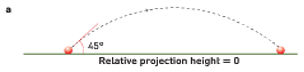
When height of release = landing height optimal angle of release is 45°
Having height of release equal to landing height maximises the distance covered by the projectile
Considered the "true" optimal angle, though rare in sport since most releases aren't at the exact same height as landing
Examples:
Soccer: Goal keeper kicking the ball across the pitch
Golf: Iron shot on a flat fairway
What is the optimal angle of release when height of release is higher than landing height?
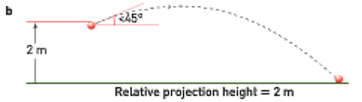
When the release point is higher than the landing point → optimal angle of release needs to be lower than 45°
EG: A basketball free throw or a shot put, released from above ground level and landing at ground level
What is the optimal angle of release when height of release is lower than landing height?
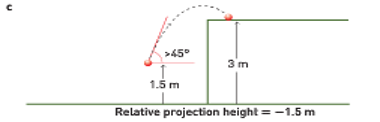
When the release point is lower than the landing point → optimal angle of release needs to be higher than 45°
EG: A high jump, or throwing a ball up onto a platform above your release point
What are the 3 scenarios for height of release?
Height of release: The difference between the height a projectile is released from and the height at which it lands or stops
The optimal angle of release depends on how the release height compares to the landing height:
Release height = landing height → optimal angle is 45° (rare in sport)
Release height > landing height → optimal angle is lower than 45° (e.g. basketball free throw, shot put)
Release height < landing height → optimal angle is higher than 45° (e.g. high jump, throwing onto a platform)
How does the velocity of release affect projectile motion? What are the two components of the velocity of release?
Velocity of release: The speed at which an object is thrown, kicked, or propelled into the air
Major factor in maximising horizontal distance
Determined by vertical and horizontal components
The greater the speed of release, the greater the horizontal range of the projectile
EG Long jump, approaching sprinting maximises horizontal velocity at take-off and therefore distance reached
What do the two components of velocity of release determine?
Vertical component → determines the height reached and the flight time
Horizontal component → determines the horizontal distance covered
How does the angle of release affect projectile motion?
Angle of release: The angle at which an object is projected into the air, which depends on the objective of the sport
When release and landing heights are equal, optimal angle for maximum horizontal distance is 45°
As it is the best combination of vertical velocity (flight time) and horizontal velocity (distance)
EG High jump → high angle of release, Volleyball block → angle is straight up
Why is 45 degrees the optimal angle for maximising distance?
As it is the best combination of vertical velocity (flight time) and horizontal velocity (distance)
Therefore when release height = landing height, optimal angle for maximum horizontal distance is 45°
When is equilibrium achieved?
Equilibrium: A state where all forces and torques are balanced
Occurs in two types
Static equilibrium: Standing still
Dynamic equilibrium: Constant velocity
How are equilibruim, stability and balance different?
Equilibrium is the state, balance is maintaining the state and stability is resisting changes to the state
Equilibrium: A state where all forces and torques are balanced
Balance: the ability to maintain and control equilibrium
Stability: being able to resist changes to equilibrium
How is height of centre of gravity a factor in affecting stability?
Height of centre of gravity (COG) -> BEND KNEES
Higher the centre of gravity the less stable a body will be
Lower the centre of gravity the more stable a body will be
How is the positioning of the line of the centre of gravity a factor in affecting stability?
Line of centre of gravity (LOG) -> shift to front edge
If the line of gravity is within the base of support, stability will be maintained
When the line of gravity falls outside the base of support an athlete will lose stability and fall over
E.g. for sprint starts athletes align their centre of gravity at the front edge of their base of support to make a quick start
How is the area of the base of support a factor in affecting stability?
Area of the base of support (BOS) -> WIDEN STANCE, ALIGN WITH INCOMING FORCE
The bigger the area of the supporting base, the greater stability
Athletes increase stability by widening their stance to increase the area of the base of support
Alignment of the base of support
The base of support should be aligned in the direction of the incoming force to increase stability
E.g. a footballer about to be tackled
What factors affect stability?
Height of centre of gravity (COG)
Line of gravity (LOG within BOS)
Area of base of support (BOS)
What is a lever?
A rigid bar that magnifies force and speed
What 3 parts do all levers consist of?
Axis: The pivot point or fulcrum
Resistance: The weight or load that is to be moved
Force: The effort required to move the resistance
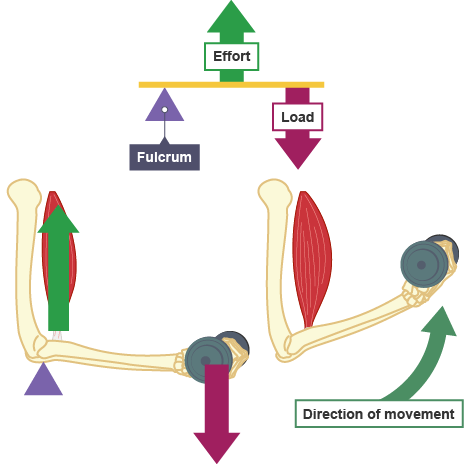
What are the 3 classifications of levers?
AhhhR Frig it’s levers: ARF
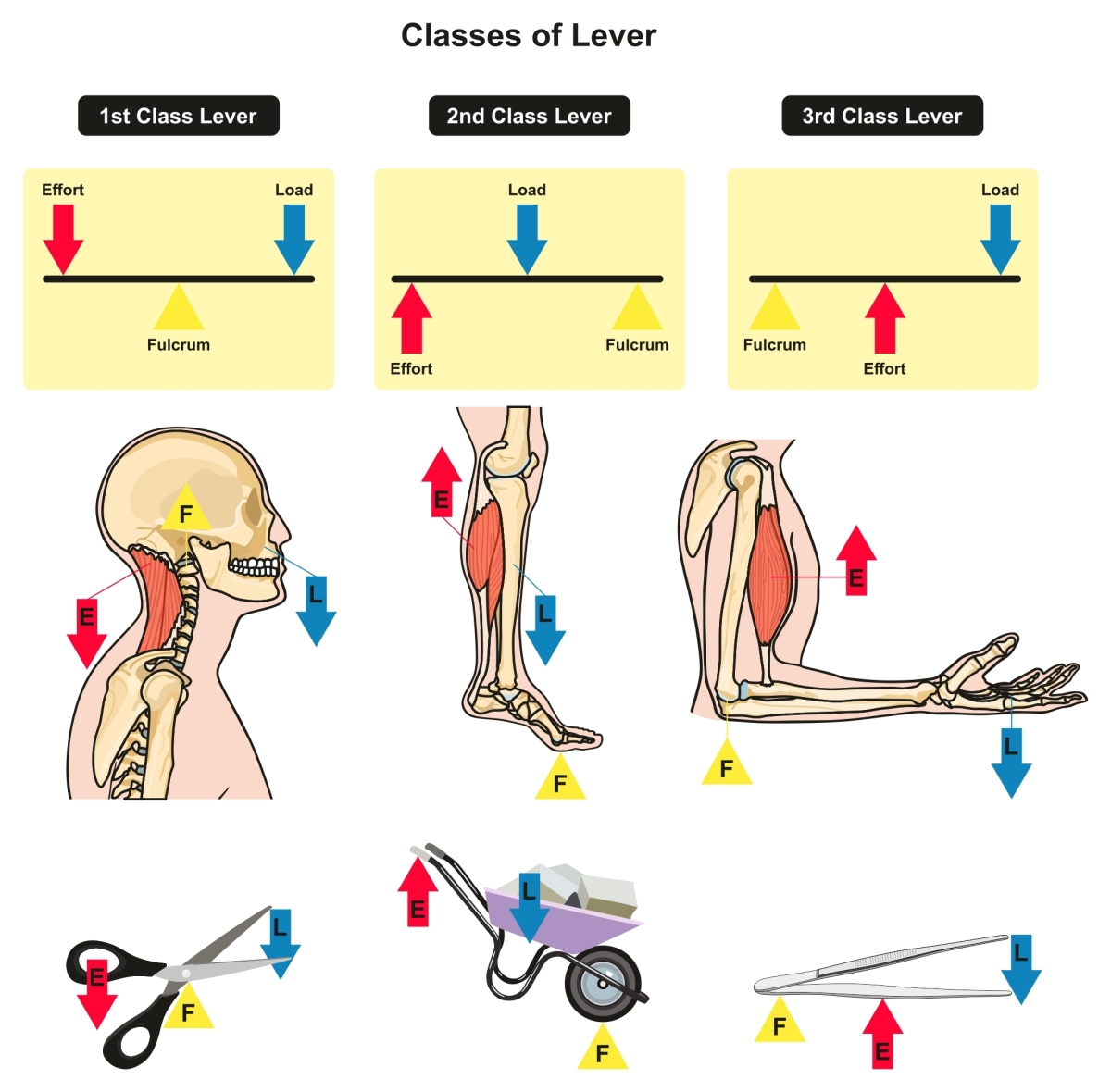
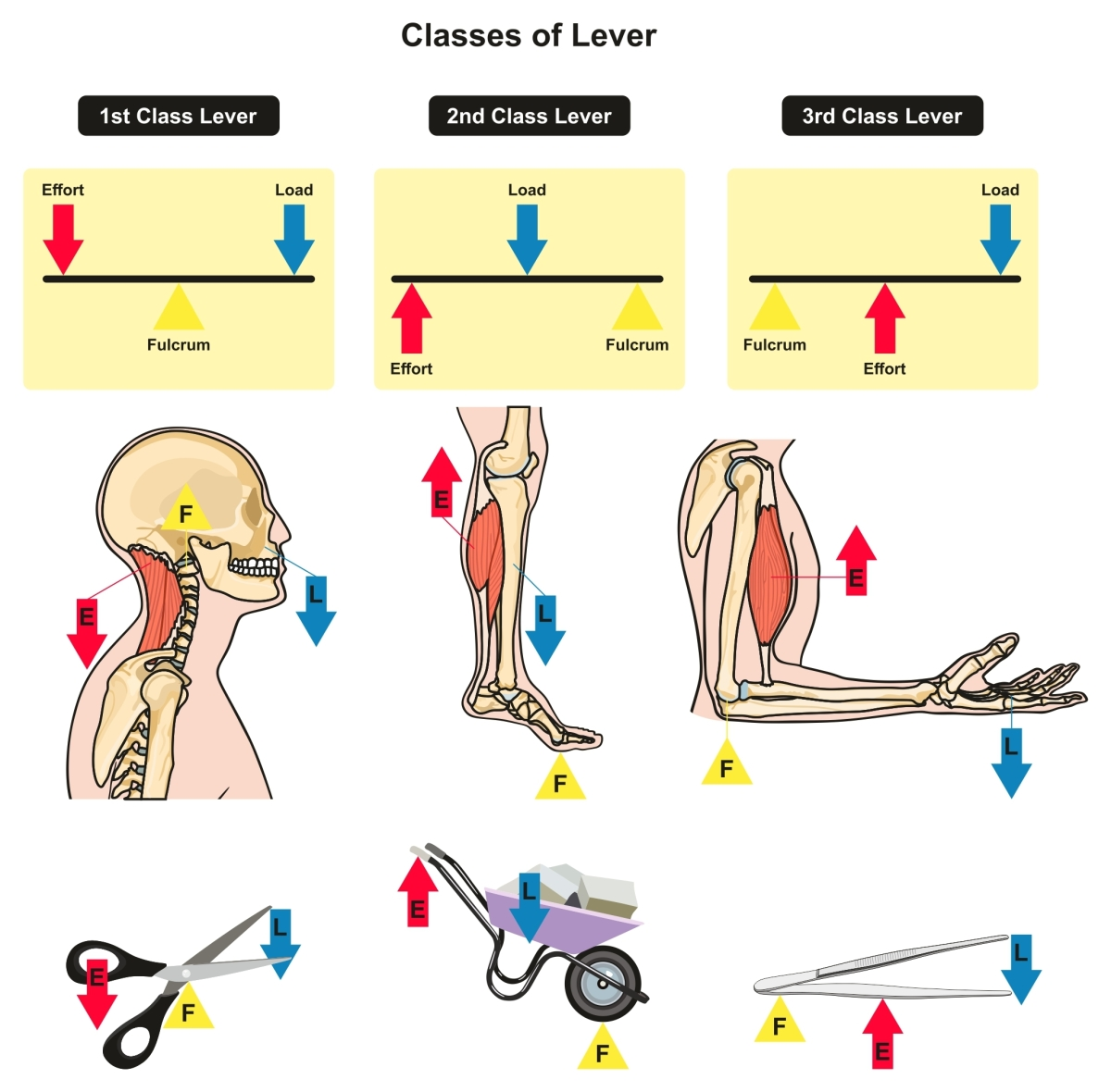
1st class levers: Axis in the middle
2nd class levers: Resistance in the middle
3rd class levers: Force in the middle
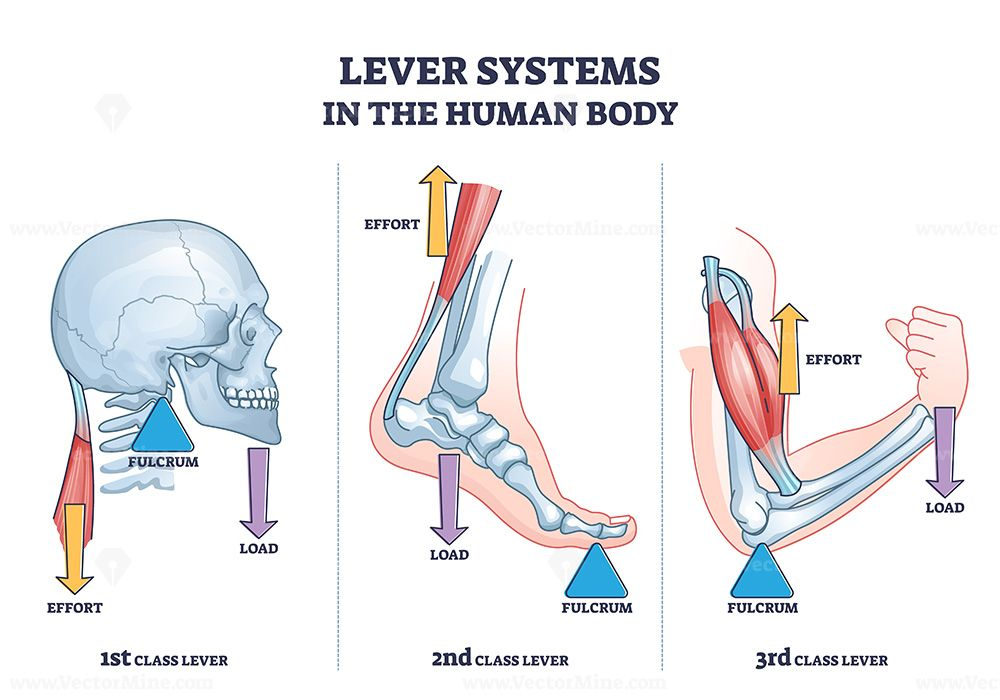
What are the characteristics of 1st class levers?
Axis in the middle
Not many examples in the human body
Amplifies force or speed depending on axis location and arm lengths
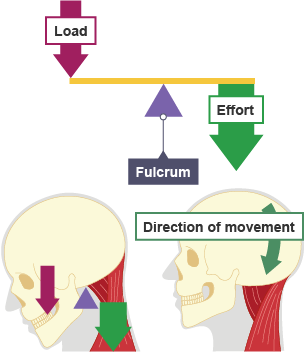
What are the characteristis of 2nd class levers?
Resistance in the middle
Favour force (all amplify force and speed but force the most for second class)
Not many examples in the human body (more than 1st class)
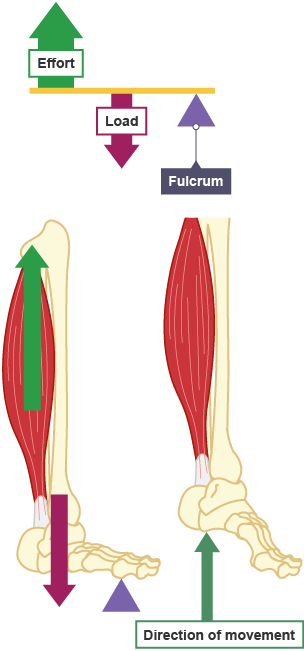
What are the characteristics of 3rd class levers?
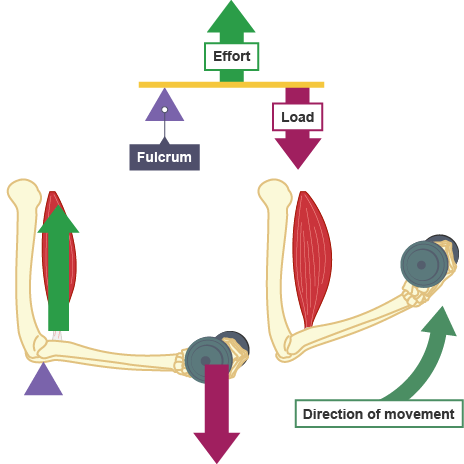
Force in the middle of the lever
Amplify speed (all amplify force and speed but speed the most for first class)
Many examples of 3rd class levers in the human body where the joints are the axis
Resistance arm always longer than force arm
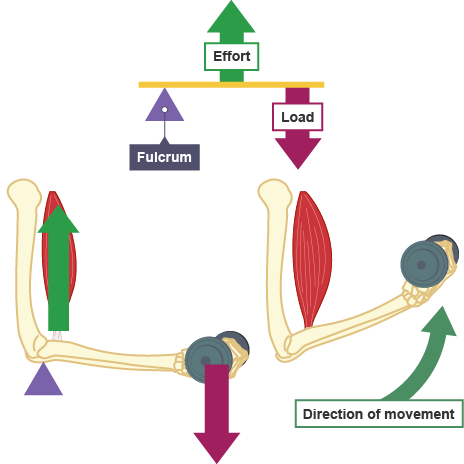
EG The arm is a third class lever, where the shoulder is the axis, force is the upper arm muscle (directly below the axis), resistance is centre of mass which is in the hand
Where is the force in all human body 3rd class levers?
3rd class levers: Amplify speed with force in the middle
Force is always directly below the axis
What is mechanical advantage?
Mechanical advantage: A measure of how much a level amplifies force
Calculated by: force arm/resistance arm
Mech adv. >1 = lever is built to increase force
Mech adv. 1 = lever is balanced between speed and force
Mech adv. <1 = lever is build to increase speed (3rd class, most in human body)
Further below 1, greater it amplifies speed
What are the two factors of mechanical advantage?
Force arm: Distance from teh force to teh axis
Resistance arm: Distance from the load to the axis
How does changing the resistance and force arm lengths affect the lever’s amplification of force and speed?
Increasing the force arm (relative to the resistance arm) → increases mech adv. → less force needed to move the load, but less speed/range of motion
Increasing the resistance arm (or using a longer lever like a bat/racquet) → decreases mechanical advantage → more force is required to move it, but this increases the speed and range of motion
Key trade-off: Levers amplify either force or speed, not both — a longer resistance arm sacrifices force for speed, while a longer force arm (or shorter resistance arm) sacrifices speed for force.
Application to the body: Most are third-class levers with a short force arm relative to resistance arm (mech adv. of less than 1) This trades away force for a big gain in speed and range of movement, which is why the body is generally built for speed and mobility rather than raw strength at the joints
How do you answer almost all biomechanics questions?
Go DEEP
Define EG Law of Acceleration states…
Equation EG F = ma
Explanation EG The cyclist with the smaller mass will accelerate faster
Performance link EG Thus they will overtake and win the race