W10 Colour Vision
 Studied by 0 people
 Call with Kai
 Learn
Learn Practice Test
 Spaced Repetition
 Match
Match Flashcards
 Knowt Play
1/19

There's no tags or description
Looks like no tags are added yet.
Name | Mastery | Learn | Test | Matching | Spaced | Call with Kai |
|---|
No study sessions yet.
20 Terms
What is light?
Distribution of energy across wavelengths in the visible range (400-700nm)
Are dogs colour blind?
They only see a range of limited colours as they only have 2 types of cones, resulting in a red-green blindness.
They do have excellent night vision due to many rods and large pupils
What types of receptors do the retina contain?
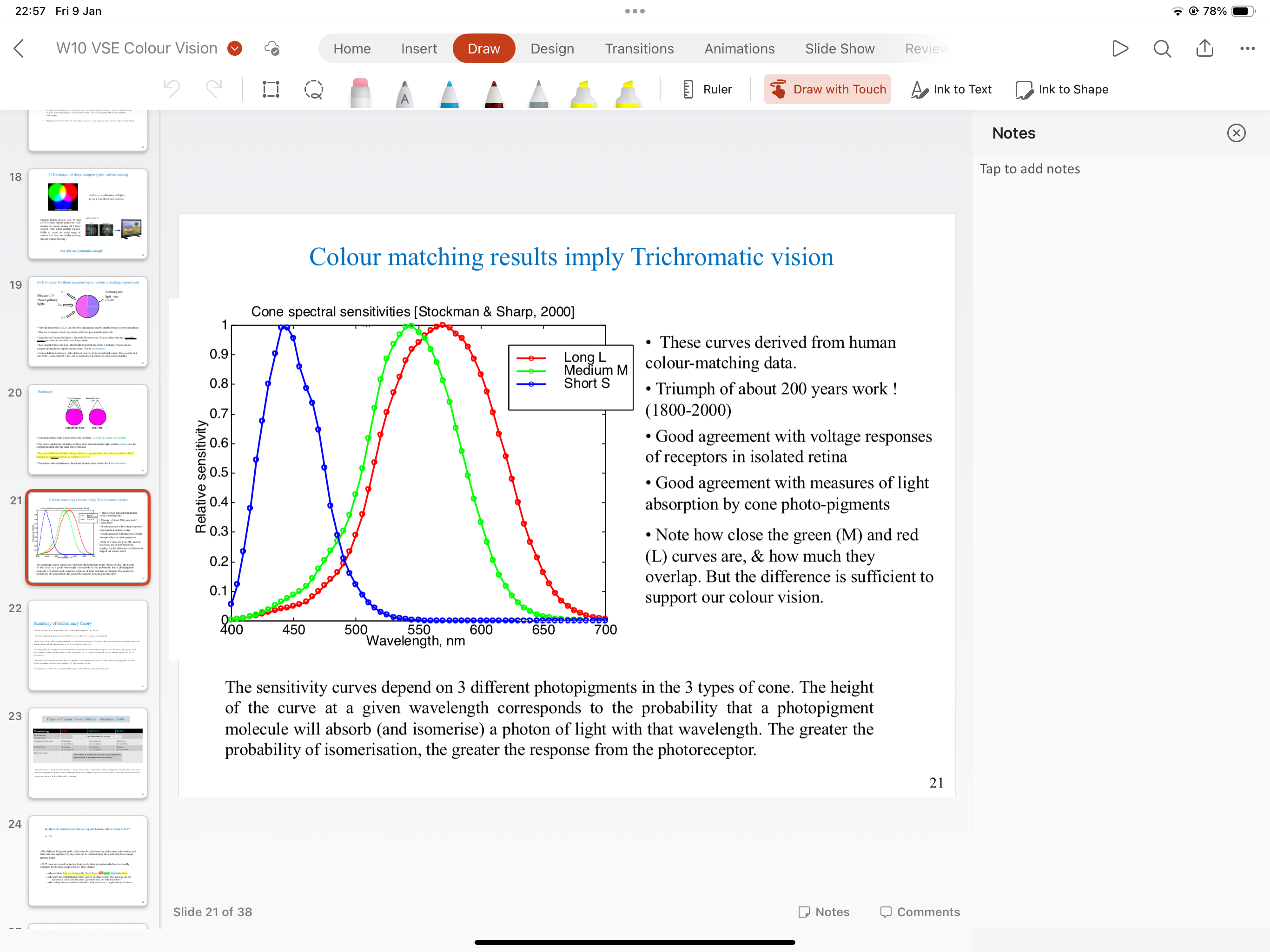
Rods, and 3 types of cone- each contains a different pigment that absorbs some wavelengths better than others
What is the function of rods?
They’re responsible for our ability to see in dim light with a peak sensitivity at 510nm (greenish part)
What are features of the cones?
Pigments in each cone have their peak absorptions at 430, 530 and 560nm- these are the short, middle and long wavelength sensitive cones
Why is colour vision useful in humans?
Distinguish objects from each other, non-verbal social communication, detecting object borders and modern day information processing and communicating
Why is colour vision useful in animals?
Camoflauge, colourful displays in mating, warning signals
What are the 3 perceptual dimensions of colour?
Hue- psychological dimension of colour corresponding to wavelength of light
Saturation- psychological dimension corresponding to spectral purity
Brightness- psychological dimension corresponding to brightness.
What are the conclusions for requirements of colour vision?
Colour vision is impossible when there’s only one receptor type (only rods operate in dim light which is why night vision is colour blind)
Species with colour vision must have at least 2 types of receptor with different photo-pigments
What is the principle of univariance?
Although light intensity varies in intensity and wavelength, the response of a photoreceptor only varies along one dimension- thus a change in intensity or wavelength may produce the same response from the receptor
What is evidence for the 3 receptor types?
Additive combination of light (mixing of primary colours) gives new colours
Colour matching experiment shows just 3 suitably chosen primaries are needed to match any colour
What are metamers?
The 2 distributions of light energy which are not equivalent but nevertheless look identical to a human observer are called metamers
What is the summary of the trichromacy theory?
The 3 cones types each with different photopigments are each selective for a different range of wavelengths. We can see how many photons each cone has absorbed but nothing ab which photon.
Changing the wavelength of a monochromatic light changes the relative response of the 3 cone types.
Trichromacy is the basis of colour technology in the print industry and colour TV
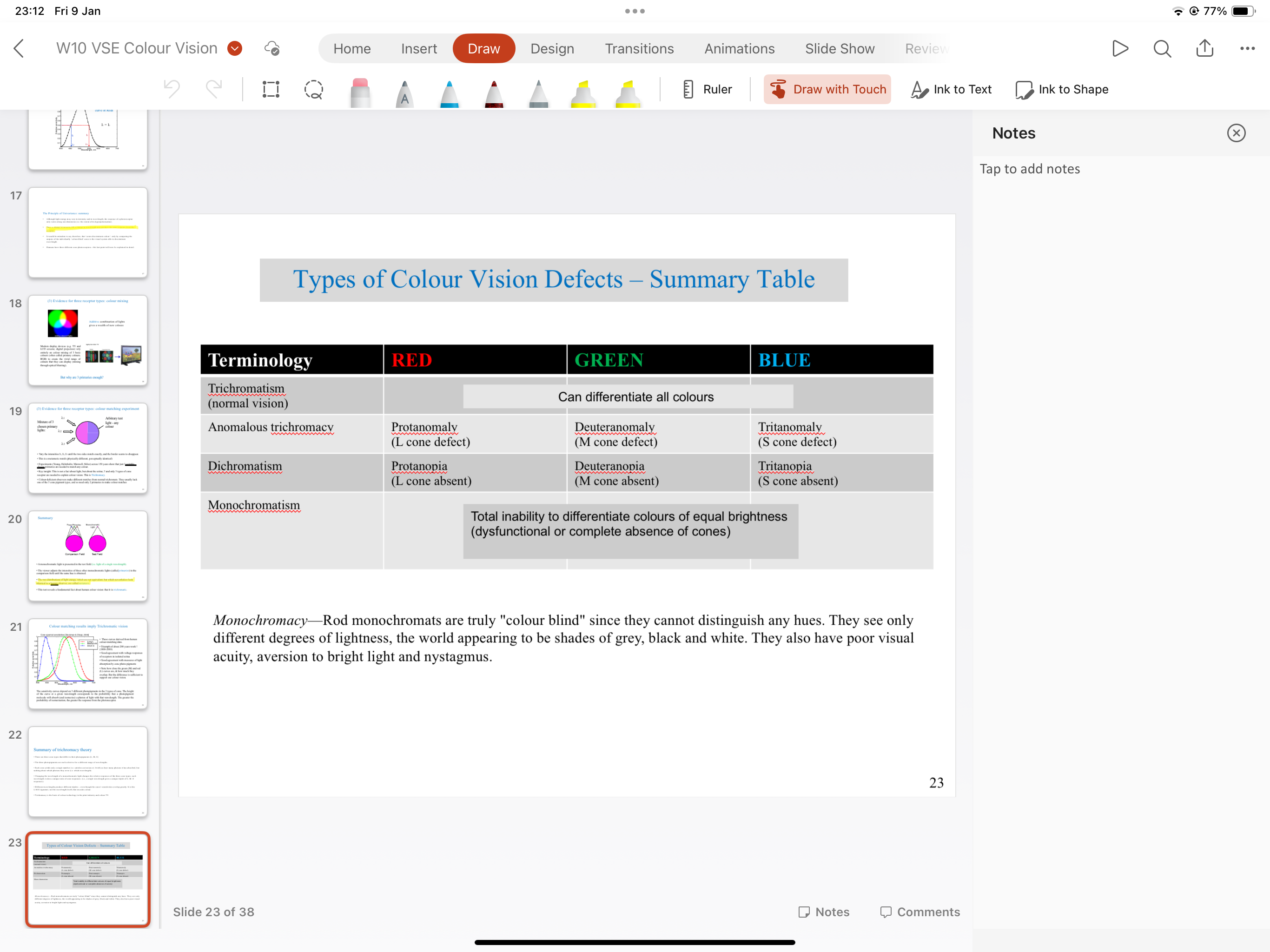
What is a summary of colour vision defects?
…
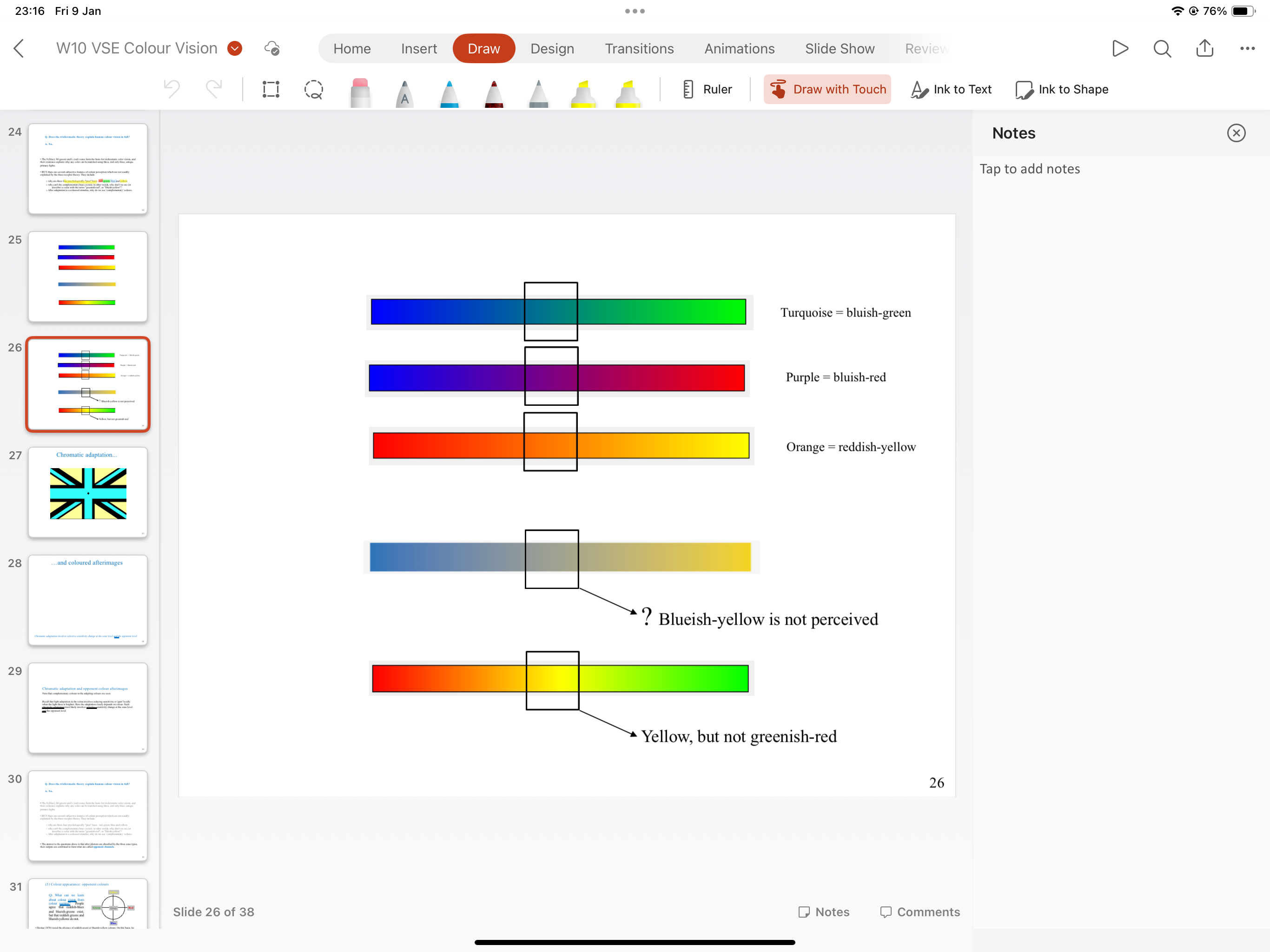
What does the trichromatic theory fail to explain?
Why there are 4 psychologically pure hues (red green blue yellow)
Why can’t the complementary hues co-exist
After adaptation to a coloured stimulus why do we see complementary colours
What happens after photons are absorbed by the 3 cone types?
Their outputs are combined to form opponent channels
What did Hering say about opponent colours?
Red-green, blue-yellow and white-black channels exist- a positive signal in the RG channel would signal redness- a negative signal would signal greenness and inhibit redness and vice versa for the other channels
How is the luminance channel formed?
The combined output of L, M and S cones form this channel, coding along the white black dimension of colour space
How is the red green channel formed?
The outputs of L and M cones form this channel- half the neurones are +R/-G (excite red light, inhibit green light) and vice versa- it cannot code for the perception of reddish green
How is the blue-yellow channel formed?
The combined outputs of the L and M cones and the S cones form this channel- majority of the neurones in this channel are +b/-Y (excite blue, inhibit yellow)- it cannot code for blueish yellow