M3 Online: Antibody and Antigens
 Call Kai
 Learn
Learn Practice Test
 Spaced Repetition
 Match
Match Flashcards
 Knowt Play
1/14

Earn XP
Description and Tags
This information is from the online module
Name | Mastery | Learn | Test | Matching | Spaced | Call with Kai | Chat |
|---|
No analytics yet
Send a link to your students to track their progress
15 Terms
M3: Features of Biologic Antigens
Q: What is the basic definition of antigen?
Q: What recognize and bind to the antigen?
Antigen: substances that are recognized by immune system
All functions of antibodies depend on their ability to specifically bind antigens
M3: Features of Biologic Antigens
Q: Is it only the antibody that the antigen can bind to or there is another one?
An antigen is any substance that can be bound by antibody or by T cell receptor (TCR)
M3: Features of Biologic Antigens
Q: Which features does the antibodies can recognize of an antigen?
lipids
simple sugars
nucleic acids
proteins
All above
complex carbohydrates
All above
M3: Features of Biologic Antigens
Q: Which features does the TLR can recognize of antigen
simple sugars
complex carbohydrates
proteins
nucleic acids
peptides derived from proteins
lipids
All above
ONLY peptides derived from proteins
M3: Features of Biologic Antigens
Q: Can all antigens activate lymphocytes? What are they called?
Not all antigens can activate lymphocytes, only some which are called immunogens
M3: Features of Biologic Antigens
Q: It is known that small chemicals itself cannot activate B cells because they are not immunogenic. In order to generate antibodies, what does the small chemicals need?
The small chemicals need to physically attached(coupled) to larger protein (which itself is an an immunogen)
M3: Features of Biologic Antigens
Q: When both the small chemical and protein are conjugated together, they are known to act as an immunogen. What are the names for the small chemical and the larger protein?
Hapten
antibody
carrier
immunogen
globulin
Hapten: small chemical
Carrier: the large protein to which it is conjugated
M3: Features of Biologic Antigens
Q: What is a antigenic determinant or epitope?
It is where an antibody only bins a portion of a macromolecule since they are generally bigger than antigen-binding region of antibodies
M3: Features of Biologic Antigens
INFORMATION ON TYPE OF EPITOPES
Since macromolecules can contain multiple epitopes, it is known that they can be repeated and each can be bound by an antibody. This is called polyvalency or multivalency. The spatial arrangement of different epitopes influences antibody binding.
M3: Features of Biologic Antigens
INFORMATION ON TYPE OF DETERMINANTS
Nonoverlapping determinants are when epitopes that are well separated can be bound by two or more antibodies and do not influence each other
Overlapping determinants are when epitopes are close together, the binding of antibody to the first epitope causes steric hinderance, preventing binding of the second
the binding of the first antibody can also cause conformational changes that affect the binding of second antibody
The formation of some epitopes depends on primary structure of protein, while other epitopes depend on the tertiary structure
M3: Features of Biologic Antigens
INFORMATION OF TYPES OF DETERMINANTS
Linear determinants: epitopes formed by several adjacent amino acids (USUALLY SIX)
Conformational determinants: formed when amino acids are spatially juxtaposed in folded protein. Denaturing destroys these epitopes.
Neoantigenic determinants: formed upon post-translational modification as glycosylation or phosphorylation
just info
M3: Structure and Chemical Basis
Q: Define affinity and avidity. Which definition it belongs to?
Strength of binding between an antibody and an epitope
Overall strength of attachment; it can be greater than ___
AFFINITY: strength of binding between an antibody and an epitope
AVIDITY: overall strength of attachment; it can be greater than affinity

M3: Structure and Chemical Basis
INFORMATION
a monovalent interactions results when epitopes are spaced wide apart on surface of a microbe.
although affinity of antibody for antigen may be high, this is a LOW avidity interaction
a bivalent or polyvalent interaction results when epitopes are closer together and both antigen binding sites on an IgG molecule (bivalent) or all 10 antigen-bindings on IgM are engaged. This is a high avidity interaction
M3: Structure and Chemical Basis
INFORMATION
polyvalent antigens are biological significance because effector functions of antibodies are optimallly tiggered
formation of antigen-antibody complex is also function of relative concentrations of antigen and antibody
formation of large immune complexes can cause inflammation and disease
at correct amounts of antibody to antigen—called zone of equivalence, a network of attached molecules if formed
increasing antigen (zone of antigen excess) or increasing antibody (zone of antibody excess) can dissociate immune complexes


M3: Structure—Function Relationships in Antibody
Features Related to Antigen Recognition—SPECIFICTY
Antibodies are very specific for antigen.
They can distinguish two linear epitopes by difference of a single amino acid or different chemical isomers
Some antibodies can bind to different but a structurally-related antigen This is called a cross-reaction and is basis for disease
M3: Structure—Function Relationships in Antibody
Features Related to Antigen Recognition—DIVERSITY
an individual can make a lot of number of structurally distinct antigens—up to 10^11—each with different specificity
ability of antibodies in a given individual to bind large number of antigens reflects antibody diversity
collection of antibodies with different specificities represents the antibody repertoire
genetic mechanism for this diversity is random recombination of a set of inherited germline DNA sequences into functional genes that encode antibody heavy and light chains
M3: Structure—Function Relationships in Antibody
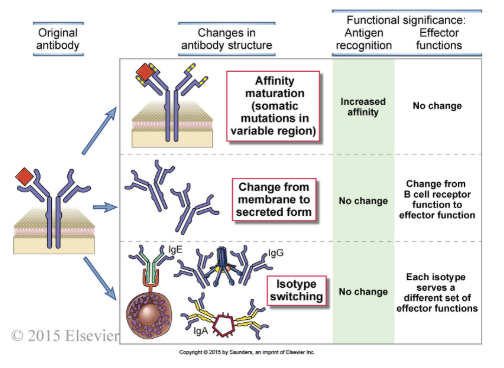
Features Related to Antigen Recognition—AFFINITY MATURATION
tight binding between antigen and antibody is needed to activate B cells
this binding achieved by generation of high affinity binding antibodies
mechanism for making high affinity antibodies are called somatic mutation, involves changes in V region of an antibody during T cell dependent humoral immune responses to protein antigens
B cells that produce higher affinity antibodies preferentially bind to antigen and re selected to become dominant B cell population made in response to that antigen (survival of the fittest)
overall process of affinity maturation increases antibody binding from Kd ranging 10^-7 to 10^-9M during a primary response to a Kd of 10^11 M or less during a secondary antigen response
.
M3: Structure—Function Relationships in Antibody
Features Related to Effector Function
Many effector functions of antibody are mediated by Fc portion of molecules.
Antibody isotypes that differ in Fc regions perform distinct functions
IgG coats microbes and helps phagocytosis because its Fc portion binds to Fc receptors expressed on neutrophils and macrophages
C1q complement protein initiates classical complement pathway by binding to Fc portions of IgM or IgG
Various effector mechanism are only activated when antibody binds antigens and not by free antibody
changes in isotype of antibodies influence how and where these responses work to eliminate antigen
after stimulation with antigen, a B cell produces antibodies of different isotype but with same V domains (antigen-binding site)
M3: Structure—Function Relationships in Antibody
Naive B cells produce IgM and IgD and upon further antigen activation (ex: microbe recognition) they undergo isotype switching in which C region of heavy chain is changed
isotype switching enables original B cell (that made IgM/IgD) to produce IgG with same antigen specificity to eradicate a bacterial infection or IgE to eliminate a parasite
heavy chain C region determines tissue distribution of antibody molecules
As B cells are activated these lose expression of membrane-bound antibody and express secreted antibody
IgA is secreted through mucosal epithelia and is major antibody found in mucosal secretions and breast milk
Neonatal IgG secreted from mothers help protect infants from infection
The transfer of maternal IgG is mediated through placental and intestinal expressed Fc receptors