Linguistics 2
 Studied by 0 people
 Call Kai
 Learn
Learn Practice Test
 Spaced Repetition
 Match
Match Flashcards
 Knowt Play
1/28

There's no tags or description
Looks like no tags are added yet.
Name | Mastery | Learn | Test | Matching | Spaced |
|---|
No study sessions yet.
29 Terms
Phoneme
The smallest unit of sound that can change the meaning of a word in a particular langauge.
Phone
Any physical speech sound regardless of its role in a language.
Consonant description and classification
A speech sound that is produced by obstructing or constricting airflow in the vocal tract.
Can be
plosive(block air and release, p),
nasal (aiflow through nose due to lowered velum, m),
fricative (air through narrow channel creating friction, f/s/th),
affricate (starts with stop then release, /ch/ or /d͡ʒ/),
approximant (articulators come close without touching, w/y)
Can be
bilabial (both lips brought together, p/m),
labio-dental (lower lip contacts upper teeth, f/v),
dental (tongue touches upper teeth, /th/),
alveolar (tongue touches alveolar ridge, t/d/n),
post-aveolar (tongue touches area behind alveolar ridge, sh),
palatal (tongue touches palate, y),
velar (tongue touches velum, k/g),
glottal (from gap between vocal cords, h)
Vowel description and classification
A speech sound produced with an open vocal tract and no obstruction of airflow.
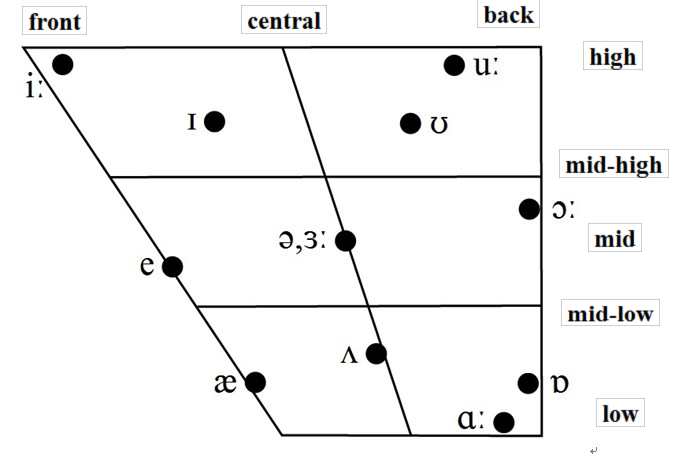
Allophonic variation
Different pronunciations (allophones) of the same phoneme that do not change a word’s meaning
Syllable structure
the internal organization of a syllable as onset (initial consonant), nucleus (vowel core), and coda (final consonant)
Prosody and stress patterns
Rhythm, stress, intonation, and loudness patters in speech
Stress features of varieties
Phonetic environment of sound changes
The sounds or context surrounding a sound which cause it to change (ex t-deletion)
Speech accent features
vowel quality, consonant articulation, rhythm, intonation, stress patterns
Rhoticity
The pronunciation of the /r/ sound in all positions where it appears in spelling
t-glottalisation
The replacement of the t sound with a glottal stop
h-dropping
The omission of the h sound at the start of stressed syllables
flapping
Intervocalic /t/ or /d/ (between vowels) turns into a quick tongue tap [ɾ]. butter→ budder
consonant cluster simplification
Reduces groups of two or more adjacent consonants by deleting or altering some, easing pronunciation (friend → fren)
substitution of dental fricatives
Replaces “th” sounds with other consonants often t or d
final obstruent devoicing
voiced obstruents (stops or fricatives like b,d,g,v) at the end of words lose their voicing and become voiceless (ex: dutch hard → hart)
unaspirated plosives
stop consonants released without a puff of air like “p” in “spin”
tense-lax neutralisation
merges distinction between tense (longer, peripheral) and lac (shorter, central) vowels (ex: Marry-merry-Mary merger: Lax /ɛ/ and tense /eɪ/ neutralize before intervocalic /r/)
vowel reduction
weakens vowels in unstressed positions making them short, more central and often schwa-like
non-reduction of vowels
unstressed vowels stay full and distinct from schwa
centring dipthongs
start from peripheral vowel and move towards central schwa sound
rising diphthongs
start with glide or less prominent sound and rise to stronger vowel
diphthongisation
The process where a single vowel sound in a syllable becomes two vowel sounds in a syllable
monophthongisation
The process where two vowel sounds in a syllable becomes one vowel sound in a syllable
Voiced
vibration
fricative
consonant produced by forcing air through a narrow channel made by placing two articulators close together
tense
greater muscular tension and higher tongue position and longer duration like /u/ in boot
lax
relaxed muscles, shorter duration, central tongue position, often monophthongs, ʊ in put