Knowledge Checks 1-9
 Call Kai
 Learn
Learn Practice Test
 Spaced Repetition
 Match
Match Flashcards
 Knowt Play
1/39

There's no tags or description
Looks like no tags are added yet.
Name | Mastery | Learn | Test | Matching | Spaced | Call with Kai | Chat |
|---|
No analytics yet
Send a link to your students to track their progress
40 Terms
A hydrogen bond forms when a partially positive hydrogen is attracted to a lone pair on another atom. The atom containing the lone pair is called the H-bond _____
acceptor
Which statement best explains why noncovalent interactions are useful in biological systems?
Option A
They are stronger than covalent bonds
Option B
They cannot be broken once formed
Option C
They can form and break as needed
Option D
They require metals to form
C
A carbon-carbon single bond and a carbon-carbon double bond have similar atoms involved, yet they behave differently.
Which statement best explains this difference?
Option A
Double bonds restrict rotation because of pi-bond overlap.
Option B
Single bonds are formed by complete electron transfer
Option C
Double bonds contain fewer electrons than single bonds.
Option D
Single bonds produce ionic interactions.
A
Which statement best describes why hydrophobic molecules tend to aggregate in water?
Option A
Water molecules donate electrons to nonpolar groups
Option B
Water becomes more ordered around isolated nonpolar surfaces
Option C
The nonpolar molecules form hydrogen bonds with water
Option D
The nonpolar molecules become charged in water
B
A bond between carbon and hydrogen is generally considered nonpolar because:
Option A
The bond contains a pi bond
Option B
Carbon and hydrogen completely transfer electrons
Option C
Carbon and hydrogen have similar electronegativities
Option D
Hydrogen is more electronegative than carbon
C
A molecule contains both a charged phosphate group and a long hydrocarbon chain.
How would this molecule be classified?
Option A
Hydrophilic
Option B
Amphipathic
Option C
Nonpolar
Option D
Hydrophobic
B
A water molecule can participate in up to four hydrogen bonds because it:
Option A
Contains four covalent bonds
Option B
Contains two ionic bonds
Option C
Contains four atoms
Option D
Contains a hydrogen-bond donor and acceptor
D
Because of its bent geometry, water possesses a net molecular _____
Dipole
Match the observations with the most likely explanation:
Ice Floats on Water
A nonpolar molecule dissolved poorly in water
Nonpolar groups cluster together in solution
A. Water cannot form favorable interactions with nonpolar surface
B. entropy increases
C. Water forms an open crystal lattice
1C
2A
3B
Water is a liquid at room temperature, whereas similar hydrides such as H₂S and NH₃ are gases.
What is the best explanation for this difference?
Option A
Water forms an extensive network of hydrogen bonds
Correct answer
Option B
Water contains more covalent bonds
Option C
Water contains heavier atoms than H₂S and NH₃
Option D
Water has a lower molecular weight
A
10.0 mL of 0.10 M HCl is diluted to a final volume of 100.0 mL.
What is the pH of the resulting solution?
2.0
A solution contains a weak acid with pKa = 4.8.
The acid concentration is 0.50 mM and the conjugate base concentration is 5.0 mM.
What is the pH?
5.8
A weak acid has a pKa of 6.2.
The concentrations of acid and conjugate base are equal.
What is the pH?
6.2
Which solution would have a pH exactly one unit above its pKa?
Option A
[Base] = 100[Acid]
Option B
[Base] = 10[Acid]
Correct answer
Option C
[Base] = [Acid]
Option D
[Base] = 2[Acid]
B
(Select any that apply)
Which form of an acid with a pKa= 4.7 would predominate at pH=8?
Option A
the ionized form would predominate.
Option B
the deprotonated form would predominate.
Option C
the unionized form would predominate.
Option D
the protonated form would predominate.
Option E
the cation would predominate.
Option F
the anion would predominate.
Option G
the ionized and unionized forms would be equal.
ABF

What is the form of this amino acid when it exists at ph=1?
ph at 1 is positive: look for answer with positive h3n and cooh

An amio acid has pKa values of 2.34 and 9.60.
What is its isoelectric point (pI)?
5.97
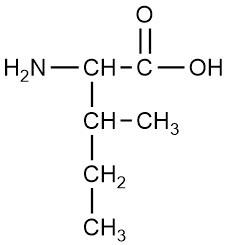
Select Any That Apply
Due to its side chain, this amino acid can be classified as ______________.
A. nonpolar
Option B
aliphatic
Option C
aromatic
Option D
polar
Option E
basic
Option F
acidic
AB

The one letter code for this amino acid is ______________.
P (for proline)
Match the amino acid to the MOST likely description.
Proline
Lysine
Tyrosine
Leucine
A. Frequently participates in interactions with the negative phosphate backbone of DNA
B. Often detected by absorbance near 280 nm
C. Commonly found in turns or kinks because of restricted backbone flexibility
D. Frequently buried in protein interiors due to hydrophobic side chain
1C
2A
3B
4D

Which area of the Ramachandran plot represents the allowed psi and phi angles for the most stable form of alpha helices?
C
Which statement correctly describes the primary structure represented by W-H-P-Y?
Trp-His-Pro-Tyr

Which one letter code corresponds to the amino acid at the C- terminal end of this tetrapeptide?
Q
If a peptide has the sequence: Leu-Gly-Tyr-Val
How many peptide bonds are present?
3
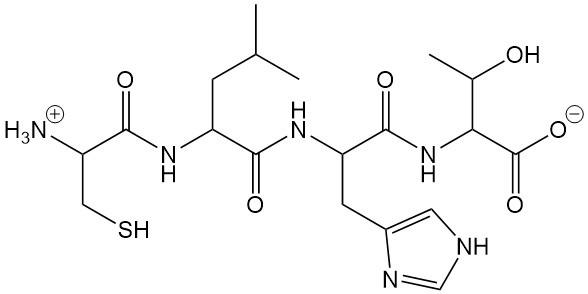
The primary sequence of this tetrapeptide is?
Cys-Leu-His-Thr
A researcher replaces a glycine residue in a β-turn with proline.
Why might this substitution be tolerated better in a β-turn than in an α-helix?
Option A
Proline readily donates hydrogen bonds in helices.
Option B
Proline often occurs in turns and can introduce changes in chain direction.
Option C
Proline forms disulfide bonds that stabilize turns.
Option D
Proline stabilizes β-sheets through aromatic interactions.
B

Which secondary structural element is shown by arrow #4?
beta strand

Which interaction is responsible for maintaining the level of protein structure shown here?
Option A
Backbone hydrogen bonds that stabilize α-helices and β-sheets
Option B
Covalent bonds between amino acids and water
Option C
Peptide bonds within a single amino acid sequence
Option D
Interactions between folded polypeptide chains
D
A folded protein is exposed to high concentrations of urea and loses its native three-dimensional structure.
This process is called:
denaturation

The Ramachandran plot below shows four regions labeled A-D. Match each region with the structural feature most commonly associated with that region.
Region A
Region B
Region C
Region D
Beta strand/sheet
Right-handed alpha helix
Left-handed alpha helix
Allowed but uncommon conformations often occupied by glycine
A1
B4
C2
D3
A formulation scientist discovers that a protein-based cosmetic ingredient gradually develops visible particles and loses activity during storage, even though no peptide bond cleavage is detected.
What is the most likely explanation?
Option A
Glycation of lysine side chains
Option B
Oxidation of aromatic amino acids
Option C
Protein aggregation
Option D
Deamidation of asparagine residues
C
A drug discovery team is evaluating the shelf-life of a protein therapeutic. After several months of storage, the biologic exhibits reduced activity and altered structural properties. Further analysis shows that multiple asparagine side chains have been chemically modified.
Option A
Phosphorylation
Option B
Acetylation
Option C
Ubiquitination
Option D
Deamidation
D
A patient with poorly controlled diabetes develops progressive neuropathy and retinopathy. Researchers suspect that long-term protein damage is contributing to these complications.
Which process is most directly linked to the protein damage?
Option A
Proteolytic degradation of proteins
Option B
Reaction of glucose with amino groups on proteins
Option C
Ubiquitin-mediated protein turnover
Option D
Addition of phosphate groups to proteins
B
A structural biologist needs to determine the structure of a 500-kDa protein complex containing multiple membrane proteins.
Which technique would be the most appropriate starting point?
Option A
Mass spectrometry
Option B
X-ray crystallography
Option C
NMR
Option D
Cryo-electron microscopy
D
A researcher wants to study how a small protein moves and changes shape while dissolved in solution.
Which technique would be most appropriate?
Option A
X-ray crystallography
Option B
NMR
Option C
Cryo-electron microscopy
Option D
Mass spectrometry
B
Match each with correct option
ATP binds myosin
ATP Hydrolysis
Pi releases
ADP releases
A. Myosin head becomes cocked
B. Strong actin binding occurs and force generation begins
C. Actin released from myosin
D. Occurs after completion of power stroke
1C
2A
3B
4D
A drug discovery teams wants to inhibit force generation by preventing the conformational change that occurs after ATP Hydrolysis. Which step of the contraction cycle would be most directly affected?
a. exposure of the actin-binding site
b. cocking of the myosin head
c. assembly of actin filaments
d. binding of calcium to troponin c
B
Calcium initiates contraction by binding to ____
Troponin C
A patient accidently ingests a toxin that prevents release of intracellular calcium in skeletal muscle. Which is mostly likely to occur?
a. enhanced power strong generation
b. reduced muscle contraction
c. increased ATPase activity
d. continuous muscle contraction
B
Match each with its description
Sarcomere
Myofibril
Thick filaments
Thin filaments
A. composed of actin
B. composed of myosin
C. Thread like structure that runs length of muscle fiber
D. Repeating contractile unite extending from z-line to z-line
1D
2C
3B
4A