Lecture 2: Motor & Premotor Cortex
 Call Kai
 Learn
Learn Practice Test
 Spaced Repetition
 Match
Match Flashcards
 Knowt Play
 Podcast
1/69

There's no tags or description
Looks like no tags are added yet.
Name | Mastery | Learn | Test | Matching | Spaced | Call with Kai | Chat |
|---|
No analytics yet
Send a link to your students to track their progress
70 Terms
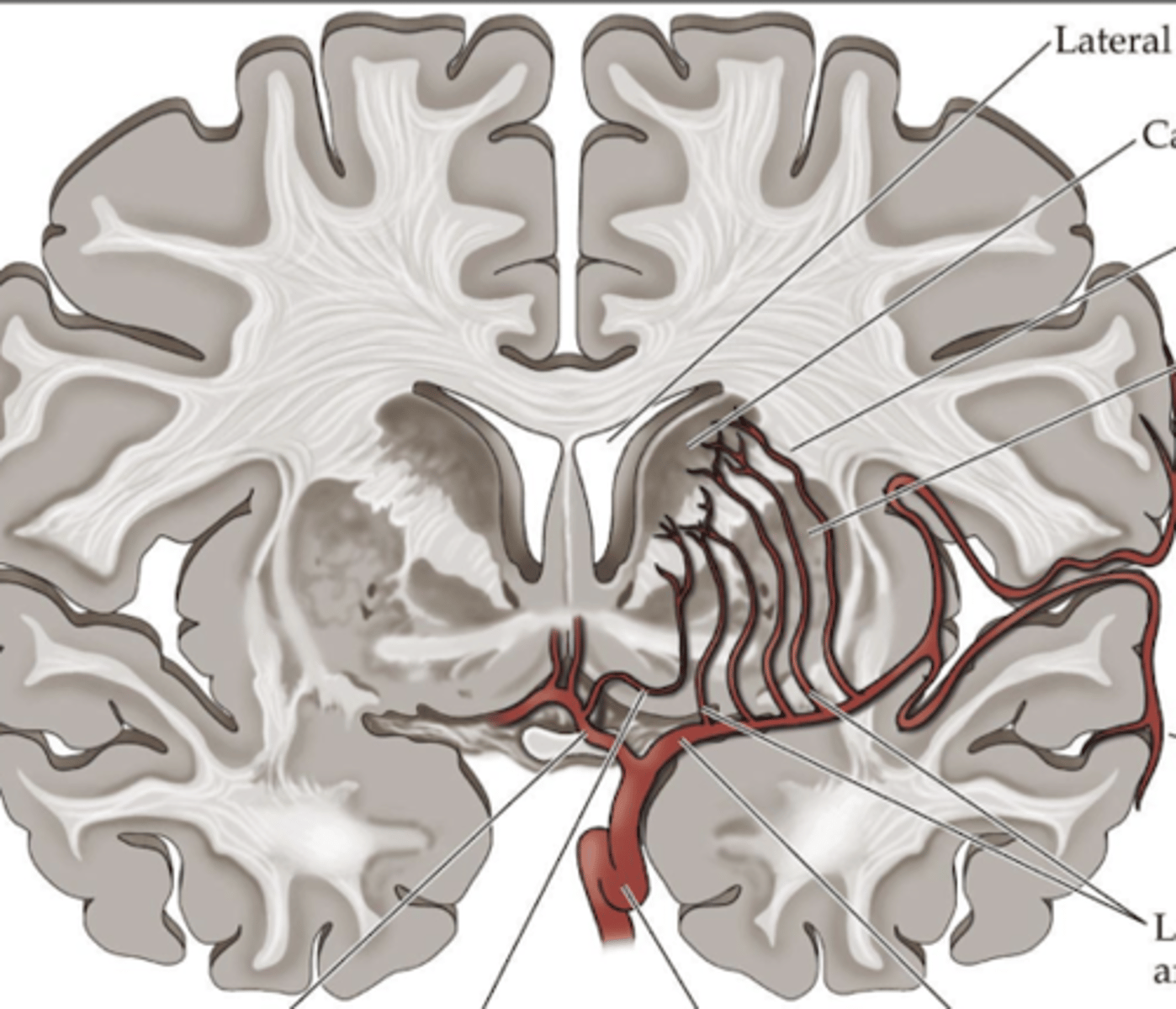
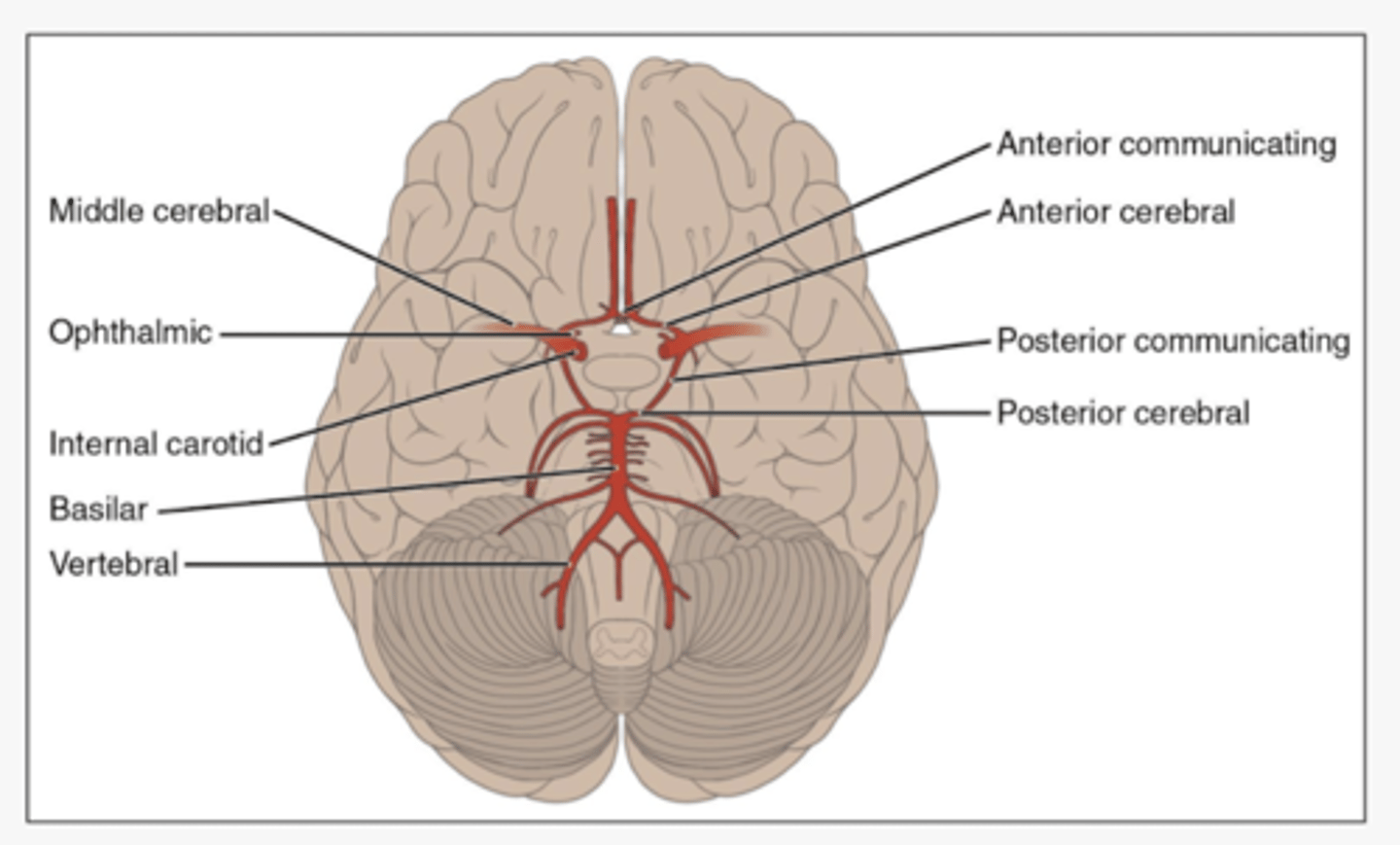
What structures provide blood supply to the brain?
Internal Carotid Arteries
Vertebral Arteries
What does the Middle Cerebral Artery (MCA) supply?
Lateral portions of the cerebrum
Portions of the frontal, parietal, temporal, and occipital lobes
Supplies the primary motor & somatosensory areas for the upper limb.
Which areas does the Anterior Cerebral Artery (ACA) supply?
Superior and anterior portions of the cerebrum
Frontal and parietal lobes
Supplies areas responsible for the lower limb.
What regions are supplied by the Posterior Cerebral Artery (PCA)?
Posterior and inferior portions of the cerebrum
Occipital and temporal lobes.
What are the main types of cerebral arteries?
Anterior Cerebral Artery (ACA)
Middle Cerebral Artery (MCA)
Branches of the carotid artery.
How can you think of the Basilar Artery’s function?
supplies oxygenated blood to the brainstem and cerebellum. it is formed by fusion of 2 vertebral arteries
Where do ischemic strokes mainly occur in the brain?
In the Middle Cerebral Artery (MCA), responsible for 2/3 of embolic strokes due to its direct blood flow from carotid arteries.
What critical brain region is supplied by the MCA?
The Internal Capsule, where ischemic strokes can lead to significant motor and sensory deficits.
What is the function of the Circle of Willis?
- Balances blood pressure between the hemispheres
- Provides alternate routes for blood flow if one artery is blocked.
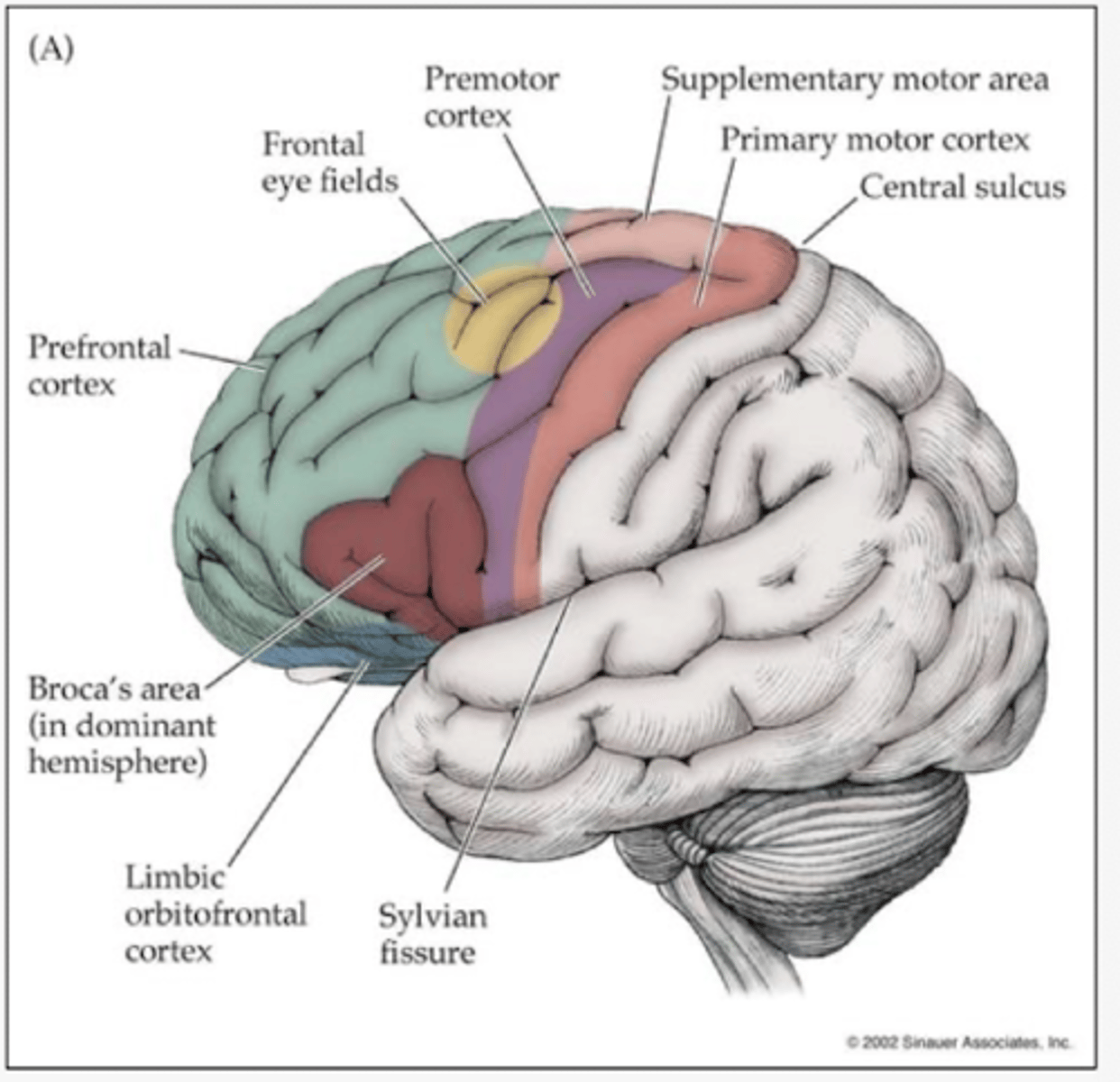
What areas are the Motor Cortex divided into?
- Primary Motor Cortex (M1)
- Premotor Cortex
- Supplementary Motor Area (SMA).
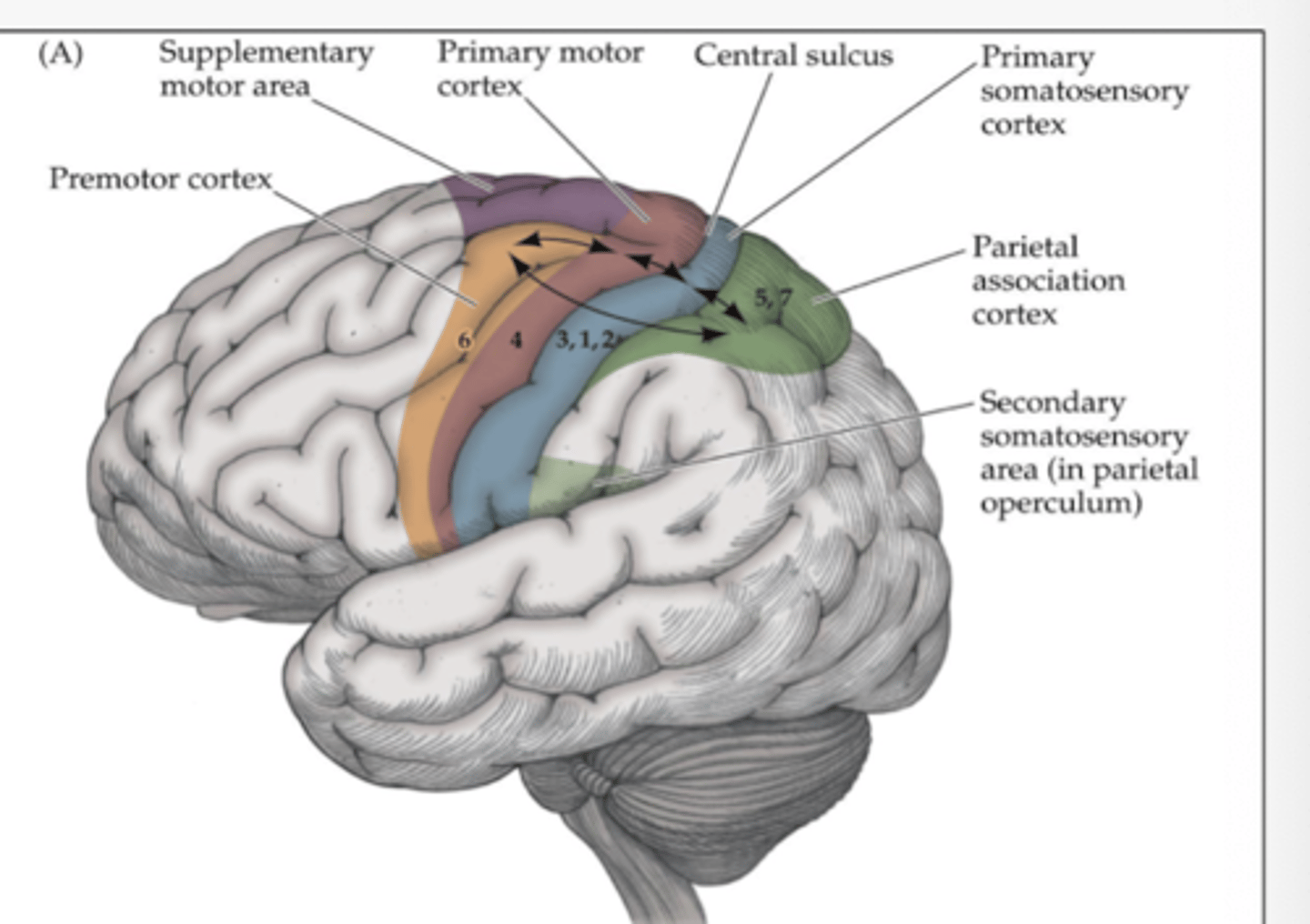
Where is the Primary Motor Cortex located, and what is its primary function?
- Located in the precentral gyrus
- Executes voluntary movements of contralateral body parts.
What do neurons in the Primary Motor Cortex (M1) encode?
- Force of contractions
- Direction of limb movement
- Distance of movement
- Speed of movement.
How do the territories of MCA and ACA relate to the Primary Motor Cortex?
- MCA supplies lateral M1 for face & upper limb areas
- ACA supplies medial & superior M1 for lower limb areas.
Why are the face and hands overrepresented in M1?
- They require fine motor control, leading to larger cortical areas dedicated to them.
What is meant by somatotopic organization in M1?
Specific regions control specific body parts in a 'motor map' layout.
What does recent research suggest about how M1 encodes movement?
It encodes coordinated movements rather than just individual muscle actions.
What is Alien Hand Syndrome?
A condition resulting from M1 problems that causes involuntary movement of the upper extremity.
Where is the Premotor Cortex located?
In the frontal lobe, anterior to M1.
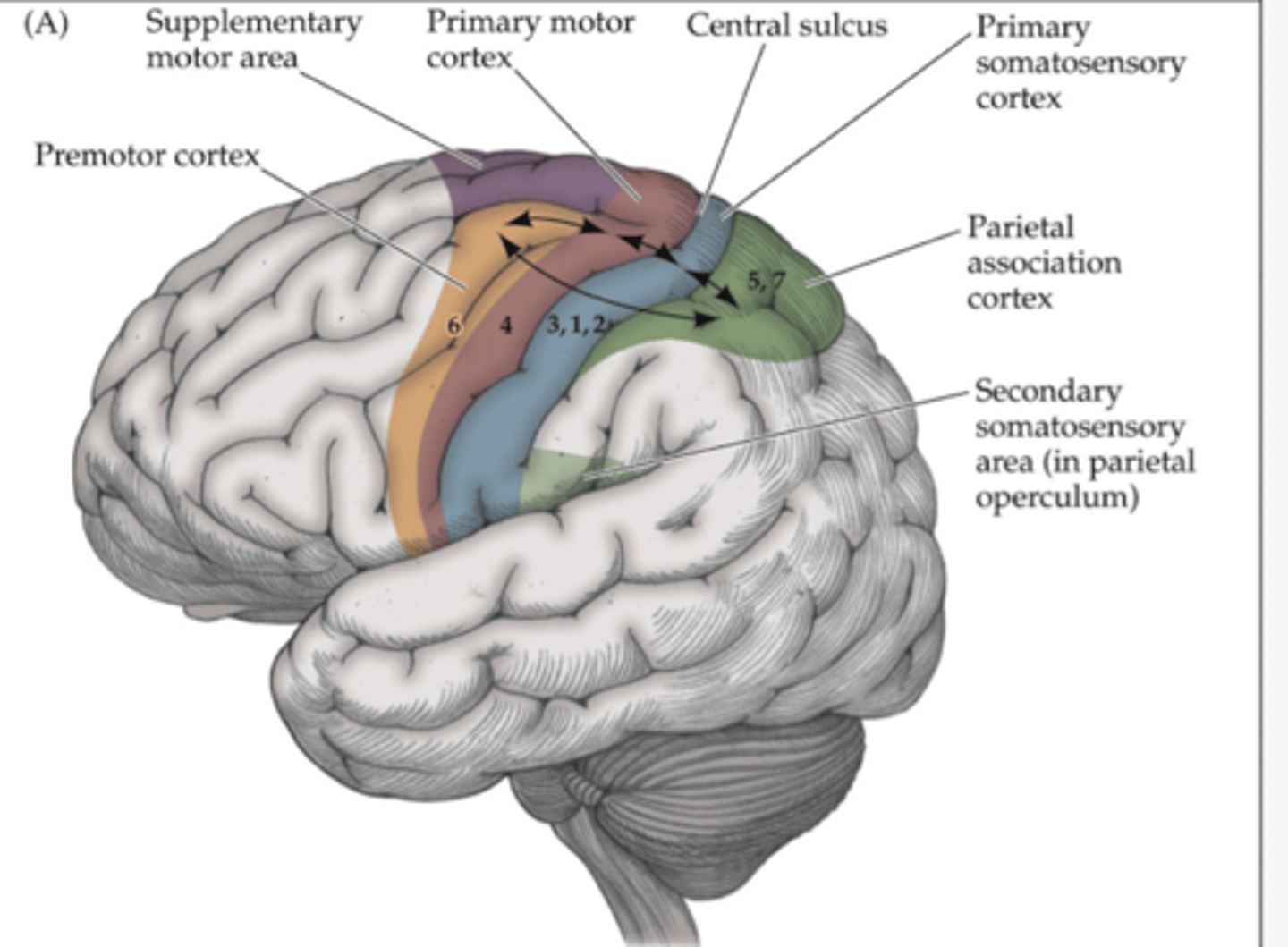
What is the primary function of the Premotor Cortex?
Motor planning, preparing movements based on external cues.
What role do mirror neurons play in the Premotor Cortex?
Fire when observing actions, aiding in understanding and learning by watching others.
How does the Premotor Cortex influence motor behavior?
Mainly through connections with M1.
What impairments occur with Lesions in the Premotor Cortex?
- Slower or less automatic reaching/grasping
- Difficulty with sequential movements
- Problems with gait and posture.
What is the primary role of the Supplementary Motor Area (SMA)?
Planning and coordinating complex movements before actual movement.
How does the SMA influence bilateral movements?
Coordinates simultaneous movements on both sides, like typing or piano playing.
What happens in a unilateral lesion of the SMA?
- Lack of contralateral complex voluntary movement
- Impaired ipsilateral movements.
What are external cues in motor planning?
Environmental stimuli that trigger brain planning for movement.
What are internal cues in motor planning?
Memories, intentions, or experiences that inform motor actions.
How does movement occur (how does signal get sent to the hands)?
Intention from the Prefrontal Cortex
Planning from Premotor Cortex & SMA (supplement)
Signal send from the motor cortex and travels down along the upper motor neuron
---> medulla (at the medulla the efferent signal decussates)
Then the neuron synapses with a 2nd neuron called LMN
The 2nd neuron (LMN) innervates the muscle
Lower motor neurons receive instructions from:
Upper motor neurons
Local circuit neurons (interneurons)
Sensory inputs.
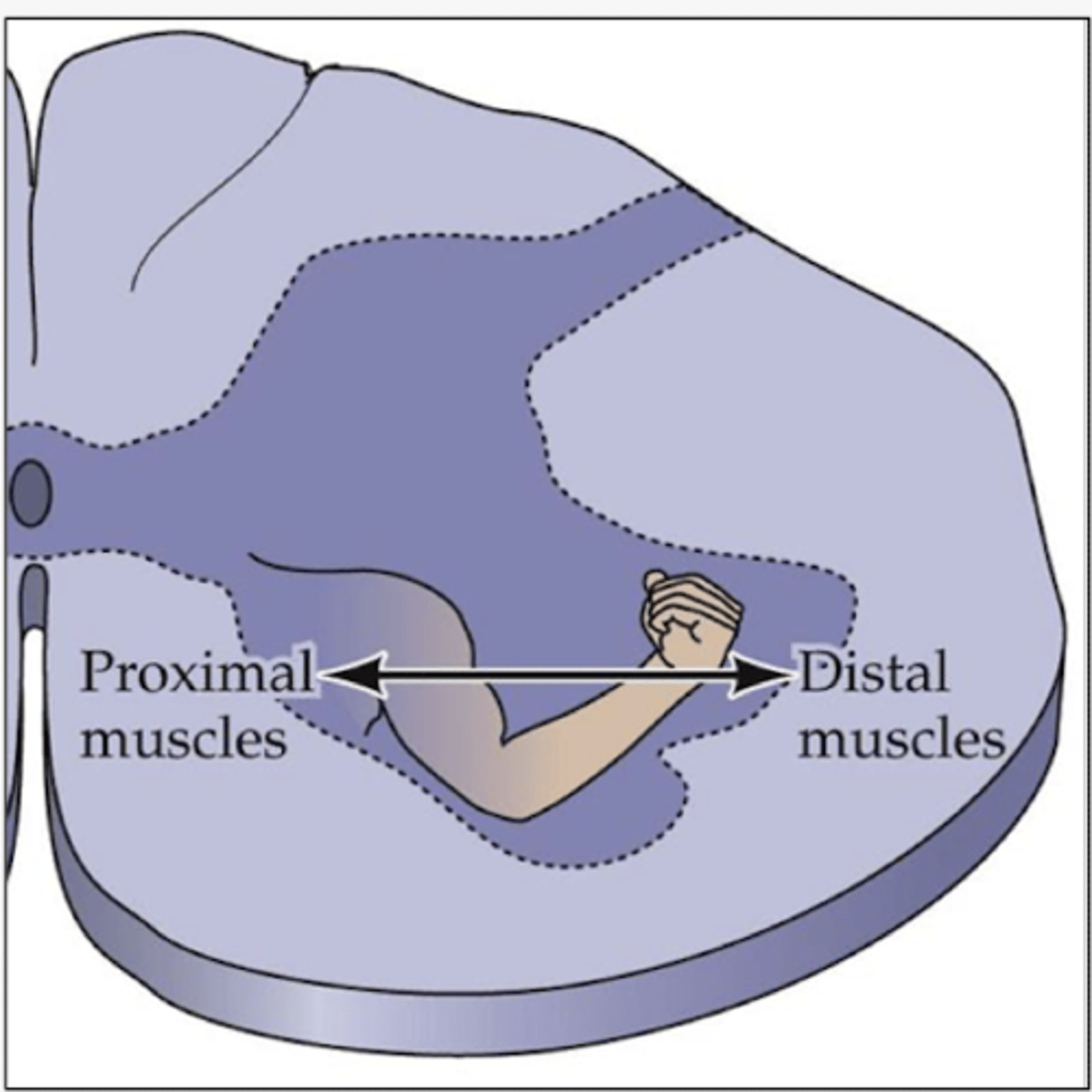
What is the organization of the lower motor neuron (LMN) anterior horn?
- Somatotopic organization corresponding to body parts
- Medial region for proximal muscles
- Lateral region for distal muscles.
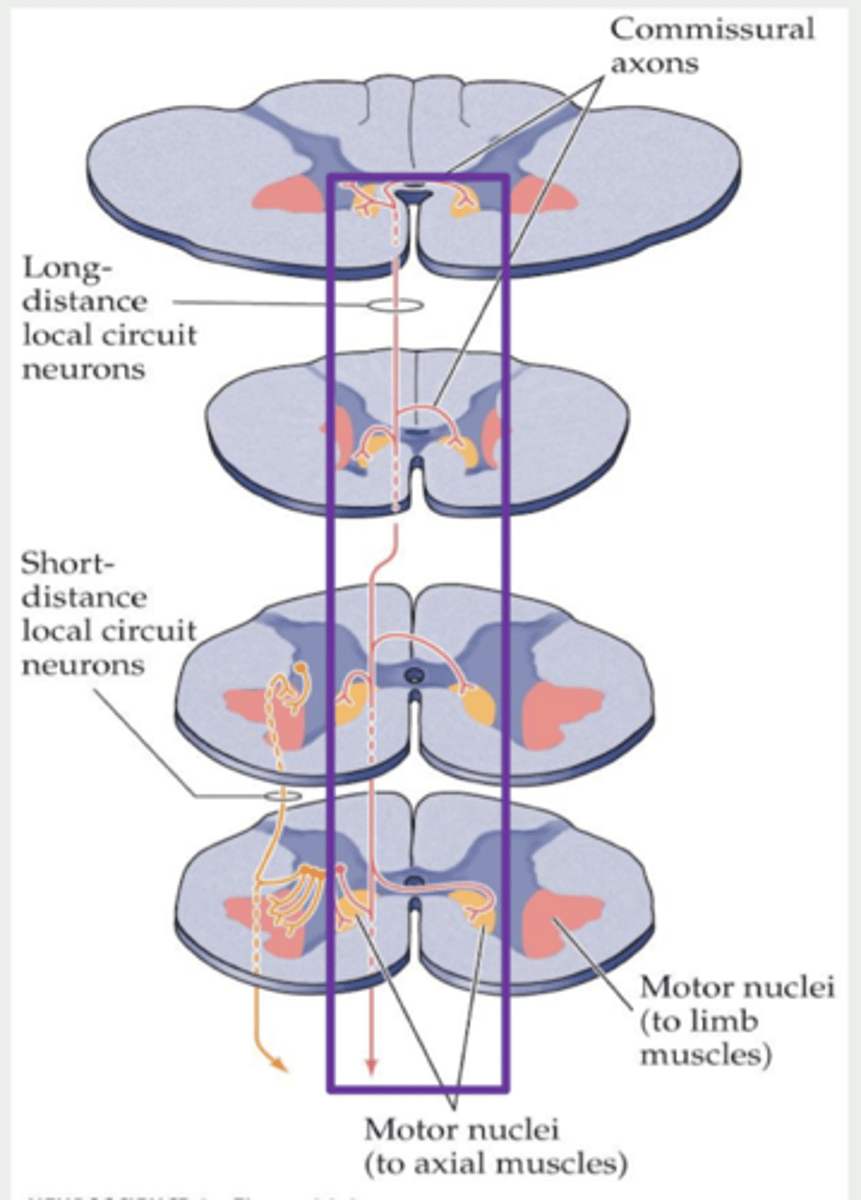
What are interneurons (local circuit neurons)?
Neurons that branch locally to inhibit unwanted movements.
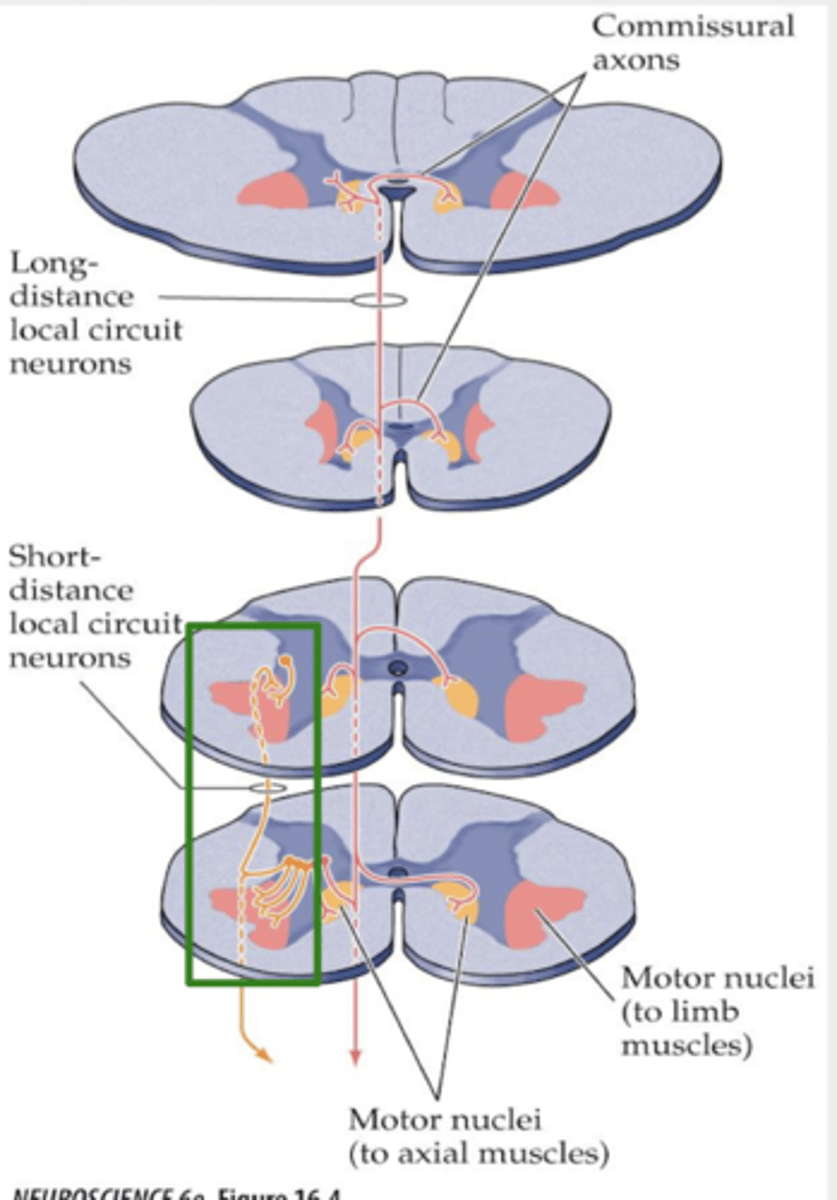
What kinds of local circuit neurons exist?
- Long Distance Local Circuit Neurons
- Short Distance Local Circuit Neurons.
What do Long Distance Local Circuit Neurons do?
act as the body's internal coordinators, sending signals across both sides of your spine to keep your posture balanced and stable while you move.
What modifies Long Distance Local Circuit Neurons?
- Descending tracts including the Anterior corticospinal tract.
What characterizes Short Distance Local Circuit Neurons?
- Quick, nearby signal processing within a specific brain area.
What enables Short Distance Local Circuit Neurons?
Fine, one-sided motor control without crossing the brain's midline.
What modifies Short Distance Local Circuit Neurons?
- Lateral corticospinal tract.
What are Descending Motor Pathways?
Networks sending motor commands from the brain to control lower motor neurons in the spinal cord.
What are the two main types of descending motor pathways?
- Pyramidal tracts
- Extrapyramidal tracts.
Where do the pyramidal tracts originate?
In the cerebral cortex.
What are the pyramidal tracts responsible for?
Skilled, voluntary movements of the limbs.
Where do extrapyramidal tracts originate?
In the brainstem.
What functions do extrapyramidal tracts serve?
Posture, balance, automatic control, and certain movements like speaking.
What types of pyramidal pathways exist?
- Corticospinal pathways — Lateral and Anterior
- Corticobulbar pathways.
What are the 4 types of extrapyramidal pathways?
Vestibulospinal Tract
Reticulospinal Tract
Tectospinal Tract
Rubrospinal Tract.
What is the origin of the Lateral Corticospinal Tract?
From mostly M1 and the Internal Capsule.
Where does the Lateral Corticospinal Tract terminate?
On local short-distance interneuron networks and lateral LMNs of the spinal cord.
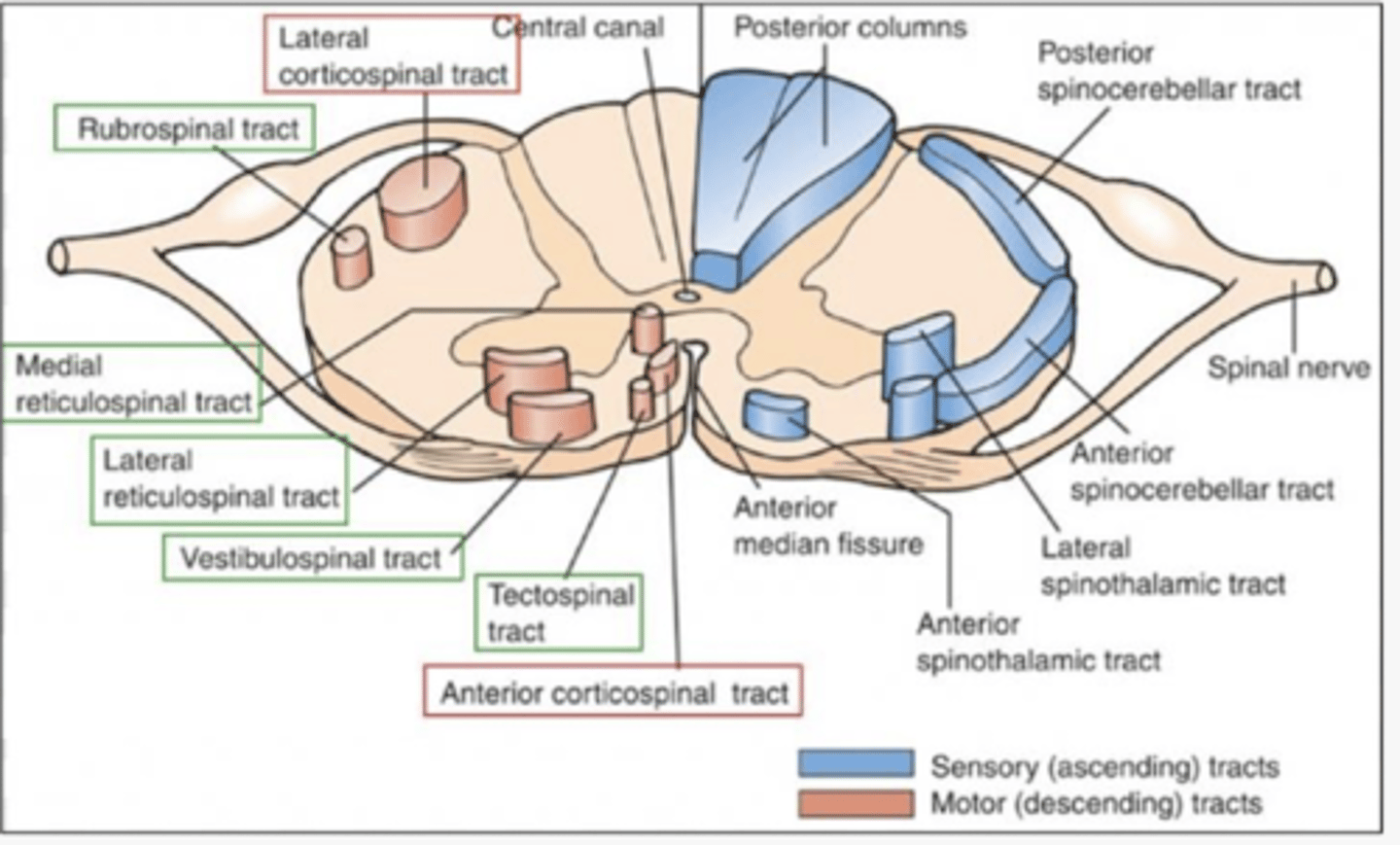
What is the function of the Lateral Corticospinal Tract?
Main pathway for skilled, voluntary movements of limbs.
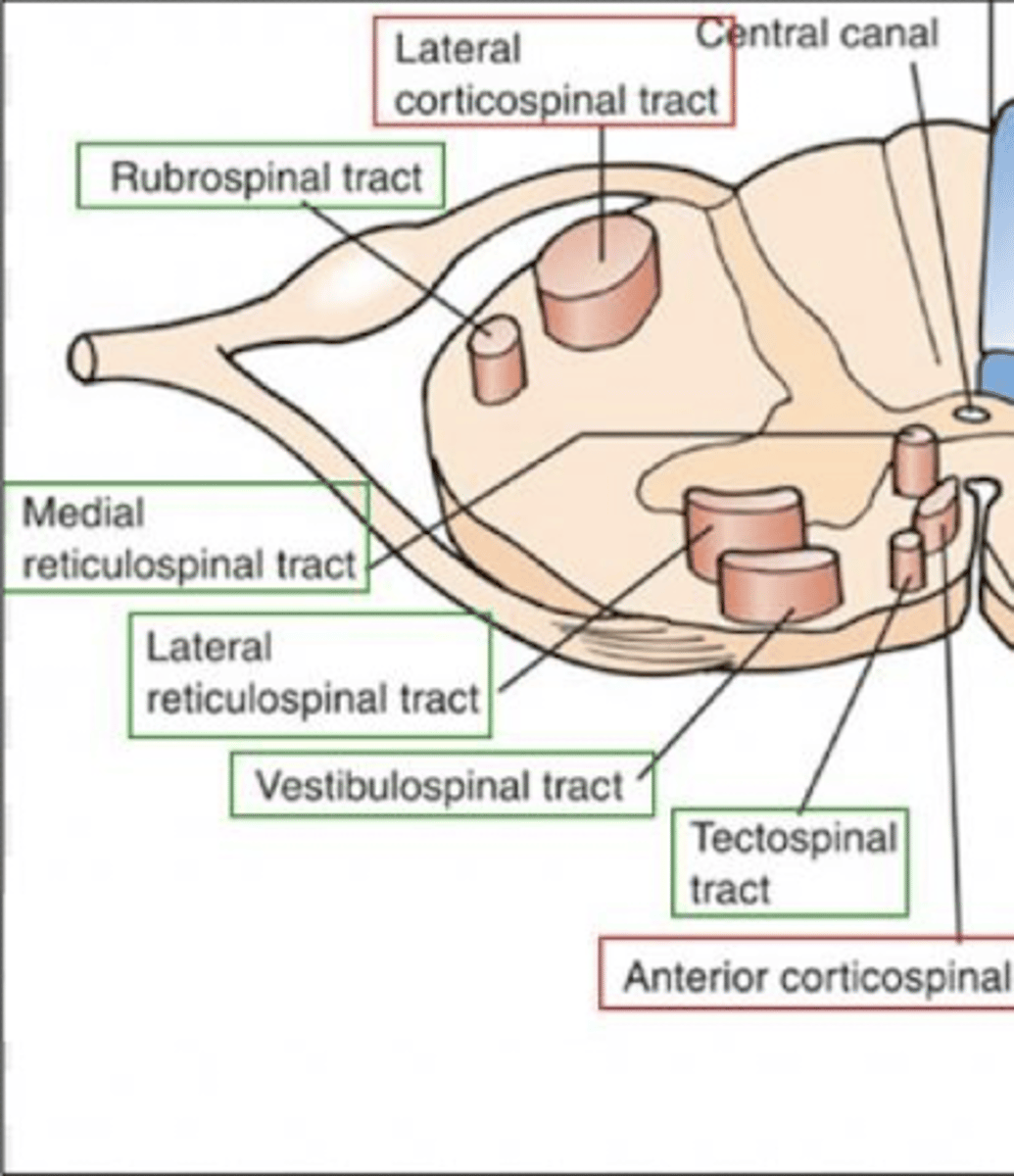
What happens when there is a lesion in the Lateral Corticospinal Tract?
Impairments on the contralateral side if the lesion occurs above the crossover.
What is the Lateral Corticospinal Tract's crossover point?
Crosses at the pyramidal decussation in the medulla (85% of the tract).
What is the origin of the Anterior Corticospinal Tract?
From mostly M1 primary motor cortext and the Internal Capsule.
How does the Anterior Corticospinal Tract crossover?
15% of the tract crosses in the spinal cord via the anterior white commissure.
Where does the Anterior Corticospinal Tract terminate?
Terminates bilaterally in the spinal cord via long-distance interneuron networks.
What is the function of the Anterior Corticospinal Tract?
Gross control of proximal postural muscles.
What are the clinical effects of an Anterior Corticospinal Tract lesion?
Minimal clinical effect noted.
How do corticospinal tracts synapse with LMNs?
Most synapse indirectly with spinal interneurons before connecting with LMNs.
Describe the example of a bicep curl in terms of neural activation.
M1 initiates the movement, the signal travels through the lateral corticospinal tract, and synapses on short-distance excitatory interneurons.
What is the origin of the Corticobulbar Tract?
From the Motor Cortex and Internal Capsule.
Where does the Corticobulbar Tract terminate?
Most terminate bilaterally on local circuit neurons in the brainstem.
What is the function of the Corticobulbar Tract?
Controls the activation of cranial nerves.
How are upper facial muscles controlled by the cortex?
Upper face (forehead & eyes) receives bilateral input from both hemispheres.
How are lower facial muscles controlled by the cortex?
Lower face (mouth & cheek) receives contralateral input only from M1.
What happens with a UMN right lesion affecting the corticobulbar tract?
Weakness in contralateral inferior face muscles (left side).
What happens with a LMN left lesion (facial nerve damage)?
Weakness in ipsilateral superior and inferior facial muscles (left side).
What is the function of the Rubrospinal Tract?
Modulation of flexor muscle tone.
What is the main function of the Vestibulospinal Tract?
Maintaining posture and balance.
What does the Reticulospinal Tract contribute to?
Gait and posture; it can excite or inhibit muscle tone.
What function does the Tectospinal Tract serve?
Coordinates eye and head motion.
How do extrapyramidal disorders typically present clinically?
Slowing or loss of voluntary and automatic movements
Postural instability
Abnormal movements.
What is the destination for extrapyramidal tracts?
Innervate bilateral local long interneuron circuits supporting proximal postural muscles.