Environmental Science: Ecosystems, Pollution, and Sustainability Concepts
 Studied by 0 people
 Call Kai
 Learn
Learn Practice Test
 Spaced Repetition
 Match
Match Flashcards
 Knowt Play
1/138

There's no tags or description
Looks like no tags are added yet.
Name | Mastery | Learn | Test | Matching | Spaced |
|---|
No study sessions yet.
139 Terms
Environmental Value Systems (EVS)
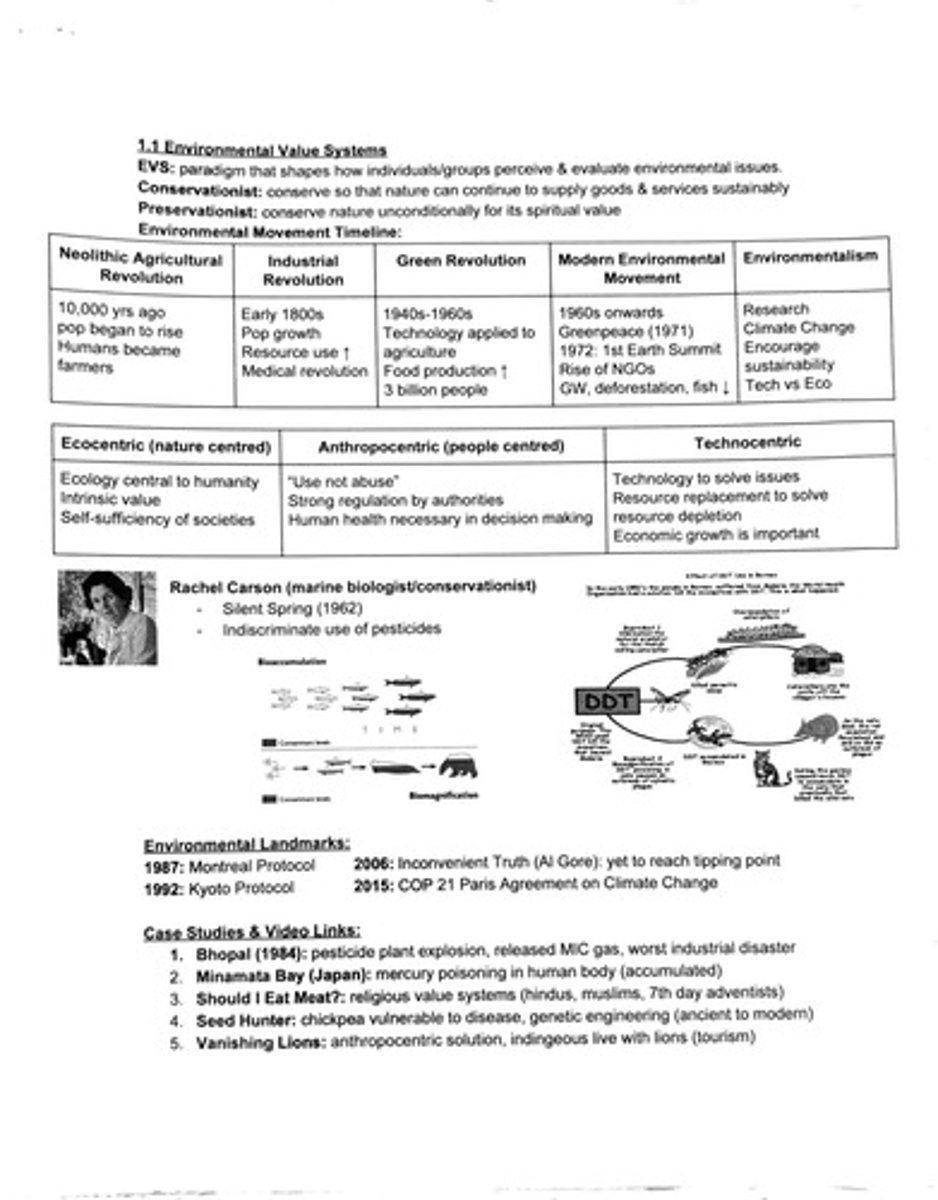
Paradigm that shapes how individuals/groups perceive & evaluate environmental issues.
Conservationist
Conserve so that nature can continue to supply goods & services sustainably.
Preservationist
Conserve nature unconditionally for its spiritual value.
Ecocentric
Nature centred; ecology central to humanity with intrinsic value.
Anthropocentric
'Use not abuse'; strong regulation by authorities.
Technocentric
Technology to solve issues; resource replacement to solve resource depletion.
Silent Spring
Book by Rachel Carson (1962) about the indiscriminate use of pesticides.
Biomagnification
Accumulation of substances, such as pesticides, in the tissues of organisms.
Montreal Protocol
1987 international treaty to phase out substances that deplete the ozone layer.
Kyoto Protocol
1992 international treaty committing state parties to reduce greenhouse gas emissions.
Bhopal Disaster
1984 pesticide plant explosion that released MIC gas, worst industrial disaster.
Minamata Bay
Mercury poisoning in human body due to industrial waste.
System
A set of interrelated parts working together to make a complex whole.
Open System
Exchanges energy and matter with its surroundings.
Closed System
Exchanges energy but not matter with its environment.
Isolated System
Exchanges none; an example is the universe.
Energy Transformation
Energy can be transformed but not created or destroyed.
Entropy
(a measure of disorder or unavailable energy) to describe the inevitable degradation of environmental quality caused by human economic activity
Equilibrium
The tendency of a system to return to its original state following disturbance.
Resilience
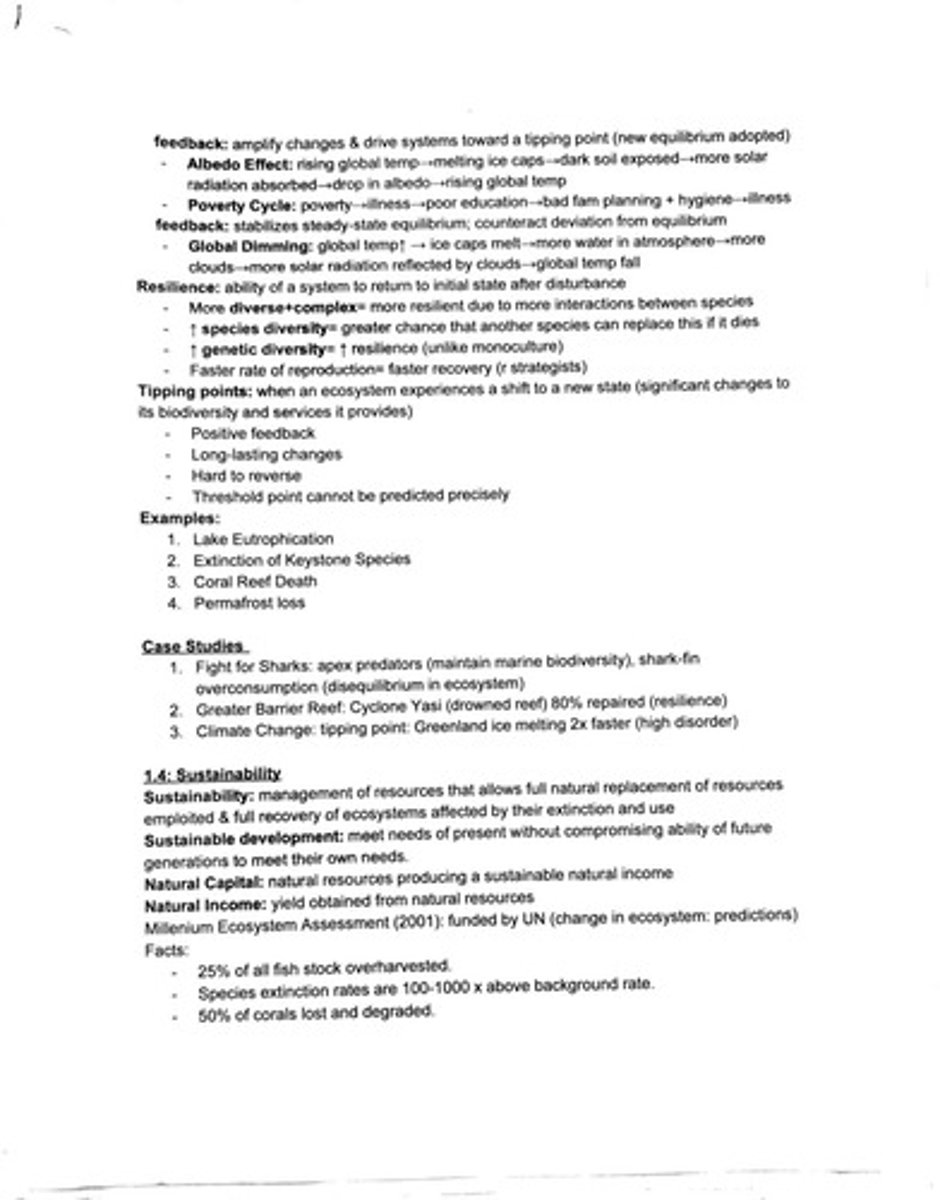
Ability of a system to return to its initial state after disturbance.
Tipping Point
When an ecosystem experiences a shift to a new state, causing significant changes.
Sustainability
Management of resources that allows full natural replacement of exploited resources.
Sustainable Development
Meet needs of present without compromising ability of future generations.
Natural Capital
Natural resources producing a sustainable natural income.
Natural Income
Yield obtained from natural resources.
Millennium Ecosystem Assessment
2001 UN-funded assessment of changes in ecosystems and predictions.
Global Dimming
Phenomenon where increased cloud cover reflects more solar radiation, cooling the Earth.
Poverty Cycle
Cycle of poverty leading to illness, poor education, and bad family planning.
Tragedy of the Commons
Acting in one's own self interest (max utility) destroys long term future of that resource.
Environmental Impact Assessment (1969 US)
Baseline study to assess environmental, social, and economic impacts.
CAFO
Concentrated animal feeding operation.
Ecological Footprint
Area of land & water required to sustainably provide all resources at the rate at which they are being consumed by a given population.
Pollution
Addition of a substance to the environment by human activity at a rate greater than which it can be rendered harmless.
Primary pollutants
Active on emission (e.g., carbon monoxide).
Secondary pollutants
Formed by primary undergoing physical/chemical changes (e.g., SO3 → acid rain).
Point source pollution
Single identifiable source (e.g., waste disposal pipe), easy to manage.
Non-point source pollution
Numerous widely dispersed origins, such as gases from vehicles, cannot detect.
Acute pollution
Large amount of pollutant released causing significant harm (e.g., Bhopal Disaster 1984).
Chronic pollution
Long-term release in small amounts, spreads widely, difficult to clean up (e.g., Beijing air).
Persistent Organic Pollutants
Pesticides resistant to breaking down (e.g., DDT, PCBs).
Biodegradable Pollutants
Don't persist in the environment, break down easily (e.g., soap, domestic sewage).
Microbeads
Small, solid, manufactured plastic particles that are less than 5mm and don't degrade or dissolve in water.
Bioaccumulation
Accumulation of substances, such as pesticides, in an organism.
Niche
A particular set of biotic and abiotic factors to which an organism responds to and makes a living towards.
Fundamental niche
Full range of conditions and resources in which a species can survive and reproduce.
Realized niche
The actual conditions and resources in which a species exists due to biotic interactions.
Population density
Average number of individuals in a stated area.
Habitat
Environment in which a species normally lives.
Natality
Birth rate of a population.
Mortality
Death rate of a population.
Migration
Movement of individuals into or out of a population.
Biotic factors
Every relationship that organisms have, where they live, and how it alters.
Abiotic factors
How much space, availability of light, water.
Limiting factors
Factors which slow down the growth of a population as it reaches its carrying capacity.
Carrying capacity
Maximum number of a species or 'load' that can be sustainably supported by a given area.
Vital categories
Competition, predation, mutualism, parasitism.
Competition
Interaction where individuals compete for the same resource.
Intraspecific competition
Competition between members of the same species.
Interspecific competition
Competition between individuals of different species.
Predation
When one animal eats another.
Mutualism
Relationship between two or more species in which all benefit and none suffer.
Parasitism
The relationship between two species in which one species lives within the other.
Herbivory
Animal eating green plants.
S-Curves
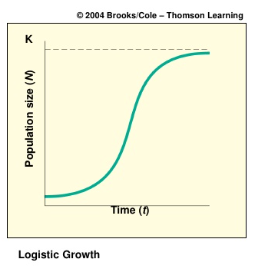
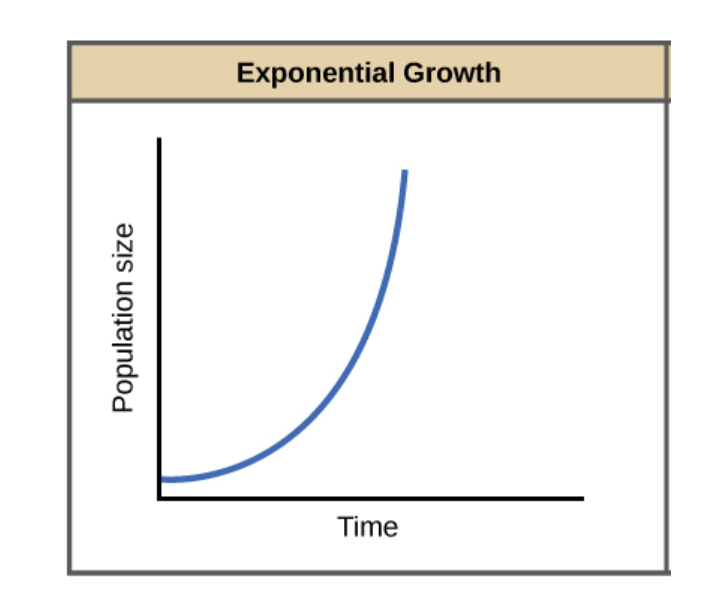
Describes a generalized response of populations that starts with exponential growth and levels off at carrying capacity.
J-Curves
Population grows exponentially and then suddenly collapses.
Photosynthesis
Process by which green plants make their own food using energy from the sun and CO2.
Respiration
Conversion of organic matter into CO2 and water in all living organisms, releasing energy.
Productivity
Conversion of energy into biomass over a given period of time.
Compensation point
Where something is not adding biomass or using it to stay alive, simply maintaining itself.
Producers
Organisms that make their own food.
Autotrophs
Organisms that make their own food using energy from the sun and CO2.
Consumers
Organisms that feed on autotrophs or other heterotrophs to obtain energy.
Ecological pyramids
Graphical models of the quantitative differences between amounts of living material stored at each trophic level of a food chain.
Pyramid of numbers
Number of organisms at each trophic level in a food chain at one time.
Pyramid of biomass
Contains biomass of each individual(s) at each trophic level.
Pyramid of productivity
Rate of flow of energy or biomass over the year.
Gross productivity
Total gain in energy or biomass per unit area per unit time.
Net productivity
Gain in energy or biomass per unit area per unit time that remains after deductions due to respiration.
Gross primary productivity
Total gain in energy or biomass per unit area for each unit time by free plants.
Net primary productivity
Total gain in energy of biomass per unit area for each unit time by green plants after allowing losses to respiration.
Nitrogen cycle
Flows in the cycle: fixation, nitrification, denitrification, feeding, excretion, death and decomposition.
Fixation
When atmosphere nitrogen is made available to plants.
Nitrification
Bacteria that convert ammonium to nitrates.
Denitrification
Conversion of ammonium, nitrites, and nitrate ion to nitrogen gas.
Wolves Changed River
Reintroduce wolves (apex predator) in Yellowstone National Park.
Trophic Cascades
Ecological phenomenon triggered by the addition or removal of top predators.
Biome
Collection of ecosystems sharing similar climatic conditions.
Biosphere
Part of the Earth inhabited by organisms.
Biomes are defined by
Temperature and precipitation, latitude, altitude, and ocean currents.
PIE/PE ratio
Not defined in the text.
Types of biomes
Aquatic, Deserts, Forests, Grassland, Tundra.
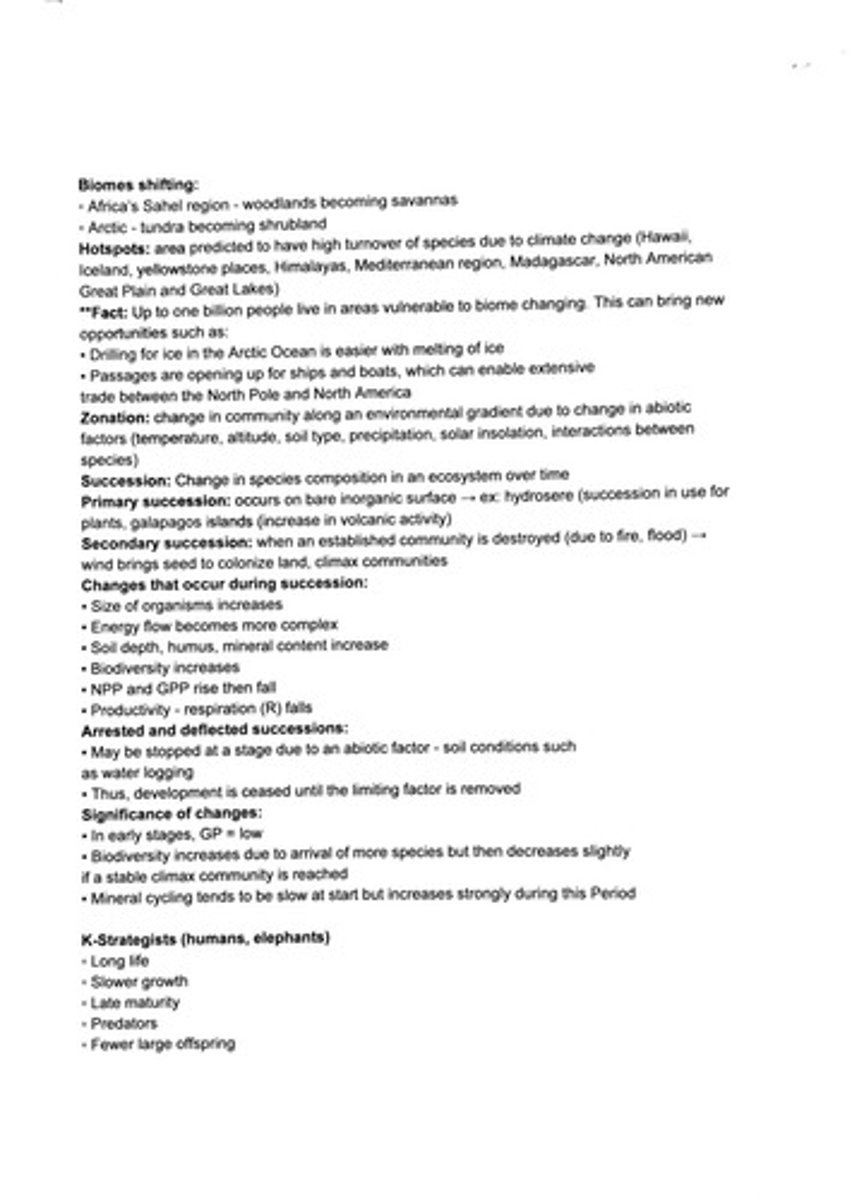
Climate change effects
Temperature increase of 1.5 to 4.5C by 2100 (IPCC), stronger storms, drier regions.
Biomes shift
Africa's Sahel region - woodlands becoming savannas; Arctic tundra becoming shrubland.
Hotspots
Areas predicted to have high turnover of species due to climate change.
Fact about biome changes
Up to one billion people live in areas vulnerable to biome changing.
Zonation
Change in community along an environmental gradient due to change in abiotic factors.
Succession
Change in species composition in an ecosystem over time.
Primary succession
Occurs on bare inorganic surface, e.g., hydrosere, Galapagos Islands.
Secondary succession
Occurs when an established community is destroyed.
Changes during succession
Size of organisms increases, energy flow becomes more complex, biodiversity increases.