Abraham Maslow - Chapter 6
 Call Kai
 Learn
Learn Practice Test
 Spaced Repetition
 Match
Match Flashcards
 Knowt Play
1/29

There's no tags or description
Looks like no tags are added yet.
Name | Mastery | Learn | Test | Matching | Spaced | Call with Kai | Chat |
|---|
No analytics yet
Send a link to your students to track their progress
30 Terms
How do you move up the hierarchy of needs
How do you move up the hierarchy of needs
Physiological needs
Safety needs
Belongingness and love needs
Esteem needs
Self-actualization
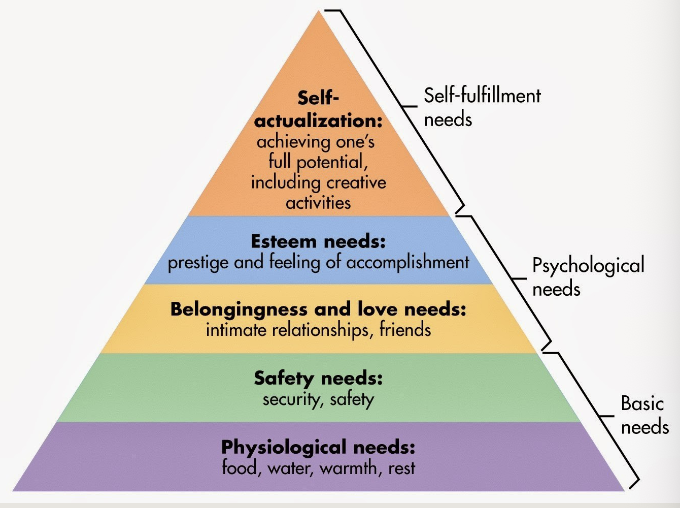
lower needs occupy the mind while WHAT
lower needs occupy the mind while UNSATISFIED
Physiological needs:
Grounded in WHAT - the body maintaining critical levels of water, salt, energy, temperature
Physiological needs:
Grounded in HOMEOSTASIS - the body maintaining critical levels of water, salt, energy, temperature
Physiological needs
The most prepotent needs: lacking everything, a person's WHAT is consumed by WHAT and WHAT
Physiological needs
The most prepotent needs: lacking everything, a person's CONSCIOUSNESS is consumed by FOOD and WATER
Physiological needs
The lowest and most clearly WHAT - the most animal-like of our behaviour
Physiological needs
The lowest and most clearly BIOLOGICAL - the most animal-like of our behaviour
Safety needs
Most visible in WHAT children: startled by loud noises, flashing lights, rough handling; upset when family members fight because it disrupts the safety of home
Safety needs
Most visible in YOUNG children: startled by loud noises, flashing lights, rough handling; upset when family members fight because it disrupts the safety of home
Safety needs
Maslow: many adult WHAT are like children who do not WHAT safe
Safety needs
Maslow: many adult NEUROTIC are like children who do not FEEL safe
Safety needs
Few people around us lack food - but many live WHAT lives: inner city crime, abusive spouses and parents, incurable disease
Safety needs
Few people around us lack food - but many live UNSAFE lives: inner city crime, abusive spouses and parents, incurable disease
Safety needs
Evolutionarily, safety was found in the WHAT, WHAT, and WHAT - the same groups that shared WHAT and WHAT
Safety needs
Evolutionarily, safety was found in the FAMILY, TRIBE, and COMMUNITY - the same groups that shared HUNTING and GATHERING
Belongingness and Love needs
Love needs require both WHAT and WHAT love to be fully satisfied (care taking vs care giving)
Belongingness and Love needs
Love needs require both GIVING and RECEIVING love to be fully satisfied (care taking vs care giving)
Esteem needs
Everyone desires a stable, firmly based WHAT of themselves and of those WHAT to them
Esteem needs
Everyone desires a stable, firmly based, HIGH EVALUATION of themselves and of those CLOSE to them
Esteem needs - Two components:
Feeling WHAT, WHAT, WHAT
WHAT or WHAT - from simple recognition to fame and glory
Esteem needs - Two components:
Feeling COMPETENT, STRONG, SUCCESSFUL
PRESTIGE or STATUS - from simple recognition to fame and glory
Esteem needs
The healthiest self-esteem rests on WHAT-earned, WHAT - not fleeting fame or celebrity
Esteem needs
The healthiest self-esteem rests on WELL-earned, DESERVED RESPECT - not fleeting fame or celebrity
Esteem needs
A dissenting voice: Albert Ellis called self-esteem a WHAT - rating yourself invites the inevitable WHAT verdict (no one is perfect)
Esteem needs
A dissenting voice: Albert Ellis called self-esteem a SICKNESS - rating yourself invites the inevitable NEGATIVE verdict (no one is perfect)
Self-actualization: the being-need
Deficiency needs (D-needs): WHAT
Self-actualization: the being-need
Deficiency needs (D-needs): physiological, safety, belongingness/love, esteem - driven by LACK
Self-actualization: the being-need
• Being-need (B-need): WHAT
Self-actualization: the being-need
• Being-need (B-need): self-actualization - driven by GROWTH and MEANING
Self-actualization: the being-need
All the basic needs are WHAT - shared with WHAT in origin. The higher, the more distinctly WHAT. WHAT is uniquely human
Self-actualization: the being-need
All the basic needs are INSTINCTOID - shared with ANIMALS in origin. The higher, the more distinctly HUMAN. SELF-ACTUALIZATION is uniquely human
Self-actualization: the being-need
Beyond even the Being-needs: WHAT
Self-actualization: the being-need
Beyond even the Being-needs: TRANSCENDENCE
Transcendance
A state tying all people and the whole of creation together
Studying self-actualizers
Criterion: people making full use of their WHAT, WHAT, and WHAT - with no evidence of WHAT
Studying self-actualizers
Criterion: people making full use of their TALENTS, CAPACITIES, and POTENTIALITIES - with no evidence of PSYCHOPATHOLOGY
Studying self-actualizers
Comparing them with less-fulfilled lives, Maslow identified WHAT characteristics of self-actualizing people (Maslow, 1950/1973, 1970)
Studying self-actualizers
Comparing them with less-fulfilled lives, Maslow identified FOURTEEN characteristics of self-actualizing people (Maslow, 1950/1973, 1970)
Studying self-actualizers
Methodological caution worth naming: a hand-picked, admired sample - WHAT, not rigorous
Studying self-actualizers
Methodological caution worth naming: a hand-picked, admired sample - INSPIRING, not rigorous
Desacralization and Resacralization
Transcendence - losing the sense of a WHAT, feeling intimate connection with the WHAT and all people - is blocked by a WHATMaslow called WHAT
Desacralization and Resacralization
Transcendence - losing the sense of a SEPARATE SELF, feeling intimate connection with the WORLD and all people - is blocked by a DEFENCE MECHANISMS Maslow called DESACRALIZATIONS
Desacralization and Resacralization
Desacralization: WHAT
Desacralization and Resacralization
Desacralization: rejecting the VALUES and VIRTUES of one's parents wholesale → growing up unable to see anything as sacred, eternal, or symbolic → a life without MEANING
Desacralization and Resacralization
“Sacred” need not be WHAT: regarded with great WHAT and WHAT by a group or individual
Desacralization and Resacralization
“Sacred” need not be RELIGIOUS: regarded with great RESPECT and REVERENCE by a group or individual
Desacralization and Resacralization
Resacralization: WHAT
Desacralization and Resacralization
Resacralization: deciding what is SACRAD and letting it GUIDE life - Maslow saw helping clients do this as an essential task of THERAPY
The chapter's cross-cultural thread: Buddhist, Christian, Muslim, and humanist voices converge on WHAT and some version of the WHAT - treat others as you would be treated
The chapter's cross-cultural thread: Buddhist, Christian, Muslim, and humanist voices converge on COMPASSION and some version of the GOLDEN RULE - treat others as you would be treated
Pargament and Mahoney (2005): spirituality = WHAT
Pargament and Mahoney (2005): spirituality = the process of DISCOVERING and CONSERVING the sacred
Pargament and Mahoney (2005): spirituality = the process of discovering and conserving the sacred; research findings:
Couples who sanctify their marriage report greater WHAT, less WHAT, better problem-solving
Parents who sanctify parenting report less WHAT, more consistent WHAT
For college students, spiritual striving correlated with WHAT more than any other form of goal-setting
Pargament and Mahoney (2005): spirituality = the process of discovering and conserving the sacred; research findings:
Couples who sanctify their marriage report greater SATISFACTION, less CONFLICT, better problem-solving
Parents who sanctify parenting report less AGGRESSION, more consistent DISCIPLINE
For college students, spiritual striving correlated with WELL-BEING more than any other form of goal-setting
Caution: sanctification is not automatically WHAT - the chapter's example is the Heaven's Gate cult
Caution: sanctification is not automatically HEALTHY - the chapter's example is the Heaven's Gate cult