Nervous System: Structure, Function, and Cranial Nerves
 Call Kai
 Learn
Learn Practice Test
 Spaced Repetition
 Match
Match Flashcards
 Knowt Play
1/77

There's no tags or description
Looks like no tags are added yet.
Name | Mastery | Learn | Test | Matching | Spaced | Call with Kai | Chat |
|---|
No analytics yet
Send a link to your students to track their progress
78 Terms
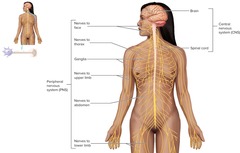
Nervous System
Two parts: central nervous system (CNS) including brain and spinal cord; peripheral nervous system (PNS) including nerves and sensory receptors.
Neuroglia
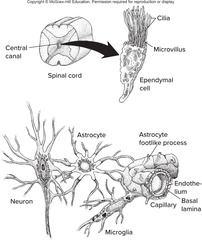
Cells that support, nourish, and insulate neurons, but they don't transmit info.
Microglia
Cells that engulf foreign material and bacteria, providing slight immune function.
Oligodendrocytes
Cells in the CNS that insulate axons of neurons.
Schwann cells
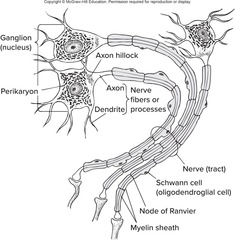
Cells in the PNS that insulate axons of neurons.
Ependymal cells
Cells that line the central canals of the brain and spinal cord.
Astrocytes
Cells that pass nutrients between blood capillaries and neurons and help form the blood-brain barrier.
Neurons
Nerve cells that transfer information via electrical stimuli throughout the body.
Cell body
Also known as soma or perikaryon, it is a part of the neuron.
Dendrites
Parts of a neuron that receive nerve signals.
Axons
Parts of a neuron that transmit nerve impulses.
(Pseudo)Unipolar Neuron
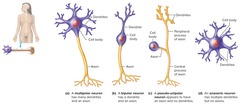
Neuron with a single stem that divides into a dendrite and axon.
Bipolar Neuron
Neuron with two processes; one dendrite and one axon.
Multipolar Neuron
Neuron with multiple dendrites and one axon.
Nerve
Bundle of axons in the PNS.
Tract
Bundle of axons in the CNS.
Ganglion
Collection of nerve cell bodies in the PNS.
Nucleus
Collection of nerve cell bodies in the CNS.
Myelin sheath
Thick, whitish, fatty material wrapped around some axons that helps to insulate them.
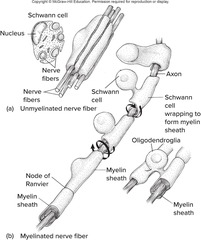
Myelinated nerves/axons
Nerves/axons that transmit faster signals.
Unmyelinated nerves/axons
Nerves/axons that transmit slower signals.
Nodes of Ranvier
Gaps that let signals propagate along myelinated axons.
Nerve impulse
An electrical signal that is transmitted by a neuron.
Graded potential
Wave of electrical excitation.
Resting potential
Electrical difference across a membrane at rest.
Action potential
All-or-none phenomenon which is the nerve impulse that sends the actual signal to other cells.
Synapse
Junction between a neuron and another cell.
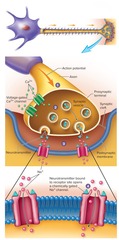
Synaptic cleft
Space between terminal and cell.
Neurotransmitters
Stored chemical signals released by neurons in response to an action potential.
Somatic nerves
Nerves that pass to or from somatic tissues - skeletal muscle, skin, and their derivatives.
Visceral nerves
Nerves that pass to or from viscera (internal organs) - involuntary muscles and glands.
Sensory (afferent) neurons
Neurons that carry info to the CNS.
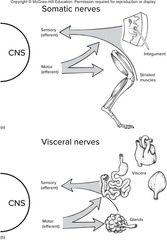
Motor (efferent) neurons
Neurons that carry info away from the CNS to effectors.
Spinal nerves
Nerves that come off the spinal column in pairs and are sequentially named and numbered.
Dorsal root
Carries afferent fibers from nerves; also has dorsal root ganglion.
Ventral root
Carries efferent fibers to nerves.
Cranial nerves
Nerves that have roots enclosed in the brain case and vary depending on animal groups.
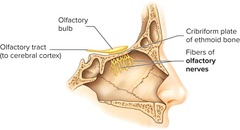
Olfactory Nerve
Nerve that senses smell.
Optic Nerve
Nerve that senses vision.
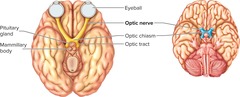
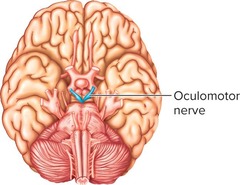
Oculomotor Nerve
Nerve that controls 4 out of 6 muscles of the eye and constricts the pupil.
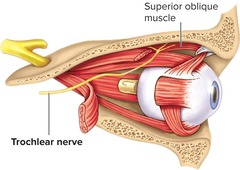
Trochlear Nerve
Nerve that moves the superior oblique muscle.
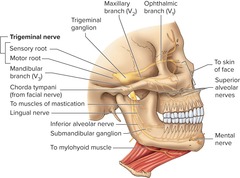
Trigeminal Nerve
Nerve with 3 branches that senses skin of face and moves muscles of mastication.
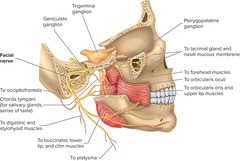
Facial Nerve
Nerve that senses taste on anterior 2/3rds of tongue and controls muscles of facial expression.
Auditory (Vestibulocochlear) Nerve
Nerve that senses hearing and balance.
Glossopharyngeal Nerve
Nerve that senses taste and feeling on posterior 1/3rd of tongue and controls salivation of parotid gland.
Vagus Nerve
Nerve that senses sensations from thoracic and abdominal organs and controls thoracic and abdominal viscera.
(Spinal) Accessory Nerve
Nerve that moves SCM and trapezius.
Hypoglossal Nerve
Nerve that moves the tongue.
Somatic reflex arc
Usually includes somatic sensory, interneuron (association neuron) and somatic motor; it sometimes doesn't have an interneuron.
Visceral reflex arc
Involves organs and is more complex with a minimum of 4 neurons.
Autonomic Nervous System (ANS)
Part of nervous system that presides over involuntary visceral activities; is poorly understood in most vertebrates except for mammals.
Autonomic sensory fibers
Monitor BP, oxygen and carbon dioxide levels, temperature, and visceral activity.
Autonomic motor fibers
Innervate cardiac muscle, smooth muscle, and glands; therefore, they control the digestive tract, blood vessels, respiratory tree, bladder, sex organs, and other general body viscera.
Control of ANS
Some people can control the ANS to a certain point, but by far, the system operates subconsciously.
Sympathetic nervous system
Fight or flight; has thoracolumbar outflow.
Parasympathetic nervous system
Rest and digest; has craniosacral outflow.
Enteric nervous system
Exclusively in the digestive tract and can be influenced by the sympathetic or parasympathetic; appears to be present in all classes of vertebrates.
Two-neuron system in ANS
The ANS has a two-neuron system most of the time in sending signals, as opposed to the one-neuron system in the somatic nervous system.
Adrenergic
Sympathetic nervous system is adrenergic because the neurotransmitters released during its stimulation are adrenaline (epinephrine) or noradrenaline (norepinephrine).
Cholinergic
Parasympathetic nervous system is cholinergic because the neurotransmitter is acetylcholine, which is also released between pre- and post-ganglionic fibers in both systems.
Dual innervation
Most organs have dual innervation from both systems, with the exception of the adrenal gland, peripheral blood vessels, and sweat glands, which only receive sympathetic innervation.
Central Nervous System (CNS)
Primarily coordinates activities that enable an organism to survive and reproduce in its environment.
Proprioceptor
Informs CNS about position of limbs, degree to which joints are bent and muscles are stretched.
Somatosensory system
Info-processing system which includes proprioceptors and surface receptors within the skin.
Exteroceptors
Gather info from the external environment - includes touch, pressure, temperature, sight, hearing, smell, taste, and other stimuli.
Embryology of CNS
Vertebrate CNS is hollow due to fusion of two raised neural folds in ectoderm.
Prosencephalon
Differentiates into forebrain, cerebrum, and diencephalon.
Mesencephalon
Differentiates into midbrain.
Rhombencephalon
Differentiates into hindbrain, cerebellum, pons, and medulla oblongata.
Meninges
Brain and spinal cord are wrapped in meninges; 3 types in mammals.
Dura mater
Tough, outermost layer of the meninges.
Arachnoid mater
Weblike, middle layer of the meninges.
Pia mater
Inner layer of the meninges.
Cerebrospinal fluid (CSF)
Slightly viscous fluid in brain ventricles, subarachnoid space, and central canal in spinal cord.
Choroid plexus
Small tufts of blood vessels with ependymal cells which produce most CSF.
Gray matter
Includes nerve cell bodies.
White matter
Includes myelinated neurons.
Brainstem
Includes midbrain, pons, and medulla oblongata.