Realistic conflict theory (RCT)
 Call Kai
 Learn
Learn Practice Test
 Spaced Repetition
 Match
Match Flashcards
 Knowt Play
1/6

There's no tags or description
Looks like no tags are added yet.
Name | Mastery | Learn | Test | Matching | Spaced | Call with Kai | Chat |
|---|
No analytics yet
Send a link to your students to track their progress
7 Terms
Realistic conflict theory (RCT)
•Proposes that intergroup hostility arises because of competition between groups for scarce but valued resources such as money, political power, military protection, or social status.
•Although competition does not always have to be for scarce resources
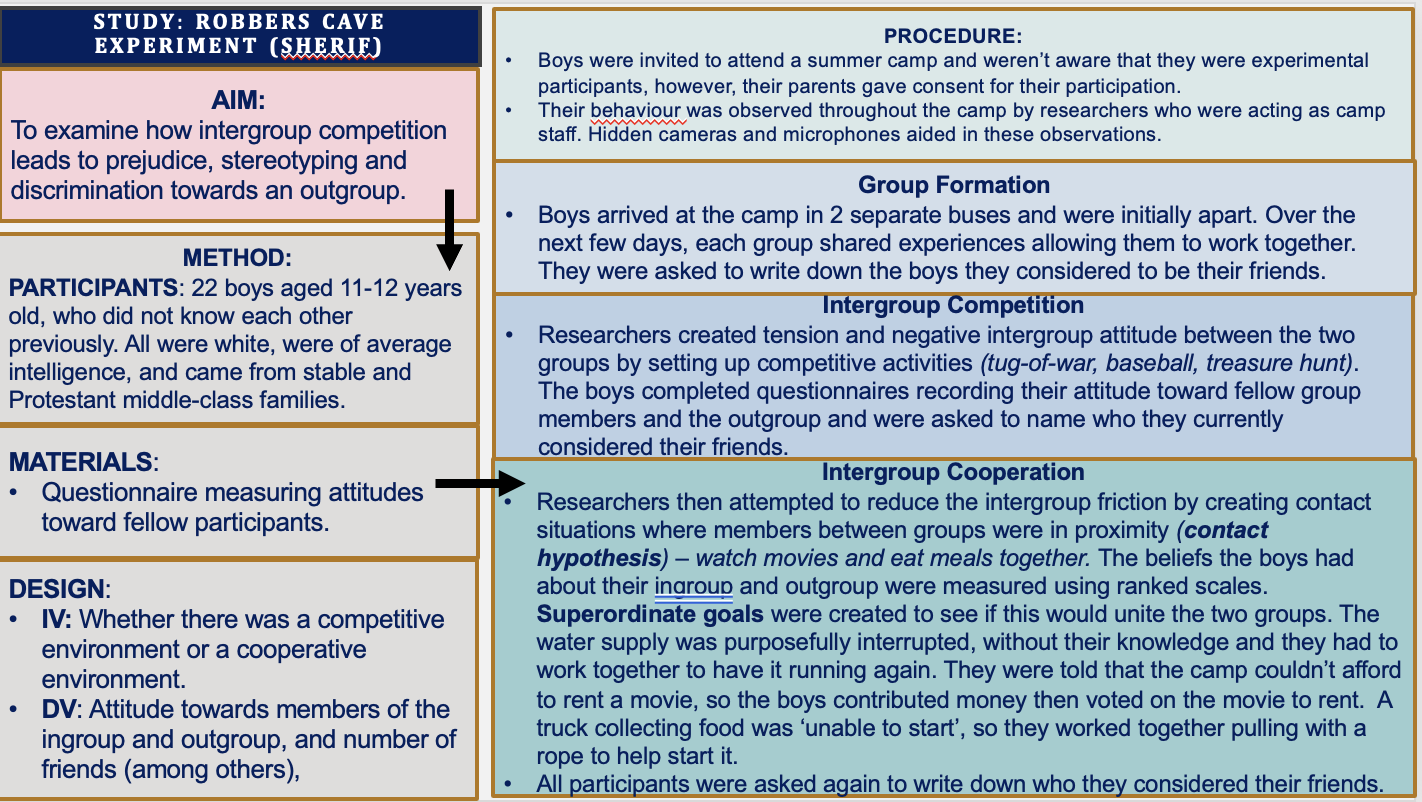
•Eg. Sherif’s Rattlers and Eagles – Robber’s Cave Experiment.
Phase 1:
KEY FINDINGS:
#1 Group Formation:
•Having the 2 groups separate and providing opportunities to develop teamwork enhanced cooperation and led to solidarity.
•A group leader for each group emerged, positive ingroup attitudes were formed and the boys developed friendships.
•The group established their own ways to perform tasks, nicknames for each other, jokes, group symbols and a group name.
•Group #1 named The Eagles.
•Group #2 named The Rattlers
•Differing social norms became apparent, e.g. The Rattlers often swore and were tougher than The Eagles, who did not sweat and cried more when they got hurt.
Phase 2
•KEY FINDINGS:
•#2 Intergroup Competition:
•During intergroup activities, intergroup relations were observed.. Each group planned and carried out raids against the other, threatening posters were made, and there was name-calling and physical scuffles. Though increased cooperation within each group, solidarity between members grew.
•
•Researchers were successful in forming prejudice and conflict between the two groups by having them compete against each other in games and activities. It was observed that when groups competed in a task that could only be achieved by one group, causing dismay for the other, over time, negative stereotypes and attitudes toward the outgroup formed. Questionnaires portrayed positive attitudes toward the ingroup, such as being brave and friendly, and negative attitudes toward the outgroup, including being sneaky and obnoxious.
•
•Results showed that 7.5% of The Eagles’ friends were members of The Rattlers, and 6.4% of The Rattlers’ friends were members of The Eagles.
phase 3
•KEY FINDINGS:
•#3 Intergroup Cooperation:
•
•Bringing the groups together to watch movies and eat meals led to further conflict.
•
•Intergroup contact (contact hypothesis) wasn’t enough to reduce the prejudice between two groups. Having them work together to achieve superordinate goals was successful in reducing prejudice and forming positive relationships between them.
•
•Outgroup friendships increased significantly with 23.2% of The Eagles’ friends being from The Rattlers, and 36.4% of The Rattlers’ friends being members of The Eagles.
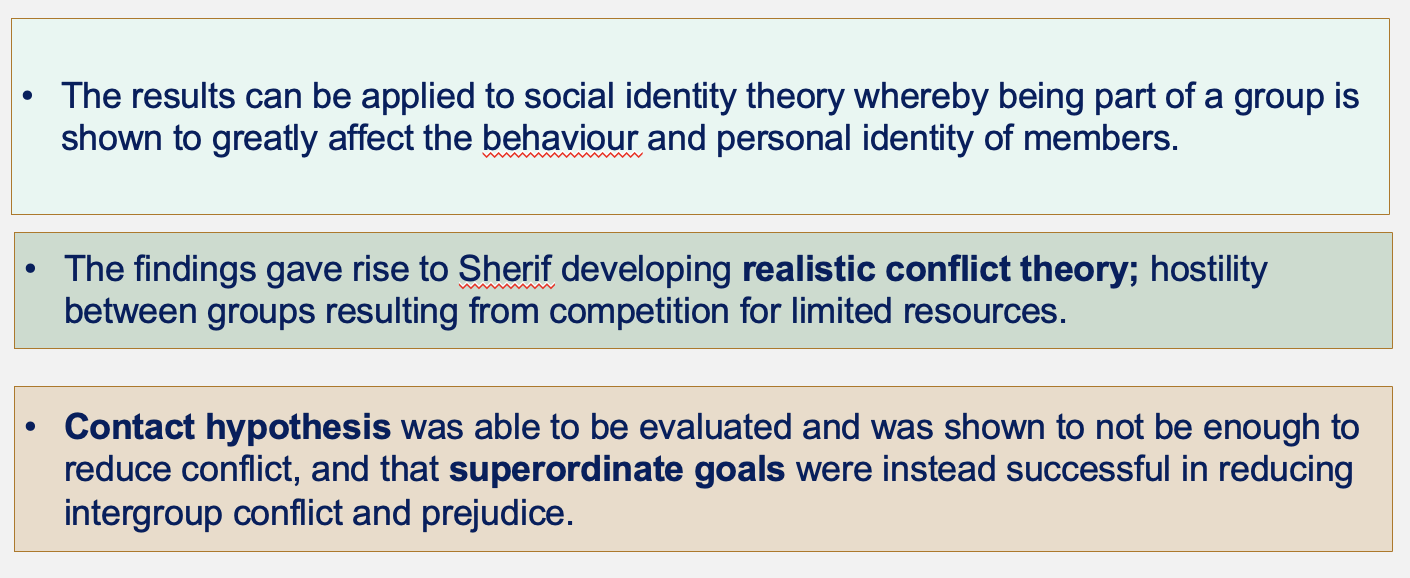
contributions
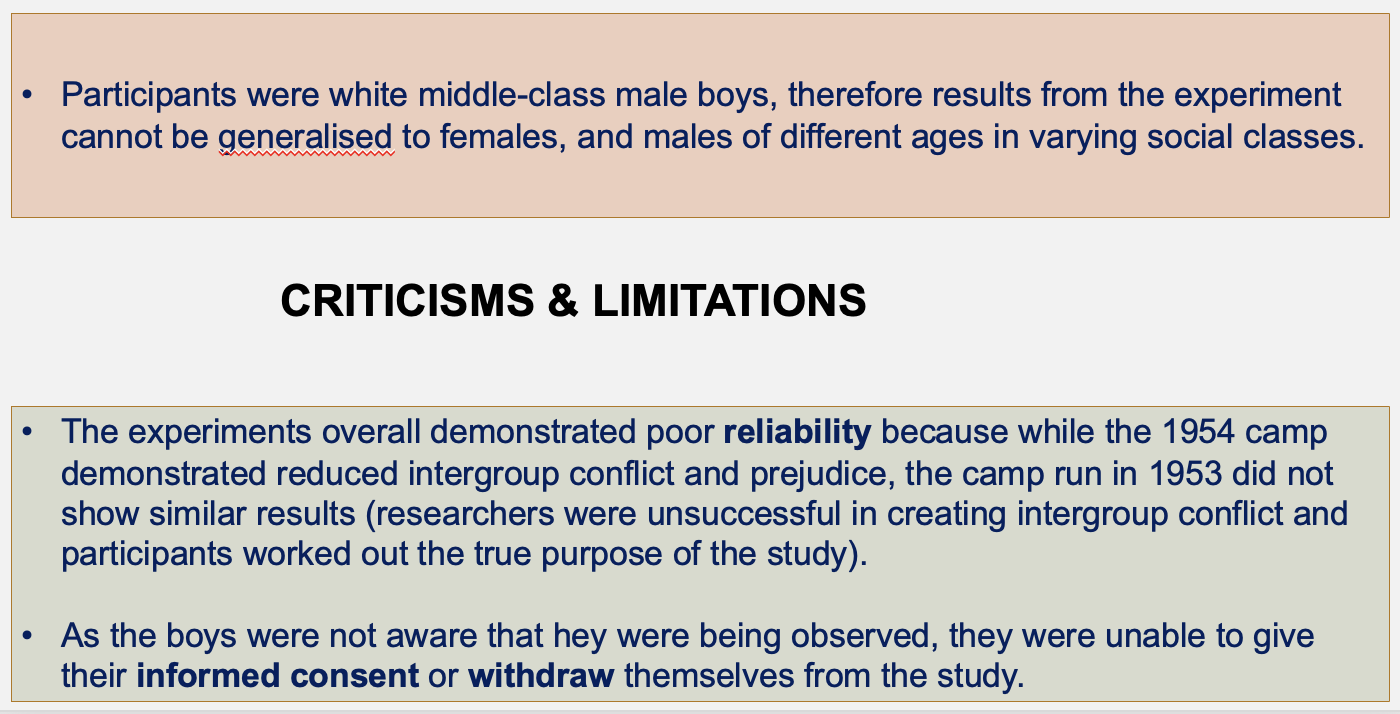
criticisms and limitations