Transfusion Medicine
 Call Kai
 Learn
Learn Practice Test
 Spaced Repetition
 Match
Match Flashcards
 Knowt Play
1/53

There's no tags or description
Looks like no tags are added yet.
Name | Mastery | Learn | Test | Matching | Spaced | Call with Kai | Chat |
|---|
No analytics yet
Send a link to your students to track their progress
54 Terms
RBC type with least amount of antigens is considered what?
Universal donor
With new antigens discovered every year, it is important to perform a ______________ to check for agglutination rather than relying on blood type
Crossmatch
What is the most important blood type in dogs?
DEA 1.1 (negative and positive)
T or F: Dogs have no naturally occuring antibodies when they are born so you have a "free pass" for your first blood transfusion
A
T or F: Cats have no naturally occuring antibodies when they are born so you have a "free pass" for your first blood transfusion
B
What is the universal donor for dogs?
DEA 1.1 negative
What are the feline blood types?
A, B, and AB
What is the most common feline blood type?
Type A
What is the rarest feline blood type?
Type AB
Type _______ cats have very strong antibodies against type ________ blood
B, A
T or F: All cats must be typed/crossmatched before transfusion
A
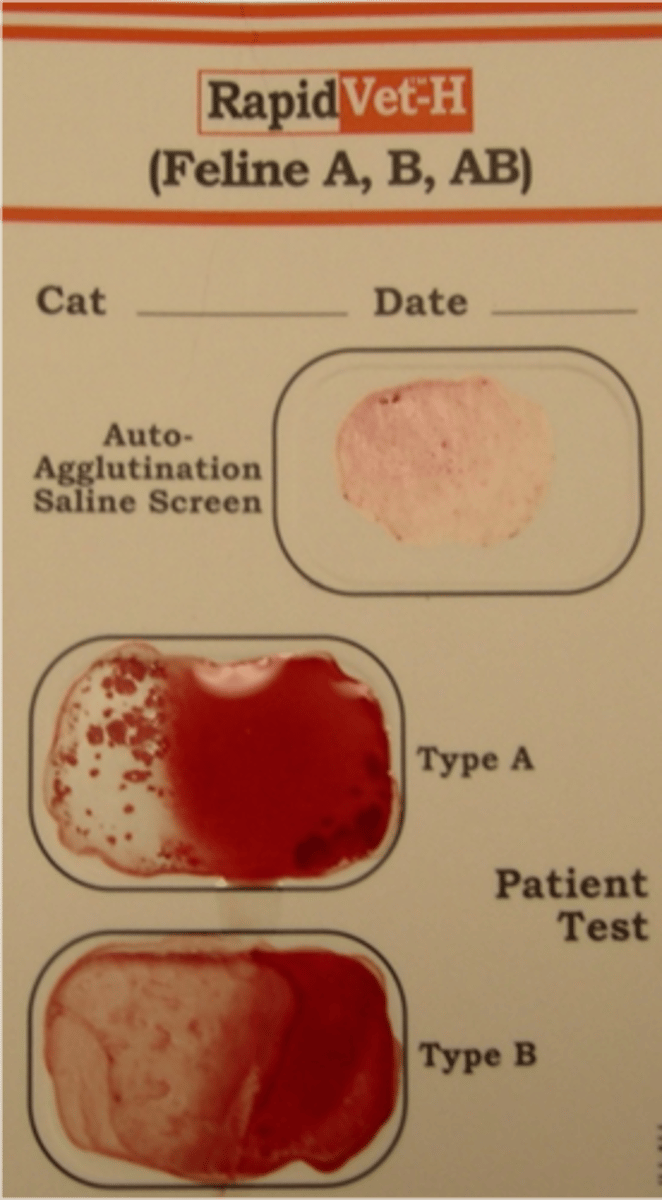
What type of blood type does this cat have based off this typing test?
Type A
Giving what blood to what type of cat will lead to a fatal reaction and death?
Type A blood to a B cat
What cat breeds are most likely to have type B blood? (8)
1. Devon rex
2. Persian
3. Somali
4. Abyssinian
5. Birman
6. Scottish fold
7. British shorthair
8. Cornish rex
T or F: There is a universal donor for both dogs and cats
B (not cats!)
There is a chance for ____________ reactions on second transfusions for dogs and cats if it has been at least 4 days since the previous transfusion
Mic reaction
Mix recipient plasma with donors RBCs
Major crossmatch
What are the components of a major crossmatch?
1. Recipient plasma
2. Donors RBCs
T or F: It is standard of care to crossmatch all blood transfusion
A
What is the endpoint of crossmatching?
Agglutination
If an animal is auto-agglutinating, what tests are invalid?
1. Crossmatch
2. Blood type
3. Coombs test
Process of separate whole blood into individual components
Whole blood fractionation
What does fresh whole blood contain?
1. RBCs
2. Plasma proteins
3. All clotting factors
4. Some viable platelets
What are the indications for fresh whole blood?
1. Blood loss
2. Anemia with hypoproteinemia
What does stored whole blood lose?
1. Platelets
2. Clotting factors 5 & 8
3. vWF
What are the indications for packed RBCs?
1. Anemia (hemolytic or chronic)
2. Loss of RBCs but normal plasma volume (IMHA)
T or F: Packed RBCs do NOT provide colloid osmotic pressure
A
Packed RBCs should never be used to treat what?
Anticoagulant rodenticide toxicity
Plasma administered within 6 hours of collection
Fresh plasma
Plasma frozen within 6 hours of collection
Fresh frozen plasma
What are indications for fresh/FF plasma?
1. Anticoagulant rodenticide
2. Hypoproteinemia
T or F: Fresh/FF plasma contains ALL coagulation factors
A
Fresh frozen plasma lasts for ____________ and then it is relabeled as frozen plasma
1 year
Frozen plasma is missing what components?
Clotting factors 5 and 8, vWF
You should not use frozen plasma for what?
1. vWD
2. Hemophilia A
T or F: Frozen plasma contains vitamin K dependent factors
A
T or F: You should NOT use frozen plasma to treat rodenticide toxicity
B
Precipitates of fresh frozen plasma; has higher concentration with a smaller volume
Cyroprecipitate
What does cryoprecipitate contain?
1. Clotting factors 8 and 13
2. vWF
3. Fibrinogen
4. Fibronectin
What are indications for using cryoprecipitate?
1. vWD
2. Hemophilia A
3. Factor VIII deficiency
Cryoprecipitate is the same as ___________ except with a smaller volume
Fresh frozen plasma
Cryoprecipitate is good for what kind of breeds?
Small breeds such as chihuahuas
T or F: You should always use a filter for a blood transfusion, even plasma
A
No blood product should be left at room temperature for __________ to prevent bacterial contamination
> 4 hours
The collection and later reinfusion of a patients own blood or blood components
Autologous transfusion
Process of infusing a patient's own blood
Autotransfusion
What are the clinical signs of a mild transfusion reaction?
1. Angioedema
2. Urticaria
3. Pruritus
4. Fever (increase 1˚C from pre-transfusion)
What is the most common clinical sign for a mild transfusion reaction?
Fever (increase 1˚C from pre-transfusion)
How do you treat for mild transfusion reactions?
1. Stop transfusion
2. Check temperature
3. Check PCV for hemolysis
4. Check urine (if available) for hemoglobinuria
5. Check the blood being transfused (any abnormalities, culture/sensitivity)
6. If blood is okay, consider diphenhydramine and starting transfusion at a slower rate
What are clinical signs of severe transfusion reactions?
1. Hypotension
2. Shock
3. Collapse
How do you treat for severe transfusion reactions?
1. Obtain airway, intubate, ventilate
2. Give IV crystalloids for shock
3. Monitor for acute renal failure/sepsis (consider antibiotics)
Synthetic analogue of lysine that reduces blood loss and transfusion requirements
Aminocaproic acid
What should you give to prevent hemorrhage in patients?
Aminocaproic acid
What are additional off label uses for aminocaproic acid?
1. ITP
2. Hemophilia
3. Hemoabdomen
4. Topical bandages for kittens with hemophilia (after declaw)