Penny chapter 14 Breast and Superficial MSK
 Call Kai
 Learn
Learn Practice Test
 Spaced Repetition
 Match
Match Flashcards
 Knowt Play
1/59

There's no tags or description
Looks like no tags are added yet.
Name | Mastery | Learn | Test | Matching | Spaced | Call with Kai | Chat |
|---|
No analytics yet
Send a link to your students to track their progress
60 Terms
Which of the following is a common cause of cellulitis?
a. Staphylococcus
b. Cytomegalovirus
c. Histoplasmosis
d. Toxoplasmosis
a. Staphylococcus
What color Doppler finding is common with an abscess?
a. Hypoemic flow surrounding the abscess
b. Hyperemic flow surrounding the abscess
c. Lack of blood flow within or around the abscess
d. Reversed Doppler signals with spectral imaging
b. Hyperemic flow surrounding the abscess
What is another name for a Baker cyst?
a. Pilonidal cyst
b. Articular cyst
c. Ganglion cyst
d. Popliteal cyst
d. Popliteal cyst
Which of the following is a clinical finding that is common for a meniscal cyst?
a. Ankle swelling
b. Previous trauma
c. Valvular slits
d. Abscess formation
b. Previous trauma
Which of the following would be better imaged with sonography rather than radiography?
a. Radiolucent objects
b. Radiopaque objects
c. Hairline fractures
d. Shrapnel
a. Radiolucent objects
What is described as a congenital condition in which an individual suffers from severe joint contractors?
a. Arthritis
b. Subluxation
c. Arthrogryposis
d. Tendosynovitis
c. Arthrogryposis
d. Breast abscess
The masses in Figure 14-41 were discovered in lactating patients who were suffering from focal breast erythema, swelling, fever, and pain. What is the most likely diagnosis?
a. Galactocele
b. Ganglion cyst
c. Intraductal carcinoma
d. Breast abscess
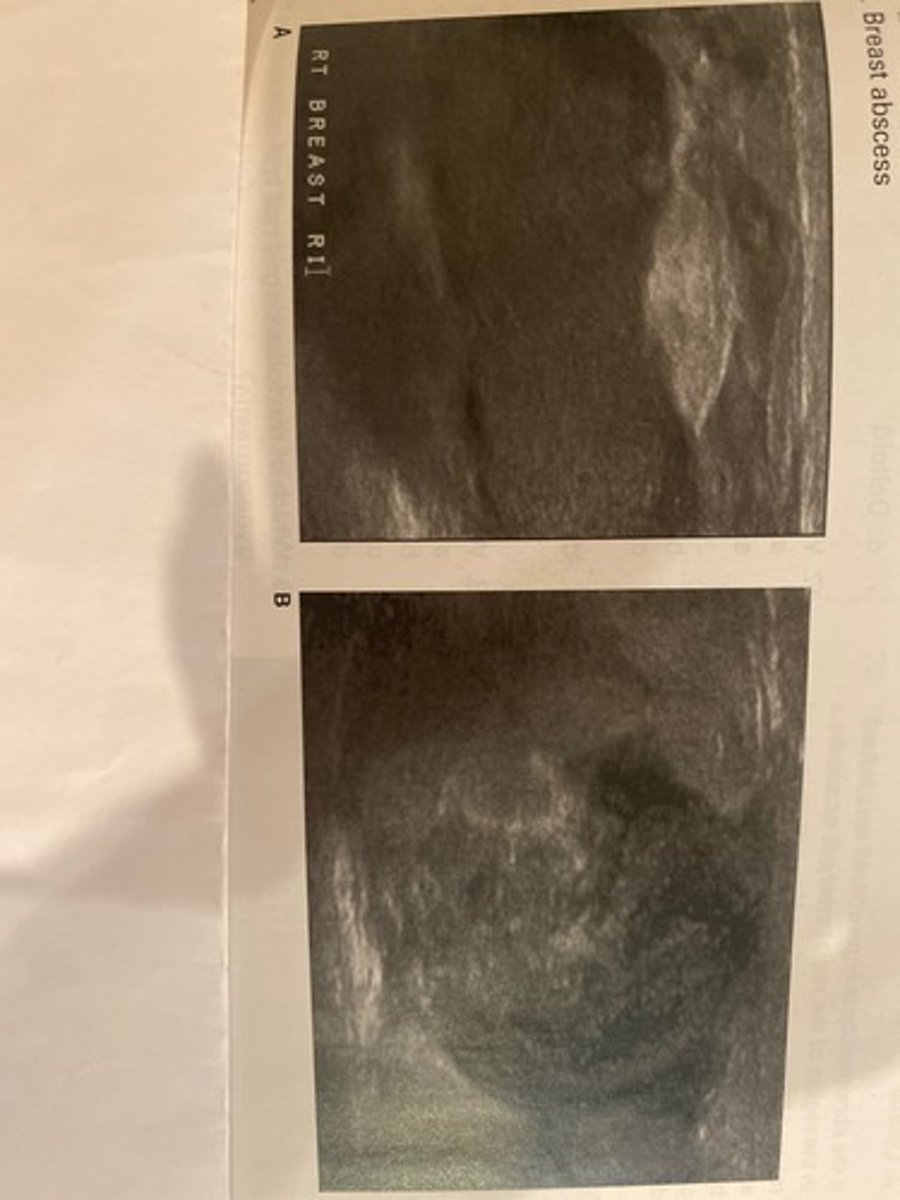
What lab would most likely be elevated in the patients in Figure 14-41?
a. Red blood cell count
b. Platelets
c. White blood cell count
d. Hemoglobin
c. White blood cell count
Which of the following would be most likely noted in a patient following the surgical removal of a malignant breast lesion?
a. Hemangioma
b. Hamartoma
c. Fibroma
d. Seroma
d. Seroma
d. Subluxation
In Figure 14-42, Figure A is without stress, whereas Figure B is with stress. What disorder can be noted?
a. Infantile traumatic dislocation
b. Normal hip
c. Developmental dislocation
d. Subluxation
b. Ganglion cyst
What is the painless abnormality noted in the wrist of the patient in Figure 14-43?
a. Baker cyst
b. Ganglion cyst
c. Pilonidal cyst
d. Lipoma
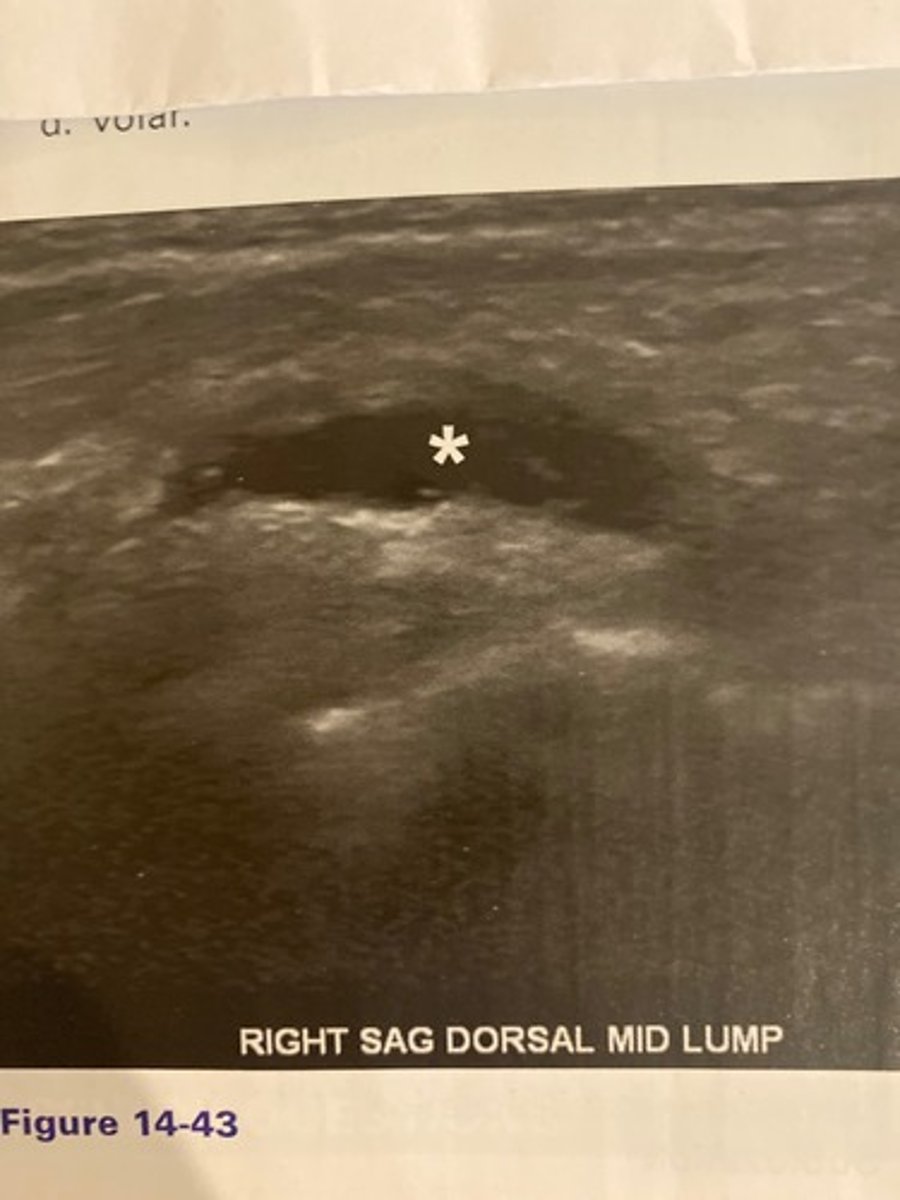
If the abnormality in Figure 14-43 was noted in the region of the radial artery, it would be referred to as:
a. dorsal.
b. anterior.
c. posterior.
d. volar.
d. volar.
What is a thin fibrocartilaginous tissue that is located within the knee joint that may suffer from tearing?
a. Tuberosity
b. Synovial
c. Meniscus
d. Condyle
c. Meniscus
Which of the following circulating maternal hormones may be responsible for the development of DDH?
a. Progesterone
b. Human chorionic gonadotropin
c. Estrogen
d. Follicle-stimulating hormone
c. Estrogen
What is another name for the calf muscle?
a. Gastrocnemius
b. Peroneus
c. Gluteus maximus
d. Latissimus dorsi
a. Gastrocnemius
A sonographer is asked to analyze a palpable, painful mass within the lateral shoulder muscle following an injection. What is the name of this muscle?
a. Trapezius
b. Pectoralis major
c. Biceps brachii
d. Deltoid
d. Deltoid
Why are radial and antiradial sonographic scanning useful for the analysis of the breast?
a. Because they better demonstrate the pattern of the ducts
b. Because they better demonstrate pathology
c. Because they better determine what tissue layers are involved in the disease
d. Because they limit the amount of tissue to thickness
a. Because they better demonstrate the pattern of the ducts
What is the medical term for the wrist bones?
a. Metacarpals
b. Tarsals
c. Metatarsals
d. Carpals
d. Carpals
Which of the following is not typically a cause of gynecomastia?
a. Klinefelter syndrome
b. Marijuana use
c. Hepatoblastoma
d. Renal adenocarcinoma
d. Renal adenocarcinoma
b. Perform the Thompson test.
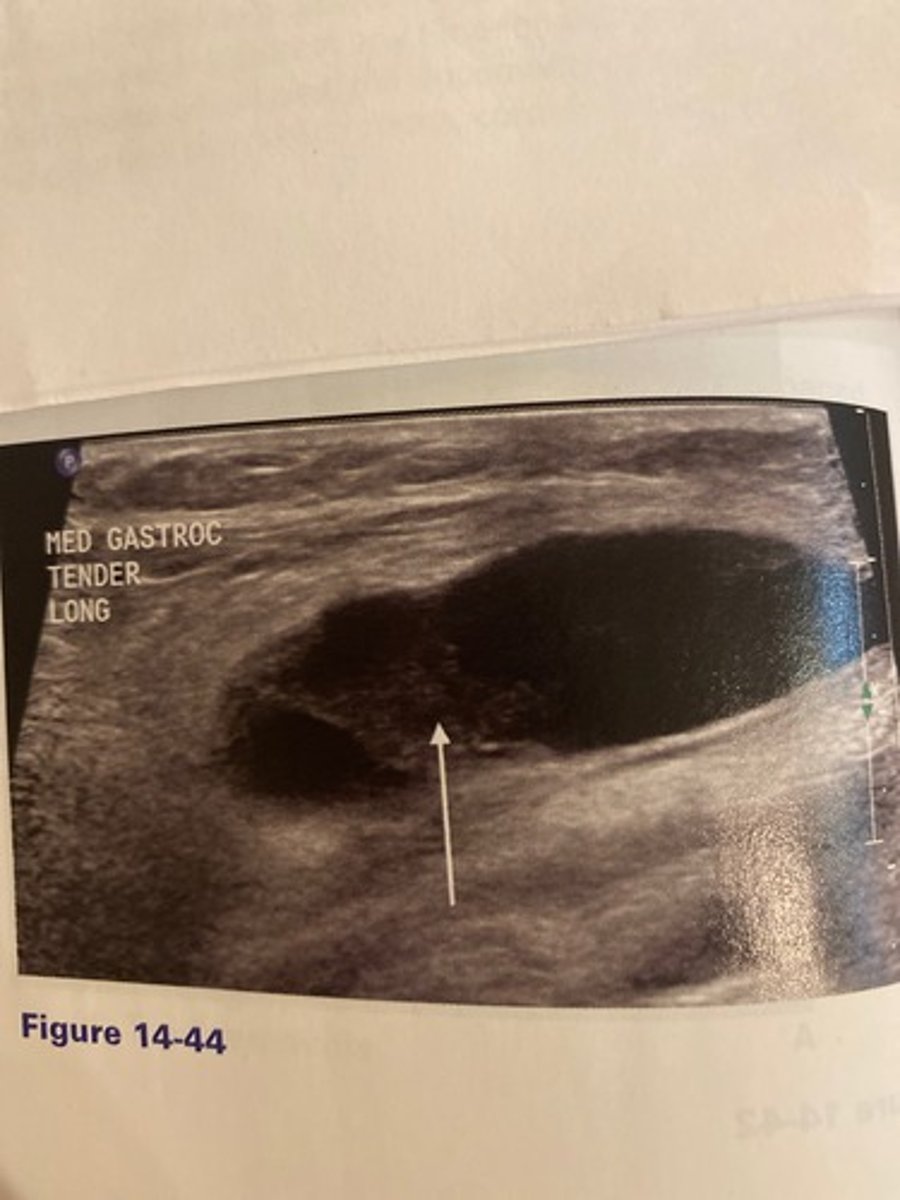
The arrow in Figure 14-44 indicates hemorrhage within a mass noted behind the knee. Which of the following would be the least helpful task the the sonographer should perform in this case?
a. Apply color Doppler.
b. Perform the Thompson test.
c. Inquire if the patient has a history of rheumatoid arthritis.
d. Analyze the cyst for evidence of channel leading to the joint.
Which of the following techniques is used to measure the relationship of the femoral head and acetabulum by evaluating the alpha and beta
angles?
a. Graf
b. Ortolani
c. Barlow
d. Thompson
a. Graf
Inflammation and infection of the skin and subcutaneous tissue is termed:
a. ascites.
b. retroperitoneal fibrosis.
c. cellulitis.
d. subcutaneous edema.
c. cellulitis.
Clinical findings of tendonitis include all of the following except:
a. itching in the area of the tendon.
b. pain.
c. edema.
d. the area is warm to touch.
a. itching in the area of the tendon.
Which of the following is a clinical test for developmental hip dysplasia that is used to evaluate the hip for the reduction or relocation of a dislocated hip?
a. Graf
b. Ortolani
c. Barlow
d. Thompson
b. Ortolani
What test can be performed to determine a torn Achilles tendon?
a. McBurney test
b. McDonald test
c. Thompson test
d. Baker test
c. Thompson test
A cystic mass located within the popliteal fossa is most likely a:
a. Baker cyst.
b. Thompson cyst.
c. ganglion cyst.
d. lipoma.
a. Baker cyst.
A patient presents with a palpable, oozing mass at the level of the natal cleft. What is the most likely etiology of this mass?
a. Pannus cyst
b. Epidermoid
c. Hemangioma
d. Pilonidal cyst
d. Pilonidal cyst
A common mass found along the dorsal aspect of the hand and wrist is the:
a. Baker cyst.
b. Thompson cyst.
c. ganglion cyst.
d. lipoma.
c. ganglion cyst.
The Achilles tendon connects the:
a. ankle to the knee.
b. heel to the ankle.
c. heel to the calf muscle.
d. knee to the calf muscle.
c. heel to the calf muscle.
In what position should the patient placed to better evaluate the Achilles tendon?
a. Prone
b. Supine
c. Right lateral decubitus
d. Left lateral decubitus
a. Prone
Inflammation of the breast that is related to pregnancy is referred to as:
a. puerperal mastitis.
b. retromammary mastitis.
c. chronic mastitis.
d. emphysematous mastitis.
a. puerperal mastitis.
Which of the following best describes the
Thompson test?
a. The patient lies prone and performs plantarflexion.
b. The patient lies prone while the symptomatic calf is squeezed.
c. The patient lies supine and performs plantarflexion.
d. The patient lies prone and performs dorsiflexion.
b. The patient lies prone while the symptomatic calf is squeezed.
Which of the following is true about patients with
а lipoma?
a. They often complain of pain in the area of the mass.
b. They are often obese.
c. They are only slightly tender in the area of the mass.
d. They feel no pain in the area of the mass.
d. They feel no pain in the area of the mass.
Subluxation denotes:
a. synovial joint obstruction.
b. partial hip dislocation.
c. rupture of the bursa.
d. inflammation of the acetabulum.
b. partial hip dislocation.
All of the following are keys to identifying foreign bodies with sonography except:
a. most foreign bodies appear hypochoic.
b. a linear array transducer should be used.
c. most foreign bodies are better visualized using a standoff pad.
d. comet-tail artifact may be seen posterior to metallic objects.
a. most foreign bodies appear hypochoic.
A 6-year-old female patient presents to the sonography department for a hip sonogram with irritability, unwillingness to walk, and low-grade fever. Sonographically, you visualize a hypochoic fluid collection that elevates the joint capsule. What is the most likely diagnosis?
a. Developmental hip dysplasia
b. Subluxation
c. Joint effusion
d. Hip dislocation
c. Joint effusion
Which of the following would be best described as a benign tumor comprised of fat?
a. Hemangioma
b. Lipoma
c. Hamartoma
d. Oncocytoma
b. Lipoma
What is the most likely cause of a hip joint effusion in infants?
a. Tendonitis
b. Bursitis
c. Developmental hip dysplasia
d. Transient synovitis
d. Transient synovitis
Which of the following would be best described as a benign tumor composed of blood vessels?
a. Hemangioma
b. Lipoma
c. Hamartoma
d. Oncocytoma
a. Hemangioma
Which of the following transducers would be best suited to sonographically assess for a splinter in a patient's hand?
a. High-frequency linear array transducer
b. Low-frequency curved array transducer
c. High-frequency sector transducer
d. Low-frequency linear array transducer
a. High-frequency linear array transducer
The accumulation of synovial fluid from a weakening in the joint capsule of the knee, as seen in conditions such as rheumatoid arthritis, can result in a:
a. hemangioma.
b. lipoma.
c. Baker cyst.
d. ganglion cyst.
c. Baker cyst.
Fluid within the synovial sheath is indicative of:
a. hyperemic flow.
b. tendosynovitis.
c. cartilaginous inflammation.
d. cartilaginous extension.
b. tendosynovitis.
Which of the following best describes the most common sonographic appearance of gynecomastia?
a. Hypochoic, retroareolar mass
b. Hyperechoic, exophytic mass
c. Anechoic, retroareolar mass
d. Hyperechoic, areolar mass
a. Hypochoic, retroareolar mass
Acoustic shadowing caused by bending of a sound beam at the edge of a curved reflector is referred to as:
a. mirror image artifact.
b. indirect artifact.
c. reflective shadowing.
d. refractive shadowing.
d. refractive shadowing.
Inflammation of the tendon and synovial tendon sheath is referred to as:
a. tendosynovitis.
b. tendonitis.
c. cellulitis.
d. pannus.
a. tendosynovitis.
A patient presents to the sonography depart. ment with a history of cellulitis on his abdomen.
The patient has fever, edema, and complains of focal tenderness in a specific region affected by the cellulitis. Sonographically, you identify a localized complex collection of fluid. What is the most likely diagnosis?
a. Superficial hemangioma
b. Subcutaneous carcinoma
c. Mastitis
d. Superficial abscess
d. Superficial abscess
A complicated Baker cyst may contain a thin flap of tissue referred to as:
a. pannus.
b. plica.
c. septation.
d. lipoma.
a. pannus.
Which of the following is also referred to as a
Bible bump?
a. Ganglion cyst
b. Superficial endodermal cyst
c. Superficial epidermal cyst
d. Epidermoid
a. Ganglion cyst
Clinical findings of a Baker cyst may mimic those
of a(n):
a. arteriovenous malformation.
b. deep venous thrombosis.
c. knee fracture.
d. ganglion cyst.
b. deep venous thrombosis.
Sonographically, normal muscle appears as:
a. hyperechoic tissue that contains linear, echogenic strands.
b. complex tissue that contains linear, hypochoic strands.
c. hypochoic tissue that contains linear, echogenic strands.
d. echogenic tissue that contains linear, hypochoic strands.
c. hypochoic tissue that contains linear, echogenic strands.
All of the following are true of ganglion cysts except:
a. a ganglion cyst is a common mass found along the superior aspect of the hand and wrist, between the tarsals.
b. ganglion cysts typically appear sonographically as an incompressible, anechoic mass with acoustic enhancement.
c. clinically, ganglion cysts may be hard to touch and painful.
d. ganglion cysts are often treated with an injection of corticosteroids.
a. a ganglion cyst is a common mass found along the superior aspect of the hand and wrist, between the tarsals.
A partial tear of a tendon typically appears as:
a. a focal hypochoic area within the tendon.
b. a focal echogenic area within the tendon.
c. a diffusely heterogeneous area within the tendon.
d. edema and refractive shadowing in the area of the divided tendon.
a. a focal hypochoic area within the tendon.
Tendons sonographically appear as:
a. echogenic, fibrous structures connecting muscles to bone.
b. echogenic, fibrous structures connecting bone to bone.
c. hypochoic, linear arrangements within hyperechoic tissue.
d. hyperechoic tissue that contains linear, echogenic strands.
a. echogenic, fibrous structures connecting muscles to bone.
A standoff pad is most useful in imaging:
a. deep structures that produce acoustic enhancement.
b. deep structures that produce acoustic shadowing.
c. structures that produce refractive shadowing.
d. superficial structures.
d. superficial structures.
Hyperemic flow within or around a structure is often indicative of:
a. malignancy.
b. benignancy.
c. inflammation.
d. rupture.
c. inflammation.
All of the following will aid in the sonographic assessment of an Achilles tendon except:
a. the patient lies prone, with their feet hanging off the end of the bed.
b. both the symptomatic and asymptomatic
Achilles tendons should be scanned for
comparison.
c. the entire tendon should be evaluated in sagittal and transverse scan planes.
d. the patient is scanned standing, with a small amount of pressure placed on the symptomatic side.
d. the patient is scanned standing, with a small amount of pressure placed on the symptomatic side.
Which of the following best describes the Thompson test?
a. The calf is squeezed and the foot should plantarflex in a patient who does not have a complete tear of the Achilles tendon.
b. The calf is squeezed and the foot should not plantarflex in a patient who does not have a complete tear of the Achilles tendon.
c. The Achilles tendon is squeezed and the foot should plantarflex in a patient who does not have a complete tear of the Achilles tendon.
d. The Achilles tendon is squeezed and the foot should not plantarflex in a patient who does not have a complete tear of the Achilles tendon.
a. The calf is squeezed and the foot should plantarflex in a patient who does not have a complete tear of the Achilles tendon.
Superficial lipomas may appear as all of the following except:
a. hypochoic to the surrounding tissue.
b. isoechoic to the surrounding tissues.
c. hyperechoic to the surrounding tissue.
d. anechoic to the surrounding tissue.
d. anechoic to the surrounding tissue.
Bullets, shrapnel, and other metallic objects may cause:
a. acoustic enhancement.
b. comet-tail artifact.
c. edge enhancement.
d. mirror image artifact.
b. comet-tail artifact.
Which of the following at the site of a foreign body may produce bright echoes and, therefore, cause some ambiguity about the correct orientation of the obiect?
a. Fluid
b. Enhancement
c. Dust
d. Air
d. Air