Anesthesiology: Exam 1 Principles of Inhalant Anesthesia & Monitoring 1 & 2
 Call Kai
 Learn
Learn Practice Test
 Spaced Repetition
 Match
Match Flashcards
 Knowt Play
1/208

There's no tags or description
Looks like no tags are added yet.
Name | Mastery | Learn | Test | Matching | Spaced | Call with Kai | Chat |
|---|
No analytics yet
Send a link to your students to track their progress
209 Terms
Vapor
Substance that is liquid at ambient temperature & pressure
Ex: Halothane, isoflurane, sevoflurane, desflurane
Vapor pressure
Pressure exerted by vapor molecules when liquid & vapor phases are in equilibrium
*Directly affected by temperature (increased temp = increased pressure)
Boiling point
Temperature at which vapor pressure = atmospheric pressure
*Inversely related to vapor pressure
Vapor pressure/ Barometric pressure
What is the formula for vaporization at ambient pressure?
Vaporizers
Vapors have a maximum administration percentage. What machine reduces this to a clinically useful dose?
*Mixes 100% oxygen with vapor's max %
-Adjusted by a knob that offers 1-5% of vapor)
Gas
Exists in a gaseous state at ambient temperature & pressure
-Ex: Nitrous oxide, xenon
N2O (Nitrous oxide)
AKA Laughing gas, provides mild analgesia & accumulates in closed gas spaces
Fast induction and recovery
Nitrous oxide has a low blood gas partition coefficient (0.47). What does this mean in terms of induction & recovery?
Xenon
Very expensive, mostly experimental gas with minimal cardiovascular depression (CO & BP don't change)
-Good for patients with heart disease but not commonly used
Boyle's Law
States that the volume of a gas is inversely proportional to the pressure
Charles's Law
States that volume of a gas is directly proportional to the temperature
Gay-Lussac's Law
States that the pressure of a gas is directly proportional to the temperature
Dawton's Law
States that the total pressure of a gas mixture is = to the sum of the partial pressure of the individual gases
Inhalant equilibrium
Reached when the partial pressure of the anesthetic is the same in each phase (CNS, blood, & alveoli)
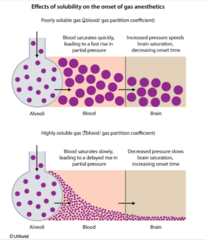
Solubility
Describes the capacity of a given solvent (blood) to dissolve the anesthetic gas
-Expressed as partition coefficient (PC)
Partition coefficient (PC)
Concentration ratio of an anesthetic in the solvent (blood) & gas phase (alveoli)
Blood-gas partition coefficient
Describes the amount of anesthetic in the blood vs. alveolar gas at equal partial pressures
-Most clinically useful number
Brain concentration
When calculating the blood gas partition coefficient, the alveolar partial pressure represents the ____ ____ after equilibrium (although usually measured as %).
Higher
Does a higher or lower Blood-gas partition coefficient indicate greater gas solubility in the blood?
Inactive, brain (CNS)
Anesthetic dissolved in the blood is pharmacologically _____ and does not produce unconsciousness until it travels to & reaches sufficient partial pressure in the _____.
Halothane, isoflurane, sevoflurane, desflurane (HISD - he isn't super dissolvable)
What the 4 most to least soluble vapors discussed?
Lower
Does a higher or lower blood-gas partition coefficient indicate less anesthetic dissolved in the blood at equal partial pressures (more in alveoli)?
Lower
Do higher or lower blood-gas partition coefficients (BG PC) provide shorter induction & recovery times?
*Since it takes less time to achieve equilibrium
Lower
Are higher or lower blood-gas partition coefficients (BG PC) more clinically useful?
Higher
Do higher or lower blood-gas partition coefficients (BG PC) cause longer induction & recovery times?
-Ex: Halothane
Hypothermia (Patient becomes deeply anesthetized bc more drug is diluted in the blood = longer recovery)
Does hypothermia or hyperthermia increase anesthetic solubility?
Pressure gradients
Anesthetic inhalants move down ____ ____ until equilibrium is achieved
*Anesthetic leaves Vaporizer → breathing circuit → alveoli → arterial blood → CNS in brain
Alveoli
Partial pressure of the brain (Pbrain) is roughly equal to the partial pressure in the ____.
PA
Partial Pressure of the inhalant anesthetic in the alveoli
*Pressure of the gas that's delivered to alveoli & removed from the lungs via the blood
Increase
During induction, do you increase or decrease the PA to reach equilibrium quicker?
Decrease
Do you increase or decrease the PA to recover the patient quicker?
*Remember inhalants are reversed/eliminated via respiration & move from high to low pressure gradients
Delivery, removal, induction
Ways to increase Partial Pressure (PA):
1) Increase anesthetic ____ to the alveoli
2) Decrease anesthetic ____ from the alveoli
3) Increase speed of ____ & change the anesthetic plane
Inspired anesthetic concentration (PI)
What concentration do these changes increase:
-Increase vaporizer setting
-Increase fresh gas flow (flowmeter)
-Decrease breathing circuit volume (Large circuit = small anesthetic concentration = takes longer for anes. concen. to increase)
Minute, dead space
To increase anesthetic delivery to the alveoli (& PA), alveolar ventilation can be increased by:
1) Increasing ___ ventilation via mechanical/manual ventilation
2) Decreasing ___ ____ ventilation (Ex: ET tube too long)
Decrease anesthetic removal from the alveoli (which increases PA)
How do the following changes affect anesthetics in the alveoli:
-Decrease blood solubility of anesthetic via different agents
-Decrease cardiac output
-Decrease alveolar-venous anesthetic gradient (Tissue uptake from anesthetic)
PA, induction
A low cardiac output causes slower extraction of anesthetics from the lungs which creates a faster rise in ____ & therefore faster _____.
PI (Inspired anesthetic concentration)
A high ___ is required at the beginning of gas anesthesia to quickly increase the PA .
-As the uptake into the blood decreases, this pressure should be decreased too
Agent solubility, alveolar ventilation
What 2 factors affect anesthetic elimination & decreases PA ?
*Anesthetic time & decreased body temp both affect this too
Hyperthermia
Does hypo or hyperthermia decrease the solubility of inhaled anesthetics (leads to a shorter anesthetic elimination, shorter recovery, & increased MAC)?
Vaporizer, O2, ventilation
Ways to Decrease PA:
-Turn off the ______
-Disconnect patient & flush the breathing system with O2
-Turn up ____ flow = dilutes the anesthetic in the circuit
-Increase ____ = increases fresh gas to alveoli
Minimum alveolar concentration (MAC)
Lowest dose of inhalant anesthetic at which 50% of patients show no response/movement to noxious stimuli
*Consistent between species
*Allows comparison between inhalant agents
Low
An inhalant with a High MAC indicates ____ potency.
Alveolar concentration (%)
What measurement describes how much (dose) of an inhalant was given?
Gas analyzer
Instrument that's the gold standard for measuring anesthetic dose
*Looks at end-tidal gas concentration
*Tells you the actual concentration of anesthetics & not a target concentration (what the vaporizer does)
1.3-1.4%
Isoflurane MAC Range in Dogs, Cats, & Horses
2.3-2.4%
Sevoflurane MAC Range in Dogs, Cats, & Horses
7.0-9.0%
Desflurane MAC Range in Dogs, Cats, & Horses
200%
General MAC of Nitrous oxide in dogs, cats, & horses
Iso, sevo, des, NO
Rank the inhalant anesthetics from lowest to highest MAC (ie most to least potent)
Increase
Do the following factors increase or decrease MAC:
-Hyperthermia (decreases anesthetic solubility)
-Hypernatremia
-Drugs causing CNS stimulation
-Decreased age
Decrease
Do the following factors increase or decrease MAC:
-Hypothermia (increases anesthetic solubility)
-Hyponatremia
-Drugs causing CNS depression
-Increased age
-Hypozemia
-Severe hypotension
-Pregnancy
-Anemia
-Metabolic acidosis/hypercapnia
50%, 95%
1 MAC describes immobility in ___% of the patients, while 1.3 MAC describes immobility in ___% of the patients.
True
True or False: Patients recover faster from inhalants than injectables since they just have to breathe out the drug versus full metabolism of injectables.
Decrease (= decreased BP due to vasodilation/less SVR & decreased CO)
Do inhalants increase or decrease cardiac contractility & systemic vascular resistance?
False (HR is not changed or minimally increased due to compensation for vasodilation)
True or False: Heart rate is heavily increased by inhalants due to decreased cardiac contractility.
Respiratory depression
Inhalants decrease ventilation by causing dose dependent ____ ____ via inhibition of central CO2 & peripheral O2 chemoreceptors.
*Apnea at 1.5-3.0 MAC
Bronchodilation
Do inhalant anesthetics promote bronchodilation or bronchoconstriction?
PaCO2 (Arterial partial pressure of CO2)
Ventilation is monitored by _____.
-Normal range = 35-45 mmHG
45
A PaCO2 > ___ mmHg indicates Respiratory depression & Hypoventilation.
Increasing (patient will be deeper anesthetized)
Does increasing or decreasing the inhalants cause an increased MAC, higher PaCO2, & subsequent respiratory depression?
Cerebral vasodilation
Inhalants can increase intracranial pressure (especially at MAC > 1) by causing ____ ____
*Sevoflurane increases the ICP less than other inhalants but propofol is the best drug to use in animals with a high ICP
Cerebral metabolic rate
Inhalants decrease ____ _____ ____, meaning the brain cells require less oxygen to survive.
*Can also suppress seizure activity
GFR (glomerular filtration rate), renal blood flow
What 2 factors in the renal system are decreased by inhalants & subsequent decreased CO?
-Older inhalants (methoxyflurane) caused Compound A formation but these inhalants are not used in modern practice
Blood flow
Inhalants reduce liver ___ ____ & O2 delivery due to decreased CO
-Modern agents have minimal hepatic metabolism compared to Halothane (hepatotoxic)
Malignant hyperthermia
Extremely rare myopathy occurring in genetically predisposed animals
-Mechanism: Genetic failure of a receptor causes uncontrollable release of Ca (Increased intracellular C) when exposed to inhalants → uncontrolled muscle contractions → increases temp of animal → Hyperthermia
EtCO2 (End-tidal carbon dioxide)
Peak concentration of carbon dioxide exhaled at the end of a breath
*Breath sample; normal range is 35-45 mmHg
Rapid increase in EtCO2
First sign of Malignant hyperthermia
-Other signs: increase in temp, red skin
*NOT A GOOD PROGNOSIS with this condition
Inhalants, stress
2 main triggers of Malignant hyperthermia
-Can both be present
Pigs
What animals are more prone to Malignant hyperthermia?
Dantrolene
Calcium channel antagonist for muscle relaxation used to treat Malignant hyperthermia
*Also discontinue volatile anesthetic, flush machine with O2 to remove residue, & provide 100% O2 to patient if this condition occurs
Ozone depletion
All inhalants cause the Greenhouse Effect, but nitrous oxide also causes _____ ____.
Guedel's stages of anesthesia
Anesthesia staging system created by places humans under anesthesia using Ether
*Has 4 stages & 4 planes within stage 3
Stage 1
Stage of voluntary excitement +/- mild sedation
-Beginning of induction to loss of consciousness
-Increased HR & RR from epinephrine release
*Disorientation (excitement) with normo-reflexia
-Salivation
Stage 2
Stage of involuntary excitement
*Period of early loss of consciousness
-Mydriasis with central eye position +/- nystagmus
-All reflexes present
- Strong jaw tone & response to surgical stimulation
Stage 3
Stage of surgical anesthesia that includes 4 Planes
-No movement in response to surgical stimulus with progressive loss of motor & autonomic reflex until cessation of breathing
Plane 1
Stage 3 with Response to noxious (pain) stimulus still present with normal breathing & pupil size
-Central eye position
-Weakening palpebral/pedal reflexes
-No swallow reflex & weak jaw tone
*Intubation is possible
Plane 2
Medium plane in Stage 3 with mydriasis & ventro-medially rotated eyes
-Surgical procedures can be performed
-Palpebral & pedal reflexes weak to absent
-Cardiovascular & respiratory function minimally affected
-Adequate muscle relaxation
Plane 3
Medium to deep plane in Stage 3 with mydriasis & central located eyes
-Palpebral & pedal reflexes absent
-Weak corneal flex & decreased lacrimation
-Cardiovascular and respiratory functions depressed
-Profound muscle relaxation
Plane 4
Dangerously deep plane in Stage 3 in which the patient is barely breathing or apnea
-Centrally located eyes with strong mydriasis
-Absent palpebral & corneal reflex
-Uncoordinated (jerky) breathing movements
-HR & arterial BP drop significantly
-Cardiopulmonary failure imminent
Corneal reflex
What reflex do you ALWAYS want to be present during anesthesia?
-Absence = dead or too deeply anesthetized
Stage 4
Stage of anesthetic overdose
-Respiratory arrest followed by circulatory failure
-Corneal reflex absent
-Anus is dilated, feces/urine may be voided
-Death from anesthetic overdose ensues shortly without immediate resuscitation
Palpebral, pedal (may be absent)
In an Ideal anesthetic depth, what 2 reflexes are weak?
Ventro-medially
In an Ideal anesthetic depth, what direction are the eyes rotated?
*In ruminants, dogs (some), cats (some)
Autonomic
In an ideal anesthetic depth, do the motor or autonomic reflexes remain stable?
Too light
Based on these signs, is the patient too light or too deeply anesthetized:
-Movement of limbs / neck in response to surgical stimulus
-Blinking
-Increased tear production (lacrimation)--> horses
-Nystagmus (horses)
Too light
Are Tachypnea & tachycardia signs that your patient is too light or too deeply anesthetized?
Too deep
Are bradycardia, bradypenia/apnea, & hypotension signs that your patient is too light or too deeply anesthetized?
Too deep
Based on these signs, is the patient too light or too deeply anesthetized:
-Absent palpebral reflex
-Absent pedal reflex
-Absent corneal reflex
-Dry wrinkled cornea (fishy eye)
Motor (somatic) reflexes
What type of reflexes are these:
-Palpebral reflex
-Corneal reflex
-Pupillary light response (not very practical)
-Pedal (withdrawal) reflex: small animals
-Anal sphincter tone / reflex: large animals
-Auricular reflex (Ear flick): cats
Lacrimation, nystagmus
What 2 eye related activities are important for evaluating anesthetic depth in HORSES?
Autonomic reflexes
What type of reflexes are these:
-Respiratory rate
-Heart rate
-Arterial Blood pressure
-Sweating (difficult to observe in thick-haired animals)
Stage 3 Plane 2-3
Ideal anesthetic stage/plane
Premedications, injectable induction
What 2 types of medications can be given to quicken/skip Stages 1 & 2 of anesthesia?
Ketamine
Dissociative anesthetic & induction agent that immobilizes patients completely but eye reflexes & ability to swallow remain
False (normal with ketamine for these reflexes to remain)
True or False: A dog that was induced with ketamine still has spontaneous blinking & a palpebral reflex. This dog is likely too light and more ketamine should be given.
Minute ventilation (VE)
Volume of air inspired or expired per minute
Tidal Vol (VT) x Resp rate (f)
Formula for minute ventilation
Tidal volume
Amount of air that moves in or out of the lungs with each normal breath
*Normal: 10 -15 mL /kg
ETCO2
End tidal CO2 measured via capnography after the end of each exhaled breath
PaCO2
Partial pressure of CO2 in arterial blood
*Measured via arterial sample