Physics waves AAAAAAAHHHHHHHHHHHHHHHHH
 Call Kai
 Learn
Learn Practice Test
 Spaced Repetition
 Match
Match Flashcards
 Knowt Play
1/22

There's no tags or description
Looks like no tags are added yet.
Name | Mastery | Learn | Test | Matching | Spaced | Call with Kai | Chat |
|---|
No analytics yet
Send a link to your students to track their progress
23 Terms
What is frequency?
Cycles per second
What is the period?
Cycles per second
What is the wavelength?
The distance between two consecutive points on successive waves
How do you calculate the period?
1/frequency
If the frequency of a wave is 8 Hz, then how much of the wave passes in 1 second (period)?
1/8th (Inverse)
What does a displacement-time graph show?
The amplitude, frequency, and period of a wave
How do you calculate the velocity of a wave?
v=fλ
If there are 6 waves per minute, and the distance between each crest is 10m, how do you solve?
Frequency=6/60=0.1Hz
∴λ=0.1/1 = 10m
v=fλ
0.1×10 = 1m/s

What is the frequency of thsi wave?
Can’t tell. Time for one λ to occur is known, but the magnitude of λ is not

What is the frequency of this wave
Can’t tell. Magnitude of λ is known, frequency is not
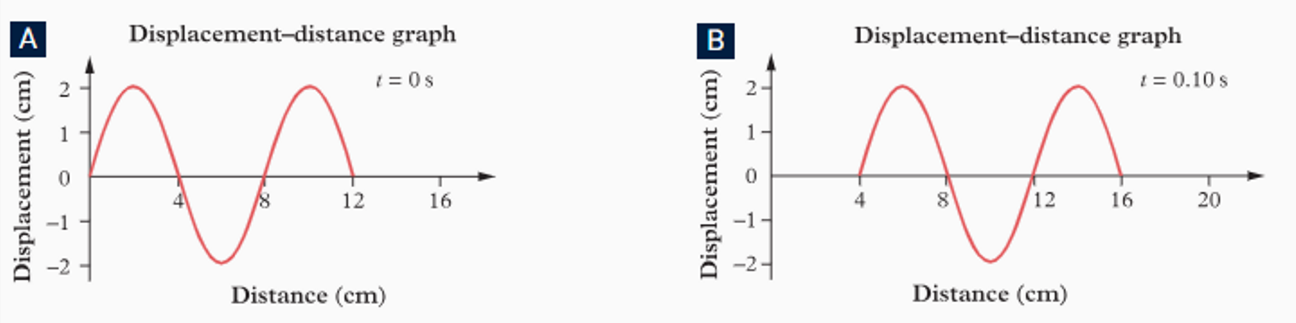
How do you calculate frequency in these two graphs
Crest moves 4cm in 0.1 seconds. λ is known to be 8cm, so it takes 0.2 seconds to complete a full cycle. This is the period, so take the inverse (1/0.2), which = 5 Hz
What unit must wave velocity be in
Meters
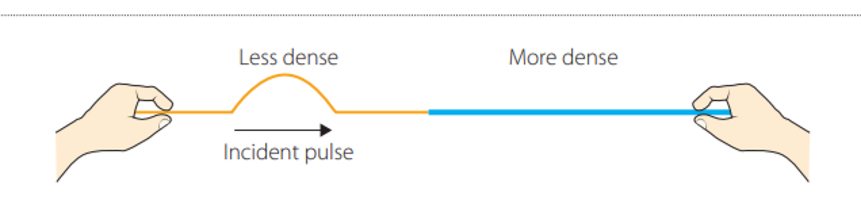
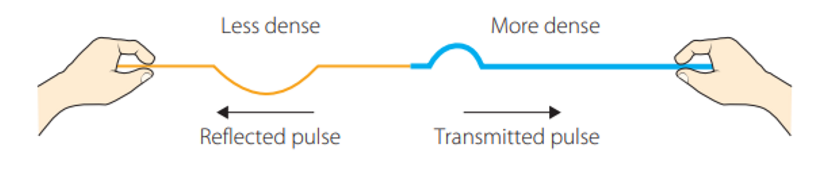
What happens when a wave is transmitted through a more dense substance?
It is reflected underneath the axis, whilst a secondary smaller wave continues along the more dense medium
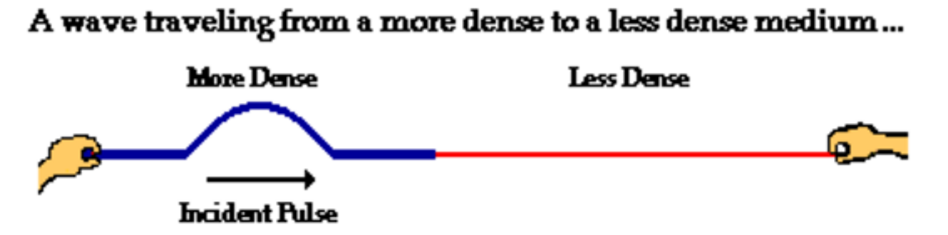
What happens when a wave is transmitted through a less dense substance?
It is reflected back normally, whilst a secondary larger wave continues along the less dense medium

What is the law of reflection?
θI=θr
What is the angle of incidence?
The incoming wave
What is the angle of reflection?
The reflected wave
What are standing waves
Waves that are stationary rather than travelling through a medium
What does a small gap do in terms of diffraction
Creates waves that have increasingly larger angles going away from the wall

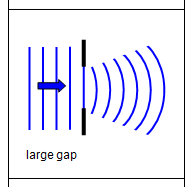
What does a large gap do in terms of diffraction
Creates waves that have marginally larger angles going away from the wall
What does a small wavelength do in terms of diffraction
Creates waves that move almost in a straight line going away from the wall

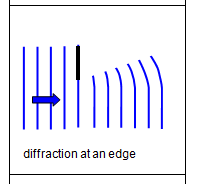
What does diffraction at an edge do
Creates waves that somewhat curve back after the edge
What does diffraction around an obstacle do
The waves eventually close back in after going around the obstacle
