Cells & Tissues of the Adaptive Immune System
 Call Kai
 Learn
Learn Practice Test
 Spaced Repetition
 Match
Match Flashcards
 Knowt Play
1/13

There's no tags or description
Looks like no tags are added yet.
Name | Mastery | Learn | Test | Matching | Spaced | Call with Kai | Chat |
|---|
No analytics yet
Send a link to your students to track their progress
14 Terms
Adaptive Immunity Lymphocytes
T and B lymphocytes.
B-Cell Receptor (BCR)
A membrane-bound immunoglobulin (Ig) that recognizes specific antigens.
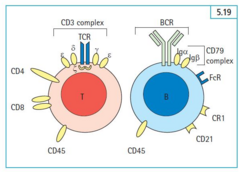
T-Cell Receptor (TCR)
The antigen-specific receptor expressed on the surface of T cells.
Cluster of Differentiation (CD)
Cell surface molecules that serve as markers for specific cell types.
Primary Lymphoid Organs (Function)
Sites of lymphocyte development and generation of antigen-specific receptor diversity. (thymus and bone marrow)

Secondary Lymphoid Organs (Function)
Sites where lymphocytes meet antigens, undergoing clonal selection and expansion.

Secondary Lymphoid Organs (Examples)
Lymph nodes, spleen, and mucosa-associated lymphoid tissue (MALT).

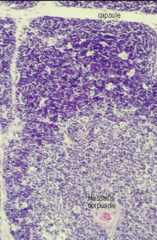
Site of T Cell Development
Thymus.
Sites of B Cell Development
Bone marrow (most mammals), bursa of Fabricius (birds), or ileal Peyer's patches (ruminants).
Antigen Source for Lymph Nodes
Antigens delivered from surrounding tissues.
Antigen Source for the Spleen
Antigens delivered directly from the blood.
Antigen Source for MALT
Antigens delivered at mucosal sites.
Thymus Structure & Location
Lobulated organ in cranial mediastinum with cortex, medulla, and epithelial cell network.
Subtypes of MALT
NALT (nasal), GALT (gut), and BALT (bronchial).
