Groups Final Semester 1
 Call Kai
 Learn
Learn Practice Test
 Spaced Repetition
 Match
Match Flashcards
 Knowt Play
1/66

There's no tags or description
Looks like no tags are added yet.
Name | Mastery | Learn | Test | Matching | Spaced | Call with Kai | Chat |
|---|
No analytics yet
Send a link to your students to track their progress
67 Terms
Cole's Seven Steps:
1. Introduction
2. Activity
3. Sharing
4. Processing
5. Generalizing
6. Application
7. Summary
Client Centered Therapy
provides guidelines that help occupational therapists develop skills for forming and maintaining therapeutic relationships
Yalom's Factor (12)
1. Instillation of hope
2. universality
3. imparting information
4. altruism
5. correct recapitulation of primary family group
6 social learning
7 imitative behaviors
8 interpersonal learning (interpersonal relationships, corrective emotional experiences, social microcosm)
9 group cohesiveness
10. catharsis
11. existential factors
12. self understanding
Installation of Hope (IOH)
As clients observe other members father along in the therapeutic process, they begin to feel a sense of hope for themselves
creates a feeling of optimism about one's future and the ability to cure that which need not be endured and endure that which cannot be cured.
Universality
helps group members realize that they are not alone in their suffering and the problems they face and that others are willing to support them
Imparting Information
educates and empowers group members with knowledge pertaining to their specific situation, whether it be information about a resource or someone's personal story of how they dealt with difficulties and experienced success.
Altruism
helping other group members. As one comes to recognize they have something of value to provide their fellow group members, they gain in self-worth and confidence.
The corrective recapitulation of the primary family group
allows for the rememberence of past family and childhood events
Clients learn functional patterns of communication, interaction, and behavior
Social Learning
encourages and advances relating and social skills such as tolerance, boundaries, empathy, and conflict resolution.
learning through observation
imitative behaviors
witnessing other members apply new and appropriate methods that disrupt their old, dysfunctional patterns.
Members and leader modeling their behavior for others
Interpersonal learning
learn about relationships and intimacy, members can openly share and communicate; in return, they receive support and respectful feedback, perhaps for the first time ever.
Members and leader modeling their behavior for others
Group cohesiveness
gives members a sense of belonging, acceptance, and value, providing both a nurturing and empowering experience.
When members feel a sense of belonging
catharsis
Clients learning to express their own feelings, speak openly about what bothers them and expressing strong feelings about others
Existential Factors
to find meaning in their life. Includes the process of understanding and accepting the reality of the human condition, with all its frustrations and limitations.
the group provides opportunities for clients to explore the meaning of their life and their place in the world
Yalom
Orientation:
hesitant participation, dependency and search for meaning
Conflict:
members start making personal comments/criticism
rebellion of group structure
leaders must promote awareness
cohesive maturity:
conflicts of previous stages are resolved
high morale and group spirit
sense of trust and nonjudgmental acceptance
Therapeutic Use of Self
calls for a dynamic, personal, and subjective investment in the client during which the therapist makes moment-to-moment decisions about how to initate and respond to the clients interpersonal characteristics
empathy and intentionality
requires therapist to strive toward a fundamental understanding of our clients as human beings at an interpersonal level
Therapeutic Relationship
"trusting connection established between therapist and client through collaboration, communication, therapist empathy, and mutual understanding"
Mosey's Developmental Theory
Repeats normal developmental sequence
How does a child learn to interact?
Primary group: Naturally occurring in life
Family is one type
Nonfamilial primary groups:
Peers, school, clubs, sports team
Moseys Group Interaction Skill
Parallel group (18 months to 2 years):
group interaction is not required
Project group (2-4 years):
interaction required to complete task
short term activity with 2 or more people
Ego-Centric Cooperative Group (5-7 years):
activity selected by members
long term activity with 5-10 people
Cooperative Group (9-12 years):
fufilling needs more important than the activity itself
Mature Group (15-18 years):
carry out all social-emotional components
Treatment of Group Interaction Skill Deficiency (Mosey)
group interaction skill defined, "ability to participate in aa variety of groups in a manner that is satisfying for oneself and for ones group members"
Parallel Groups (mosey)
Each Member:
engages in an individual task as opposed to a group activity
is aware of others in the group
initates some verbal and nonverbal interaction with others
Leader Role:
director, chooses and assists with task
meets all social-emotional needs of members
Key Example: Group members engage in activities side by side, such as drawing or watching a movie, with minimal interaction.
Project Group (mosey)
Members:
occasionally engage in group activity according to their own whim
seek some assistance from others
a little more peer activity
Leaders:
chose activity
assists group with task
Key Example: Completing a puzzle together while learning to cooperate and share responsibilities.
Egocentric Cooperative Group (mosey)
Members:
chose the task
aware of goal relative to the task
aware of group norms
Leaders:
support and guide
act as a role model
Key Example: Group members work together to make a meal, dividing tasks and communicating effectively.
Cooperative Group (mosey)
Members:
make their own wishes, needs, and desires known
participates in group activity but seems concerned primarily with their needs and the needs of others
Leaders:
advise
Key Example: A grief support group where participants openly share memories and feelings.
Mature Group (mosey)
Members:
responsive to all group members
takes a variety of task roles
able to share leadership
promotes a good balance over task and accomplishment
Leaders:
interacts as co-equal member
Key Example: A community group that plans and executes an event, prioritizing the group's needs over individual desires.
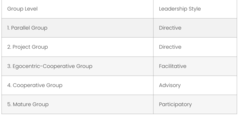
Moseys Leadership style based on group
Parallel: directive leadership
Project: Directive leadership
Egocentric: facilitative
cooperative: facilitative
mature: advisory/participation
S in Soap Note
Subjective
clients report of their own needs, limitations
their perception of treatment & progress
EX: "I had a bad night last night"
O in SOAP Note
Objective
measurable & quantifiable
length of time, location, therapeutic reason for treatment
start with client engaged in __ minute session to work on ___
A in SOAP note
Assessment
analysis and interpretation of events
clinical reasoning
end with client will benefit from ____
P in SOAP note
plan
whats the OT's next plan
ex. continue direct OT services 40 minute session 1/week to support ___ with re eval in ___ weeks. Next session to utilize __
The Intentional Relationship Model (IRM)
should help you make the process of establishing a successful relationship with clients easier and clearer
should complement the usual concepts and strategies of OT
4 central elements of IRM
1. clients interpersonal characteristics
2. inevitable interpersonal events that occur during therapy
3. therapeutic use of self
4. occupational engagement (mechanism of change)
Enduring Interpersonal characteristics
•Knowing the client at a baseline level
•Identifying the interpersonal characteristics that are stable through time and across people and contexts
consistent patterns of emotions, behaviors, and reactions
Situational Interpersonal Characteristics
Emotions, behaviors, and reactions that are context-specific and INCONSISTENT with how the client typically interacts.
14 categories of client interpersonal characteristics
1. communication style
2. tone of voice
3. body language
4. facial/postural expression
5. response to change and challenge
6. level of trust
7. need for control
8. approach to asserting needs
9. predisposition to giving feedback
10. response to feedback
11. response to human diversity
12. orientation toward relating
13. preference for touch
14. interpersonal reciprocity
12 categories of interpersonal events
1. Expression of strong emotion
2. Intimate self-disclosures
3. Power dilemmas
4. Nonverbal cues
5. Verbal innuendos
6. Crisis points
7. Resistance and reluctance
8. Boundary testing
9. Empathic breaks
10. Emotionally charged therapy tasks and situations
11. Limitations of therapy
12. Contextual inconsistencies
The therapist role in IRM (3)
1. interpersonal knowledge and skill base
2. use of therapeutic modes
3. interpersonal reasoning
The 6 therapeutic modes
1. Advocating
2. Collaborating
3. Empathizing
4. Encouraging
5. Instructing
6. Problem Solving
Advocating Mode
Ensuring that the client's rights are enforced and resources are secured.
May require the therapist to serve as a mediator, facilitator, negotiator, enforcer, or other type of advocate with external persons and agencies
Collaborating Mode
Expecting the client to be an active and equal participant in therapy.
Ensuring choice, freedom, and autonomy to the greatest extent possible.
Empathizing Mode
Ongoing striving to understand the client's thoughts, feelings, and behaviors while suspending any judgment.
Ensuring that the client verifies and experiences the therapist's understanding as truthful and validating.
Encouraging Mode
Seizing the opportunity to instill hope in a client. Celebrating a client's thinking or behavior through positive reinforcement. Conveying an attitude of joyfulness, playfulness, and confidence.
Instructing Mode
Carefully structuring therapy activities and being explicit with clients about the plan, sequence, and events of therapy.
Providing clear instruction and feedback about performance. Setting limits on a client's requests or behavior.
Problem-Solving Mode
Facilitating pragmatic thinking and solving dilemmas by outlining choices, posing strategic questions, and providing opportunities for comparative or analytical thinking
Therapeutic Relationship at the macro-level
occurs outside of the interpersonal events that occur during therapy
Therapeutic Relationship at the micro-level
is influenced by the interpersonal events of therapy
Therapeutic Relationship Functions
support to occupational engagement
a place where the emotions and coping processes associated with the client's impairment and its implications for occupational participation
Underlying principles of IRM
1.Critical self-awareness
2.interpersonal discipline
3.head before heart
4. mindful empathy
5. grow your interpersonal knowledge
6. wide range of therapeutic modes can work and be used interchangeably
7. client defines successful relationship
8.activity focusing balanced with interpersonal focusing
9.application of IRM applied with core values and ethics
10.Cultural competency is central to practice
COAST goals
C: client
O: occupation
A: assistance level
S: specific condition
T: time
C in COAST goals
the who
ex. client will
O in COAST goals
essential focus on the goal
ex. participate in a circle
A in COAST goals
level of independence
ex. with a visual sequence model
S in COAST goals
condition which the client is expected to perform the action
location, adaptive equiptment, modified technique
ex. from w/c level in a rehab kitchen
T in COAST goals
ex. within 4 weeks
MOHO Volition
Motivation
MOHO Habituation
roles and routines
MOHO performance capacity
mental and physical skills
Dunn's 4 sensory processing patterns:
sensation seeking (hypo responsive)
sensation avoiding (hyper responsive)
sensory sensitivity (hyper responsive)
low registration (hypo responsive)
Ross's 5 Stage of groups
Stage I: acknoledgement of group members
Stage II: gross motor movement
Stage III: (30 mins) focus on attaining goal calming
Stage IV: cognitive stimulation
Stage V: resolution and termination
Directive Leadership Style
defines the group, activity, and structure
sets goals, structure, and in charge of activity
works with: peds, neurodevelopment, developmental delays
Facilitative Leadership Style
decisions are made by group, taking on roles allowing choice
Advisory Leadership
serves as a consultant
higher functioning groups
not necessarily goals and structure
Open Groups
Members may join and leave at any time
Closed Groups
Members join at one time
Runs for a set period
Tuckman
Forming
Storming
Norming
Performing
Reforming
Bion
Flight
Fight
Unite
Schutz
Inclusion
Control
Affection