Lesson 1: Patterns and Numbers in Nature and the World
 Call Kai
 Learn
Learn Practice Test
 Spaced Repetition
 Match
Match Flashcards
 Knowt Play
1/47

There's no tags or description
Looks like no tags are added yet.
Name | Mastery | Learn | Test | Matching | Spaced | Call with Kai | Chat |
|---|
No analytics yet
Send a link to your students to track their progress
48 Terms
Patterns
The regularities that we see in the forms of things in the natural world.
Natural Patterns
Regularities found in the forms and structures of things in nature.
Symmetry
A pattern in which an imaginary line drawn across an object results in parts that are mirrors of each other.
Spiral
A curved pattern that focuses on a center point and consists of circular shapes that revolve around it.
Meander
A series of regular sinuous curves, bends, loops, turns, or windings in the channel of a river, stream, or other watercourse.
Cracks
Linear openings that form in materials to relieve stress; their patterns indicate whether the material is elastic or not.
Stripe
A strip or band that has a different color from the surface surrounding it, commonly seen in various living things, especially animals.
Logical Patterns
Patterns identified through changes or relationships involving shapes, colors, positions, and numbers.
Four Things to Look for in Logic Patterns
Rotating shapes, increases or decreases in numbers of shapes or patterns, alternating patterns/colors/shapes, and mirror images or reflections.
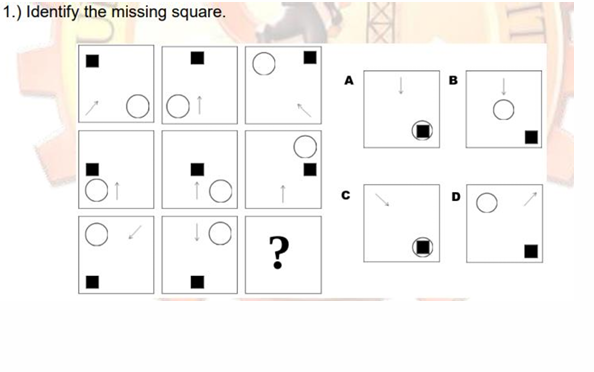
C
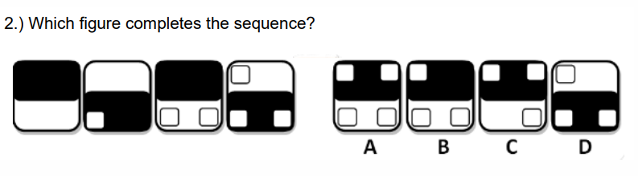
A
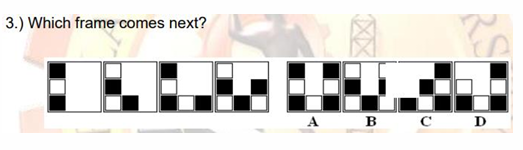
A
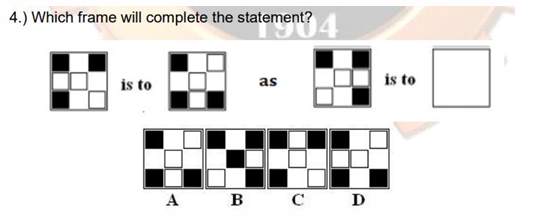
C
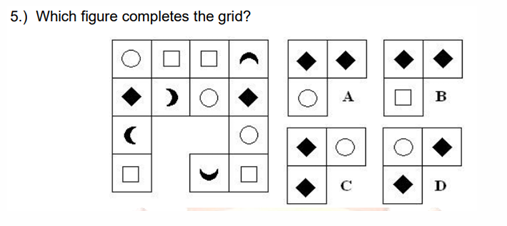
A
Logic Reasoning
A type of reasoning involved in identifying relationships and patterns.
Pattern Observation
The process of examining objects or sequences to identify regularities and relationships.
Geometric Patterns
Patterns consisting of shapes such as polygons and circles that are repeated to create a design.
Tessellation
A pattern formed by repeating polygons to cover a plane with no gaps or overlaps.
Regular Tessellation
A tessellation in which one regular polygon is repeatedly used.
Semiregular Tessellation
A tessellation in which two or more regular polygons are repeated.
Fractal
A never-ending pattern formed by continuously repeating something.
Self-Similar
A property of fractals in which each part of an object is similar to the whole object.
Sierpinski Triangle
A fractal formed by starting with an equilateral triangle, marking the midpoint of each side, connecting the points, and repeatedly applying the process to the resulting triangles except the middle triangle.
Pascal's Triangle
A triangular arrangement containing the numerical coefficients of binomial expansions. (x + y)^n
Koch Snowflake
A famous example of a fractal. In drawing a Koch Snowflake, one needs to start by drawing an equilateral
Fractal Tree
A fractal created by drawing a line segment, branching from an endpoint, and repeatedly creating branches from new endpoints.
Word Patterns
Patterns expressed through words. Plural forms and Tenses
Analogy
Comparison of two differnt things, showing the relationship between them. single colon “ : ” reads is to while double colon “ :: ” reads as
Rhyme Schemes
Rhyming patten at the end of a line of a poem or song
Number Patterns
Lists of numbers that follow a particular sequence or order.
Common Difference
The difference between two consecutive terms in an arithmetic sequence.
Arithmetic Sequence
A sequence in which the difference between consecutive terms is constant.
Arithmetic Sequence Example
90, 86, 82, 78, 74, 70, 66, 62, 58, 54, 50, 46
is an arithmetic sequence with a common difference of -4.
Arithmetic Sequence Example
23, 30, 37, 44, 51, 58, 65 and 72
is an arithmetic sequence with a common difference of 7.
Arithmetic Sequence with Increasing Terms
A sequence may be formed by repeatedly adding the same number to the previous term.
Arithmetic Sequence with Decreasing Terms
A sequence may be formed by repeatedly adding the same negative number to the previous term.
Consecutive Odd Integers Pattern
A number pattern formed by adding consecutive odd integers.
Consecutive Negative Integers Pattern
A number pattern formed by adding consecutive negative integers.
Perfect Square Pattern
A number pattern whose terms are perfect squares.
Perfect Squares
Numbers obtained by squaring whole numbers, such as 1, 4, 9, 16, 25, and 36.
Geometric Sequence
A sequence where a term is multiplied by a constant to obtain the next term.
Common Ratio
The constant number by which a term is multiplied to obtain the next term in a geometric sequence.
Triangular Numbers
Numbers related to the number of dots needed to create a triangle.
Triangular Number Sequence
A sequence beginning 1, 3, 6, 10, 15, where each term represents the total number of dots in a triangular arrangement.
Square Numbers
Numbers that are the squares of their position in a sequence.
Square Number Sequence
A sequence beginning 1, 4, 9, 16, 25, where each term is the square of its position.
Cube Numbers
Numbers that are the cubes of their position in a sequence.
Cube Number Sequence
A sequence beginning 1, 8, 27, 64, 125, where each term is the cube of its position.