Modules 1-4
 Call Kai
 Learn
Learn Practice Test
 Spaced Repetition
 Match
Match Flashcards
 Knowt Play
1/85

There's no tags or description
Looks like no tags are added yet.
Name | Mastery | Learn | Test | Matching | Spaced | Call with Kai | Chat |
|---|
No analytics yet
Send a link to your students to track their progress
86 Terms
Which of the following disciplines studies the origin and evolution of planet Earth over the past 4.6 billion years?
Historical geology
What is the primary goal of science?
To explain natural patterns and processes
Which type of observation is free from personal bias?
Objective observation
A subjective observation is based on a person's:
Feelings and beliefs
Which of the following is a quantitative observation?
The temperature is 35C
Why are quantitative measurements preferred in science?
They are more precise and can be statistically analyzed
What does it mean for a scientific claim to be falsifiable?
It can be tested and possibly proven false
Why is astrology considered pseudoscience?
Its claims are not falsifiable and lack experimental evidence
What is the purpose of peer review in science?
To eliminate unsupported or invalid research
Which step comes first in the scientific method?
Observation or identifying a problem
Which of the following is NOT part of the principle of uniformitarianism?
Geologic time is vast and difficult to comprehend
Catastrophism and uniformitarianism differed in which way?
A. Catastrophism argued for a young Earth, while uniformitarianism argued for an old Earth.
B. Catastrophism emphasized rapid change, while uniformitarianism argued for slow, gradual change being more important.
Both A and B
What is a rock cycle?
The continuous transformation of rocks as the environments in which they are found change
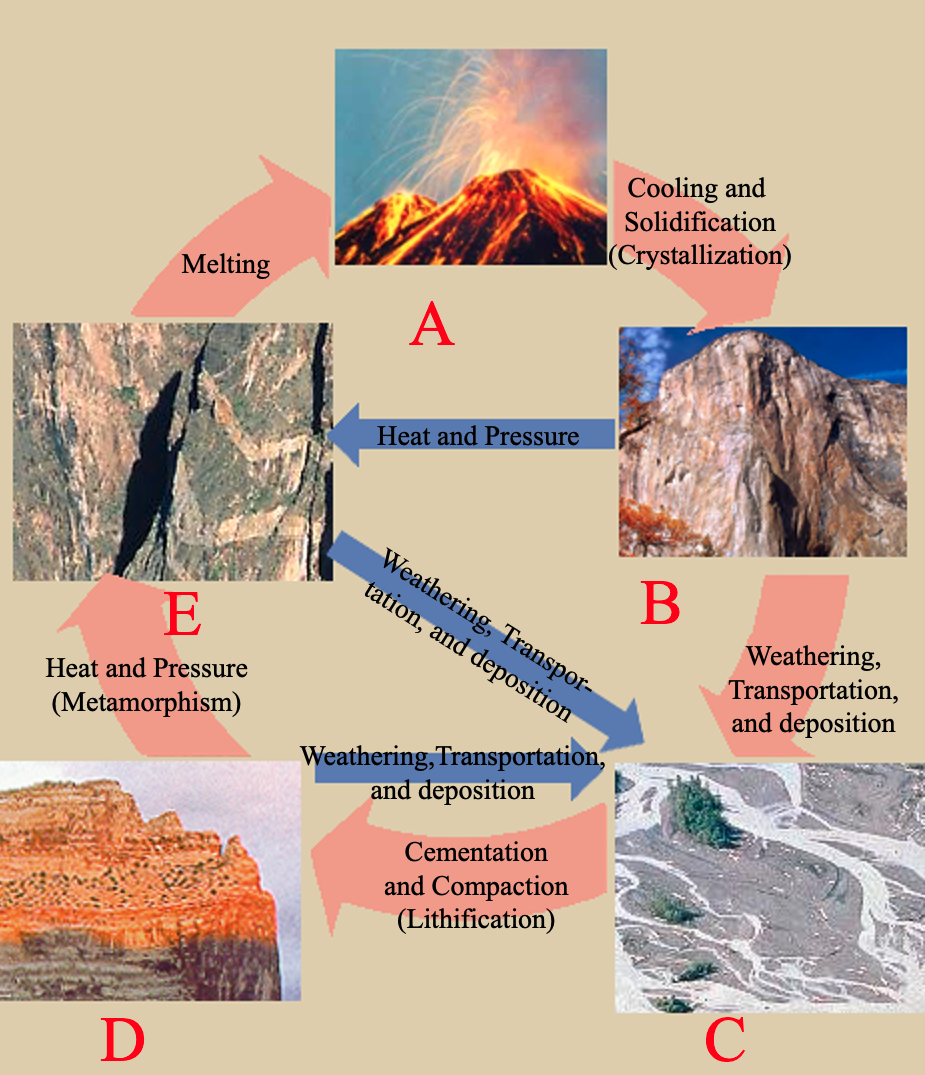
A. Molten rock
B. Igneous rock
C. Sediment
D. Sedimentary rock
E. Metamorphic rock
Which of the following is not true of the rock cycle?
Magma forms when molten rock cools.
What is molten rock beneath Earth’s surface called?
Magma
Lava differs from magma because lava:
Erupts onto Earth’s surface
Rocks formed by cooling magma or lava are called:
Igneous rocks
What is weathering?
Physical and chemical breakdown of rocks
Which process removes rock fragments from their original location?
Erosion
Compaction and cementation together are known as:
Lithification
Rocks changed by extreme heat and pressure without melting become:
Metamorphic rocks
The theory that explains the movement of Earth’s plates is called:
Plate tectonics
Which Earth layer is the outermost compositional layer?
Crust
What is the rigid layer made of crust and upper mantle called?
Lithosphere
Which layer of Earth is mostly made of iron and nickel?
Core
Approximately how old is Earth?
4.54 billion years
What are the four eons of geologic time from oldest to youngest?
Hadean, Archean, Proterozoic, Phanerozoic
Which era is known as the “Age of Reptiles”?
Mesozoic
The Cenozoic Era is often called the:
Age of Mammals
Which scientific theory revolutionized geology in a way similar to how evolution revolutionized biology?
Plate tectonics
Who proposed the continental drift hypothesis?
Alfred Wegener
Alfred Wegener included all of the following lines of evidence as supporting his "continental drift" hypothesis except one. Which was NOT part of Wegener's evidence?
Stripes of reverse magnetism on either side of oceanic rides
Which continent did Wegener note git together like puzzle pieces?
Africa and South America
Which fossil was found on both Africa and South America
Mesosaurus
Why did Wegener reject the land bridge hypothesis?
Land bridges across deep oceans were improbable
With regards to ancient climates, Wegener's continental drift hypothesis states that 300 million years ago,
areas in North America, northern Africa, Europe, and Asia produced tropical swamps along the equator while areas in South America, Africa, India, Australia, and Antarctica were glaciated at the South Pole.
What were two aspects of Wegener's continental drift hypothesis that were objectionable to most Earth scientists?
Scientists objected to the driving force behind plate tectonics, which Wegener claimed to be the gravitational forces of the Sun and Moon, and his claim that continents traveled by plowing through oceanic crust.
Which process is now considered one of the major driving forces of plate movement?
Convection
Paleomagnetism is the study of:
Frozen magnetic fields in rocks
Which mineral commonly preserves paleomagnetic records?
Magnetite
Most of Earth’s seismic activity, volcanism, and mountain building occur along (blank).
Plate boundaries
WadatiÐBenioff zones are associated with:
Earthquake zones near subduction areas
New oceanic crust and lithosphere are formed at (blank).
Divergent boundaries by submarine eruptions and intrusions of basaltic magma

A. Divergent
B. Convergent
C. Transform fault
At convergent boundaries, tectonic plates:
Move toward each other
Which of the following is NOT true of convergent plate boundaries?
Continental-continental convergent boundaries produce volcanoes that only erupt mafic lavas.
What is subduction?
The sinking of a denser plate beneath another
Which type of lithosphere is generally denser?
Oceanic lithosphere
What forms when magma rises above a subduction zone?
Volcanic arc
Island arcs are commonly formed at:
Oceanic-oceanic subduction zones
What happens during continental collision?
Two continental plates slam together
Which supercontinent was proposed by Wegener?
Pangea
What is the name of the deep depression formed during continental rifting?
Rift valley
Which process creates magma at rift zones?
Decompression melting
The alternating magnetic reversals recorded in rocks of mid-ocean ridges support which theory?
Seafloor spreading
Why are volcanoes NOT found at transform boundaries?
Transform boundaries do not cause changes to the pressure, temperature or composition of the mantle.
Which famous transform fault is located in California
San Andreas Fault
The movement of Earth’s tectonic plates is caused by…
The uneven distribution of heat in the mantle
Ten million year from now, the East African Rift valley system will most closely resemble the modern (blank).
Red Sea
Which statement best describes a mineral in the geological sense?
A naturally occurring, inorganic solid, with an orderly internal structure and definite composition
A scientist creates diamonds using high-pressure laboratory experiments. These diamonds are not considered minerals because which of the following requirements has been violated?
Mineral must occur naturally.
What are the three main subatomic particles in an atom?
Protons, neutrons, and electrons

A. Electron
B. Proton
C. Neutron
What is the periodic table of the elements?
A list of elements organized by their chemical symbols.
What determines the atomic number of an element?
Number of protons
Isotopes of an element differ in their number of:
Neutrons
Which isotope of carbon has six protons and seven neutrons?
Carbon-13
What type of bond involves the transfer of electrons between atoms?
Ionic bond
What are the eight most abundant elements in Earth’s crust?
Oxygen, silicon, aluminum, iron, calcium, sodium, potassium, and magnesium.
Which compound is formed when sodium and chlorine bond together?
NaCl
What is the name of the outermost electron shell?
Valence shell
According to the octet rule, atoms are most stable when their outer shell contains:
8 electrons
What determines the charge of an ion?
The difference between the number of protons and electrons.
What type of bond is formed when atoms share electrons?
Covalent bond.
What type of bond is formed by the electrostatic attraction between atoms with opposite charges?
Ionic bond.
What is the basic structural unit of silicate minerals?
Silicon-oxygen tetrahedron
Pyroxenes are characterized by:
Single silica chains
Amphiboles differ from pyroxenes because amphiboles contain:
Double silica chains
Which mineral property describes how light reflects from a mineral surface?
Luster
Which mineral property describes the dominant wavelength of light coming off a mineral?
Color
What is the streak of a mineral?
The color of its powdered form
What is hardness?
Resistance to scratching
Which mineral is the hardest on the Mohs scale?
Diamond
Which mineral property refers to breaking along smooth, flat planes?
Cleavage
Which of the following is not a correct description of one of the properties used to identify minerals? (Know the correct descriptions for all these properties. I could reword the options so that a different one is wrong if this question comes up on the test.)
Luster is the color of the mineral in powdered form.