L9 - Glycogen Metabolism
 Call Kai
 Learn
Learn Practice Test
 Spaced Repetition
 Match
Match Flashcards
 Knowt Play
1/34

There's no tags or description
Looks like no tags are added yet.
Name | Mastery | Learn | Test | Matching | Spaced | Call with Kai | Chat |
|---|
No analytics yet
Send a link to your students to track their progress
35 Terms
Glycogen is____; function in muscle vs liver
excess glucose stored in polymeric form; energy in muscle, storage in liver
Glycogen avoids
osmotic pressure
β-particles vs α-granules
~55,000 residues; protein-rich granules of 20-40 clustered β-particles
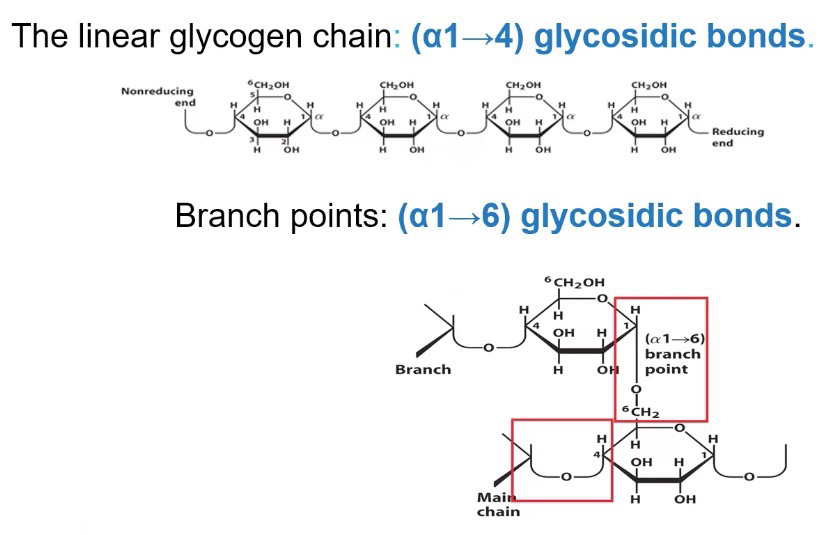
Bond type of glycogen chain:
Bond type of glycogen branch point:
(α1→4) glycosidic bonds; (α1→6) glycosidic bonds
Glycogenolysis -
breakdown of glycogen
Glycogenesis -
making glycogen
Glycogen phosphorylase - catalyze the phosphorolytic cleavage of
non-reducing end of glycogen chains
A form is active
B form is inactive
Needs Pi
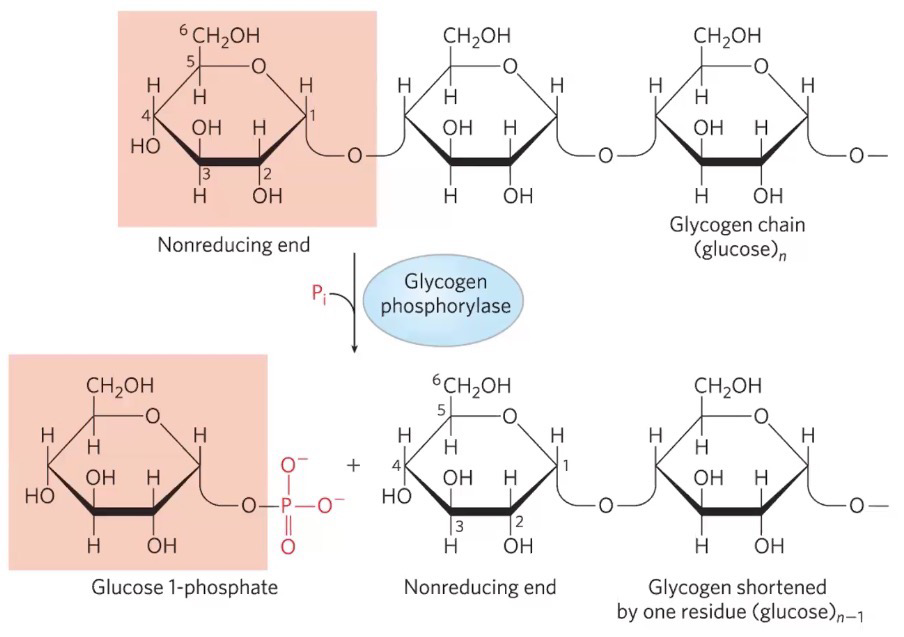
Phosphorolytic cleavage of glycogen yields
glucose 1-phosphate
Glycogen phosphorylase is/is not regulated
IS
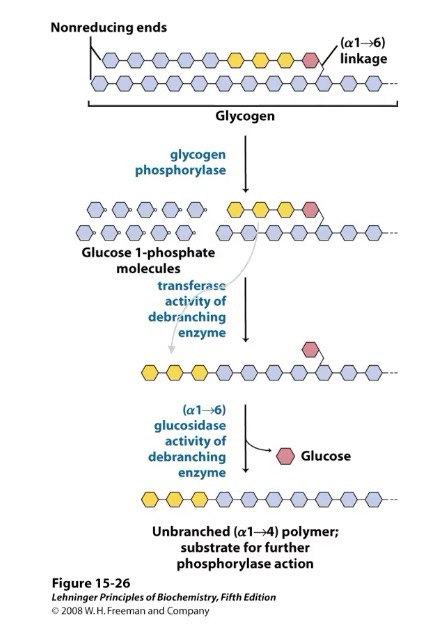
Debranching enzyme
Once glycogen has been reduced to 4 glucose on one branch, it will act as a transferase and transfer 3 of the 4 glucose onto the linear chain onto another linear chain on the non-reducing end and act as a glucosidase to release the remaining (α1→6) glucose (not G1P).
Phosphoglucomutase catalyzes
glucose 1-phosphate into glucose 6-phosphate
In order to use it in other pathways
Saves 1 ATP for glycolysis and increases the net ATP production to 3 (Bc hexokinase needs ATP)
Primarily in muscle (think energy needs)
Reversible
In skeletal muscles, glucose 6-phosphate enters; What about the liver?
glycolysis; G6P enters gluconeogenesis via G6Phatase to replenish blood glucose
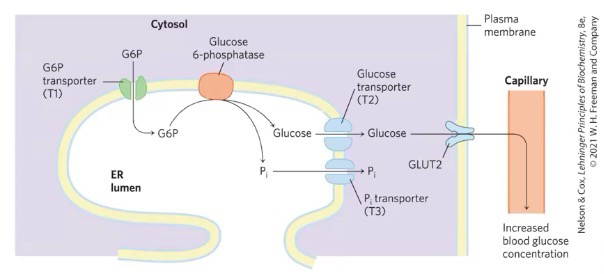
In allosteric regulation of glycogen phosphorylase
Ca2+ is a signal for muscle contraction. Binds to and activates phosphorylase b kinase
Amp accumulates in vigorously contracting muscle. Binds to and activates phosphorylase to speed up glucose 1-phosphate release from glycogen
ATP blocks the allosteric site, inactivating phosphorylase
In hormonal regulation of glycogen phosphorylase
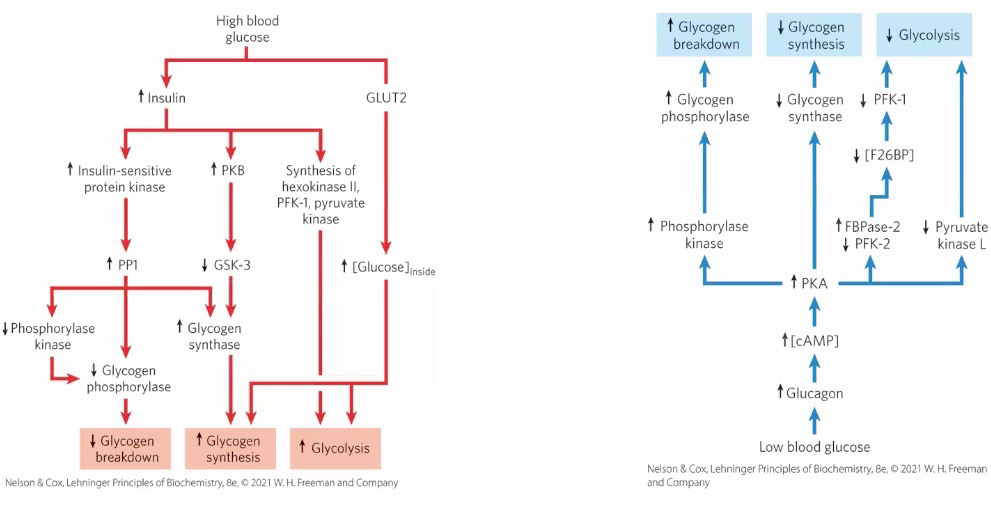
Epinephrine (from vigorous muscle activity) and glucagon (in the liver) trigger phosphorylation of phosphorylase b, converting it to phosphorylase a
Two forms of glycogen phosphorylase
Glycogen phosphorylase a is active, while glycogen phosphorylase b is much less active
Phosphorylase b kinase is a target of
PKA
Steps of glycogen phosphorylase regulation starting from epinephrine and glucagon
Both cause a G-protein cascade activating adenylyl cyclase, which creates cAMP that activates PKA, which activates phosphorylase b kinase, which converts glycogen phosphorylase b to glycogen phosphorylase a, which can then break down glycogen to G1P
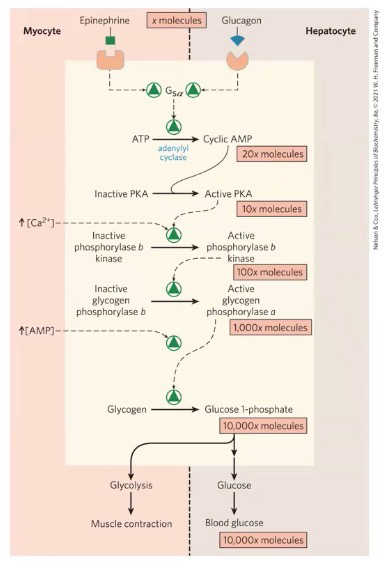
AMP directly acts on
glycogen phosphorylase a (activation)
Protein Phosphatase 1 (PP1) dephosphorylates
phosphorylase a to phosphorylase b
PP1 is under the control of
insulin
Glycogenin
a dimer that acts as a primer on which new glycogen chains are assembled and the enzyme that catalyzes their assembly
To build glycogen we need; What enzyme and substrates/products?
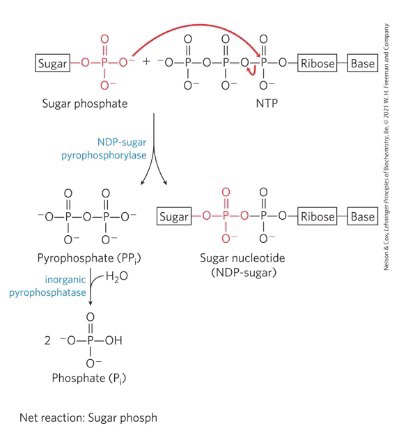
activated sugar nucleotides (UDP-glucose); UTP + G1P turns into UDP-glucose + PPi via UDP-glucose pyrophosphorylase
Glycogen synthase
Catalyzes transfer of glucose from UDP glucose to growing glycogen (α1→4) from the non-reducing end; Also has a and b form (active/inactive)
Sugar nucleotide compounds are anomeric carbon of a sugar activated by
the attachment of a nucleotide through phosphate extra linkage.
UDP-glucose pyrophosphorylase catalyzes
UTP + Glucose 1-phosphate -> UDP-glucose + PPi
Glucose 1-phosphate is from PPP
Phosphoglucomutase makes G6P to G1P
Branching enzymes =
amylo (1→4) to (1→6) transglycosylase
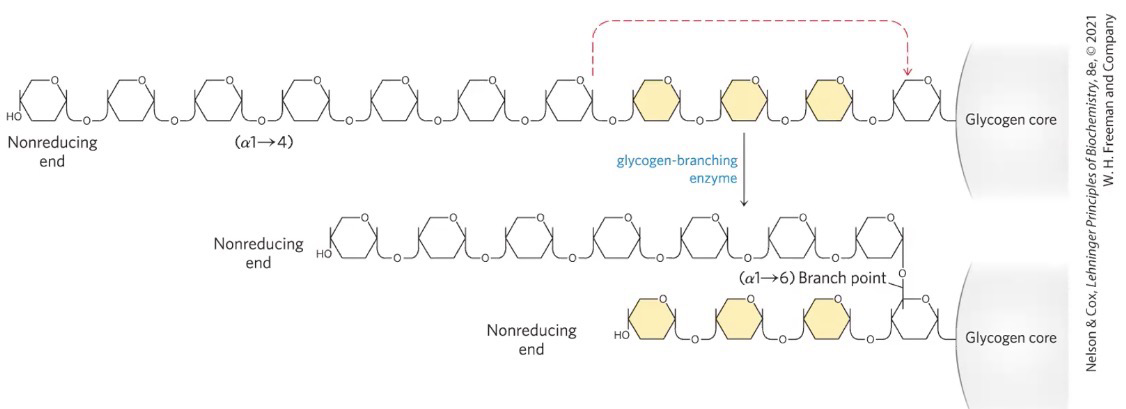
Branching enzyme lifts up a chain and puts them into an
a1→6 branch point of a previous molecule (From the 4th glucose, imagine debranching enzyme but reverse)
Insulin enhances PP1 to
phosphorylate Glycogen synthase b to a
Insulin inhibits _______ while enhancing ______
GSK3, which keeps glycogen synthase dephosphorylated; PP1
Glucose 6-phosphate that enhances
PP1 to convert glycogen synthase b to a
Glucagon and epinephrine inhibits PP1 to
convert glycogen synthase b to a
Skeletal muscle uses its own stored glycogen only for ________ because
its own needs; it can undergo very large changes in its demand for ATP
Skeletal muscle lacks the enzymatic machinery for
gluconeogenesis
Liver vs muscle during epinephrine release
Glucose production/release vs glucose consumption for energy
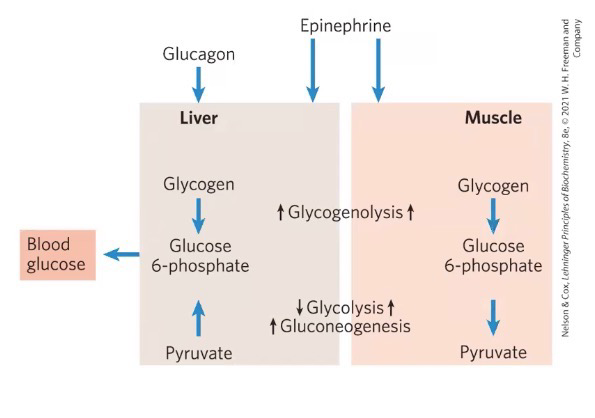
Glucose and glycogen pathway
In the liver