Laboratory Animal Technology Lab Midterm - Handling and Restraint, Drug Calculations, Injection Techniques, ID Methods, Anesthesia, and Controlled Substances
 Call Kai
 Learn
Learn Practice Test
 Spaced Repetition
 Match
Match Flashcards
 Knowt Play
1/142

There's no tags or description
Looks like no tags are added yet.
Name | Mastery | Learn | Test | Matching | Spaced | Call with Kai | Chat |
|---|
No analytics yet
Send a link to your students to track their progress
143 Terms
• Pick up by the base of the tail and scruff neck
• Secure tail between your little finger and ring finger of the same hand
• Injections can be given using the opposite hand
Describe how to properly restrain mice
Picked up by cupping hands or picking up a group of pups together with a small amount of bedding material
How should mice pups less than 10 days old be held?
• Based on the anogenital distance
• The distance is greater in males than in females
How is sex determined in mice, rats, hamsters, and gerbils?
Shoe box cages
Solid‐bottom plastic cages with bedding and microisolation lids used for rats or mice
Provide air circulation within each individual cage to reduce moisture buildup from feces and urine
Identify the benefit of using ventilated caging systems for mice
Allow urine and feces to fall through the floor of the cage, minimizing the mouse's exposure to any experimental drugs excreted in the urine or feces
Identify the benefit of using wire‐bottom or metabolic caging for mice in toxicology research
Plastic restraint
Mechanical restraint device used to hold mice in a confined space for certain research procedures

• Pick up by the base of the tail
• Put one hand over the back with your thumb and forefinger gently pressing its forelegs toward its head
• The tail or hindquarters may be restrained with the other hand
• Can also be picked up and lightly restrained by the scruff of the neck
Describe how to properly restrain rats
Rats are prone to developing foot lesions if kept in the cage for a year or more
What precaution should be noted before housing rats in wire-bottom cages?
• Wrap in a towel
• Insert into a tapered plastic bag (DecapiCone)
• Placed in a plastic cylinder restrainer
Identify mechanical means of firmly restraining rats
Cyclic activity (seen in gerbils)
Intermittent periods of high‐level activity followed by periods of rest or sleep
• Little odor
• Cyclic activity
• Male and female have ventral marking gland
• Use foot stomping as a means of communication
What makes gerbils unique compared to other rodents?
• Gently grasp base of tail or cup both hands beneath them
• Restraint is similar to that of the mouse
Describe how to properly restrain gerbils
At 9 to 10 weeks of age, before the gerbils are sexually mature, to avoid fighting and death during the establishment of breeding pairs
When should gerbils be paired for breeding?
Male gerbils
Which rodent species will stomp their hind feet before mating?
Ovarian cysts
Which condition in gerbils can cause females to cease reproducing prematurely?
Lactating gerbils
The nests of _____ should be disturbed as little as possible to prevent cannibalism
• Grasp skin across shoulders or scoop with hands
• Place on flat surface and gently press palm of hand down against hamster's back
• Curl fingers and thumb around opposite sides, gathering in as much loose skin as possible
• With loose skin bunched tightly in hand, skin will be taut against the abdomen and thorax
Describe how to properly restrain hamsters
Review proper restraint of a hamster!
Review proper restraint of a hamster!

Hand mating
Female hamster in estrus is introduced into cage during dark cycle, mating occurs within minutes, and then pair is separated
Harem mating
One male hamster is housed with 2-3 females, then females are removed at least two days prior to giving birth
Intermittent mating
Female hamsters are placed sequentially with 1-2 males, and females then removed to give birth
• Place one hand under front legs and chest, with your thumb and forefingers directly behind the front legs
• Place other palm under the hindquarters to support their weight
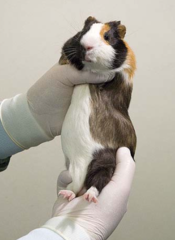
Describe how to properly handle a guinea pig
Review proper restraint of a guinea pig!
Review proper restraint of a guinea pig!
• The position of the anus is very close to the genitals in both sexes
• The shape of the opening in the genital papilla is round in males and Y‐shaped in female
• Apply pressure in inguinal area, and the male's penis will protrude
How do you determine sex in guinea pigs?
Wire-bottom cages
Which housing type is not recommended for guinea pigs?
False! Testes can move freely between the scrotum and the abdomen.
Holding a male in an upright position will cause the testes to descend into the scrotum.
True or false? Adult male guinea pigs can easily be sexed by checking for descended testicles.
Female
What does this symbol represent?

Male
What does this symbol represent?

Female
Identify the sex of this guinea pig

Male
Identify the sex of this guinea pig

Female
Identify the sex of this guinea pig
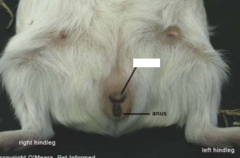
Male
Identify the sex of this guinea pig
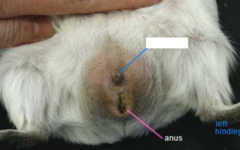
Dosage (mg/kg)
The amount of drug administered to a patient per unit of body weight
Age, health, and potentially excitement state
A drug dosage is influenced by the animal's
• Misunderstanding written orders
• Administering the wrong medication
• Administering the wrong concentration of the medication
The most common medication errors are due to
• Drug
• Concentration
• Dose
• Route of administration
• Time of administration
• Animal
Before administering any drug, you should confirm that you have the correct
Dose
The amount of drug administered at one time for a specific patient
Dosage regimen
A prescription for the amount of a drug to administer, the route of administration, and the frequency
1 gram/100 ml
1% solution =
2.27 gram/100 ml
2.27% of Baytril solution =
2.2 lb
1 kg =
100 ml (remember like 100%)
Always base % concentration using
Caustic or acidic properties can cause ulcerations
Why should Baytril ALWAYS be diluted when working with rodents?
Weight x Dose / Concentration
3.5kg x 20 mg/kg / 15 mg/ml = 4.7 ml of solution
A veterinarian writes a prescription for a cat weighing 3.5 kg to receive a 20 mg/kg dose of antibiotic.
The bottle label states that the antibiotic solution has a concentration of 15 mg/mL.
How much of this solution do you give to the cat?
21-28 days
At what age do mice begin weaning?
21-28 days
At what age do gerbils begin weaning?
20-21 days
At what age do rats begin weaning?
21-28 days
At what age do hamsters begin weaning?
14-28 days
At what age do guinea pigs begin weaning?
5-8 weeks
At what age do rabbits begin weaning?
10-15°
At what angle should intradermal injections be given?
45-60°
At what angle should SQ injections be given?
90°
At what angle should IM injections be given?
Intragastic
Administered via a gastric gavage needle for rodents
Luer lock syringe (safest to use for injections)
Prevents accidental dislodgment which may result in auto-inoculation or back spray
Catheter tip
Elongated and tapered tips designed to fit into a tube for infusing or aspirating materials
Highest gauge should be used considering the dose volume, species, route of administration, viscosity, and speed of injection
What needle size should you use to minimize the amount of trauma to the surrounding tissue?
Length and diameter
Needle sizes are designated according to
Needle diameter (the larger the gauge number, the smaller the needle diameter)
What does the gauge of a needle refer to?
Enteral administration
Providing a drug directly into the gastrointestinal tract, either orally or rectally
Parenteral
Administration of drugs by injections, or means other than through gastrointestinal system
• Restrain the mouse by the scruff method
• Secure the rear foot nearest to you beneath your little finger and lower thumb
• Insert the needle into the caudal thigh at a 45° angle
• Aspirate and inject
• A technique with two people or a tail first restrainer can be used
Explain how to administer an IM injection to a mouse
• Use your thumb and forefinger to make a tent of skin over the scruff
• The needle should be inserted parallel to the skin and should be directed toward the posterior of the animal
How should a SQ injection be given?
• Expose ventral side of mouse, tilting the head down at a slight angle
• Place needle in lower right or left quadrant of the abdomen
• Insert needle at a 30° angle, aspirate, and inject
Explain how to administer an IP injection to a mouse
• Insert a 25-30 gauge needle nearly parallel to the plane of the skin
• Do not aspirate before injecting
• Volume of the injection should be limited to 50 ul per site to avoid tissue trauma or necrosis
• A properly performed IP injection will result in a small, round skin welt
How should you administer an IP injection?
Hemodilution
Adding large volumes of fluid to the animal's blood supply may cause
• Carefully warm the mouse under a heat lamp to dilate blood vessel
• Place mouse in a restraint device and stabilize the tail
• Attempt the injection starting at the middle or slightly distal part of the tail
• Insert the needle parallel to the vein and do not aspirate or you will collapse the vein
• Inject the material in a slow, fluid motion
Explain how to administer an IV injection to a mouse
Retro-orbital sinus
Administration route that may be performed on anesthetized mice if scientifically justified in the IACUC protocol
Oral gavage
Used to dose an animal with a specified volume of material directly into its stomach
• Restrain by the scruff and place the tip or ball of the needle into the mouth
• Slide the tip gently past the back of the tongue
• The needle should slide easily down the esophagus, if properly placed. Do not force!
• Do not aspirate, and administer material once needle is properly placed
How do you perform oral gavage in rats and mice?
Tip of the nose to the first rib
How do you measure your syringe for oral gavage?
• Restrain and hold in a vertical position, immobilizing the head
• Place a small drop of a liquid compound at the nasal opening
• The animal should inhale the droplet
How do you administer intranasal material in a conscious animal?
Lateral tail vein (22-25g needle)
Common IV injection site in rats and mice
Caudal thigh
Common IM injection site for mice
Scruff
Common SQ injection site for mice
Lower ventral quadrants
Common IP injection site for mice
Mus musculus
The most widely used species of mouse in research is the common house mouse known as
Rattus norvegicus
The most common species of rat used in research
Rattus rattus
The scientific name for the black rat
Oryctolagus cuniculus
The scientific name of the laboratory rabbit is
Cavia porcellus
The scientific name of the guinea pig
Meriones unguiculatus
The scientific name of the gerbil
• Ear notching
• Cage cards
• Colored nontoxic marker
• Tattoo
• Microchips
• Toe clipping (only for neonates)
List common methods of mice and rats identification
• Ear tags
• Ear punches
• Temporary markings on the fur
• Microchips
List common methods of hamster identification
• Cage cards
• Microchips
• Ear tags
• Ear notching
• Colored markers
List common methods of gerbil identification
Ear tags
The most common method of guinea pig identification
C) Tail tattoo
Which of the following is not used as an identification method in guinea pigs?
A) Microchip
B) Fur coloring
C) Tail tattoo
D) Ear tag
Central ear artery
When tattooing or placing ear tags on rabbits, it is important to avoid
• Ear tags on pinna
• Tattoos on pinna
• Microchips
• Dyes
List common methods of rabbit identification
• Ear tags
• Microchips
• Tattoos (difficult by the thickness of hair coat and small ears)
List common methods of ferret identification
A durable, legible tag attached to a collar or an ear tattoo
According to USDA regulations, all cats and dogs are required to have identification by way of
• Ink injection (not permanent due to skin shedding)
• Toe clipping (not appropriate for Xenopus)
• Regenerate limb
List common methods of amphibian identification
Reptiles are often individually housed, so identification records are easily maintained with cage cards
The most common method of reptile identification
• Cage cards
• Subcutaneous dye injections (the less invasive method)
• Tags
• Fin clipping
• Subcutaneous or abdominal transponders
List common methods of fish identification
Leg bands (wing tags can be used for larger birds)
The most common method of avian identification
Tattoos under anesthesia on the inner thigh, chest, or arm
The most common method of identification for nonhuman primates
Ear tag, tattoo, or notch
List common methods of pig identification
Ear tags and ear tattoos
List common methods of identification in ruminants
• Tag
• Collar
• Tattoo
• Microchip
• Freeze or heat brand
List common methods of identification in horses