d426 3
 Call Kai
 Learn
Learn Practice Test
 Spaced Repetition
 Match
Match Flashcards
 Knowt Play
1/40

There's no tags or description
Looks like no tags are added yet.
Name | Mastery | Learn | Test | Matching | Spaced | Call with Kai | Chat |
|---|
No analytics yet
Send a link to your students to track their progress
41 Terms
operator
is a symbol that computes a value from one or more other values, called operands:
operands | Operator | Description | Example | Value |
|---|---|---|---|---|
Arithmetic |
| Adds two numeric values |
|
|
| Reverses the sign of one numeric value |
|
| |
| Subtracts one numeric value from another |
|
| |
| Multiplies two numeric values |
|
| |
| Divides one numeric value by another |
|
| |
| Divides one numeric value by another and returns |
|
| |
Comparison |
| Compares two values for equality |
|
|
| Compares two values for inequality |
|
| |
| Compares two values with < |
|
| |
| Compares two values with ≤ |
|
| |
| Compares two values with > |
|
| |
| Compares two values with ≥ |
|
| |
Logical |
| Returns TRUE only when both values are TRUE |
|
|
| Returns FALSE only when both values are FALSE |
|
| |
| Reverses a logical value |
|
|
unary vs binary
unary: 1 operand, arithimetic
binary: 2 operands, most operators, logical, arithmetic
expression
is a string of operators, operands, and parentheses that evaluates to a single value. Operands may be column names or fixed values. The value of an________may be any data type.
Ex: Salary > 34000 AND Department = 'Marketing'
operator precedence
Precedence | Operators |
|---|---|
1 | - (unary) |
2 | ^ |
3 | * / % |
4 | + - (binary) |
5 | = != < > <= >= |
6 | NOT |
7 | AND |
8 | OR |
select
statement selects rows from a table
FROM clause specifies the table from which rows are selected.
*is for all cloumns
-- SELECT with expressions
SELECT Expression1, Expression2, ...
FROM TableName;limit
clause that limits the number of rows returned by a SELECT statement.
SELECT *
FROM City
LIMIT 100;condition
is an expression that evaluates to a logical value.
where
A SELECT statement has an optional _______ clause that specifies a condition for selecting rows. A row is selected when the condition is TRUE for the row values. A row is omitted when the condition is either FALSE or NULL.
SELECT Expression1, Expression2, ...
FROM TableName
WHERE Condition;is null (in not null)
operators must be used to select NULL values
Value IS NULL returns TRUE when the value is NULL.
Value IS NOT NULL returns TRUE when the value is not NULL.
WHERE Salary = NULL; never returns any rows, because the WHERE clause is always NULL.
truth table
x | y | x AND y | x OR y |
|---|---|---|---|
TRUE | NULL | NULL | TRUE |
NULL | TRUE | ||
FALSE | NULL | FALSE | NULL |
NULL | FALSE | ||
NULL | NULL | NULL | NULL |
x | NOT x |
|---|---|
NULL | NULL |
in
operator is used in the WHERE clause to check if a specified column's value matches any value within a provided list.
operator functions as a shorthand for multiple OR conditions, making queries shorter and more readable.
SELECT column_name(s)
FROM table_name
WHERE column_name IN (value1, value2, ...);between
operator provides an alternative way to determine if a value is between two other values.
replaces value >= minValue AND value <= maxValue.
like
operator, when used in a WHERE clause, matches text against a pattern using the two wildcard characters % and _.
%matches any number of characters. Ex:LIKE 'L%t'matches "Lt", "Lot", "Lift", and "Lol cat"._matches exactly one character. Ex:LIKE 'L_t'matches "Lot" and "Lit" but not "Lt" and "Loot".:
LIKE BINARY 'L%t'matches 'Left' but not 'left'. to make uery case sensitiveLIKE 'a\%'matches "a%" matches wildcard characters
distinct
keyword is used with a SELECT statement to return only unique or _____ values.
SELECT DISTINCT column1, column2, ...
FROM table_name;order by
clause orders selected rows by one or more columns in ascending (alphabetic or increasing) order.
The DESC keyword with the ________clause orders rows in descending order.
SELECT column1, column2, ...
FROM table_name
ORDER BY column1, column2, ... ASC|DESC;function
operates on an expression enclosed in parentheses, called an argument, and returns a value.
Some have several arguments, separated by commas, and a few have no arguments at all.
numeric functions
Function | Description | Example |
|---|---|---|
ABS(n) | Returns the absolute value of n |
|
LOG(n) | Returns the natural logarithm of n |
|
POW(x, y) | Returns x to the power of y |
|
RAND() | Returns a random number between 0 (inclusive) and 1 (exclusive) |
|
ROUND(n, d) | Returns n rounded to d decimal places |
|
SQRT(n) | Returns the square root of n |
|
string functions
Function | Description | Example |
|---|---|---|
CONCAT(s1, s2, ...) | Returns the string that results from concatenating the string arguments |
|
LOWER(s) | Returns the lowercase s |
|
REPLACE(s, from, to) | Returns the string s with all occurrences of from replaced with to |
|
SUBSTRING(s, pos, len) | Returns the substring from s that starts at position pos and has length len |
|
TRIM(s) | Returns the string s without leading and trailing spaces |
|
UPPER(s) | Returns the uppercase s |
|
date and time functions
Function | Description | Example |
|---|---|---|
CURDATE() | Returns the current date, time, or date and time in | returns '2019-01-25' returns '21:05:44' returns '2019-01-25 21:05:44' |
DATE(expr) | Extracts the date or time from a date or datetime |
|
DAY(d) | Returns the day, month, or year from date d | returns 25 returns 10 returns 2016 |
HOUR(t) | Returns the hour, minute, or second from time t | returns 22 returns 11 returns 45 |
DATEDIFF(expr1, expr2) | Returns expr1 - expr2 in number of days or time |
|
SELECT *
FROM Movie
WHERE YEAR(ReleaseDate) > 2017 OR MONTH(ReleaseDate) = 11;aggregate function
processes values from a set of rows and returns a summary value. Common:
COUNT() counts the number of rows in the set.
MIN() finds the minimum value in the set.
MAX() finds the maximum value in the set.
SUM() sums all the values in the set.
AVG() computes the arithmetic mean of all the values in the set.
appear in a SELECT clause and process all rows that satisfy the WHERE clause condition.
ignore null values
group by
clause consists of the ______ keyword and one or more columns.
Each simple or composite value of the column(s) becomes a group. The query computes the aggregate function separately, and returns one row, for each group.
SELECT column1, aggregate_function(column2), column3, ...
FROM table_name
WHERE condition
GROUP BY column1, column3
ORDER BY column_name;having
clause is used with the GROUP BY clause to filter group results.
follows the GROUP BY clause and precedes the optional ORDER BY clause.
SELECT column1, aggregate_function(column2), column3, ...
FROM table_name
WHERE condition
GROUP BY column1, column3
HAVING condition -- The condition on grouped data
ORDER BY column_name;join
is a SELECT statement that combines data from two tables, known as the left table and right table, into a single result using
tables are combined by comparing columns from the left and right tables, usually with the = operator. The columns must have comparable data types.
natural join
combines two tables by automatically matching columns that share the same name and have compatible data types.
It eliminates duplicate columns from the result set, producing a streamlined table that contains only one copy of each matched column.
prefix
When duplicate column names appear in a query, the names must be distinguished with a ________
alias
Use of a prefix makes column names more complex. To simplify queries or result tables, a column name can be replaced with an _______.
follows the column name, separated by an optional AS keyword.
SELECT column_name AS alias_name
FROM table_name;inner join
Returns only rows that have matching values in both tables. no null values
can be written without the JOIN keyword
SELECT column_name(s)
FROM table1
INNER JOIN table2
ON table1.column_name = table2.column_name;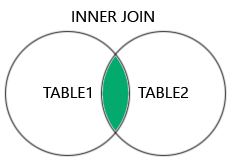
full join
returns all rows when there is a match in either the left or right table. unmatched result as NULL
SELECT column_name(s)
FROM table1
FULL JOIN table2
ON table1.column_name = table2.column_name
WHERE condition;left join
returns all rows from the left table (table1), and only the matched rows from the right table (table2).
If there is no match in the right table, the result for the columns from the right table will be NULL.
SELECT column_name(s)
FROM table1
LEFT JOIN table2
ON table1.column_name = table2.column_name;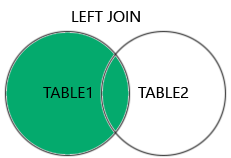
right join
returns all rows from the right table (table2), and only the matched rows from the left table (table1).
If there is no match in the left table, the result for the columns from the left table will be NULL.
SELECT column_name(s)
FROM table1
RIGHT JOIN table2
ON table1.column_name = table2.column_name;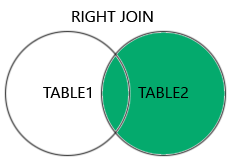
outer join
is any join that selects unmatched rows, including left, right, and full joins.
LEFT (OUTER) JOIN: Returns all rows from the left table, and only the matched rows from the right tableRIGHT (OUTER) JOIN: Returns all rows from the right table, and only the matched rows from the left tableFULL (OUTER) JOIN: Returns all rows when there is a match in either the left or right table
can be written with a UNION keyword instead of a JOIN keyword.
union
operator is used to combine the result-set of two or more SELECT statements.
automatically removes duplicate rows from the result set.
Every
SELECTstatement within_____must have the same number of columnsThe columns must also have similar data types
The columns in every
SELECTstatement must also be in the same order
SELECT column_name(s) FROM table1
UNION
SELECT column_name(s) FROM table2;equijoin
compares columns of two tables with the = operator. Most joins are _____
non-equijoin
compares columns with an operator other than =, such as < and >.
SELECT col1, col2
FROM table1
LEFT JOIN table2
ON col3 < col4;self join
regular join, but the table is joined with itself.
aliases are necessary to distinguish left and right tables.
SELECT column_name(s)
FROM table1 T1, table1 T2
WHERE condition;cross join
combines two tables without comparing columns. A cross-join uses a _______ clause without an ON clause. As a result, all possible combinations of rows from both tables appear in the result.
SELECT column_name(s)
FROM table1
CROSS JOIN table2;view table
a virtual table (or behaves like a table), even though it doesn't usually store data.
based on a
SELECTstatement.It can change how data is shown (columns, order, names, or values) without changing the database.
insert, update, delete not recommended
Used to:
Hide sensitive data.
Save complex queries.
Reuse optimized queries.
create view
statement creates a view table and specifies the view name, query, and, optionally, column names. If column names are not specified, column names are the same as in the view query result table.
CREATE VIEW ViewName [ ( Column1, Column2, ... ) ]
AS SelectStatement;base table
A table specified in the view query's FROM clause. refrence tables for view query
are always source tables, created as tables rather than as views.
data is stored
materialized view
is a view for which data is stored at all times. Whenever a base table changes, the corresponding view tables can also change, so ________ must be refreshed.
with check option
the database rejects inserts and updates that do not satisfy the view query WHERE clause. Instead, the database generates an error message that explains the violation.
CREATE VIEW ViewName [ ( Column1, Column2, ... ) ]
AS SelectStatement
[ WITH CHECK OPTION ];