The Sensorimotor System (not reading)
 Studied by 0 people
 Call Kai
 Learn
Learn Practice Test
 Spaced Repetition
 Match
Match Flashcards
 Knowt Play
1/201

Earn XP
Description and Tags
smart falling, buttered cats, robot movement. Understand the general architecture of the motor system from cortical association areas to contraction of muscle fibres Understand how lower and upper motor neurons contribute to motor control Understand the importance of integration of ascending (sensory) and descending (motor) signals in accurate motor control Understand the main roles of the motor cortex, cerebellum and basal ganglia in motor control Understand the principle descending motor pathways including their subdivisions and the functional differences between them
Name | Mastery | Learn | Test | Matching | Spaced | Call with Kai |
|---|
No analytics yet
Send a link to your students to track their progress
202 Terms
motor control involves…
a dynamically changing mix of conscious and unconscious regulation of muscle force
motor control involves a dynamically changing mix of conscious and unconscious regulation of muscle force, informed by…
continuous and complex sensory feedback, operating in a framework sculpted by evolutionary pressures
overview of motor control
motor control involves a dynamically changing mix of conscious and unconscious regulation of muscle force, informed by continuous and complex sensory feedback, operating in a framework sculpted by evolutionary pressures
what has NS been sculpted by
evolutionary realities
evolution + motor control
way we control movement and diff systems involved has a lot in common w very ancient vertebrate ancestors when first crawled on to land- lots of similiarities in type and function of brain structures and how work together
types of motor control
voluntary
goal directed
habit
involuntary
most voluntary motor control is…
goal directed
goal directed motor control
conscious, explicit, controlled
habitual motor control
unconscious, implicit, automatic
examples of voluntary motor control
running, walking, talking, playing, guitar, etc
examples of involuntary motor control
eye movements, facial expressions, jaw, tongue, postural muscles throughout trunk, hand and fingers, diaphragm, cardiac, intercostals (around the lungs), digestive tract
falling + motor system
stops hurting important parts
protects ur face, protects neck/core parts of body
e.g. fall and roll forwards, step up, keep running
scruff on shoulder or in knee, rolled
momentum not stopped but carried
lot unconscious process to keep safe- all uncon and complicated
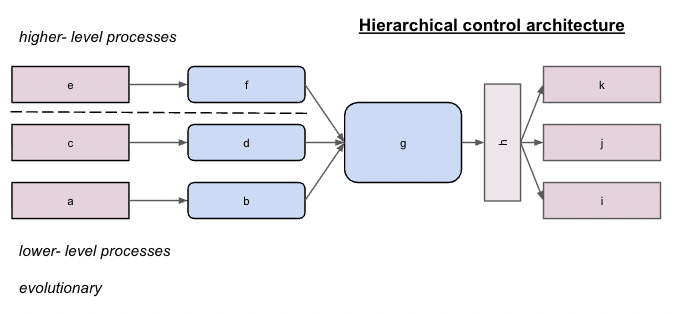
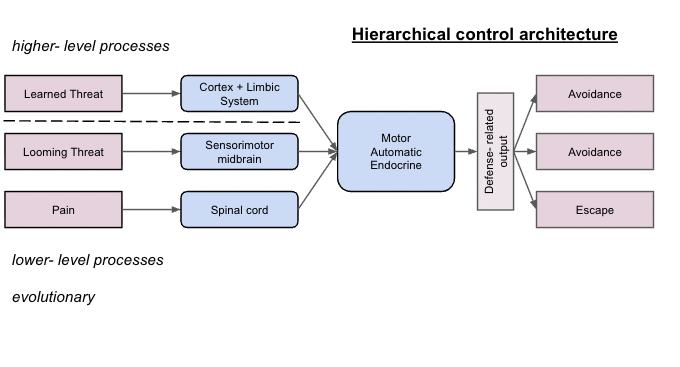
hierarchical control architecture
three levels of control
elementary → pain → spinal cord → escape
next level → looming threat → sensorimotor midbrain
top level → learned threat → cortex + limbic systems
these things → motor/ autonomic / endocrine → defense related output
hierarchical control architecture: evolutionary perspective
pain and looming threats are evolutionary
learned threat, related to cortical structures, is higher level and not evolutionary
hierarchical control architecture: level 1
pain is elementary sensory signal that tells u tissue damage is happening
response to withdraw from pain/pain source
mediated by simple circuits in spinal cord
basic defensive behaviours is shared by most animals, even most organisms like plants
hierarchical control architecture: level 2
needing to move in response to something
looming threat
more complicated
need visual systems to encapture lumens, objects, size, in front of you- big part of visual image effected by potential predator
need motor coordination to be able to move away
sensorimotor midbrain
hierarchical control architecture: level 3
top level, learned threat
e.g.- gun, nothing intrinsic or innate, all learned
weapon- not a big visual image
visual processing, learning, able to break down image and id object within it, understanding high level, cognitive function
cortical and limbic system
emotional parts telling threat
high levels development, humans highly cortical animals
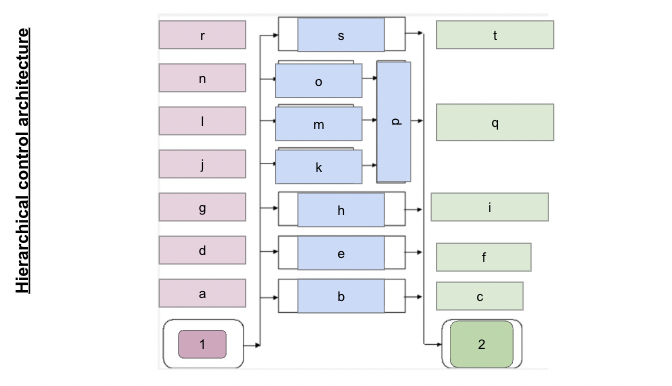
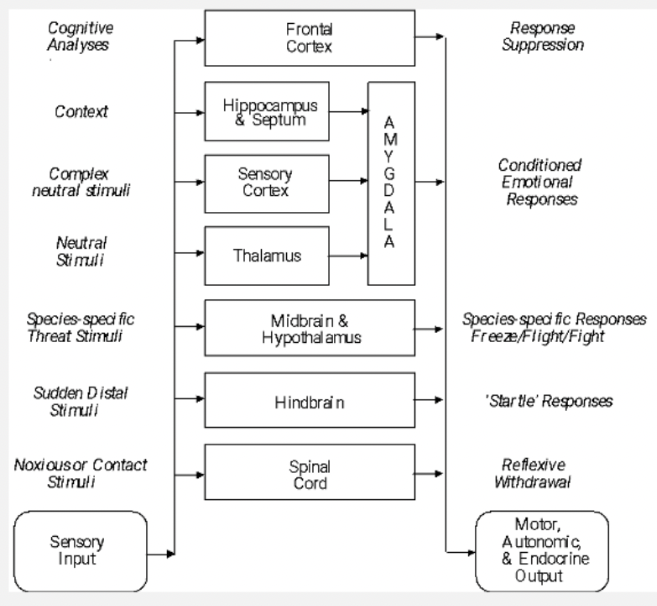
noxious or contact stimuli →
spinal cord
spinal cord →
reflexive withdrawal
sudden distal stimuli →
hindbrain
hindbrain →
‘startle’ responses
species- specific threat stimuli →
midbrain and hypothalamus
midbrain and hypothalamus →
species-specific responses e.g. freeze/flight/fight
neutral stimuli →
thalamus
thalamus →
amygdala
complex neutral stimuli →
sensory cortex
sensory cortex →
amygdala
context →
hippocampus. and septum
hippocampus and septum →
amygdala
amygdala →
conditioned emotional responses
cognitive analyses →
frontal cortex
frontal cortex →
response suppression
threat detection, avoidance behaviour, processing compacity
more complicated and sophisticated threat detection and avoidance behaviour → requires additional or more complex processing capacity (neural systems)
label
pain
spinal cord
looming threat
sensorimotor brain
learned threat
cortex and limbic system
motor, autonomic, endocrine
defense-related output
escape
avoidance
avoidance
label
Sensory input
Motor, autonomic, and endocrine output
Noxious or contact stimuli
Spinal cord
Reflexive withdrawal
Sudden distal stimuli
Hindbrain
Startle responses
Species specific threat stimuli
Midbrain and hypothalamus
Species specific responses freeze/flight/fight
Neutral stimuli
Thalamus
Complex neutral stimuli
Sensory cortex
Context
Context hippocampus and septum
Amygdala
Conditioned emotional responses
Cognitive analyses
Frontal cortex
Response suppression
what is motor control governed by?
lower and upper motor neurons
lower motor neuron: location
begins (has its cell body) in brainstem or spinal cord and projects to the muscle
upper motor neuron: location
originate in higher centres and project down to meet the other category of motor neurons
what is at the bottom of the sensorimotor system
spinal cord and motor circuits
what is at the top of the sensorimotor system
association cortex
what does the association cortex sit between
visual and motor cortices
association cortex: location
top of sensorimotor system
between motor and visual (above) cortices
interaction between
describe overview of sensory motor system layout
association cortex. ← → basal ganglia X sensory feedback ←
secondary motor cortex. ←. → basal ganglia X sensory feedback ← and ^
primary motor cortex ← → cerebellum X sensory feedback ← and ^
brainstem motor nuceli X sensory feedback ← and ^
spinal motor circuits X ← → muscle ^ sensory feedback ← and ^
motor units X ← → muscle ^. sensory feedback ← and ^
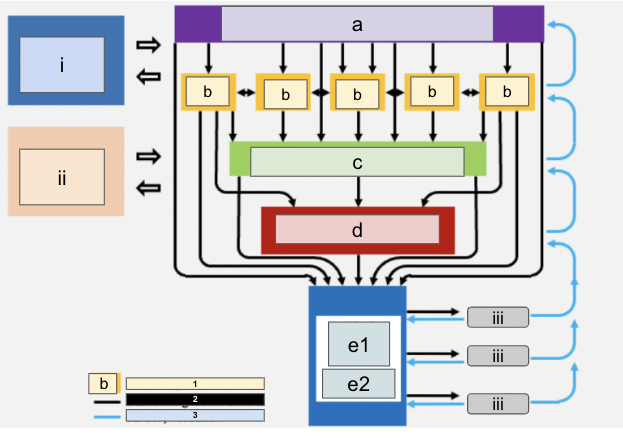
label
Association cortex
M2
Primary motor cortex
Brainstem motor nuclei
e1. Spinal motor circuits
e2. Motor units
i) basal ganglia
ii) cerebellum
iii) muscle
Secondary motor cortex
Descending motor circuits
Sensory feedback
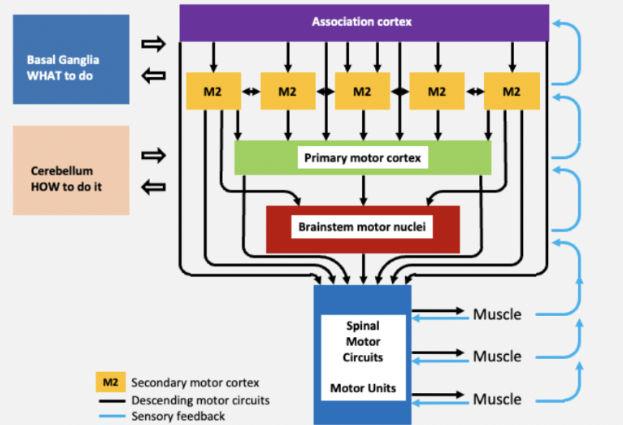
basal ganglia function
selecting programmes of motor activity
cerebellum function
fine control and correction of motor activity
describe sensorimotor system
lots of interaction between different parts
bottom- spinal cord and motor circuits
top- association cortex
motor cortex below, and secondary and primary corticies
controlling neurons as go down
all feedback into system at lots of different levels
signals at top, going down to bottom
other systems may interfere with or optimise signals as go down
basal ganglia and cerebellum
what type of system is the sensorimotor system
a descending control system with lots of ascending feedback
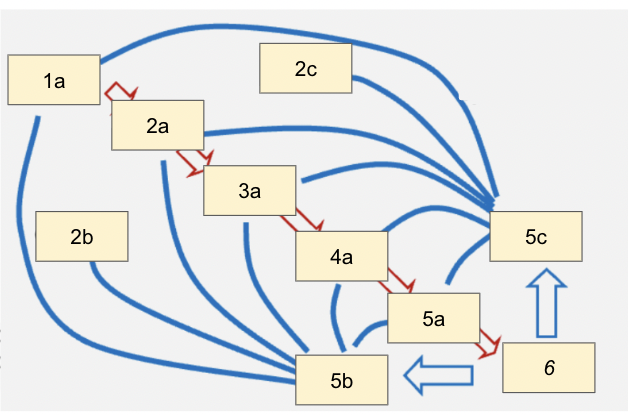
label, including:
red arrows show… a
blue lines show… b
a) Descending control system
b) Ascending feedback
1.a. Association cortex
2.a. Motor cortex
2.b. Cerebellum
2.c. basal ganglia
3.a. Brainstem circuits
4.a. Spinal circuits
5.a. Motor unit
5.b. Sensory systems
5.c. Sensory systems
6. Effect on the World
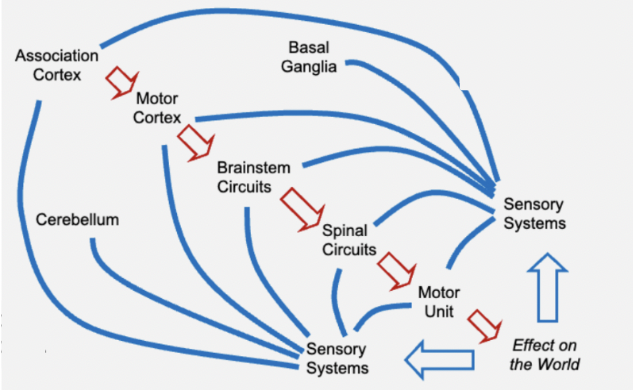
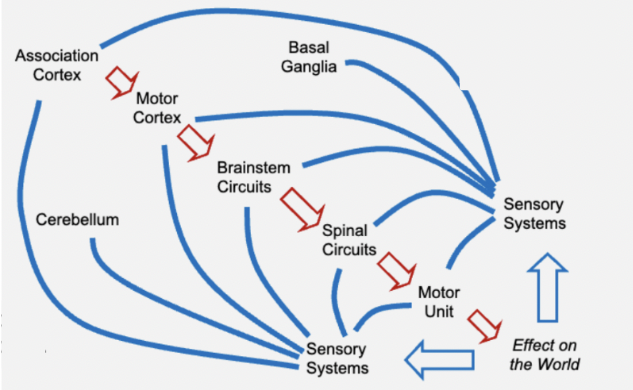
describe
sensorimotor system is a descending control system coming down through these different layers, but with lots of feedback, effect guides movement
what manner do muscle fibres act in
all or none
what does control of muscle force depend on?
the way in which lower motor neurons activate different types of muscle fibre, bc individual muscle fibres act in an all or none manner
why are individual muscle fibres acting in an all or none manner
bc neurons are all or none- action potential (fires) or it does not
postsynaptic potentials and other stuff happen, but re signal- it either fires or does not fire
muscle fibres are the same
what do individual muscle fibres do
they either contract or do not contract- not a continuum
how are muscle fibres controlled, as an implication of knowing they how individual ones work
individual muscle fibres either contract or do not contract
indicates muscle control is not about more or less work, but about number of and type of muscle fibres
how many and what type are activated
what % of body weight is muscle
40
how many types of muscle
three
types of muscle
cardiac
smooth
skeletal
smallest muscle
stapedius, in inner ear
focus on dampening sound
largest muscle
gluteus maximus, in hip/buttock
strongest (based on weight) muscle
masseter, in jaw
skeletal muscle
focus of our content
controls movement
attached to skeleton
skeleton is frame around which muscles pivot you to move
smooth muscle
lots in body
does lots of diff things
lines digestive system
blood vessels
e.g. blood vessels in brain decide how much goes to which parts
cardiac muscle
heart muscle
diff type designed to not stop working
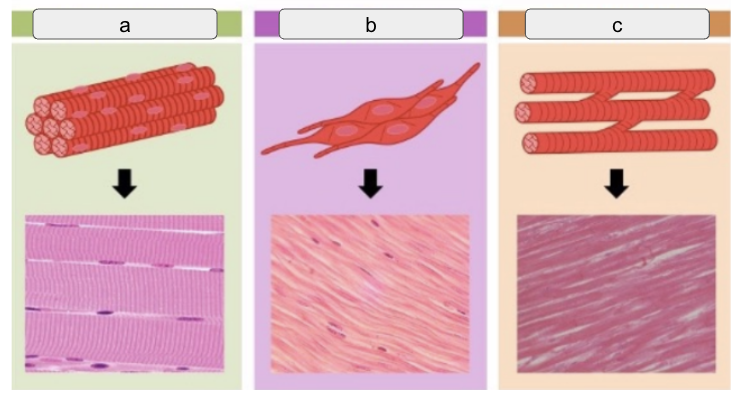
label
skeletal muscle
smooth muscle
cardiac muscle
how do we achieve such a range of movements and forces?
antagonistic arrangement
recruitment of muscle fibres
antagonistic arrangment
combined, coordinated action
recruitment of muscle fibres
fast/slow twitch, small and large motor units
active muscle state
contracted
passive muscle state
relaxed
explain muscle arrangement
antagonistic arrangment
oppose one another
examples of antagonistic arrangement
biceps and triceps
muscles above, below, and to either side of eye, that allow full degrees of freedom
what does the number of muscle fibres vary across?
individuals
what does the number of muscle fibres change very little across?
lifetime, with either time or training- appears to be genetically determined
what is muscle size and strength dependent on?
cross sectional area of individual fibres and different proportions of the different types of fibre
how much does the number of muscle fibres between individuals vary?
lots, with lots of reasons why people have different amounts
impact of time and training on muscle fibres
does not really change number an individual has
the thickness of the muscle fibres- their individual size- tends to change
also the type of muscle fibres tends to change
explain how muscles contract
fibres arranged in a way where they are interlocking
when contract, muscle fibres are interlacing, and walking towards eachother close up
muscle fibres walk up against one another and close the distance between eachother, thus shortening the muscle
actin and mysoin filaments, esp myosin head, are walking the muscle fibres against one another
myosin cross bridge cycle
myosin head has little bend in
head attaches to actin filament
head bends at neck, which pushes it along actin filament
molecules- calcium ions, magnesium ions, and atp (energy) releases
pushes it along
repeats
molescules flying around enable this to happen
action potentials
causing bend in protein at end of myosin filament, causing it to change chape- bend in neck
bend in beck supplying muscle contraction
whole process supplied by neurotransmitter acetylcholine
explain how muscles contract
release of ACh triggers biochemical cascade in muscle cells
molecules like atp, magnesium ions, and calcium ions release due to ACh
cycle of:
ACh releases calcium from inside fibre
myosin head changes shape
myosin head binds with actin filament
ions causes bend in protein at end of myosin filament
myosin head bends at neck
pushes itself along actin filament
release of things like ADP and Pi
pushes it along
atp breaks bond between myosin head and actin filament
repeats ^^^^
explain rigor mortis
release of ACh → release of calcium from inside muscle cell (fibre)
→ myosin head change shape so it can → bind with actin filament
ATP is required to break bond between myosin head and actin filament, so it can happen again
ATP produced by oxidative metabolism, which stops upon death
so muscles become contracted and remain that way until enzymes begin to breakdown the actin/myosin
depleted energy and muscles stiff bc filaments stuck together
why does rigor mortis happen?
stiffness of body after death is bc no energy supply to muscle which means myosin head constantly stuck to actin filament bc of lack of atp released so lack of energy
what does atp do
provides energy for cells
what is atp produced by
oxidative metabolism
motor unit
average number of muscle fibres innervated by a single motor neuron
what do motor units vary by
two functional requirements for that muscle:
level of control
strength
what is typical for motor units in a muscle
a range of them, some with few and some with many fibres
size principle
motor units recruited in order of size (smallest first)
what type of control is typically required at lower forces
fine
fine control is typically required at…
lower forces
when would you have very small motor units
when precise, fine control is needed
when would you have very large motor units
when large amounts of force but not precise control is needed
explain how motor units work
motor neuron activated → fires action potential → ACh released
motor neuron is attached to X number of muscle fibres
they activate when innervated by their motor neuron, forming a motor unit
motor unit definition
a single alpha (lower) motor neuron and all the muscle fibres it innervates
innervation rule
each individual muscle fibre recieves signals from only one motor neuron
recruitment (Henneman’s Size Principle)
nervous system activates motor units in order from smallest (fine control) to largest (more force) ensuring smooth, graded contractions
less fibres in a motor unit means…
more precise
more fibres in a motor unit means…
more force
in the arm, it is useful to have…
different motor units
how are motor units recruited
into order of size
increasing force, starting with smaller motor units, going up and up
 Note
Note  Flashcards (57)