Electrostatics
 Call Kai
 Learn
Learn Practice Test
 Spaced Repetition
 Match
Match Flashcards
 Knowt Play
1/22

There's no tags or description
Looks like no tags are added yet.
Name | Mastery | Learn | Test | Matching | Spaced | Call with Kai | Chat |
|---|
No analytics yet
Send a link to your students to track their progress
23 Terms
Charge of an electron
1.6 × 10^-19 C
Relative mass of protons/neutrons and electrons
Protons/neutrons are 2000 times heavier than electrons
Coulomb’s force
F = k (q1. q2 / r²)
k is constant: 9 × 10 ^9, N m² C^-2
Dielectric constant (Er)
Dictates how much insulating material weakens an electric field compared to a vacuum
dielectric constant formula
Er = E / E0
where: E is the absolute permittivity of the medium, E0 is the permittivity of free space/ the vacuum

electrostatic force and dielectric constant formula (Coulomb’s Law)
units: N
where ke: Coulomb’s constant = 9 × 10 ^9, Er: dielectric constant,
in a vacuum Er is equal to 1

notes on dielectric material in electrostatic force
Inserting a dielectric material always decreases the net electrostatic force between two charges by a factor of Er
ke (Coulomb’s Constant) in formula ( for electrostatic force and dielectric constant)
where E0: permittivity of free space, Er: dielectric constant/ relative permittivity

dielectric material in an electric field
Em = Eo / Er
where Em: electric field inside a material, E0: electric field in a vaccum (or air), Er: dielectric constant
notes on dielctric material in an electric field
Adding a dielectric material weakens the internal electric field because its internal polarization opposes the external field.
capacitance for dielectric material in parallel plate capacitor
C = Er . C0
where C : capacitance, C0: capacitance in a vacuum, Er: dieelctric constant

capacitance
C = Q/V, in F
capacitance in a vacum formula (C0)
C0 = (E0 . A)/ d
where C0: capacitance in a vacuum, A: Area of the plates, d: Distance between plates
notes on dielectric material and capacitance
Inserting a dielectric increases the capacitance by a factor of Er
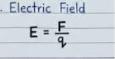
electric field formula
E = F / q, units: N/C
electric field due to point charge
E = k ( q / r²)

electric potential energy
U = (k . q1. q2) / r, units: J
uniform electric field
E = V/d, units V/m
energy and potential formula
U = q . V or ∆U = q. ∆V, units: J
where q is charge in C, V is voltage/electric potential in V
formulas for energy stored in a capacitor
U = ½ CV²
U = ½ QV
U = Q² / 2C
If the capacitor is still connected to a battery…
the Voltage (V) stays constant
Use U = ½ CV²
If the capacitor is disconnected from the battery…
the Charge (Q) stays constant
Use U = Q² / 2C
dielectric in a capacitor (simpler formula)
C = Er . C0