Oxidation of alcohols (3.3.5.2)
 Call Kai
 Learn
Learn Practice Test
 Spaced Repetition
 Match
Match Flashcards
 Knowt Play
1/4

There's no tags or description
Looks like no tags are added yet.
Name | Mastery | Learn | Test | Matching | Spaced | Call with Kai | Chat |
|---|
No analytics yet
Send a link to your students to track their progress
5 Terms
How can primary alcohols be oxidised?
Primary alcohols can be oxidised to form aldehydes and further oxidised to form carboxylic acids.
They can be oxidised by excess acidified potassium dichromate ([O]/H+)
CH3CH2OH + [O] → CH3COH + H2O
CH3COH + [O] → CH3COOH
How does the method used to oxidise a primary alcohol determines whether an aldehyde or carboxylic acid is formed?
The primary alcohol must be oxidised with excess [O]/H+ and distilled to form an aldehyde
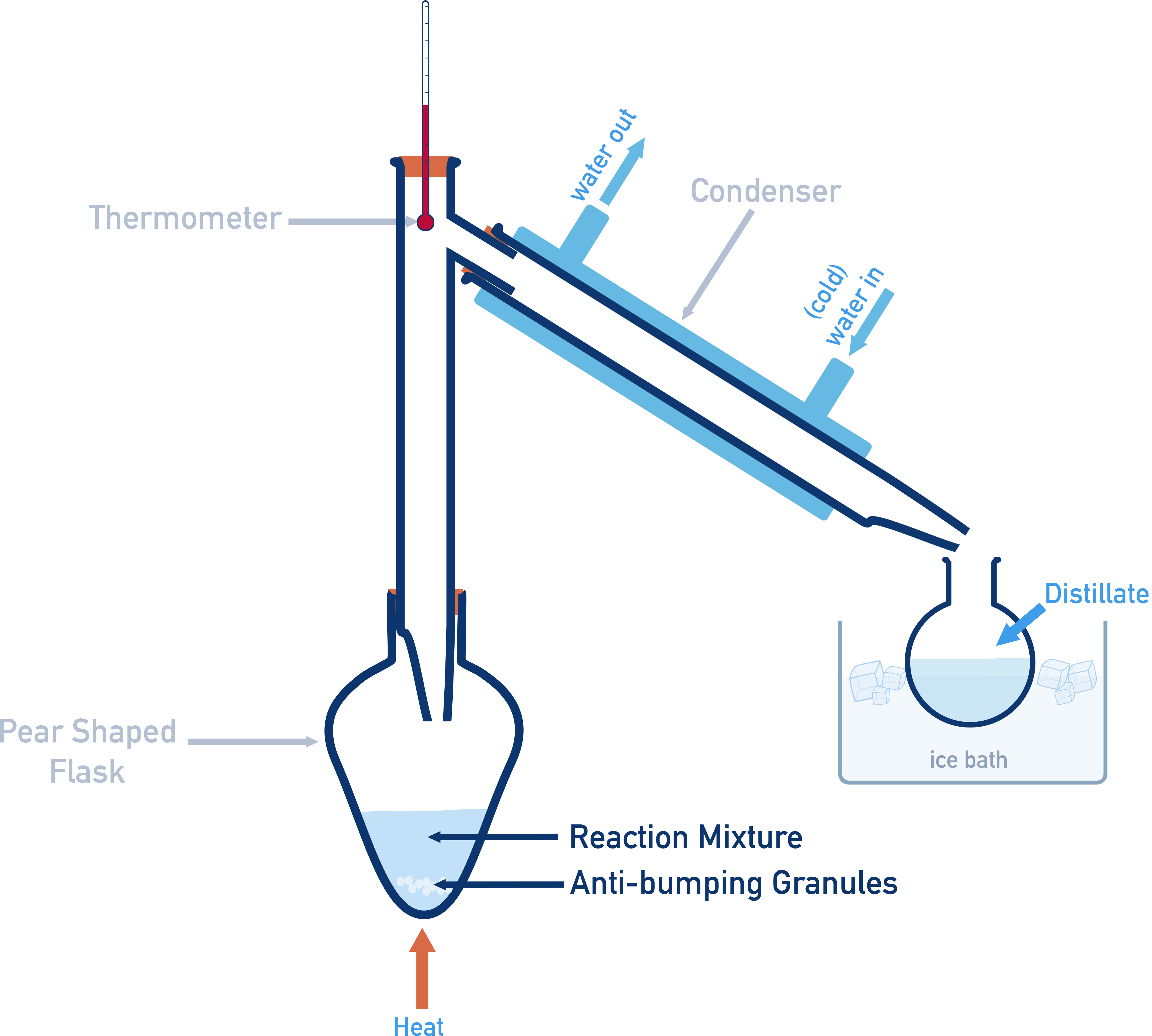
The primary alcohol must be oxidised with excess [O]/H+ under reflux to form a carboxylic acid

How can secondary and tertiary alcohols be oxidised?
Secondary alcohols - oxidised in the presence of [O]/H+ to form ketones - they cannot be further oxidised
CH3CHOHCH3 + [O] → CH3CHOCH3
Tertiary alcohols - not easily oxidised
How can primary, secondary and tertiary alcohols be distinguished between?
Add K2Cr2O7/H+ to each solution:
Observations for 1° - solution changes colour from orange to green
Observations for 2° - solution changes colour from orange to green
Observations for 3° - solution remains orange
How can chemical tests be used to distinguish between aldehydes and ketones?
1) Warm with K2Cr2O7/H+
Observation for aldehyde - solution changes colour from orange to green
Observation for ketone - solution remains orange
2) Warm gently with Tollen’s reagent
Observation for aldehyde - silver mirror precipitate will form
Observation for ketone - solution remains colourless
3) Heat with Fehling’s solution
Observation for aldehyde - a brick red precipitate will form
Observation for ketone - solution remains blue