Science Unit Test 1 - Space
 Call Kai
 Learn
Learn Practice Test
 Spaced Repetition
 Match
Match Flashcards
 Knowt Play
1/82

There's no tags or description
Looks like no tags are added yet.
Name | Mastery | Learn | Test | Matching | Spaced | Call with Kai | Chat |
|---|
No analytics yet
Send a link to your students to track their progress
83 Terms
What is a planetary system?
A collection of large and small bodies that orbit a central star
What are galaxies?
Large groups of gas, dust, and stars that are held together by gravity
What are the three types of galaxies?
Spiral, Elliptical, and Irregular
What are stars?
Celestial bodies made of gas that emit light
What are clusters?
Clusters are areas of concentrated galaxies
Clusters-several thousand galaxies
Superclusters-group of ten or more clusters
What are voids
Voids are spherical areas where little matter exits between galaxies
What is magnitude?
Magnitude is the brightness of stars = the lower the number, the brighter the star
Apparent Magnitude vs. Absolute Magnitude
Apparent magnitude is the how bright the star looks from Earth, while Absolute magnitude is the actual brightness of the star
What is the process of a stars creation?
Stars are made of gas-mostly Hydrogen and Helium
The gases fuse together creating nuclear fusion
Fusion gives off light
The length of the wave length is determined be the color
What color star is the hottest?
Blue
What color star is the coolest
Red
What is the life cycle of a star?
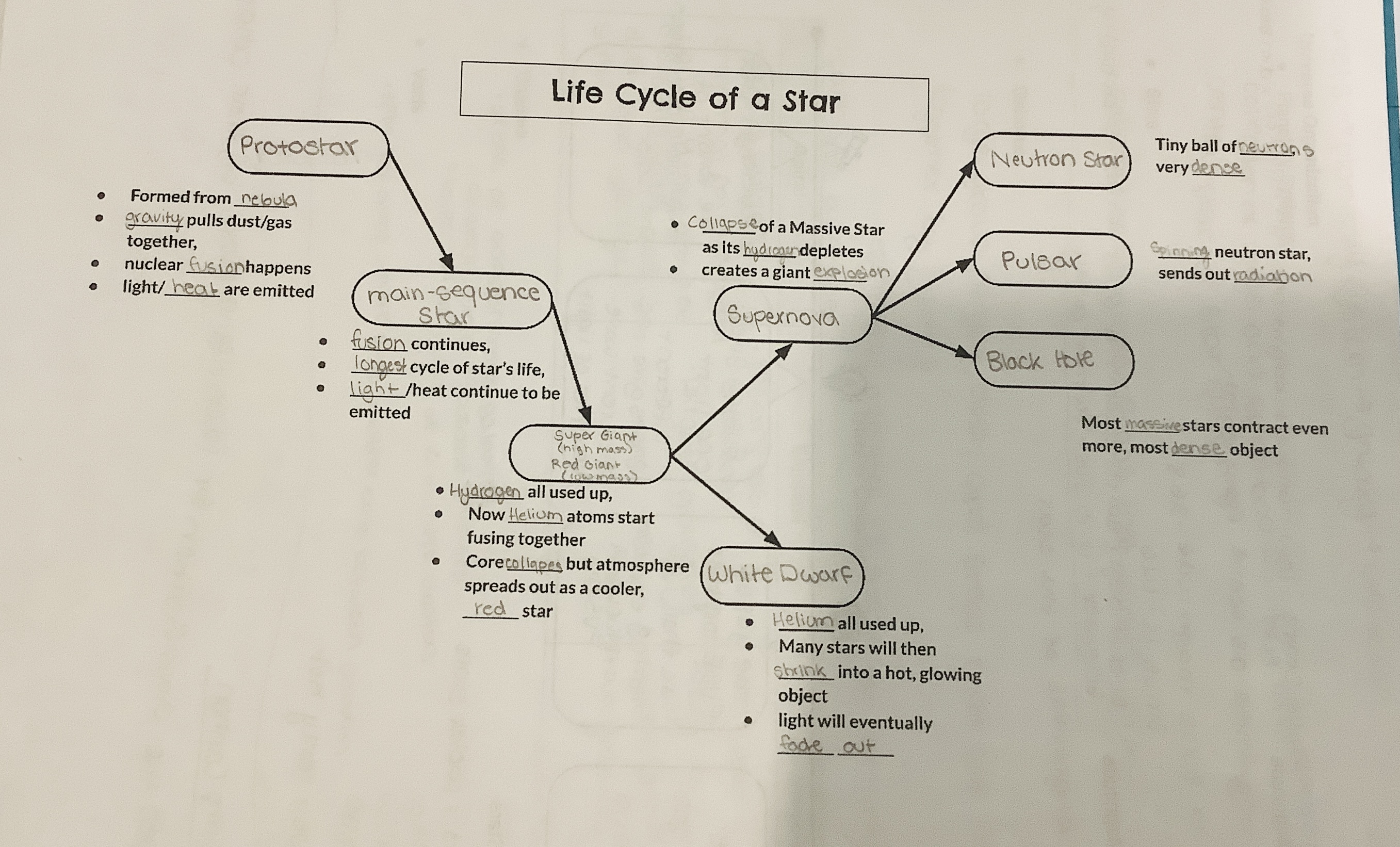
What are Supergiants?
Supergiants are massive stars that burn through their fuel so quickly that they die off relatively faster than other stars
What are Giants? (stars)
Giants are very large stars that tend to be cooler because they are not as dence
What are White Dwarf stars?
White Dwarf stars have less mass but are denser than giants so they are hotter stars
Is the Sun a Supergiant, Giant, Main Sequence star, or White Dwarf?
A Main Sequence Star
What is the Sun’s official name?
Sol
Where is the astroid belt located in our solar system?
Between Mars and Jupitor
Where is the Kuiper Belt located?
Beyond Neptune-it is the home of Pluto and many other Dwarf planets
Where and what is the Ort Cloud?
The Ort Cloud is the outer most layer of our solar system, and is a giant sphere around the sun
Why are all the drawing and images of the Solar System inaccurate?
They are inaccurate because the size of the planets and sun, and the spacing in space is so big that you can’t fit an accurate drawing or model onto a piece of paper-the planets would be microscopic
What are the two types of planets?
Terrestrial and Jovian
What are the features of the Terrestrial Planets?
They have rocky and solid surfaces, they are the closest to the sun, and the are generally smaller
What are the features of the Jovian Planets?
They have gassy surfaces, are the farthest from the sun, and are generally larger
What planets are Terrestrial?
Mercury, Venus, Earth, and Mars
What planets are Jovian?
Jupiter, Saturn, Uranus, and Neptune
Order the Planets from Closest to the Sun to Furthest from the Sun
Mercury, Venus, Earth, Mars, Jupiter, Saturn, Uranus, Neptune (and Pluto)
Order the Planets from largest to smallest
Jupiter, Saturn, Uranus/Neptune, Earth/Venus, Mars, Mercury
What is a main feature of Mercury?
Has the biggest temperature swings
What is a main feature about Venus?
Hottest planet
What is a main feature about Earth?
Has human life
What is a main feature about Mars?
It is red and has the biggest volcano in the solar system
What is a main feature about Jupiter?
It has the storm
What is a main feature about Saturn?
It’s rings
What is a main feature about Uranus?
It rotates on it’s side
What is a main feature about Neptune?
It has the strongest winds?
What type of celestial body is Pluto?
A dwarf planet
What are moons?
Moons are natural satellites that orbit planets
What are asteroids?
Asteroids are rocky remnants from the solar systems early formation. Most are found in the Asteroid Belt
What are comets?
Comets are large balls of ice, rock, and dust that orbit the sun
What are Dwarf Planets?
Dwarf Planets are smaller than regular planets but share similar characteristics, like being round and orbiting the Sun.
What are Meteors?
Meteors are small pieces of rock do not orbit the sun, and burn up as they enter our atmosphere, producing bright streaks of light.
What is another name for a Meteor?
A shooting star
What is the difference between Meteors, Meteoroids, and Meteorites?
Meteoroids are found in space, Meteors are found in our atmosphere(shooting stars), and Meteorites are Meteors that didn’t fully burn up and have landed on Earth.
What is the general spacing between the planets in our solar system?
The Terrestrial Planets are closer to the sun and have about the same amount of space between them, while the Jovian planets are the furthest form the sun and get further apart the further out into space they get.
What is the difference between Earth’s rotations and Earth’s revolution?
Rotation is Earth spinning on it’s axis, and Earth’s revolution is it’s orbit around the sun.
Which way does Earth rotate around the Sun?
Counter Clockwise
How long does it take the Earth to full rotation on it axis?
24 hours = 1 day
How long does it take the Earth to revolve around the Sun?
365 days = 1 year
What causes seasons?
Earth’s tilt (23.5º)
Earth orbit/revolution around the sun
Define the seasons.
Seasons are a time of year characterized by a particular weather pattern.
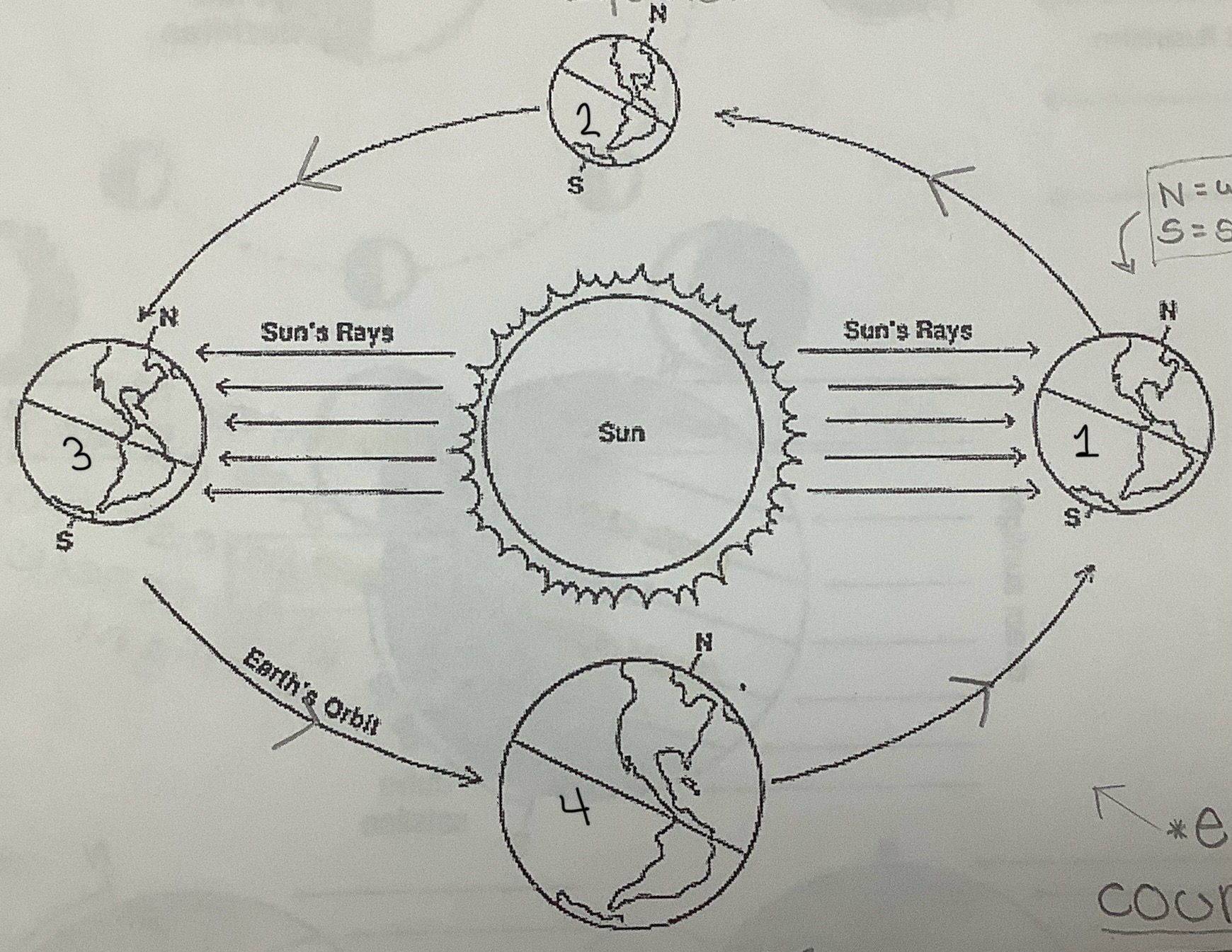
Define the seasons for the southern hemisphere.
Summer
Fall
Winter
Spring
What are the characteristics of seasons?
-the length of day
-temperatures
-height of noon sun
Define solstice and equinox.
Solstice- largest difference between light and dark in a day
Equinox- 12 hours of light and 12 hours of dark
What is a nebula?
The birth place of a star - collection of dust and gas
What galaxy do we live in?
The Milky Way
What time of galaxy are we?
Spiral
What is the main latitude line?
The equator (0º)
What are the two main longitude lines?
The Prime Meridian (0º)
The International Date Line (180º)
What it the Tropic of Cancer line?
It is the farthest spot in the North that can receive direct sunlight.
What is the Tropic of Capricorn?
It is the farthest spot in the South that can receive direct sunlight.
What is the Goldilocks Principle?
Where Earth is just the right distance from the Sun to have the right conditions for us to live on Earth.
What is Luminosty?
The brightness of a star
What is a Protostar?
A Protostar is the phase after a nebula in the star creation
What are the phases of the moon, starting with New Moon?
New moon, waxing crescent, first quarter, waxing gibbous, full moon, waning gibbous, third/last quarter, waning crescent
How many days does it take the moon to do a full orbit around Earth?
28 days
What does waxing mean?
Waxing means to build or to increase
What does waning mean?
Waning means to remove or decrease
What does eclipse mean?
To hide
What is a Solar Eclipse?
A solar eclipse is when the moon is on the same plane as the sun and blocks the sunlight for a part of earth
What is a Lunar Eclipse?
A lunar eclipse is when the Earth is blocking the light to the moon
What is the order of the moon, sun, and earth in a Solar Eclipse?
Sun, Moon, Earth = SME
What is the order of the moon, sun, and earth in a Lunar Eclipse?
Sun, Earth, Moon = SEM
What are tides?
Tides happen when the Earth rotates into a bulge created by the Sun and Moon’s gravitation pull, which cause the oceans to have high and low tides.
What are the two types of tides?
Spring and Neap
What are Spring Tides?
Spring tides are the highest high tides and the lowest tides. The occur when the sun and the moon are lined up, causing the most gravitational pull on two areas and non on the others.
What are Neap tides?
Neap tides are the medium high tides and the medium low tides. They occur when the Sun and Moon’s gravitational pulls confilct.
What is the Geologic Time Scale?
It is a list of Earth’s significant events in order
How old is the Sun?
4.6 billion years old
How is the timeline divided?
Eons-Eras-Periods
Why do the Eons/Eras/Periods end or change?
They end or change because of global events, or geological or biological events, causing a new Eon, Era, or Period to start
What is the difference between the spacing of the geological or biological events?
The geological events are more spread out across the whole timeline, but more towards the beginning, while the biological events are more clump together at the end of the timeline-they are more recent.
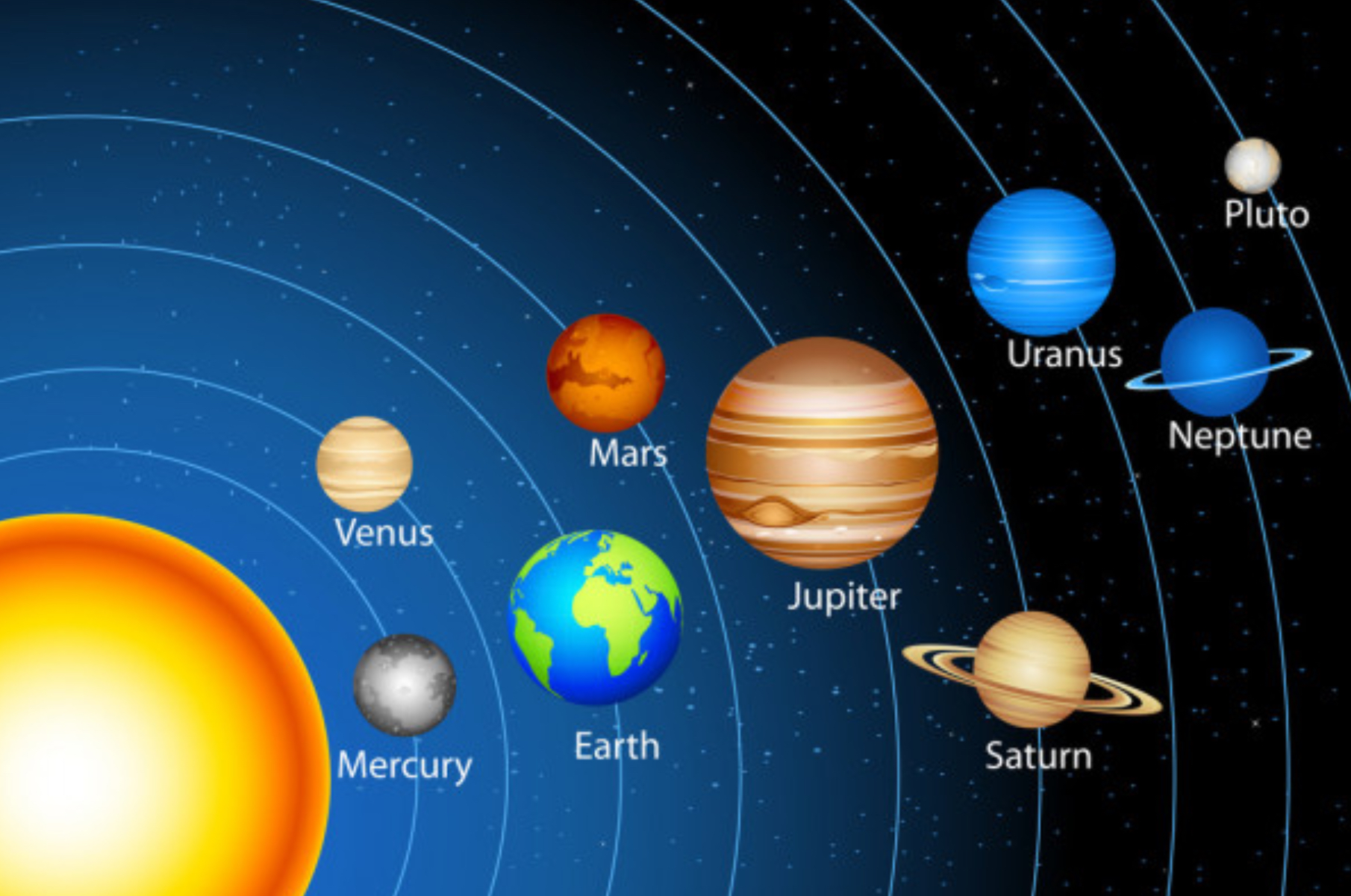
What is missing in this image?
Asteroid Belt
Kuiper Belt
Oort Cloud
Other Dwarf Planets
Jupiter and Uranus’s rings
Asteroids
Comets
Moons
Meteors