geology rox
 Call Kai
 Learn
Learn Practice Test
 Spaced Repetition
 Match
Match Flashcards
 Knowt Play
1/100

There's no tags or description
Looks like no tags are added yet.
Name | Mastery | Learn | Test | Matching | Spaced | Call with Kai | Chat |
|---|
No analytics yet
Send a link to your students to track their progress
101 Terms
talc 1, gypsum 2, calcite 3, fluorite 4, apatite 5, orthoclase 6, quartz 7, topaz 8, corundum 9, diamond 10
mohs’ hardness scale
quartz
silicate, hardness of 7, concrete
potassium feldspar
silicate, 2 planes of 90° cleavage, salmon pink, lowers the melting temperature in glassmaking and ceramics
plagioclase feldspar
silicate, 2 planes of 90° cleavage, white or gray, lowers the melting temperature in glassmaking and ceramics
hornblende
amphibole, oblique cleavage angles of 56° and 124°, abrasive
augite
pyroxene, grayish streak, no industrial use but used in geological research
olivine
silicate, hardness of 6.5, abrasive
muscovite
silicate, hardness of 2.5, heat and electrical insulator
biotite
silicate, perfect basal cleavage, filler in paint and rubber
garnet
silicate, no cleavage, sandblasting
talc
silicate, hardness of 1, baby powder and cosmetics
kaolinite
silicate, dull luster, paper production
calcite
carbonate, dissolves in HCl, cements and mortars
dolomite
carbonate, dissolves in HCl, extraction of magnesium
halite
chloride, tastes salty, cooking
fluorite
fluoride, hardness of 4, source of fluoride for teeth
magnetite
oxide, magnetic, steel production
hematite
oxide, metallic or dull luster, iron and steel production
gypsum
sulfate, hardness of 2, plaster
barite
sulfate, vitreous and pearly luster, drilling mud for petroleum
pyrite
sulfide, metallic luster, fools gold
galena
sulfide, metallic luster, lead-acid batteries
sphalerite
sulfide, 1 perfect plane of cleavage, zinc ore
graphite
native element, gray streak, pencil lead
sulfur
native elements, smells like rotten eggs, fertilizer production
metallurgy
the process of extracting elements from rock
element
a substance made up entirely of one type of atom with the same atomic number (number of protons)
mineral
naturally-occurring chemical compound, composed of one or more elements
rock
solid aggregate of one or more minerals
mineral requirements
naturally-occurring
inorganic
solid
definite chemical composition
ordered atomic arrangement
THIS IS WHY ICE IS A MINERAL 🧊
atomic number
number of protons in the nucleus of an atom. determines the chemical properties of an element and its place in the periodic table
ion
an atom with an unequal number of protons and neutrons, creating a positive (cation) or negative (anion) charge
isotopes
atoms of the same element with different numbers of neutrons
hubble
proved that:
the universe goes beyond the milky way
the universe is expanding (doppler effect)
big bang theory
the universe was created 13.8 Ga when all of its mass and space were concentrated in a single particle. this particle exploded, creating a fireball, which cooled as it expanded
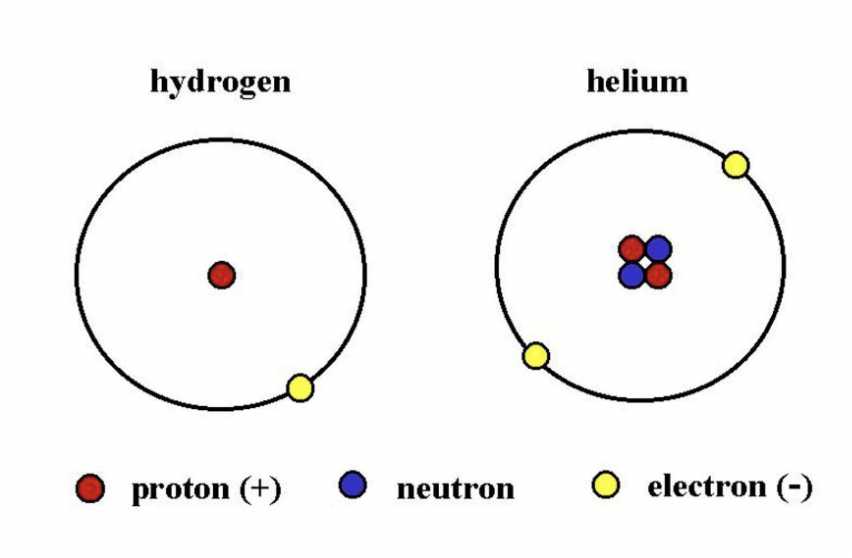
H and He
elements in early universe
star
formed by the contraction of H and He under the influence of gravity. when the core temperature gets hot enough, the H-fusion reaction starts
H fusion
dominant process that generates energy in the cores of main-sequence stars. H protons fuse to form ⁴H nucleus. by adding alpha particles and capturing neutrinos, we can build the rest of the periodic table
red giant
when most of the H has been converted, the rate of energy production initially decreases, and the star contracts. the compression of the interior raises the temperature around the core, and the site of fusion shifts to the shell outside the core
alpha particle
two protons and two neutrons bound together into one particle, identical to an He nucleus
triple alpha process
two ⁴He atoms collide to form a nucleus of ⁸Be. problem: ⁸Be is unstable, but ⁹Be is stable. solution: to become stable, it must assimilate a third alpha particle immediately
⁸Be + ⁴He → ¹²C + energy
neutron capture
an atom captures additional neutrons and becomes an unstable isotope, so it must decay by emitting an electron
⁵⁹Fe → ⁵⁹Co + beta particle + neutrino + energy
supernova
when a star reaches the end of the red giant stage, it explodes
nebula
the gas ejected by a supernova into space forms a molecular cloud. our sun and its planets likely formed from the contraction of a molecular cloud
protostar
contracting mass of gas that represents an early stage in the formation of a star. emits energy by light and infrared rays but not yet by nuclear reactions
protoplanetary disc
contraction of the solar nebula increases its rate of rotation. the irregular cloud is flattened into a disc, which extends out from the protosun at the center. the local composition is related to the temperature/distance from the protosun
planetesimals
during the final stages of the contraction of the sun, the solar wind blew most of the volatiles out of the protoplanetary disc, leaving refractory dust particles that could stick together and grow in mass to form planets. those in the inner part of the disc are mainly composed of refractory particles, while those in the outer part are composed of dust AND ice
4.56 Ga
age of the solar system
4.54 Ga
age of earth
iron
earth’s core
sulfides
earth’s mantle
silicates
earth’s crust
goldschmidt classification
distribution of elements in today’s earth reflects their siderophile, chalcophile, lithophile, and atmophile behavior
siderophile
iron-loving
metallic liquid phase
core
typically also chalcophile
chalcophile
sulfur-loving
sulfide liquid phase
may be concentrated in core
typically also siderophile
atmophile
gas-loving
extremely volatile (form liquids and gases at earth’s surface)
atmosphere and hydrosphere
lithophile
rock-loving
silicate phases
concentrated in silicate portion of earth (mantle and crust)
silicate differentiation
when earth cooled, silicate minerals crystallized from the silicate magma forming the mantle and crust. the sequence of silicate minerals that crystallize from cooling magma depend on:
temperature
pressure
magma composition
bowen’s reaction series
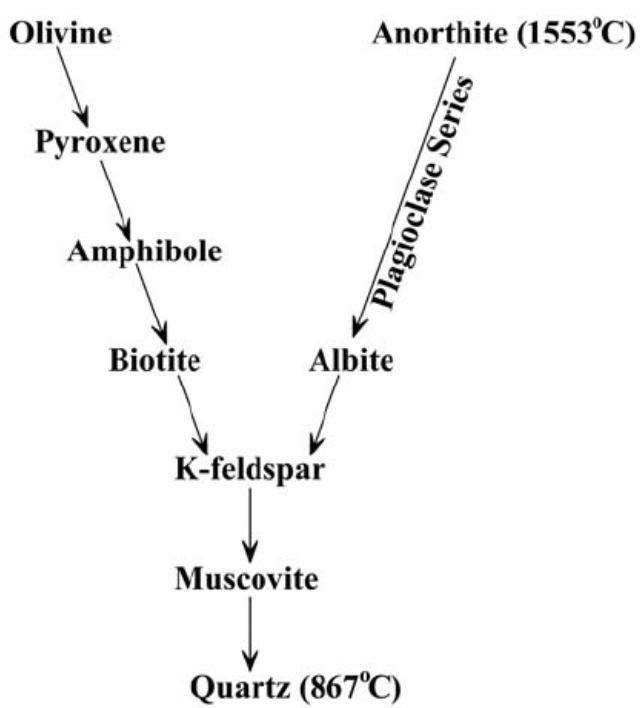
olivine and pyroxene
denser, found in mantle and oceanic crust
quartz and feldspar
less dense, found in continental crust
magnetic field
created by convection currents in the outer liquid core
mantle
layer above the core. mainly solid but behaves like a viscous fluid in geologic time
hadean
4.6-4.0 Ga
toxic atmosphere
magma ocean
early asteroid bombardment
basically hell
archean
3.8-2.5 Ga
gases from volcanism and asteroid impacts formed second atmosphere, better but still toxic
allowed for early life
bombardment slowed down
earth cooled
“the beginning”
the great oxidation event
2.4 Ga
free oxygen started to exist in the atmosphere
proterozoic
2.5-0.5 Ga
eon before complex life
“earlier life”
phanerozoic
0.5 Ga-present
rapid evolution of life
“visible life”
evaporites
water-soluble mineral sediments left behind when evaporation occurs
definite chemical composition
all minerals have specific ratios of cations to anions
native elements
elements that occur in nature in uncombined form with a distinct mineral structure
alloys
mixture of two elements, one of which is a metal
hardness
resistance of mineral surface to scratching
streak
color of powdered mineral
luster
overall sheen or look of surface
habit
how crystals tend to form when unobstructed
cleavage
the way a mineral breaks along preferred atomic planes
igneous
rocks formed by crystallization and cooling of magma on or near earth’s surface. the type of rock formed depends on:
cooling rate
pressure
magma composition
felsic
feldspar - silica
magma rich in quartz and feldspar
light-colored
mafic
magnesium - Fe
magma rich in olivine and pyroxene
dark-colored
plutonic
intrusive
slow-cooling
larger crystals
granite
volcanic
extrusive
fast-cooling
small to no crystals
basalt
viscosity
the property of a liquid to resist flow when a shear stress is applied (ex. how fast ketchup pours when you tip the bottle over). the higher the SiO₂ content, the higher the viscosity
subduction zone
denser slab of oceanic crust goes below less dense slab of continental crust. SiO₂-rich magmas migrate upwards and erupt violently
hot spot
mantle plumes low in SiO₂ rise from deep in the earth. they pierce the crust and erupt quietly. as plates move above them, they create volcano island chains (hawaii)
mid ocean ridge
mantle magmas are erupted along divergent plate boundaries
sedimentary rock
sediment particles that are lithified into cohesive rock mass. can tell a lot about paleo-environmental conditions
compaction
increased pressure due to burial/loading
cementation
mineral phases that precipitate from water and volcanic ash
ripples
bedforms created at low velocities
sand dunes
bedforms created at increased velocities
plane beds
bedforms created at great velocities
antidunes
bedforms created at greatest velocities
cross bedding
layering in one or multiple beds that is at an angle to the plane of stratification. formed when sand eroded from the windward side of the dune is deposited on the other side. generally sand dunes, can be ripples
clastic/detrital
sedimentary rocks derived from weathering/erosion of pre-existing rocks
chemical
sedimentary rocks formed from chemical precipitation (ex. limestone, carbonates, evaporites)
conglomerate
clastic sedimentary lithology with poorly sorted, rounded clasts. transported in a high-energy environment, typically rivers or glaciers. how we knew there were rivers on mars!
breccia
clastic sedimentary lithology with angular clasts in a finer matrix, suggesting limited transportation. typically seen on steep hillsides or foots of cliffs
sandstone
clastic sedimentary lithology with sand-sized fragments, mostly quartz and feldspar. formed in moderate-energy terrestrial or marine environments. described in terms of cementation, sorting, and grain size (within range)
mudstone
clastic sedimentary lithology with fine grain, original constituents clays and muds. low energy depositional environment like an estuary or lagoon. important rock source for petroleum