Molecular Diagnostics Chapter 5
 Call Kai
 Learn
Learn Practice Test
 Spaced Repetition
 Match
Match Flashcards
 Knowt Play
1/76

There's no tags or description
Looks like no tags are added yet.
Name | Mastery | Learn | Test | Matching | Spaced | Call with Kai | Chat |
|---|
No analytics yet
Send a link to your students to track their progress
77 Terms
What type of restriction enzyme is commonly used in the laboratory?
type II, 4-6 bp recognition sites
restriction map
diagram that shows the lengths of fragments between restriction sites in the strand of DNA
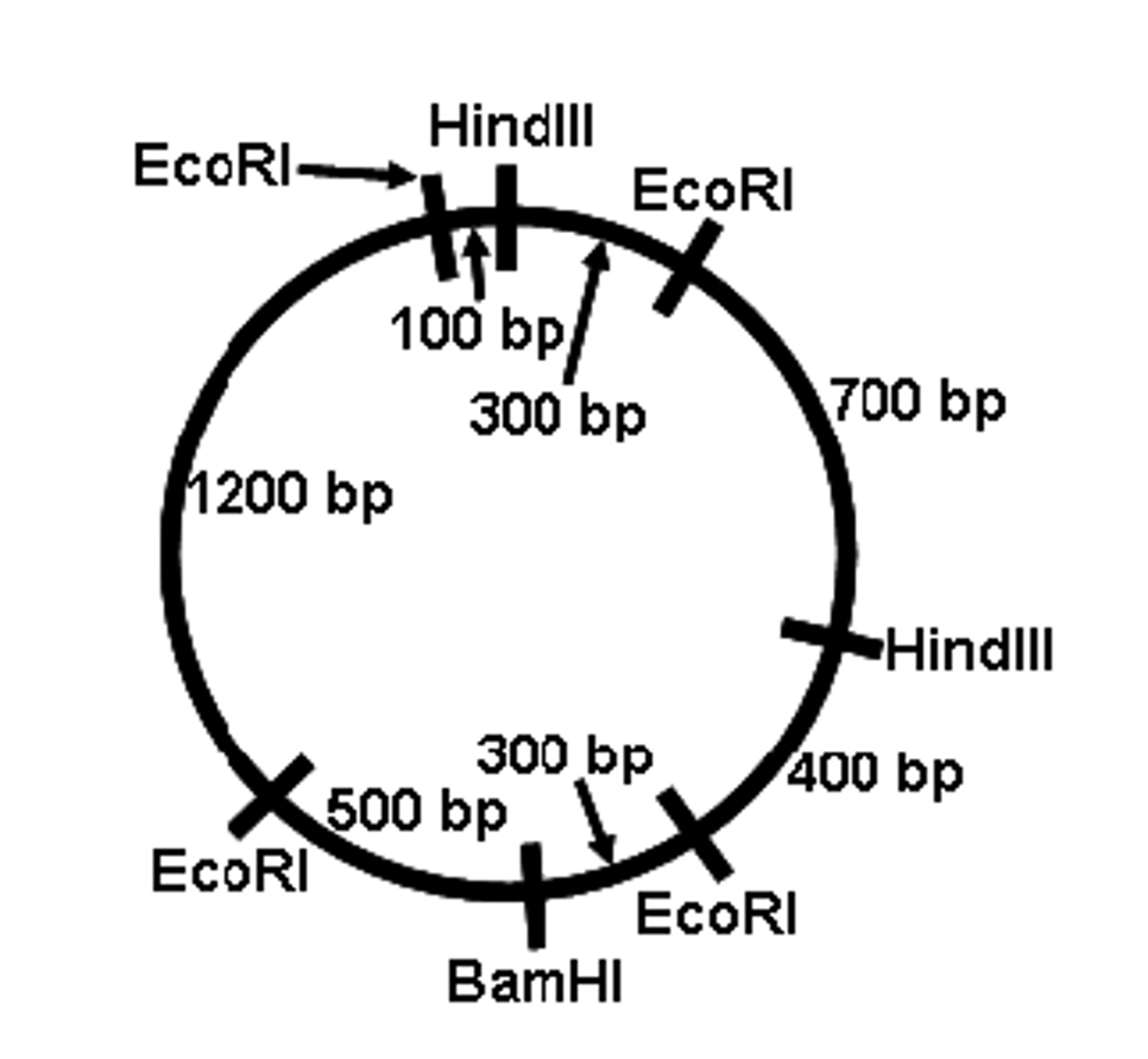
If you cut a linear fragment of DNA with a restriction enzyme at three sites, how many fragments do you have? What about if you cut a plasmid at three sites
4 fragments, 3 fragments
How do you perform restriction mapping?
Cut DNA with restriction enzyme, then cut with two restriction enzymes, then three and so on you can use the size of the fragments to map where the cut sites are located
Are restriction enzyme cuts unique to different strands of nucleic acid?
yes due to somatic differences in individuals, so fragment analysis can be used for paternity or forensic profiling
star activity
when REs are not always site-specific and cut at an incorrect sequence. This error increases if the reaction proceeds for too long or an incorrect buffer is used or organic solvents like ethanol
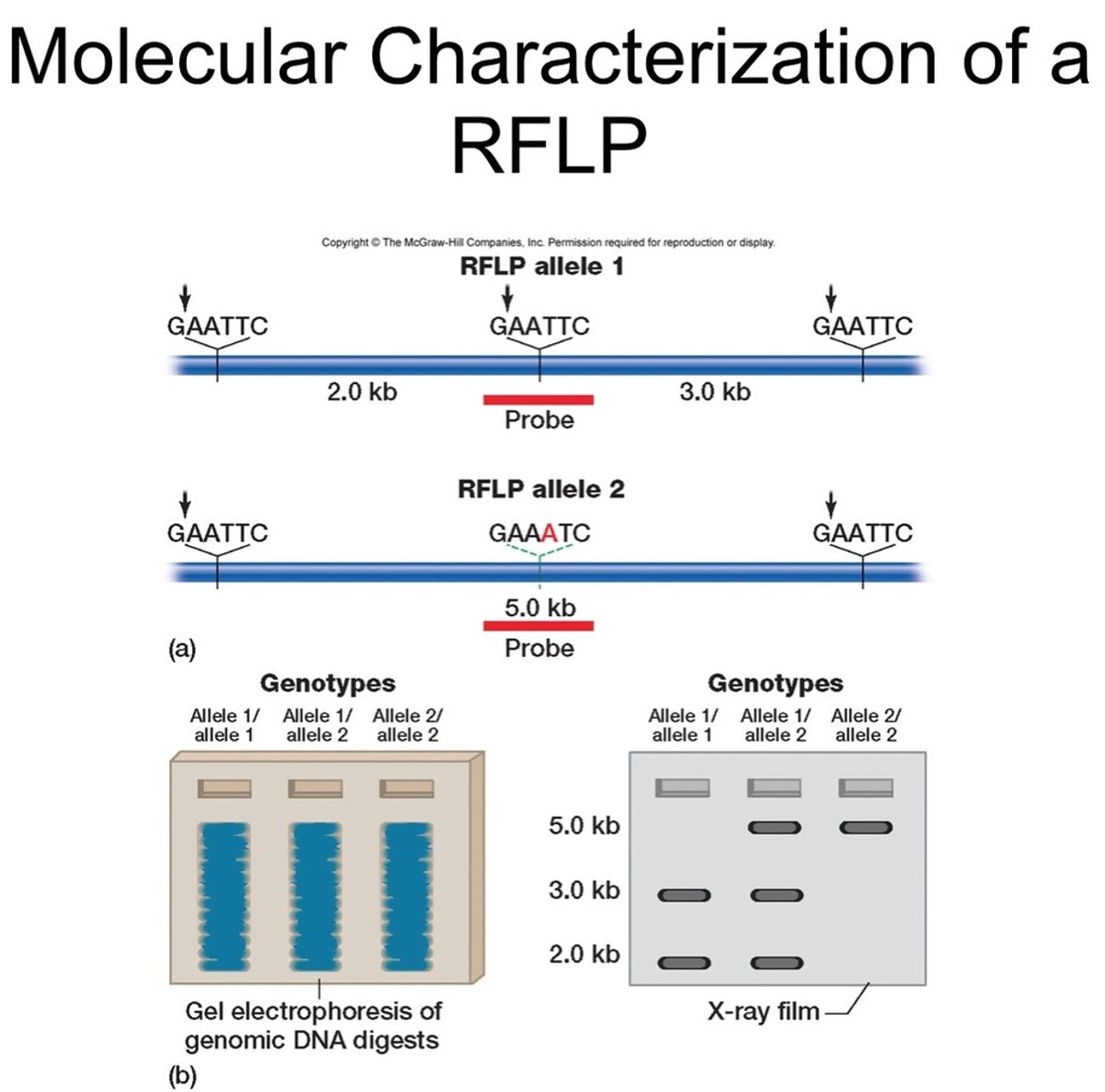
Restriction Fragment Length Polymorphisms (RFLPs)
Differences in DNA sequence on homologous chromosomes that can result in different patterns of restriction fragment lengths (DNA segments resulting from treatment with restriction enzymes).
CRISPR
clustered regularly interspaced short palindromic repeats are a class of repeated DNA throughout Archeae and prokaryotes. a collection of DNA sequences that tells Cas9 exactly where to cut
What is the difference between CRISPR/CAS9 system DNA cuts and restriction enzyme?
restriction enzymes cut at sites determined by that enzymes recognition capabilities the 4-6 bp site. While CRISPR/CAS9 cuts based off of RNA determined components which can be manipulated
Cas9
RNA-guided DNA endonuclease enzyme associated with the CRISPR, produces single strand breaks in DNA
crRNA
CRISPR RNA, RNA derived from spacer element that matches target DNA to cut
tracrRNA
Trans Activating Crispr RNA, required for binding to Cas9 protein
PAM
Protospacer Adjacent Motif, necessary sequence found adjacent to the protospacer in the target DNA, discriminates target from self
Southern Blot
A DNA sample is cut with restriction enzymes and electrophoresed on a gel, denatured, and then transferred to a filter. The filter is then soaked in a denaturant and subsequently exposed to a labeled DNA probe that recognizes and anneals to its complementary strand. The resulting ds labeled piece of DNA is visualized when the filter is exposed to film.
Nitrocellulose
a modified cellulose molecule used to make paper membrane for blots of nucleic acids and proteins, promotes probe binding, positively charged attracts DNA/RNA
Is southern blot analysis used for small regions or large regions of DNA?
larg, 10-100 kb
Long fragments are run on gel electrophoresis at _________________ (longer/shorter) run time and ________________ (higher/lower) voltage compared to smaller fragments
longer, lower
After restriction enzyme digestion of DNA, the fragments are run on gel electrophoresis prior to souther blot analysis. How should the bands look? What if there is a large band at the beginning? What if there is a large band at the end?
even smear signifies successful enzyme digestion, signifies enzyme digestion was incomplete, indicates degraded DNA was ran through the gel
In southern blot analysis how do you distinguish your desired target DNA fragment from the other fragments after restriction enzyme digestion?
Through hybridization of a complementary DNA or RNA probe
Large fragments in southern blot analysis can't be denatured directly. How must they be processed prior to denaturation?
Depurination-removing purine bases from sugar-phosphate backbone, soaked in a solutioin of HCL to remove purine bases to loosen up the DNA prior to denaturation
How is DNA denatured prior to blotting in souther blot analysis?
soak in strong base (NaOH) which promotes the breakage of hydrogen bonds
Is nucleic acid permanently bound to nitrocellulose after transfer? What is the advantage of this?
Yes, multiple probes can be used since they can be removed
What happens if the nitrocellulose membrane isn't soaked evenly in buffer?
probe binding won't occur in the areas that were not soaked in buffer and are dry
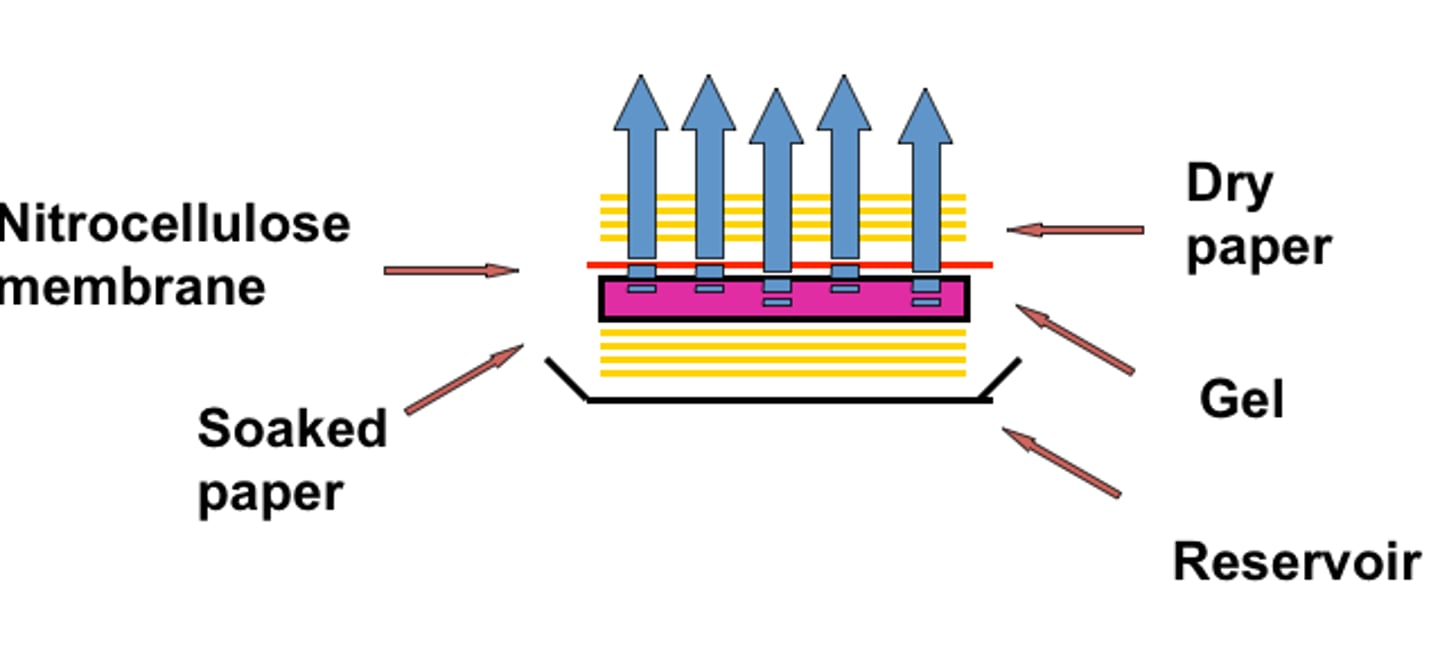
capillary transfer
a method for transferring nucleic acid fragments from a gel to a membrane. uses a buffer pool with paper soaked in buffer, gel on top of paper and membrane on top of gel then a stack of dry paper. The transfer will occur through capillary action from wet to dry. This process is cheap and does not take a lot of equipment but takes time and isn't as accurate due to problems like bubbles or salt crystals
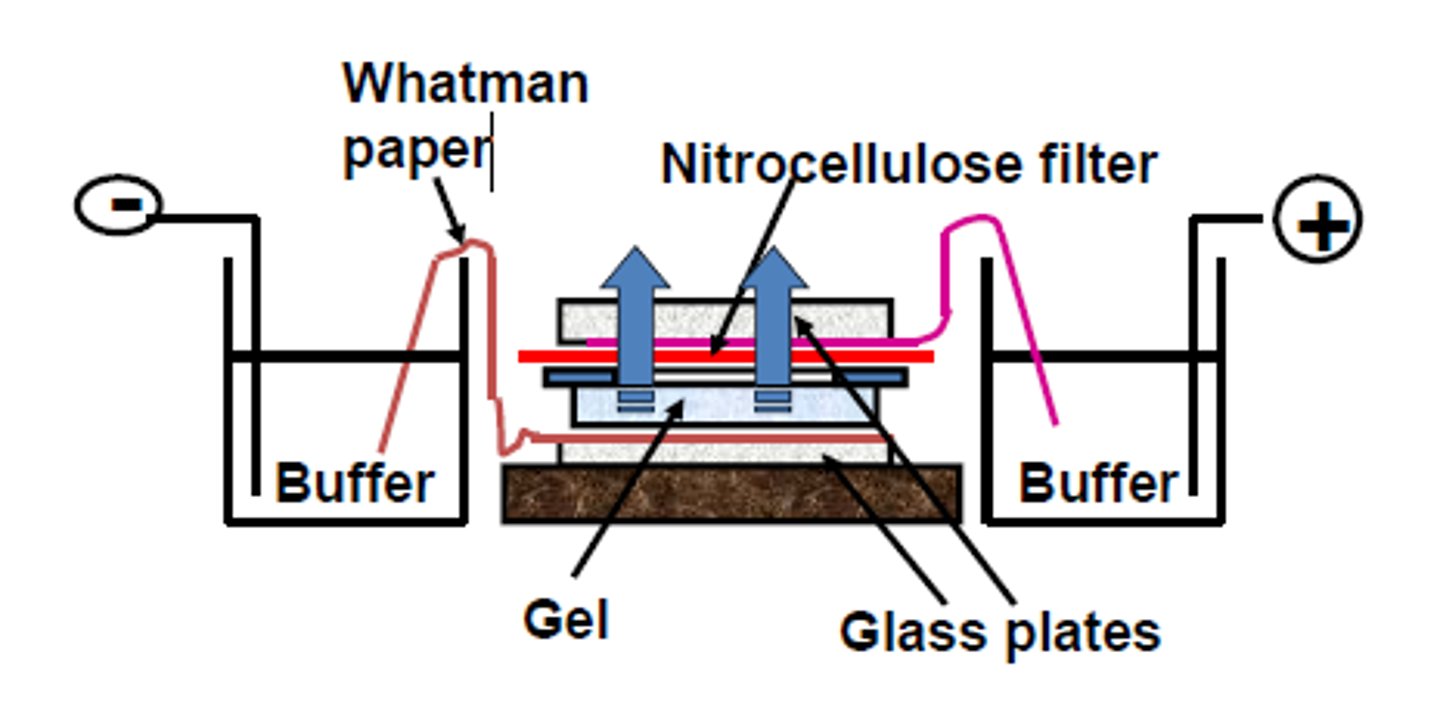
electrophoretic transfer
uses electric current to move DNA from gel (cathode) to membrane (anode) in a tank of buffer, requires specialized equipment
vacuum transfer
uses suction to transfer DNA from gel to membrane in a recirculating buffer, typically faster but requires specialized equipment
Once transfer from gel to membrane occurs during southern blot analysis, how is DNA permanently immobilized?
baking or UV cross-linking
What is the point of prehybridization during souther blot analysis?
to prevent nonspecific binding of probe
What are examples of prehybridization buffers?
ficoll, polyvinyl pyrrolidine, bovine serum albumin, salmon sperm dna, SDS, formamide
Northern Blot
Similar technique [to Southern], except that Northern blotting involves DNA probe binding to sample RNA . RNA is already denatured prior to running on a gel so no need to denature again. Purpose is to analyze gene expression and mRNA structural abnormalities
Why must denaturant be removed from the membrane prior to probe hybridization?
prevents nucleic acid and probe from forming H-bonds
Western blots
-used to detect a particular protein in a mixture of proteins
-antibodies are commonly used
-A primary antibody specific to the protein of interest is placed on a membrane.
-Primary antibody binds to protein of interest
-A secondary antibody-enxyme is added to bind to the primary antibody and marks it with an enzyme that can be visualized because the reaction cataylzed by enzyme produces a colored product.
probe
single stranded fragment of nucleic acid attached to a signal
What is the purpose of a probe in blotting analysis?
to identify one or more large sequences of DNA within the fragment. Needs to be able to hybridize specifically. Can be protein, DNA, RNA
Peptide Nucleic Acid (PNA)
modified nucleic acid with backbones other than phosphodiester backbones
Which blot technique acts as a confirmation for ELISA?
Western blot, once blotted the patient's serum is overlaid on the membrane and antibodies bind to the viral proteins. They are then marked with a second anti-human antibody to visualize
How are DNA probes made?
-cloning-->restriction enzyme-->gel
-isolation of sequence from viral genome
-in vitro organic synthesis of nucleic acid
-PCR
What determines the specificity of DNA probes?
length of sequence, longer the sequence of the probe the more specific
Do RNA/DN or DNA/DNA probes bind more strongly?
RNA/DNA
What is the probe for Western blots?
antibodies
Haptens
incomplete antigens, can be used to generate an immune response
polyclonal antibodies
a series of antibodies are produced responding to a variety of different sites on the antigen
monoclonal antibodies
Antibodies produced by a single clone of B lymphocytes and that are therefore identical in structure and antigen specificity.
hybridomas
Hybrid cell lines that make monoclonal antibodies of defined specificity. They are formed by fusing a specific antibody-producing B lymphocyte with a myeloma cell that grows in tissue culture and does not make any immunoglobulin chains of its own.
Labs used to use radioactive labels for probes but this has been replaced with nonradioactive tags. What are two nonradioactive tags used commonly now?
biotin and digoxigenin
what are three methods used for adding a tag to a probe?
1. end labeling- labeled nucleotides are added to the end of the probe using terminal transferase
2. nick translation-nucleotides are incorporated into single-strand breaks
3. random priming-synthesis of new probe with short labeled oligomers
Specificty
can be considered as the percentage of times a test will correctly identify a negative result. The fraction of those without disease who will have a negative test result.
stringency
how well the probe and target bind. High stringency typically involve high temperature and low salt and is dependent on specific target and probe binding. Low stringency conditions are low temperature and high salt and may have less specific probe-target binding
How are the ideal conditions for probe hybridization calculated?
melting temperatrure
Tm
amount of energy required to separate hybridized strands, at Tm half of the strands are denatured and half are double-stranded
How does GC content affect probe stringency? How about Tm?
more stringent with higher GC content, increases Tm
Tm for long probes equation
=81.5 C + 16.6 log M + 0.41 (%G+C)-0.61 (%formamide_-(600/n)
Tm for short probes
= 4 degrees CGC pairs + 2 degrees CAT pairs
Ct value
sequence complexity, the length of unique, non-repetitive nucleotide sequences in the genome
Ct value equation
= C_0*t
C_0=initial concentration
t=time to reanneal
What is the effect of hybridization buffer on hybridization optimal temperature?
lowers optimal hybridization temperature
What signals are produced signifying probe detection?
chromogenic (color), chemiluminesence (light)
Which two enzymes are used for probe signaling detection?
alkaline phosphotase, horse radish phosphotase
Nitroblue tetrazolium (NBT) and 5-bromo-4-chloro-3-indolyl phosphate are added to probe mixture to produce a signal of successful probe binding to target. What is this signal? What reactions take place?
blue color, dephosphorylation and oxidation reduction
cross-hybridization bands are a result of? How do you reduce cross-hybridization bands?
non-specific binding of probe, increase stringency
1,2-dioxetane undergoes what type of reaction with alkaline phosphotase? What signal is produced?
dephosphorylation, light
Why is an internal control important for interpretation of results of blot analysis?
the amount of expression is determined relative to the internal control. Helps to correct for errors in isolation, gel loading, and transfer of sample
What types of analysis can dot blots and slot blots be applied to?
gene expression, mutation, amplification, deletion
reverse dot blot
the probes are immobilized on the membrane instead of the target and the target is labeled with a marker for hybridization
macroarrays
are reverse dot blots. best used with samples that have a lot of material, limits specimen that can be used. This assay greatly increases the numerous targets
Microarray
Silicon or glass sheet with thousands of DNA probes that can be used to identify which genes in a tissue are expressed, 80,000 spots available on the glass
How many genes in a human genome?
30,000 genes
Put in order of complexity proteome, genome, transcriptome
proteome is the most complex and genome the least
high density oligonucleotide arrays
a large number of probes (more than 100,000) synthesized in place on the substrate, oligomers are synthesized directly on the glass through photolithographic target sequence
High density oligonucleotide array can be used to identify ______ mutations?
Unknown
Known
Both unknown and known
Only framshift
Expression arrays
Reverse Transcribe mRNA to cDNA
Label with fluorescent dyes
Hybridize to special exon arrays
Compare relative signal to derive relative mRNA quantity
measure gene expression
comparative genomic hybridization
A molecular-cytogenetic method used to determine copy number changes (gains/losses) in the DNA content of a cell (e.g. tumor cells). It is a competitive assay where sample and control DNA labeled with two different fluorophores compete for binding sites on complementary DNA affixed to a micro array. The relative signals of the two fluorophores is compared on a computer. Designed to test DNA. Entire genomes
Solution Hybridization
probe and target bind in solution rather than on a membrane. Can be visualized on a gel. Used to measure mRNA expression
gel mobility shift assay
detects specific peptides by changes in electrophoretic migration speed upon binding to specific antibodies; ie, identifying trans factors that bind to cis acting elements
Name two ways to permanently bind nucleic acid to nitrocellulose following transfer.
baking at 80 degrees Celsius for 30 min and exposure to UV light for cross-linking
If a probe for Southern blot was dissolved in a hybridization buffer that contains 50% formamide, is the stringency of hybridization higher or lower than if there were no formamide?
The stringency is higher because form amide facilitates denaturation of double-stranded DNA
If a high concentration of NaCl were added to a hybridization solution, how would the stringency be affected?
stringency would be lowered as the salt promotes h-bonding of nucleic acid by forcing nucleic acids closer together