Chemistry Quiz #2
 Call Kai
 Learn
Learn Practice Test
 Spaced Repetition
 Match
Match Flashcards
 Knowt Play
1/42

There's no tags or description
Looks like no tags are added yet.
Name | Mastery | Learn | Test | Matching | Spaced | Call with Kai | Chat |
|---|
No analytics yet
Send a link to your students to track their progress
43 Terms
What is an element?
a substance that cannot be broken down into simpler chemical substances
How many elements are there?
90 naturally occurring on Earth
30 synthetically created
How do you identify an element?
Name
Symbol
Atomic Number
Mass Number
What are some the more abundant elements common to the universe, earth and humans?
Hydrogen
Helium
Oxygen
Carbon
Neon
Iron
Calcium
Nitrogen
Silicon
Aluminum
What are some uniquely abundant elements in humans compared to earth and the universe?
Oxygen
carbon
Hydrogen
Calcium
Iron
Aluminum
Dalton’s Postulates
Atoms are indivisible.
Identical for each element
Combined in whole-number ratios
What is an atom?
Smallest part of an element (matter) that retains its identity
What are the subatomic particles?
Proton
Neutron
Electron
Proton
Charge: positive (+)
Mass: 1.67 × 10⁻²⁴
Location: Nucleus
Neutron
Charge: 0
Mass: 1.67 × 10⁻²⁴
Location: Nucleus
Electron
Charge: negative (-)
Mass: 9.11 × 10⁻²⁸
Location: Electron Cloud
How do you find the # of electrons?
= to the # of protons
Number of protons - charge
How do you find the atomic number?
It is equal to the number of protons
How do you find the mass number?
Protons + Neutrons
How do you find out the charge?
Protons - Electrons
What does the following indicate: 2H
Two H atoms
What does the following indicate: H2
One H2 Molecule
How do you find the # of neutrons?
Atomic # - Mass #
What is an isotope?
Atoms with the same # of protons, but different # of neutrons
What is atomic mass and its unit?
Weighted average of isotopes
Unit = amu
Electron Arrangement
Quantum Mechanics: Electrons have quantized energies.
Shells: Labeled by n (1, 2, 3...).
Subshells: s, p, d, f → hold 2, 6, 10, 14 e- respectively.
Electron Configuration: Shows distribution (ex: O: 1s² 2s² 2p⁴).
Valence Electrons = outermost, responsible for bonding
How is the periodic table classified?
Metals: shiny, conductors, malleable.
Nonmetals: dull, brittle, poor conductors.
Metalloids: intermediate properties.
How is the periodic table organized?
Organized by atomic number & electron configuration.
Groups = columns (same valence e- → similar chemistry) 18 groups, up & down
Periods = rows, 7 periods, # of electron shells, left to right
What are the atomic radius trends?
Increases ↓ a group (more shells).
Decreases → across a period (greater nuclear pull).
What is an ionic bond?
Electron transfer (metal + nonmetal)
What is a covalent bond?
Electron sharing (nonmetal + nonmetal)
What is the octet rule?
Atoms stable with 8 valence e- (duet rule for H, He, Li).
What is a cation?
Loses e-, positive (metals, left side of table)
What is an anion?
Gains e-, negative (nonmetals, right side
What is an isoelectronic?
Two ions of the same element with the same electron configuration (ex: Na⁺ and Ne) (same # of electrons)
How do you solve for the average atomic mass?
(# amu × %) + (# amu × %) + (# amu × %)
_________________________________ = amu
100
Atoms on the ______ of the periodic table tend to lose electrons. (<4 v.e.)
Left
Atoms on the _______ of the periodic table tend to gain electrons. (>3 v.e.)
Right
Lewis Diagrams
Show only valence electrons as dots.
Pairing begins after each side has 1 electron.
Arrows represent e⁻ transfer.
Charge Balance
Compounds must be neutral overall.
Example: Mg²⁺ + 2 Br⁻ → MgBr₂
Conventions Formula
Cation first.
Lowest whole-number ratios.
Subscripts used as needed.
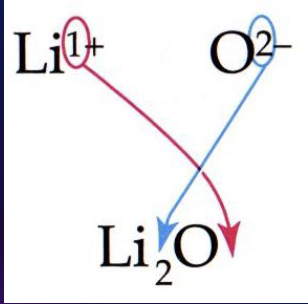
Cross-Charges Method Formula
Swap charges to subscripts (Na⁺, O²⁻ → Na₂O)
What are polyatomic ions?
Covalently bonded atoms acting as one charged unit (ex: SO₄²⁻, NH₄⁺)
Ion Naming Rules (CATION)
Fixed charge: just name (Na⁺ = sodium ion).
Variable charge: Roman numeral (Fe³⁺ = iron (III) ion).
Common system: -ic (higher), -ous (lower) (Fe³⁺ = ferric)
Ion Naming Rules (ANIONS)
Add “-ide” (Cl⁻ = chloride, O²⁻ = oxide
Ion Naming (IONIC COMPOUNDS)
Cation name + anion name (NaCl = sodium chloride)
What is an ion?
An atom with a net electric charge
How do ions form?
When electrons are given to or take from an atom