Behavioral and Neuroscience Methods in Cognitive Psychology
 Call Kai
 Learn
Learn Practice Test
 Spaced Repetition
 Match
Match Flashcards
 Knowt Play
1/49

There's no tags or description
Looks like no tags are added yet.
Name | Mastery | Learn | Test | Matching | Spaced | Call with Kai | Chat |
|---|
No analytics yet
Send a link to your students to track their progress
50 Terms
What are behavioral methods in cognitive psychology?
Behavioral methods refer to the performance on cognitive tasks, often measured through accuracy and reaction time.
What is accuracy in the context of cognitive tasks?
Accuracy refers to the ability to make correct responses on a task, such as in a recognition task.
What is a recognition task?
A recognition task involves participants responding 'old' or 'new' to items presented in a study list compared to a test list.

What are the four types of responses in a recognition task?
Hit, Miss, False Alarm, Correct Rejection.

What is a hit in a recognition task?
A hit occurs when a participant correctly identifies an old item as 'old.'
What is a false alarm in a recognition task?
A false alarm occurs when a participant incorrectly identifies a new item as 'old.' Needs balance with false rate.
Correct Rejection
If a participant correctly responds "new" to a new stimulus
Measure of discrimination
The ability to discriminate old from new stimuli
What does the term 'd'' (dee-prime) refer to?
d' is a standardized measure using the z distribution to assess recognition performance, calculated as d' = z(HIT) - z(FA).
What is reaction time (RT)?
Reaction time is the time it takes a participant to respond to a stimulus, usually measured in milliseconds.
What is the Flanker Task used for?
The Flanker Task is used to study attention and response inhibition by measuring reaction times to congruent and incongruent stimuli. Contains many tasks

What is the flanker task relevant for?
Studying attention, attention disorders
EEG: Error-related negativity
What is the speed-accuracy tradeoff?
The speed-accuracy tradeoff refers to the relationship where slower responses tend to be more accurate, while faster responses may decrease accuracy.
What are floor and ceiling effects?
Floor effects occur when a task is too difficult, leading to low performance, while ceiling effects occur when a task is too easy, resulting in high performance.
What is the importance of stimulus presentation in cognitive tasks?
Stimulus presentation is crucial for ensuring consistent and controlled conditions, which aids in accurate data collection.
Why is it important to have a sufficient number of stimuli in a study?
Having more stimuli increases the signal-to-noise ratio and helps achieve a more accurate representation of cognitive performance.
What factors can affect participant performance in cognitive tasks?
Factors include sleepiness, health, time of day, stress levels, and caffeine consumption.
What is the role of laboratory control in cognitive psychology studies?
Laboratory control ensures that all participants experience the same conditions, such as visual angle and stimulus presentation, to minimize variability.
What is the significance of using computers in behavioral methods?
Computers provide consistent stimulus presentation and precise data collection, enhancing the reliability of cognitive task measurements.
What is the maximum recommended time length for a study session?
30 minutes is generally the maximum time recommended to keep participants engaged and minimize fatigue.
What is the purpose of using a chin rest in experiments?
A chin rest ensures that all participants maintain the same position relative to the stimuli, controlling for visual angle.
Other Environmental and Participant Controls
Lighting, soundproofing, electrical shielding (for EEG), stationary chairs, normal or corrected vision, handedness (hand used to make responses), ability to respond without looking
What is the significance of the study by Schaeffer & Chek (2022)?
The study explores the relationship between recollection, familiarity, and behavioral pattern separation in memory.
What does fMRI stand for?
Functional Magnetic Resonance Imaging

What is the primary purpose of fMRI?
To measure blood oxygenation in the brain. Oxygenated hemoglobin vs. deoxygenated hemoglobin: respond differently to the magnet
High Spatial Resolution
When overlaid onto an MRI image, Cubic cm to mm.
What is the BOLD signal in fMRI?
Blood-oxygen-level dependent signal that reflects changes in blood oxygenation. Oxygenated and deoxygenated hemogloblin behave differently

How does fMRI respond to brain activity? (Hemodynamic Response)
When a brain area is active, it uses oxygen, leading to blood vessel dilation and increased blood flow. Peaks around 5-6 seconds after brain activity begins.

What is PET and what does it measure?
Positron Emission Tomography; it measures blood flow, oxygen consumption, glucose metabolism, and neurotransmitters.

Radioactive Tracer
Injected into the blood, greater in areas with high blood flow, as the tracer decays, it emits gamma waves that are measured by the machine. Fluorodeoxyglucose is a common tracer that is used in PET imaging
What is a key difference between PET and fMRI?
PET requires injection of radioactive tracers, while fMRI does not. But PET can measure things that fMRI cannot and FMRI is more common.
What does fNIRS stand for?
Functional Near Infrared Spectroscopy

How does fNIRS work?
It emits near infrared light and detects the amount reflected back, which varies based on blood oxygenation as blood absorbs light. Does not provide an image of the brain.

What is EEG?
Electroencephalography: Electrodes are placed on the scalp; electrical changes from neural activity are measured; these can be distorted by muscle activity. Measures oscillatory activity, which is the wavy pattern that depicts brain activity.

What is the main advantage of EEG?
It has high temporal resolution, allowing detection of millisecond changes in neural activity.
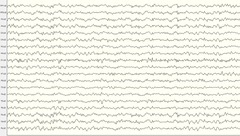
Frequency Bands
Delta: 0-4 Hz (slow-wave sleep) ,Theta: 4-8 Hz (certain types of memory), Alpha: 8-12 Hz (present when relaxed and eyes are closed), Beta: 12-20 Hz (certain types of memory and neural plasticity), Gamma: > 30 Hz (certain types of memory and neural plasticity),.
Event-related potential (ERP)
EEG potentials that are time-locked to a particular event (e.g., the presentation of a picture on a screen).

What does MEG measure?
Magnetic fields generated by neural activity.

MEG vs. EEG
MEG is similar but more precise and expensive and has better resolution than EEG; MEG has better spatial and temporal resolution. Each works best for detecting cortical changes. Neither can accurately detect activity of areas deeper in the brain
What are the strengths of EEG compared to fMRI?
EEG is temporally precise but spatially limited; fMRI is spatially precise but temporally limited.
Electrocardiography (ECG or EKG)
Measures electrical activity of the heart. All muscles have electrical activity and can be measured similarly. Measures heart rate, heart rate variability, and oscillatory change in heart rate across time
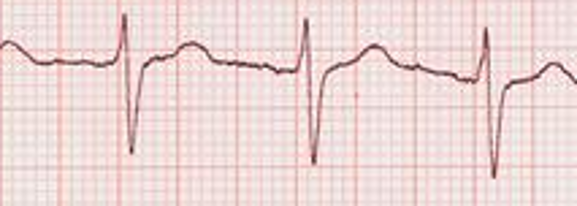
Heart Rate Variability
Oscillatory change in heart rate across time. Reflects balance between sympathetic and parasympathetic nervous systems. Greater variability = greater parasympathetic activity = better health (typically)
What is the purpose of Transcranial Magnetic Stimulation (TMS)?
To temporarily disrupt neural communication or induce lasting effects on neuronal excitability using a magnetic coil. Can also be used for a sustained time (~20 minutes) to induce lasting effects. To either slightly increase or decrease neuronal excitability for a brief time (~1 hour)
What does Transcranial Direct Current Stimulation (tDCS) involve?
Placing electrodes on the scalp to pass a current that can alter neuronal excitability. Sustained stimulation (~20 minutes) can have slight lasting changes in brain activity. Increase or decrease neuronal excitability (~1 hour)
What does Electrodermal Activity (EDA) measure?
Non-specific arousal related to sympathetic activity, such as stress or excitement. Skin Conductance Response, Galvanic Skin Response.
What is heart rate variability and what does it reflect?
Oscillatory changes in heart rate that reflect the balance between sympathetic and parasympathetic nervous systems.
What is the main use of a polygraph?
To detect physiological arousal, often used in lie detection (skin conductance, heart rate, breathing rate, blood pressure).
What is a limitation of polygraph testing?
It detects arousal, not deception, which can lead to inaccuracies.
What factors influence the choice of neuroscience methods?
Research questions, location, timing, metabolism, resources, time, and money.
What is the role of neuromodulation in cognitive enhancement?
Techniques like TMS and tDCS can enhance cognitive functions such as threat detection.