AAMC FL 3 and 4 Missed Topics C/P and B/B
 Call Kai
 Learn
Learn Practice Test
 Spaced Repetition
 Match
Match Flashcards
 Knowt Play
1/68

There's no tags or description
Looks like no tags are added yet.
Name | Mastery | Learn | Test | Matching | Spaced | Call with Kai | Chat |
|---|
No analytics yet
Send a link to your students to track their progress
69 Terms
You place it on the non-exchangeable position. C-H bonds are generally more non polar and more stable, so this is here you would to put the tritium labeling. N-H and O-H bonds are highly polar, so the protons exchange rapidly with water, you would not want to put the label here.
How do you keep the label on the guanine molecule so you can actually track it?
An atom must be a lewis base (donates lone pair) to be a coordinate with another molecule of calcium. Oxygen would be involved in coordination to calcium.
What type of atom is involved in coordination with calcium?
A cation-exchange column binds to positively charges proteins, which only occurs when the pH is less than the pI or pKa.
If talking about a pH buffer when it comes to separating molecules based on their ion affinity in a cation-exchange column, what are you looking for in the buffer?
The buffer capacity is ± 1 of its # and will be a buffer to those other molecules.
If they ask about a buffer capacity, what are you looking for?
Frequency of a wave is a characteristic of the wave source, not of the medium surrounding the source. Therefore, frequency is not changed by the medium through which the wave propagates.
What properties of an ultrasound wave remain unchanged as it passes through human tissues?
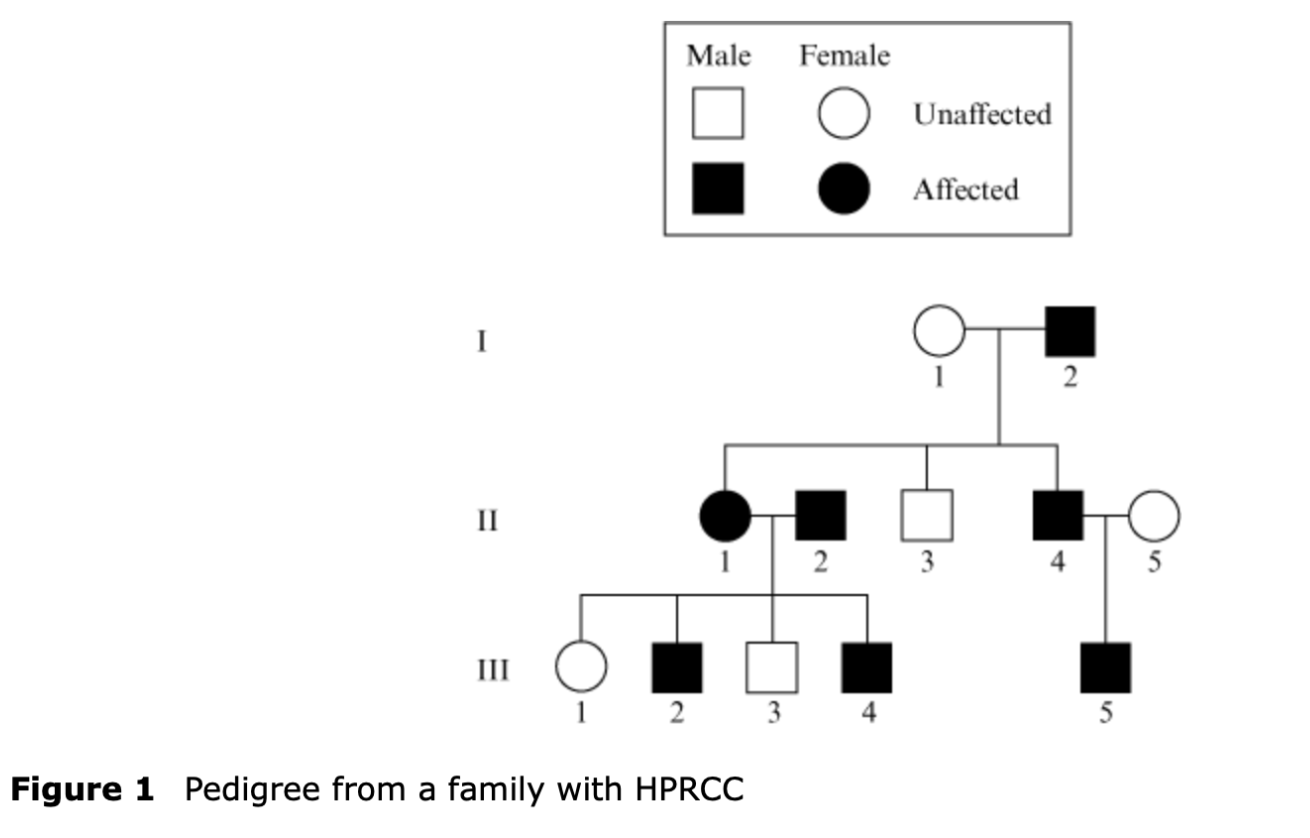
The mechanism of inheritance is Autosomal dominant. We know it is not x-linked because the father at II 4 passing it to his son. A father passing Y to son and X to daughter. Because we see father-to-son transmission (II-4 passing the trait to III-5), the disease gene cannot be located on the X chromosome. It must be autosomal. We know its dominant because 2 affected parents (II 1 and II 2) have unaffected children.
What type of mechanism of inheritance is this graph and why?
undergoing growth arrest
What do cells do that are undergoing apoptosis?
Cancer cells have uncontrolled growth (opposite of apoptosis). To become a cancerous cell, a cell must evade apoptosis.
What type of growth is cancer cells?
Operon
A group of genes under the control of ONE promoter, ONE polycistronic mRNA, and MULTIPLE separate proteins.
Histone Deacetylases
Remove acetyl groups from histone
Removing the acetyl group restore the positive charge, allowing the DNA to condense and inhibit transcription.
The tightly condensed DNA is called heterochromatin.
Histone Acetyltransferase
Add acetyl group to the positive lysine residues on histone
The acetyl group neutralizes the positive charge on the lysine
The histones lose their tight electrostatic grip on the negative DNA. The chromatin loosens into an open structure called euchromatin. This allows transcription to occur.
Palindromic sequence
A nucleotide sequence that is identical when read in either direction, often found in restriction enzyme recognition sites.
Imprinted Gene vs Y-Linked Gene
Imprinted Gene: a trait that can show up in both females and male, but it is only expressed if it is inherited from a specific parent (strictly from dad or strictly from mom)
Y-lined Gene: a trait that shows up only in males, and is passed down strictly from father to son
From N-terminous to C-Terminous
What direction are proteins synthesize?
code for or carry a transcriptase that copies viral RNA. (reverse transcriptase)
What is a way RNA viruses replicate themselves?
Glomerulus
What part of the nephron filters lots of proteins?
a big increase in temperature!! (20C-37C)
What increases the rate of enzymatic reactions?
Epithelial
What tissue type in the lungs secrets mucous that inhibit microbial infections?
Reuptake
is the process by which neurotransmitters are reabsorbed by the presynaptic neuron after transmitting a nerve impulse, thus terminating the signal and recycling the neurotransmitters for future use.
a large surface area in order to increase nutrient absorption
What does the small intestine rely on for absorption?
Increase fluid in body tissues because there will be more liquid leaving the blood to compensate for the higher levels of solute in the tissue.
What do decreased blood osmotic pressure do to fluid in body tissues?
Ligase
join, use ATP (ex: DNA ligase)
Isomerase
rearrangement, enzyme that catalyzes the conversion of a molecule into one of its isomers, facilitating structural changes.
Lyase
cleave with out H2O
Hydrolase
cleavage with H2O
Oxidoreductase
redox, transfer electrons
Transferase
transfer of a functional group, includes kinases
They are hydrolases
What type of enzyme are protease?
They oxidize compounds and the compounds will lose electrons.
What are the function of cytochrome P450 enzymes?
they contain a DNA binding domain
What is a defining characteristics of proteins that act as transcription factors?
the mitochondria
Where does fatty acid oxidation occur?
decreases as a result of a decrease in plasma pH
As blood passes through actively contracting skeletal muscle tissue, the affinity of hemoglobin for oxygen in the muscle tissue does what?
nucleotides
What is mRNA made of?
50 S
Erythromycin interferes with protein synthesis by binding to what ribosomal structural unit?
50S / 30S — all together 70S
Prokaryotes small and large subunit
60S / 40S — all together 80S
Eukaryotes small and large subunit
The ribosome has three main sites for tRNA attachment, which are the A (aminoacyl), P (peptidyl), and E (exit) sites.
What are the three main sites for tRNA attachment?
mRNA levels of a specific protein
What does RT-PCR measure?
The mass and charge of a protein. Smaller molecules move farther.
What does a Native Page measure? What moves farther?
Separates the proteins based on the mass.
What does gel filtration, size exclusion chromatography measure?
The addition of a reducing agent will denature the protein further and it can travel even farther.
What does reducing SDS measure?
separates proteins based on their charge
What does ion exchange chromatography measure?
separates proteins based on pI, where the protein is neutral
What does isoelectric focusing measure?
6 because 3! (3 factorial which means 3×2×1=6)
A peptide consisting of nine amino acids was partially hydrolyzed. Three separate amino acids were isolated. None of the tri-peptides share a common amino acid. Based on the data, what is the total number of possible structures possible for the full-length peptide.
To turn dilute filtrate into a highly concentrated urine, ADH will pull water out of the collecting ducts and put back in the blood stream. There will be a high osmolarity of urine.
What is a way the kidneys conserve water?
Lactate concentration in plasma. This is because during exercise, muscles produce lactate that goes into circulation. The presence of lactate will increase the osmolarity of venous blood.
During exercise, the osmolarity of venous blood from active muscles will increase as a result of an increase in what?
Rough ER —> Golgi complex —> secretory transport vesicle
What pathway depicts the sequence of cellular compartments traversed by newly synthesized GABA—receptor subunits as they move to the cell surface?
Hydrophobic!!
Are transmembrane domains usually hydrophobic or hydrophilic?
Epimer
A type of carbohydrate that differs from another carbohydrate in the configuration of only one specific carbon atom.
Enantiomer
A type of stereoisomer that is a mirror image of another molecule, differing in configuration at all chiral centers.
big change in temperature, substrate concentration, enzyme concentration, and the presence of inhibitors
What affects the rate of an enzymatic chemical reaction?
Smallest change in energy and smallest frequency
The longest wavelength will have what amount of energy?
lactone
cyclic ester
nucleophile
A species that donates an electron pair to form a chemical bond in a reaction. (lewis base)
They like to attack positive charges to form covalent bonds
electrophile
A species that accepts an electron pair to form a chemical bond in a reaction (Lewis acid).
Shortest alkyl chain
Will a longer or shorter fatty acid be most soluble in water?
-B decay
atomic number increases by 1
atomic weight stays the same
+Beta decay
atomic number decreases by 1
atomic weight stays the same
topoisomerase
An enzyme that alters the supercoiling of double-stranded DNA during replication and transcription.
helicase
Enzyme that unwinds DNA strands during replication.
primase
An enzyme that synthesizes short RNA primers needed for DNA replication.
ligase
An enzyme that connects Okazaki fragments on the lagging strand and seals nicks in the DNA backbone during replication.
mesoderm
One of the three primary germ layers in embryonic development, it gives rise to muscles, bones, and the circulatory system.
Dermis
Adrenal Cortex
Notochord
Skeletal Bones
Circulatory system
Muscles
Excretory system
Reproductive system
Cavity living
ectoderm
The outermost layer of the three primary germ layers in embryonic development, it gives rise to the skin, hair, nails, and the nervous system.
corneas/lens
anus/mouth epithelial
pineal and pituitary gland epithelial
sensory receptors in epidermis
tooth enamel
adrenal medulla
nervous system
skin epidermis (sweat glands, hair folicles)
endoderm
The innermost layer of the three primary germ layers in embryonic development, it gives rise to the lining of the digestive and respiratory systems.
Digestive tract epithelial lining
respiratory tract epithelial
urethra / urinary bladder
reproductive system
liver
thymus
thyroid and parathyroid
Epithelial tissue
A type of tissue that forms protective layers covering organs and structures throughout the body. It is involved in absorption, secretion, and sensation.
connective tissue
A type of tissue that provides support, binds other tissues together, and facilitates the transport of substances throughout the body. It includes bone, blood, adipose, and cartilage.
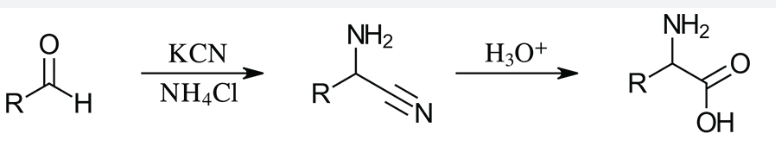
Strecker synthesis
Turn an aldehyde into an aminonitrile (a carbon with both an amine group and a nitrile group).
Turn that nitrile into a carboxylic acid.
A method for synthesizing amino acids from aldehydes using ammonia and potassium cyanide.
1. Imine formation (The aldehyde reacts with ammonia to form an imine (a carbon double-bonded to nitrogen) releasing a water molecule.)
2. Nucleophilic attack (The cyanide ion ($\text{CN}^-$) acts as a nucleophile and attacks the electrophilic imine carbon. This forms an aminonitrile intermediate.)
3. Hydrolysis (strong acid and heat added)
Produces racemic mixture!
Gabriel synthesis
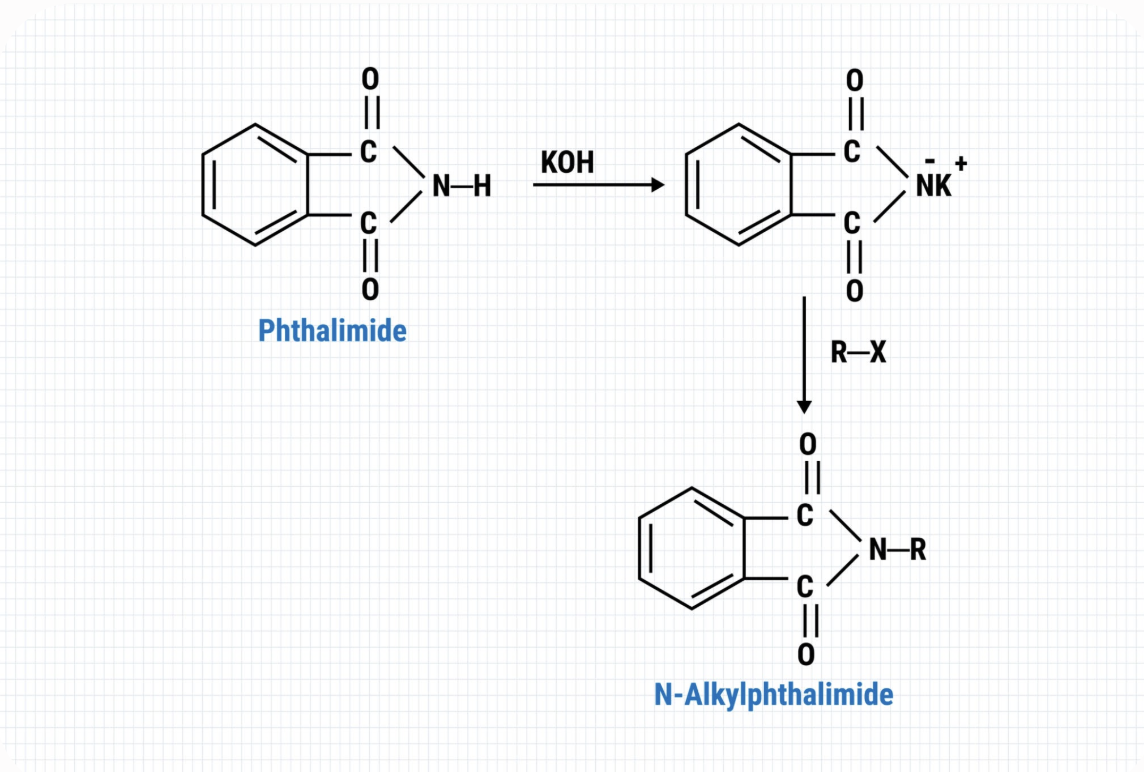
A method for synthesizing primary amines from phthalimide. This involves the formation of an N-alkylphthalimide followed by hydrolysis to yield a primary amine.
tarting Materials: Potassium phthalimide (the protected "nitrogen shield") and diethyl bromomalonate
1. (SN2 Attack): The nucleophilic phthalimide nitrogen attacks the diethyl bromomalonate, kicking off the bromine leaving group.
2. Alkylating the alpha carbon: A base is added to alkylate the alpha carbon. This carbon then attacks an alkyl halide, attaching the specific R-group
3. Acid hydrolysis: Strong acid and heat is added. This breaks the phthalimide shield off completely (releasing it as phthalic acid) and converts the ester groups of the malonic ester into carboxylic acids.
4. Decarboxylation: The heat causes one of the two carboxylic acid groups on the alpha-carbon to leave as carbon dioxide, leaving you with a single carboxylic acid group and a completed alpha-amino acid.