Powder Metallurgy
 Call Kai
 Learn
Learn Practice Test
 Spaced Repetition
 Match
Match Flashcards
 Knowt Play
1/24

There's no tags or description
Looks like no tags are added yet.
Name | Mastery | Learn | Test | Matching | Spaced | Call with Kai | Chat |
|---|
No analytics yet
Send a link to your students to track their progress
25 Terms
What is powder metallurgy?
Parts produced with metallic dust through pressing and sintering (net or near net shape process)
What is blending?
Combining particles of the same element but different sizes together
What is mixing?
Combing particles of different elements together
What is pressing?
Powders are compressed into a desired shape to produce a green compact
What is a green compact?
The basic shape of a part that is incredibly weak and brittle before it is sintered
What is sintering?
Heating green compacts at temperatures below the melting temperature to bond the particles into a hard rigid mass
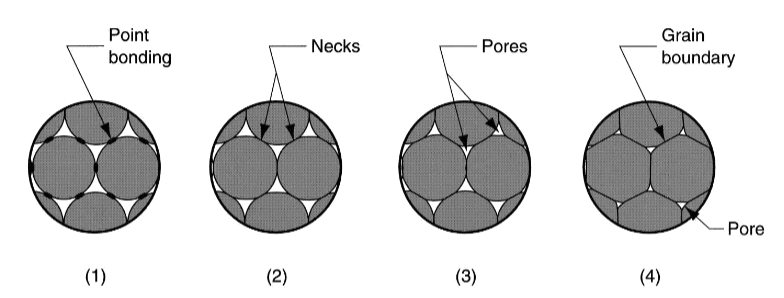
What are some limitations of powder metallurgy?
High tooling and equipment costs, powders are incredibly expensive, complex storage and handling requires/procedures, limited in part gemoetry as metal powders do not flow laterally during pressing, variations in density present especially in complex geometries
What is a mesh count?
Number of openings per linear inch of screen
200 = 200 openings per linear inch
Higher mesh count = smaller particle size
What effects does friction have in powder metallurgy?
Friction between particles affects the ability for it to flow & pack tightly.
What is the angle of repose?
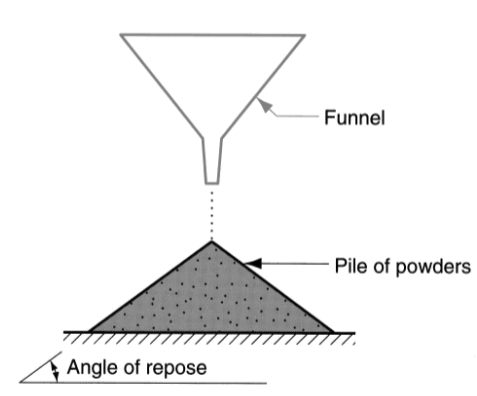
Angle formed by a pile of powders as they are poured from a narrow funnel
Higher angle of repose = finer particle sizes
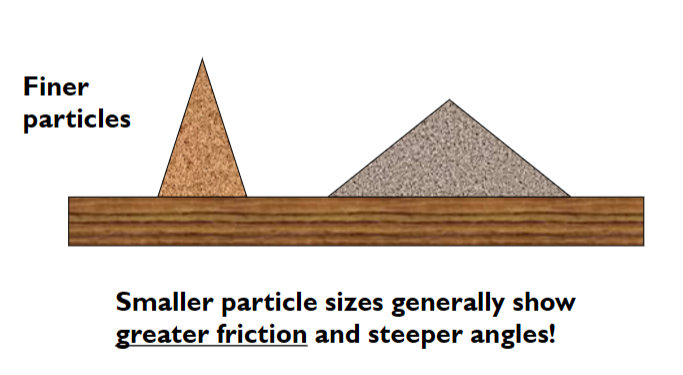
If you had spherical grains with small and large sizes, which one has more friction?
The smaller grains because there is a larger surface area in contact, creating more friction, resulting in a larger angle of repose.
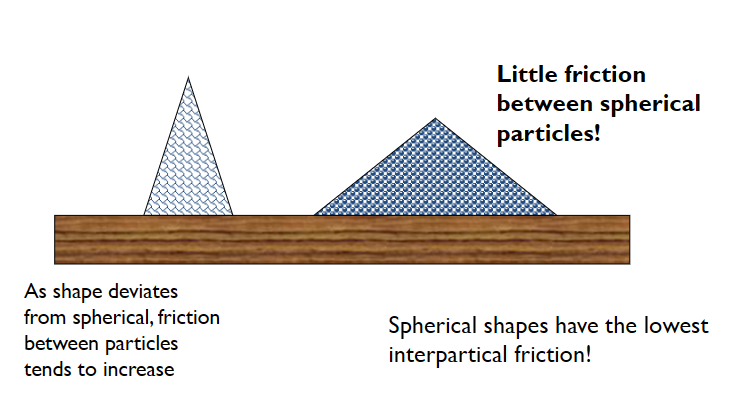
Which one has more friction, spherical, or irregular shaped grains?
Irregular shaped grains result in interlocking between grains, resulting in more friction. Spherical grains have the lowest interparticle friction.
What is the difference between bulk and true density?
Bulk Density - density of powders in the loose state after pouring
True Density - density of true volume of material if it were melted into a solid mass
Is the bulk density or true density smaller?
Bulk density is smaller as it includes the pores and gaps whereas true density is completely solid
What is packing factor?
Packing Factor = Bulk Density / True Density
A higher packing factor means fewer gaps
Packing can be increased by vibrating or applying pressure during compaction to pack particles closer together
What is porosity?
Ratio of volume of pores (holes) in the powder to the bulk volume
In principle: Porosity + Packing Factor = 1
What are the two types of metallic powders?
Elemental - Pure metal
Pre-Alloyed - Each particle is an alloy
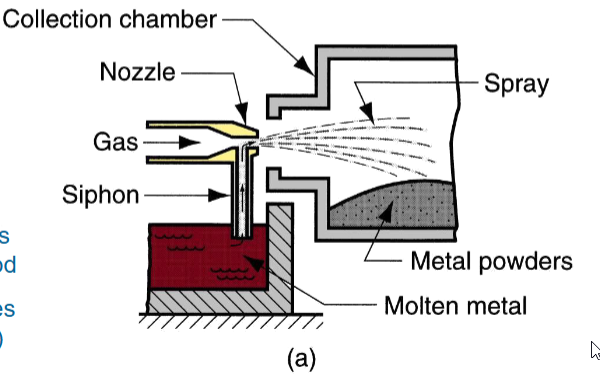
What is gas atomization?
Molten metal flows through a nozzle into an atomization chamber where high-pressure gas jets violently strike the liquid stream, shearing it into a fine mist of micro-droplets that cool rapidly while falling through the chamber and solidify into spherical, pre-alloyed particles.
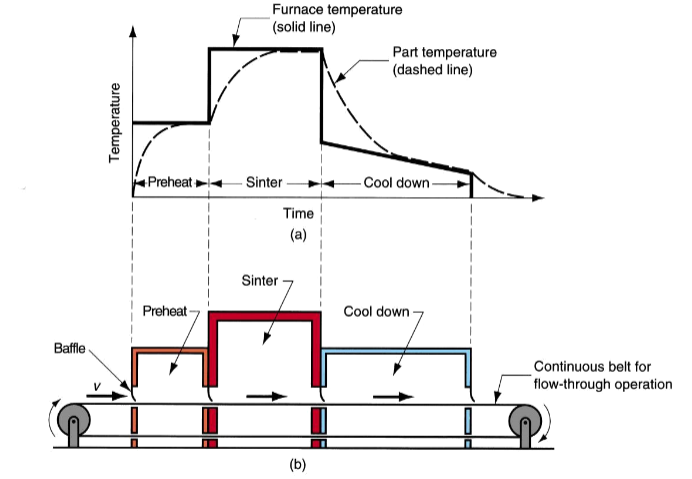
Why is it important to use a heat treatment cycle when sintering instead of blasting the part at high temperature once?
By heating the green compact in a sequence, it avoids shocking the part and causing it to crack or create unwanted qualities.
What is repressing?
Pressing sintered part in a closed die to increase density & improve mechanical properties
What is sizing?
Pressing a sintered part to improve dimensional accuracy
What is coining?
Pressworking on a sintered part to press details into its surface
What is machining?
Creating features that cannot be done through pressing like threads and side holes (powder doesn’t move laterally)
What is impregnation?
Uses oil or resin to fill gaps for sealing or lubricating a part
What is infiltration?
Uses a lesser molten metal to fill gaps and increase mechanical properties of a part