8.4 Transport of Oxygen and Carbon Dioxide in the blood
 Call Kai
 Learn
Learn Practice Test
 Spaced Repetition
 Match
Match Flashcards
 Knowt Play
1/102

There's no tags or description
Looks like no tags are added yet.
Name | Mastery | Learn | Test | Matching | Spaced | Call with Kai |
|---|
No analytics yet
Send a link to your students to track their progress
103 Terms
What is the most specialised transport role of the blood?
the transport of oxygen from the lungs to the cells of the body by erythrocytes
What are erythrocytes also involved in the removal of?
carbon dioxide from the cells (and its transport to the lungs for gaseous exchange)
Erythrocytes adaptations: what are they specialized to do?
transport oxygen
Erythrocytes adaptations: shape?
flattened, biconcave disc shape
Erythrocytes adaptations: why is the biconcave shape beneficial?
ensures a large surface area to volume ration for efficient gas exchange (more surface area for diffusion)
Erythrocytes: where do they form in adults?
form continuously in the red bone marrow
Erythrocytes: by the time mature erythrocytes enter the circulation what have they lost?
their nuclei
Erythrocytes adaptations: why is having no nucleus or organelles beneficial?
maximises space for haemoglobin, so more oxygen can be transported
Erythrocytes: what does having no nucleus limit?
their life
Erythrocytes: how long do they last in the bloodstream?
about 120 days
Erythrocytes adaptations: what do they have a large amount of?
haemoglobin - for transporting oxygen
Erythrocytes adaptations: what is their diameter?
6-8μm - larger than capillary diameter
Erythrocytes adaptations: why is their diameter being larger than capillary diameter beneficial?
slows down blood flow to enable diffusion of oxygen
Average cell diameter?
40μm
Erythrocytes adaptations: however, in general, their diameter is very small - why is this beneficial?
haemoglobin is very close the the plasma membrane so oxygen in loaded and unloaded very quickly in and out of the cell
Erythrocytes: haemoglobin role?
red pigment that carries oxygen (and also gives erythrocytes their colour)
Haemoglobin: What percentage of the dry mass of a red blood cell does this protein make up?
95%
Haemoglobin: What type of protein is haemoglobin?
a very large globular conjugated protein
Haemoglobin: how many polypeptide chains is this protein made up of?
4 peptide chains
Haemoglobin: what are each of these 4 polypeptide chains bound to?
an iron-containing haem prosthetic group
Haemoglobin: how many oxygen molecules can each haem group combine with?
1
Haemoglobin: how many oxygen molecules can each Haemoglobin molecule bind to?
4
Haemoglobin: how many Haemoglobin molecules are there in each red blood cell?
300 million
Haemoglobin: what does oxygen bind quite loosely to Haemoglobin to form?
oxyhaemoglobin
The chemical formula for the production of oxyhaemoglobin?
…

Is the reaction for the production of oxyhaemoglobin reversible?
yes
What are the oxygen levels in the cell like when the erythrocytes enter the capillaries?
low
What does the cells oxygen levels being low create between the inside of the erythrocytes and the air in the alveoli?
a steep concentration gradient
What does the oxygen bind with when it moves into the erythrocyte?
haemoglobin
What does the arrangement of the haemoglobin molecule cause to happen to it when one oxygen molecule binds to the a haem group?
the molecule changes shape to make it easier for the next oxygen molecules to bind
What is the haemoglobin changing shape once one oxygen molecule binds to it to make it easier for the next oxygen molecule to bind?
positive cooperativity
Why does the free oxygen concentration in the erythrocyte stay low?
the oxygen is bound to the haemoglobin
Because the free oxygen concentration in the erythrocyte stays low what is maintained?
a steep diffusion gradient until all of the haemoglobin is saturated with oxygen
When the blood reaches the body tissues, where is the concentration of oxygen low?
concentration of oxygen in the cytoplasm of body cells is lower than in the erythrocytes
What moves out of the erythrocytes down a concentration gradient?
oxygen (into body cells)
What happens to the haemoglobin molecule after the first oxygen molecule is removed?
changes shape again so it becomes easier to remove the remaining oxygen molecules
Oxygen dissociation curve: what is it an important tool for understanding?
how the blood carries and releases oxygen
Oxygen dissociation curve: what is plotted on the axis?
the percentage saturation haemoglobin with oxygen in the blood is plotted against the partial pressure of oxygen
Oxygen dissociation curve: what do they show?
the affinity of haemoglobin for oxygen
When does oxygen bind to haemoglobin?
when oxygen is at a high concentration
When does oxygen dissociate from haemoglobin?
when oxygen is at a low concentration
What can the concentration of a gas in a mixture of gases be quantified in terms of?
its partial pressure
Partial pressure?
the amount of pressure exerted by the gas relative to the total pressure exerted by all the gases in the mixture
What is partial pressure measured in?
Kpa
How is partial pressure written?
P(O2), P(CO2), etc.
Oxygen dissociation curve: what does a very small change in the partial pressure of oxygen in the surroundings make a significant difference to?
the saturation of haemoglobin with oxygen
Oxygen dissociation curve: why does it make a significant difference to the saturation of haemoglobin with oxygen?
once the first oxygen molecule becomes attached the change in shape of the haemoglobin means other oxygen molecules are added rapidly
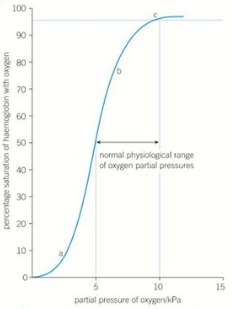
Oxygen dissociation curve: (a) why does haemoglobin not carry much oxygen at a low partial pressure of oxygen?
few haem groups are bound to oxygen
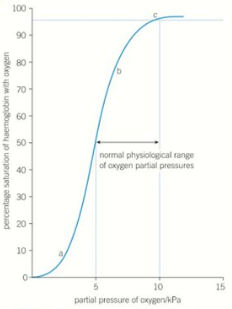
Oxygen dissociation curve: (b) at a higher partial pressure of oxygen what makes it easier to pick up more oxygen?
more haem groups are bound to oxygen
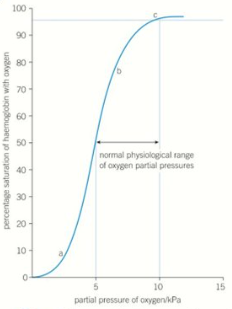
Oxygen dissociation curve: C) when does the curve level out?
at the highest partial pressure of oxygen
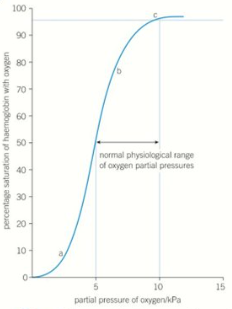
Oxygen dissociation curve: why does the curve level out at the highest partial pressure of oxygen?
because all the haem groups are bound to oxygen and so the haemoglobin is saturated and cannot take up any more
At the high partial pressure of oxygen in the lungs what is the haemoglobin in the red blood cells rapidly loaded with?
oxygen
What does a relatively small drop in oxygen levels in the respiring tissues cause?
oxygen to be rapidly released from the haemoglobin to diffuse into the cells
What enhances this process?
the relatively low pH in the tissues compared with the lungs
In the lungs partial pressure is high, so what percentage saturation does haemoglobin have?
95-97% saturation
What is the partial pressure like at respiring tissue?
low
At respiring tissue the partial pressure is low, so what percentage saturation does haemoglobin have?
looses oxygen to only 20-25% saturation
When you aren’t very active what percentage of the oxygen carried in your erythrocytes is released into the body cells?
about 25%
What does the rest of this unreleased oxygen act as?
a reservoir for when the demands of the body increase suddenly
As the partial pressure of carbon dioxide rises what happens to haemoglobin?
haemoglobin gives up oxygen more easily
Bohr shift?
the affect of high partial pressures of carbon dioxide on haemoglobin’s affinity for oxygen
The Bohr shift: as the proportion of carbon dioxide increases, where does the oxygen dissociation curve for haemoglobin move to?
to the right
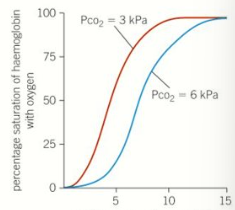
The result of the Bohr effect/shift: what happens to haemoglobin in active tissues with a high partial pressure of carbon dioxide?
haemoglobin gives up its oxygen more easily
The result of the Bohr effect/shift: where does oxygen bind to haemoglobin easily?
in the lungs where the proportion of carbon dioxide in the air is relatively low
Foetal haemoglobin: what contains this special form of haemoglobin?
the red blood cells in the foetal bloodstream
Foetal haemoglobin: when the fetus is developing in the uterus what is it completely dependent on to supply it with oxygen?
its mother
Foetal haemoglobin: what does the oxygenated blood from the mother run close to?
the deoxygenated foetal blood in the placenta
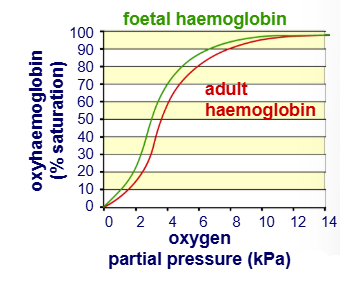
Foetal haemoglobin: what does it have a higher affinity for oxygen than?
adult haemoglobin
Foetal haemoglobin: how does it remove oxygen from the maternal blood?
foetal haemoglobin has a higher affinity for oxygen than adult haemoglobin at each point along the dissociation curve - helps to maximise the oxygen uptake from the mother’s bloodstream
Oxygen dissociation curves for adult and foetal haemoglobin that show how the foetus can gain oxygen from the mother?
…
Transporting carbon dioxide: what percentage of the carbon dioxide produced by respiring cells is transported by being dissolved in the blood plasma?
5%
Transporting carbon dioxide: what is lots of carbon dioxide converted to in the cytoplasm of the erythrocytes?
hydrogen carbonate ions
Transporting carbon dioxide: what converts the CO2 into hydrogen carbonate ions?
carbonic anhydrase (an enzyme)
Transporting carbon dioxide: hydrogen carbonate chemical formula?
HCO3-
Transporting carbon dioxide: what percentage of carbon dioxide is carried in erythrocytes?
75-85%
Transporting carbon dioxide: what is carbon dioxide combined with the amino groups in the polypeptide chains of haemoglobin to form?
a compound called carbaminohaemoglobin
Transporting carbon dioxide: what is most of the carbon dioxide that diffuses into the blood from the cells transported to the lungs in the form of?
hydrogen carbonate ions
Transporting carbon dioxide: in the lungs what does all the carbon dioxide in various forms leave to enter the lungs?
leaves the plasma and haemoglobin
Transporting carbon dioxide: what does carbon dioxide react slowly with water to form?
carbonic acid
Transporting carbon dioxide: carbonic acid chemical formula?
H2CO3-
Transporting carbon dioxide: what happens to carbonic acid as it is a weak acid?
partially dissociates
Transporting carbon dioxide: what does carbonic acid partially dissociate to form?
hydrogen carbonate and hydrogen ions
Transporting carbon dioxide: the chemical formula for the reaction of water and carbon dioxide and carbonic acid dissociating?
…

Transporting carbon dioxide: how quickly the carbonic acid reaction occur in blood plasma?
slowly
Transporting carbon dioxide: why does the carbonic acid reaction happen quicker in erythrocytes?
in the cytoplasm of blood cells there are high levels of carbonic anhydrase
Transporting carbon dioxide: what reaction does carbonic anhydrase catalyse?
the reversible reaction between carbon dioxide and water to form carbonic acid
Transporting carbon dioxide: the chloride shift?
the negatively charged hydrogen carbonate ions move out of the erythrocytes into the plasma by diffusion down a concentration gradient and negatively charged chloride ions move into the erythrocytes
Transporting carbon dioxide: what does the chloride shift maintain?
the electrical balance of the cell
Transporting carbon dioxide: how do the erythrocytes maintain a steep concentration gradient for carbon dioxide to diffuse from the respiring tissues into the erythrocytes?
by removing the carbon dioxide and converting it to hydrogen carbonate ions
Transporting carbon dioxide: when the blood reaches the lung tissue where there is a relatively low concentration of carbon dioxide, what happens?
carbonic anhydrase catalyses the reverse reaction, breaking down carbonic acid into carbon dioxide and water
Transporting carbon dioxide: what diffuses back into erythrocytes?
hydrogen carbonate ions
Transporting carbon dioxide: what do hydrogen carbonate ions react with to form?
more carbonic acid
Transporting carbon dioxide: what does carbonic acid release when it is broken down by carbonic anhydrase?
releases free carbon dioxide, which diffuses out of the blood into the lungs
Transporting carbon dioxide: what do chloride ions diffuse out of the red blood cells back into?
the plasma
Transporting carbon dioxide: what do chloride ions diffuse out of the red blood cells back into the plasma down?
an electrochemical gradient
Transporting carbon dioxide: the role of haemoglobin in this process?
acts as a buffer and prevents changes in the pH
Transporting carbon dioxide: how does it prevent changes in the pH?
accepting (binding with) free hydrogen ions produced by the dissociation reaction
Transporting carbon dioxide: what does the H= ions binding with haemoglobin form?
haemoglobinic acid
Transporting carbon dioxide: what does haemoglobin acting as a buffer cause it to release?
all the oxygen it is carrying
Transporting carbon dioxide: what diffuses out of the red blood cell into the plasma?
hydrogen carbonate