CH. 2 | Cells: The Living Units
 Call Kai
 Learn
Learn Practice Test
 Spaced Repetition
 Match
Match Flashcards
 Knowt Play
1/7

There's no tags or description
Looks like no tags are added yet.
Name | Mastery | Learn | Test | Matching | Spaced | Call with Kai | Chat |
|---|
No analytics yet
Send a link to your students to track their progress
8 Terms
Define cell, its basic activities, and its three major regions.
Cell
The smallest living unit in the body
Functions:
→ Obtain nutrients and essential substances from body fluids
→ Use nutrients to make molecules in order to survive
→ Dispose of waste
→ Maintain its shape and integrity
→ Replicate itself
Cell’s 3 Major Regions
Plasma Membrane
Outer boundary
Cytoplasm
Internal, contains most organelles
Nucleus
Surrounded by the cytoplasm, controls cellular activities
Describe the composition and basic functions of the plasma membrane.
Plasma Membrane
Composition / Structure
The Fluid Mosaic Model
A bilayer of lipid molecules with protein molecules embedded within it
Phospholipid (most abundant)
Each molecule has:
Polar “head” — charged, attracted to water, and lines the inner and outer faces of the membrane
Nonpolar “tail” — uncharged, avoids water, lines up in the center
Other Lipids
Glycolipids — Sugar groups that are attached to about 10% of the outer lipid molecules (“sugar fats”)
Cholesterol — Makes the membrane more rigid and increases its impermeability to water and water-soluble molecules
Proteins
Two distinct types:
Integral Proteins
Firmly embedded in or attached to the lipid bilayer
Most are transmembrane proteins — span the entire width of the membrane, protruding from both sides
Peripheral Proteins
Loosely attached to the membrane surface
Forms a network of filaments that supports the membrane from its cytoplasmic side (without them, the membrane would tear easily)
Glycocalyx (Cell Coat)
Short chains of carbohydrates attach to integral proteins → forms glycoproteins
These sugars project from the external cell surface → forming the glycocalyx
Function of the Glycocalyx
Sticky — Helps bind cells together
Biological marker — Each cell type has a unique sugar pattern, allowing cells to recognize each other
i.e., a sperm recognizes an egg cell by the distinctive composition of its glycocalyx
Structure of a generalized cell
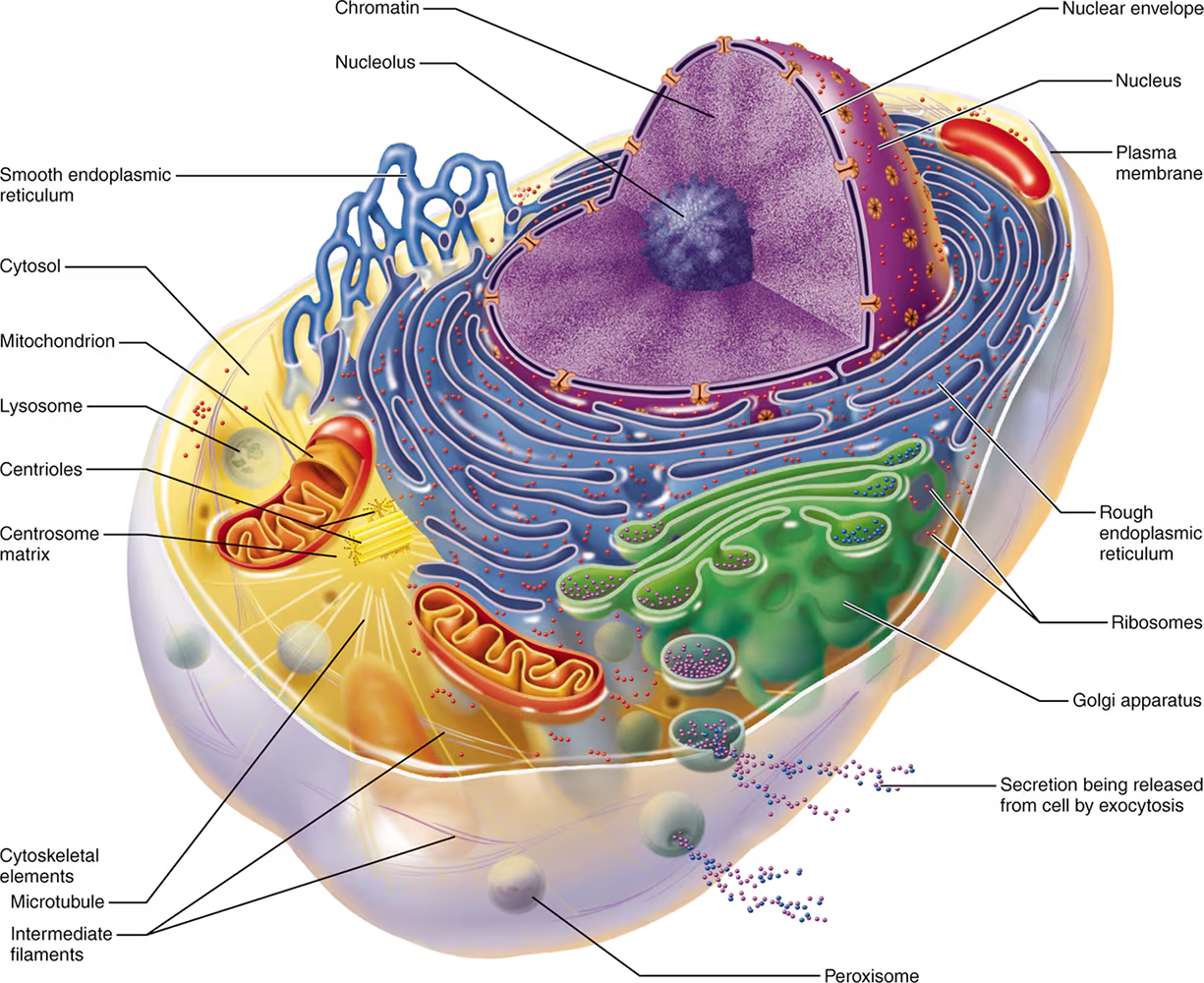
Explain the different processes used to move across the plasma membrane.
Describe the structure and cellular activity of each organelle: ribosomes, endoplasmic reticulum, golgi apparatus, lysosomes, peroxisomes, mitochondria, cytoskeleton, centrosome, and centrioles.
Describe the role of each of the three parts of the nucleus in the control of cellular activities: the nuclear envelope, the nucleolus, and chromatin.
List the phases of the cell life cycle, and describe a key event of each phase.
Name specific cell types, and relate their overall shape to their specific functions.