Unit 5 Test Review
0.0(0)Studied by 34 people
Build your Mastery score
 Multiple Choice & FRQ
 Call Kai
Card Sorting
1/24

Earn XP
Description and Tags
Last updated 7:53 PM on 3/14/23
Name | Mastery | Learn | Test | Matching | Spaced | Call with Kai | Chat |
|---|
No analytics yet
Send a link to your students to track their progress
25 Terms
1
New cards
Define the crowding-out effect
Government takes massive loans out for public projects (expansionary fiscal). Long term results of increased government borrowing, since G takes up so many bank loans the average ^^interest rate goes up, private investments decrease.^^
2
New cards
Explain the effects of crowding-out within the short-run aggregate demand and aggregate supply model
In the short run crowding out can increase AD and/or AS, however in the longer run or eventually both will decline as a result of increased interest rates (decreased Investment spending)
3
New cards
Demonstrate the use of monetary policy to lessen or reinforce the crowding-out effect
Since the crowding out effect eventually leads to higher interest rates, the Fed can use monetary policy to “add” money (increase money supply) to bring interest rates back down
4
New cards
Analyze the effects of combined monetary and fiscal policies on the loanable funs market
Fiscal Policy: expansionary (increase AD) higher demand for money for C and I
Monetary Policy: Expansionary leads to more supply of money since more is in circulation, interest rates come down allowing for more investment again
\
Fiscal policy is the steroid, and monetary is the acne medication (steroid analogy)
Monetary Policy: Expansionary leads to more supply of money since more is in circulation, interest rates come down allowing for more investment again
\
Fiscal policy is the steroid, and monetary is the acne medication (steroid analogy)
5
New cards
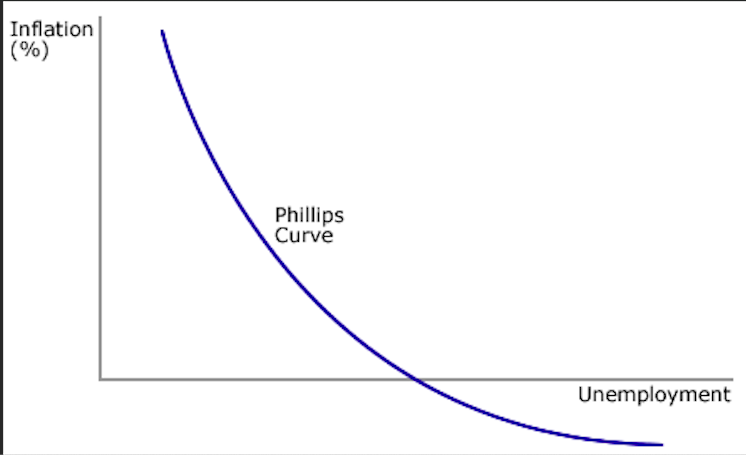
Define the Phillips Curve
showing the direct relationship between inflation and unemployment in an economy
6
New cards
Show how monetary and fiscal policy can help economy move along the short-run Phillips Curve
Tools of Fiscal Policy (changes in taxation/ Government spending)
Tools of Monetary Policy (changes to the money supply through G bond sales primarily)
Aiming at either fixing inflation (contractionary) or fixing unemployment (expansionary)
Tools of Monetary Policy (changes to the money supply through G bond sales primarily)
Aiming at either fixing inflation (contractionary) or fixing unemployment (expansionary)
7
New cards
Describe long-term growth trends in the U.S.
Slightly raising levels of inflation (2-3% per year) with overall increases in GDP output, includes business cycle. Upward growth despite occasional dips and peaks of business cycle.
8
New cards
How can economic growth be measured
Through the economy’s GDP, more accurate if adjusted for inflation, even more accurate if “per capita”
9
New cards
Relate economic growth to the long-run aggregate supply curve and the production possibilities curve
The shifters of the PPC will also shirt the LRAS curve (natural resources, technology, techniques, quantity and quality of population)
10
New cards
Explain the reason why prices and wages do not adjust instantaneously
Prices take time to adjust to market values, wages are even more “sticky” as those hiring will try to resist paying more and will try to become more efficient.
Policy lags before the changes and after the changes can take weeks, months, years to feel the effects
Policy lags before the changes and after the changes can take weeks, months, years to feel the effects
11
New cards
What is fiscal policy? Who controls it and what are the tools?
Actions taken by the Government (congress + president) to adjust taxes and government spending to increase or decrease AD (aggregate demand)
12
New cards
What is monetary policy? Who controls it and what are the tools?
Actions taken by the Federal Reserve System to adjust the money supply and therefore interest rates for borrowing money. Controlled by the Fed. Tools: Adjusting reserve requirements, discount rate, open market operations.
13
New cards
What is classical theory? What did Keynes change about this theory?
Classical theory is the lack of government intervention in the economy, let the market sort itself out over time. John Maynard Keynes suggested slight and calculated adjustment could lights the dips of the business cycle with government intervention, we now call our modern understanding of economics “Keynesian Theory”
14
New cards
How does expansionary fiscal policy impact interest rates?
Expansionary Fiscal Policy looks to increase AD in the economy by lowering taxes and increasing government spending to create new government funded jobs, but this money has to be borrowed from banks to fund the jobs, therefore interest rates will go up.
15
New cards
How can expansionary monetary policy be used to compliment expansionary fiscal policy and continue encouraging economic growth
Expansionary policy will inadvertently raised interest rates (crowding out from government borrowing). Expansionary monetary policy can increase the supply of money and bring interest rates back down (steroid side effects being treated)
16
New cards
What are the main components for encouraging economic growth
Improving physical captial, improving human capital, improving technology. the government can also have a factor in all three of these
17
New cards
What is the spending multiplier and how do you find the spending multiplier when you have MPC/MPS? Create and example problem and solve it. How does this apply to a change in government spending?
Spending multiplier is the expected amount that money will be re-spent within an economy after there is a change in spending habits or the supply of money in the economy. If MPC = .75 and MPS = .25, the formula is 1/MPS which in 4x. A $100million change in government spending would result in $400 million change in GDP output.
18
New cards
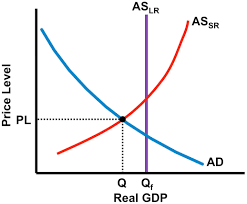
With high unemployment (recession) what policy do you take?
Expansionary
19
New cards
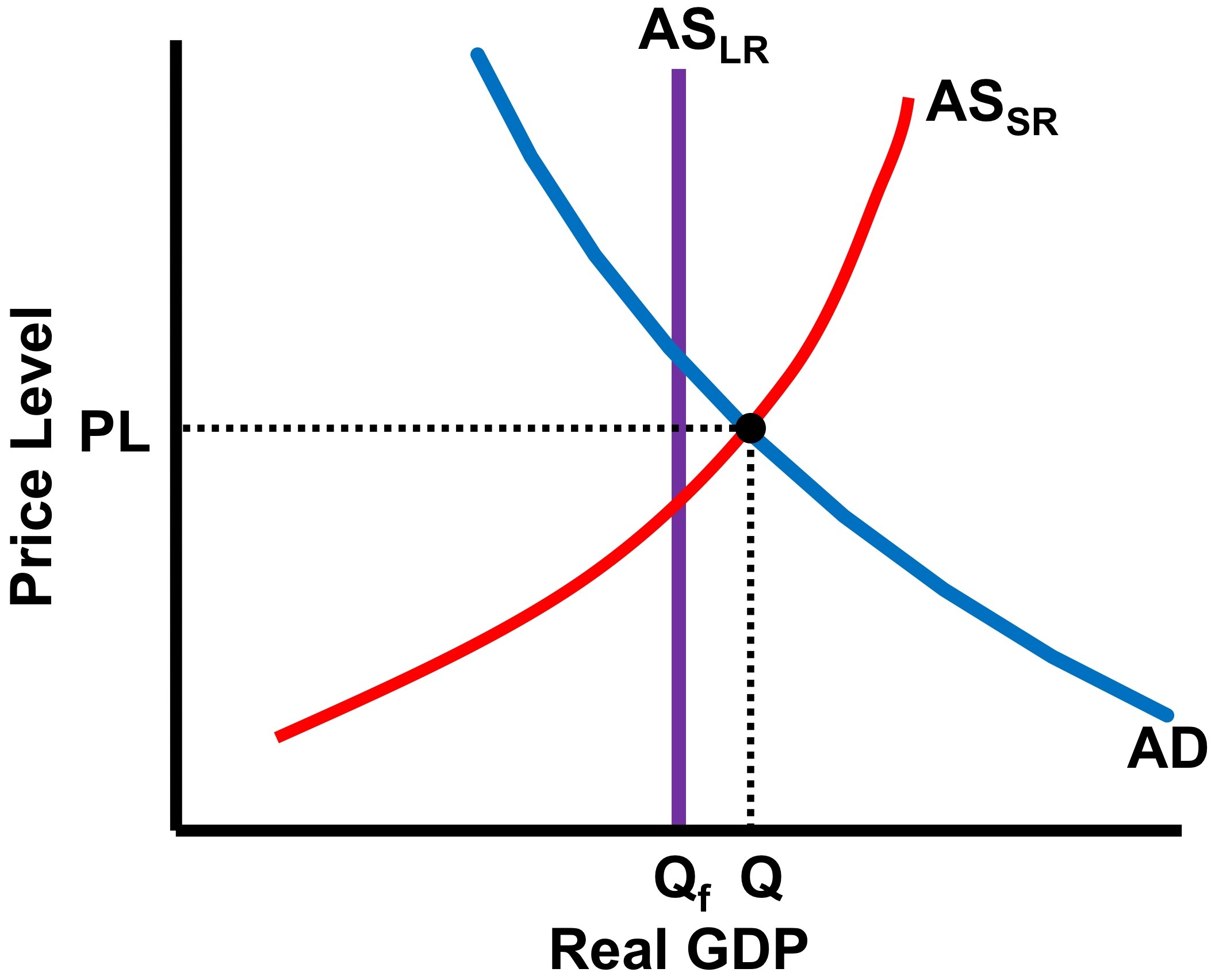
With high prices (inflation) which policy do you take?
Contractionary
20
New cards
Recessionary AD/AS graph
21
New cards
Inflationary AD/AS graph
22
New cards
What fiscal policy responses correct recession
\-Cut taxes
\-Increase gov spending
\-Increase gov spending
23
New cards
What fiscal policy responses correct inflation
* Increase taxes
* Cut government spending
* Cut government spending
24
New cards
What monetary policy response to correct recession.
decrease reserve requirement
decrease discount rate
decrease federal funds rate
Fed buys bonds
decrease discount rate
decrease federal funds rate
Fed buys bonds
25
New cards
What monetary policy response to correct inflation.
increase reserve requirement
increase discount rate
increase federal funds rate
Fed sell bonds
increase discount rate
increase federal funds rate
Fed sell bonds