Genome Anatomy
 Call Kai
 Learn
Learn Practice Test
 Spaced Repetition
 Match
Match Flashcards
 Knowt Play
1/19

There's no tags or description
Looks like no tags are added yet.
Name | Mastery | Learn | Test | Matching | Spaced | Call with Kai | Chat |
|---|
No analytics yet
Send a link to your students to track their progress
20 Terms
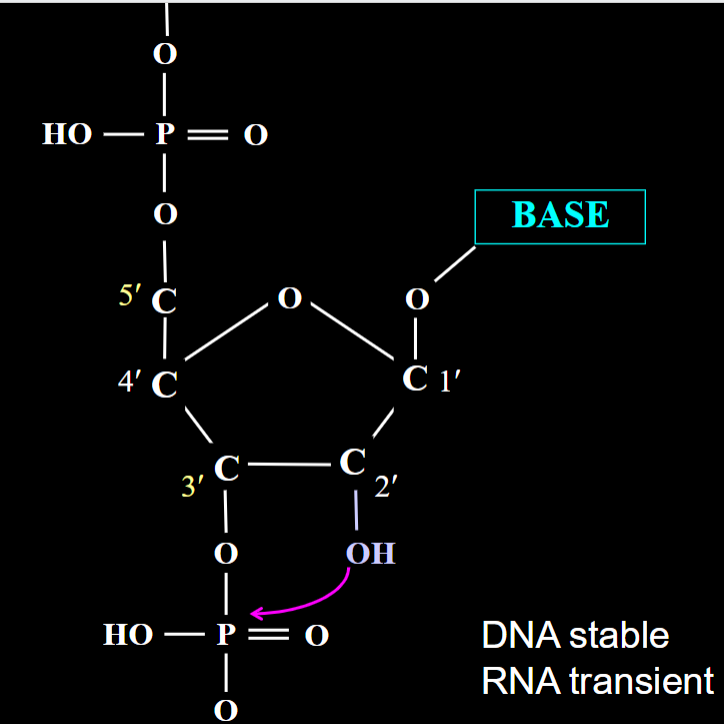
DNA structure
2’ deoxyribose sugar (no OH on C2)
1’ base
3’, 5’ phosphate group
what direction is DNA written
5’ → 3’
direction in which DNA and RNA are synthesised
DNA replication
DNA gyrase unwinds the helix
Hydrogen bonds between bases are broken by DNA helicase
Free nucleotides are present in the nucleus→ can link to complementary bases.
DNA polymerase joins adjacent nucleotides to reform sugar-phosphate backbone, linking the new strands together.
DNA replication in leading vs lagging strand
leading strand allows continuous extension
lagging strand causes discontinuous replication:
creates okazaki fragments
joined by DNA ligase
telomeres
found at the end of chromosome
TTAGGG telomeric repeat sequence
telomeres shorten with somatic cell division→ finite number of divisions
nucleosome
basic structural unit of DNA packaging in eukaryotic cells
segment of DNA wound around histone proteins

chromosome landmarks

diploidy
n=23
2n=46
2 copies of every gene→ paternal, maternal
dosage of genes
haploinsufficiency→ one is not enough
exception is the X chromosome
human genome
3000 Mbp dsDNA per haploid genome
>90% is non-coding
approx. 20 000 protein coding genes
mitochondrial genome
circular not linear
37 genes
cytoplasmic not nuclear
maternal inheritance
sequence classes
single-copy sequences (non-repetitive)
genes
repetitive sequences
satellite DNA→ large blocks of repetitive sequence
interspersed repeats
genes
functional units of DNA
genes are expressed
components of genes
exons
introns
regulatory sequences→ promoters, enhancers, locus control regions
satellite DNA
large blocks at centromeres and heterochromatic chromosomal regions
tandemly repeated sequences
alphoid DNA
type of satellite DNA found at centromeres
171-bp repeat unit
shows chromosome specific sequence variation
alphoid DNA is required for assembly of centromere
interspersed repeats
scattered around the genome
individual copies are present at many locations
e.g. Alu repeat

gene structure

gene families
evolution of genes progresses by duplication and divergence
most genes belong to a family of structurally related genes
members of gene family may be clustered or widely dispersed
processed genes
intronless copies of other genes
usually remote from parent gene
reverse transcription and reintegration
retroviruses
occasionally remain functional
most are non-functional