exam 2 study pt 2
 Call Kai
 Learn
Learn Practice Test
 Spaced Repetition
 Match
Match Flashcards
 Knowt Play
1/21

Earn XP
Description and Tags
quasi ppt and survey ppt
Name | Mastery | Learn | Test | Matching | Spaced | Call with Kai | Chat |
|---|
No analytics yet
Send a link to your students to track their progress
22 Terms
describe a quasi experimental design
•close to experimental design, but lack random assignment and/or a comparison group
–Often having nonequivalent groups
–Degree of control is decreased
describe a one group pretest post test design
does not have a control group, so One group is measured before and after treatment
IV = time (pretest vs posttest)
Weak internal validity and external validity due to lack of control group
Used when control group is not feasible or prior evidence exists

one way repeated measure design
You measure the same outcome many times over time, and you look at how it changes when (or if) a treatment is introduced.
IV = time
No randomization or control group
Useful when disease progression is predictable
Weak internal validity (cannot strongly infer causation)
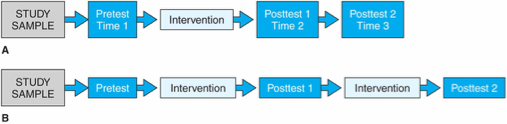
describe a time series design
•Multiple measurements before and after intervention to examine patterns of behaviors
•Most effective when serial data can be collected evenly (time) throughout the study
–Avoids confounding variables
–Most threats to internal validity are controlled for
–External validity is limited

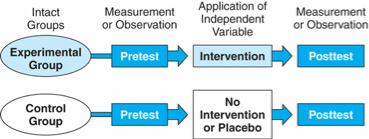
describe the non equivalent pretest posttest control group design
•Similar to pretest-posttest experimental design, except subjects are not randomly assigned
•Can be designed with one treatment group and one control group or with multiple of each
•Limited due to lack of randomization
historical controls
instead of comparing two groups at the same time, you compare a new treatment group to a past group of patients who already received the old treatment.
The control group is NOT recruited at the same time—it comes from earlier data.
Used when researchers expect a new treatment to be superior or when prospective controls are not feasible
Advantage: efficient, uses existing data
Disadvantage: low internal validity due to differences across time; findings may not replicate in RCTs
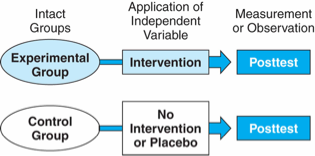
non equivalent post test only control group design
•Should only be used for exploratory research- cannot prove cause effect
•Can include any number of treatment levels, with or without a control group
Internal validity is severely threatened by selection bias and attrition
ex: A researcher studies a rehab program:
Group 1: patients from Clinic A (gets new therapy)
Group 2: patients from Clinic B (standard therapy)
They measure outcomes only at the end and compare groups.
define interview, survey, and questionnaires
survey- composed of questions that can be given to a group( intended for generalization/description of a group)
interview- asks respondents questions and record answers for analysis ( typically in respondants natural setting
questionannaires- structured surveys that are self administered
what are the advantages and disadvatages of interviews
oAdvantages
oIn-depth analysis
oCan probe responses
oCan directly observe respondents’ reactions
o Disadvantages
oCost and time
oNeed for personnel
oScheduling
oLack of anonymity
what are the questionnaire advantages and disadvantages
oAdvantages
oMore efficient than interviews
oData can be gathered from a large sample (geographically)
oShort period of time to gather data
oRespondents can take time to choose answer
oProvide anonymity
oUseful to examine phenomena that cannot be observed
oDisadvantages
Potential misunderstanding of question
what is the distribution, return rate, self report for questionnares
Distribution
Mail
Online / survey platforms
Response rates
60–80% = excellent
30–60% = common
Low return → incomplete data often discarded
Self-report issues
Recall bias (forgetting past events)
Social desirability bias
Inaccuracy possible (but still widely used)
what is the design of surveys process
research question
hypothesis
questionnaire outline
review of existing instruments
designing the instrument ( logical order)
preliminary drafts (panel feedback)
pilot testing and revisions
selecting a sample
what is an open ended question and close ended question
Respond in own words
rich detail
− hard to code/analyze
Closed-ended
Fixed answer choices
easy to code, consistent
− limits responses, may bias
what are the two common formats of close ended questions
brackets of circling answer
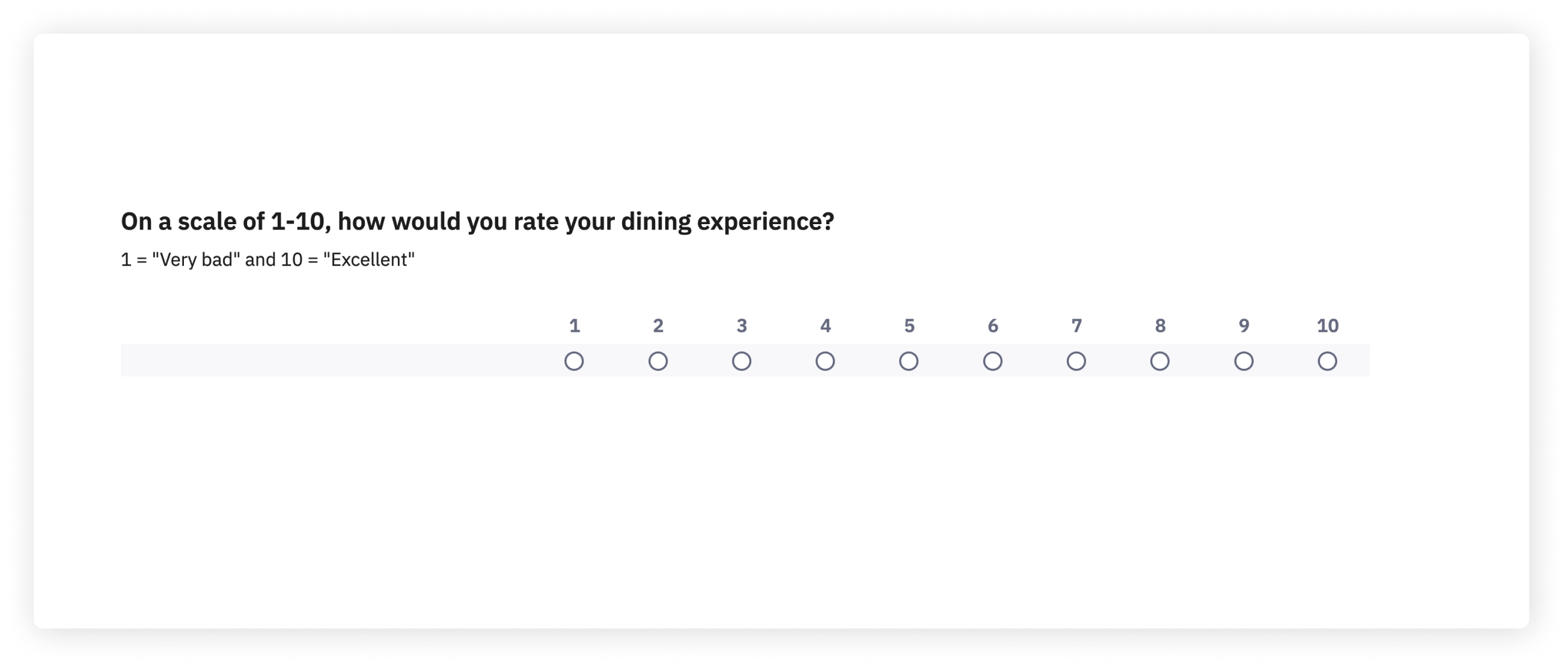
what are the formats of close ended questions
Dichotomous (Yes/No)
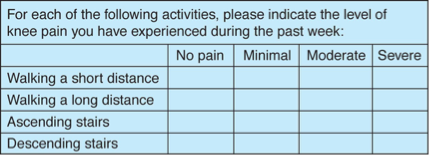
Range of responses (ex: pain scale)
Grid/checklist
Ranking order (1 = most important)
Branching (skip irrelevant questions) ex: picture
what are the survey question writing rules
Keep simple language
Avoid jargon/idioms
Avoid double-barreled questions (2 questions in 1)
Be clear + unambiguous
Include time frame for frequency questions
Be careful with sensitive questions
allow refusal option
reduce discomfort
what is the purpose of scales
To distinguish between people who have different intensities of the measured characteristic
what are the types of scales
Categorical
Groups (gender, diagnosis)
Frequencies/percentages
Continuous
Measured on continuum (age, BP)
Summative scales
Total score from multiple items
All items equally weighted
Cumulative scales
Items build in intensity (e.g., depression severity)
what is a linkert scale
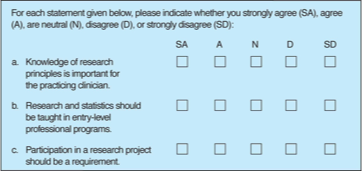
Most common summative scale to assess attitudes/values
“Strongly agree → strongly disagree”
Produces total summed score
Requires item analysis/validation
what is a semantic differential scale
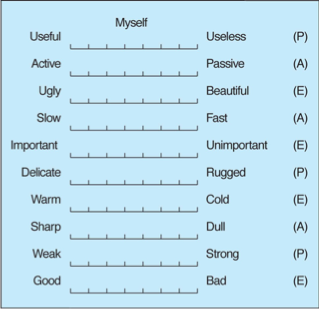
Measures attitude using opposite adjectives
e.g., good – bad, strong – weak
Usually 7-point scale
Not agree/disagree (different from Likert)
analysis of survey data process
code responses into computer
Responses to closed-ended questions are coded
analysis can look like » Descriptive statistic, Relationships between variables, Totals from scales
what is the relation between informed consent an surveys
Must go through IRB (review board)
Surveys often exempt or expedited
Still required even without face-to-face contact