BISC 101 Week 7 Lecture 2
 Call Kai
 Learn
Learn Practice Test
 Spaced Repetition
 Match
Match Flashcards
 Knowt Play
1/16

There's no tags or description
Looks like no tags are added yet.
Name | Mastery | Learn | Test | Matching | Spaced | Call with Kai |
|---|
No analytics yet
Send a link to your students to track their progress
17 Terms
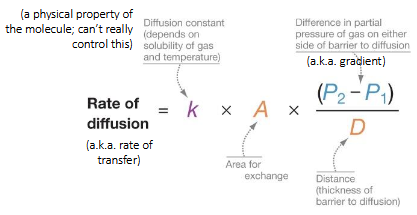
General principle to maximize rate of transfer
Rate of transfer equation: Fick’s law
Area for exchange
partial pressure concentration difference
Distance (Thickness of barrier to diffusion)
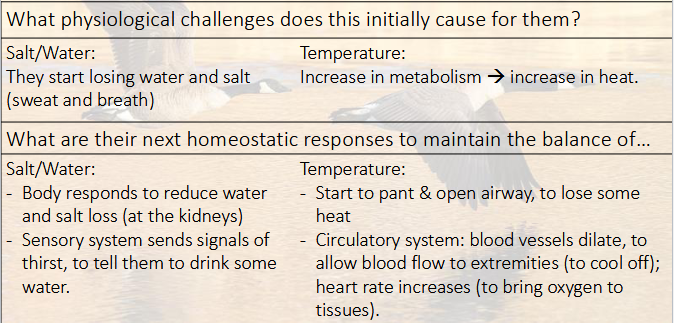
Goose Homeostasis: hot weather
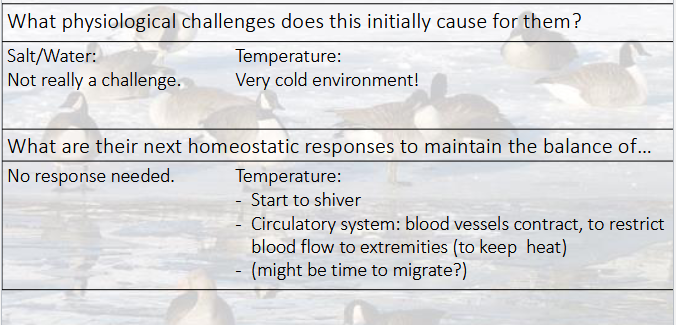
Goose homeostasis: cold weather
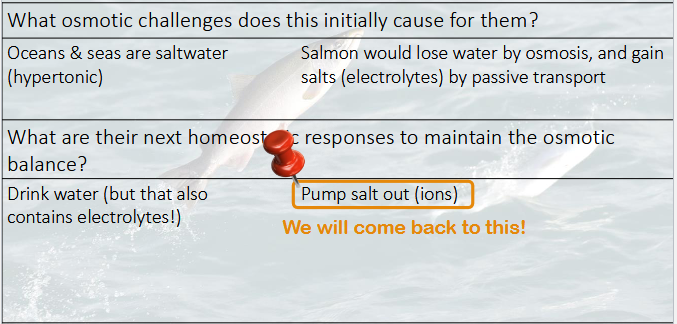
Osmotic regulation: Salmon in salt water
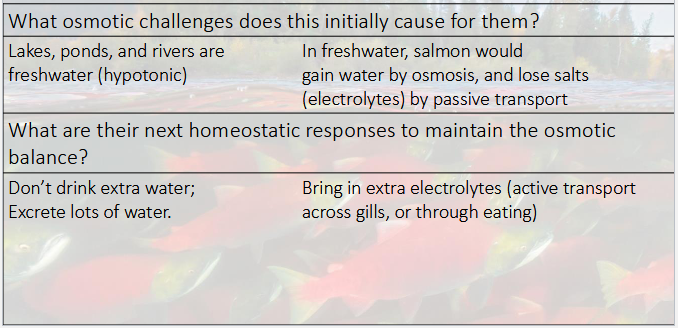
Osmotic regulation: Salmon in freshwater
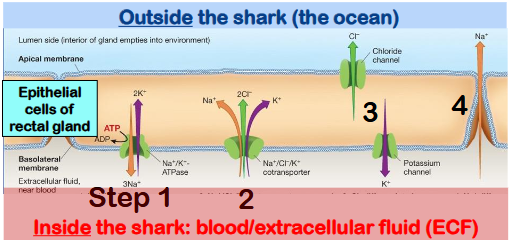
NaCl(Salt) excretion
Overall goal: Release Na+ and Cl- from body
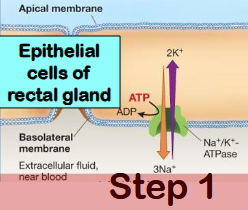
Salt excretion step 1
Sodium potassium pump. Sodium moves into blood/ECF, potassium moves into epithelial cells.
Uses ATP.
Primary active transport.
Purpose: establish sodium concentration gradient for steps 2 and 4. (High in blood, low in cell)
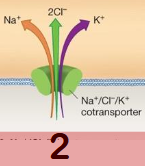
Salt excretion step 2
Sodium, chloride, and potassium transported from blood/ECF into epithelial cells.
Uses concentration gradient of Sodium. Secondary active transport.
Purpose: brings chloride into the cell, establishing concentration gradient for step 3.
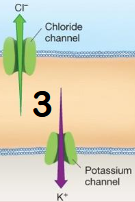
Salt excretion step 3
Chloride moves outside of cells into the ocean. Potassium moves into blood from cells.
Doesn’t use energy. Passive (Facilitated diffusion)
Purpose: excrete Chloride, rebalance potassium into blood
Salt excretion step 4
Sodium diffuses from blood to the ocean, between cells.
Doesn’t use energy. Simple Passive transport.
Purpose: To excrete sodium.
Kidneys
Where osmoregulation occurs in terrestial vertebrates
Renal artery: brings blood (with nitrogenous wastes) into kidneys
Renal vein: carries blood away
Renal corpuscle
where filtration occurs
blood enters renal corpuscle and filtration occurs as it passes through.
proteins, cells, and large components of blood are too big to fit through the pores.
fluid is now pre-urine once filtered
Proximal Tubule
Reabsorption of small molecules
Filtrate contains water and small solutes (e.g., urea, glucose, amino acids, vitamins, electrolytes)
Almost all nutrients (& most of the NaCl and water filtered by renal corpuscle) are reabsorbed here.
Loop of Henle descending
Water reabsorbed (aquaporins), using salt gradient
Loop of Henle ascending
Na+ and Cl- reabsorbed, using and making salt gradient
active Na & Cl transport in ascending limb makes the medulla hypertonic, which drives the water transport in the descending limb.
impermeable to water
Distal Tubule
Reabsorption continues
If Na+ is low in blood, it can be reabsorbed (K+ and H+ from blood may move into distal tubule) – Hormone: Aldosterone
The filtrate that enters the distal tubule is always dilute
Collecting Duct
Water reabsorption, especially if dehydrated
Antidiuretic hormone (ADH) plays a role in the production of concentrated or dilute urine
ADH: part of a negative feedback loop, returning the system to a set point.