HESI Women's & Children's updated!!!
 Call Kai
 Learn
Learn Practice Test
 Spaced Repetition
 Match
Match Flashcards
 Knowt Play
1/107

There's no tags or description
Looks like no tags are added yet.
Name | Mastery | Learn | Test | Matching | Spaced | Call with Kai | Chat |
|---|
No analytics yet
Send a link to your students to track their progress
108 Terms
A 13-year-old male presents to the emergency department with sudden onset of severe testicular pain and swelling in the right scrotum. He reports that the pain began during a basketball game. He appears distressed, and upon examination, the affected testicle is elevated, with a tender, hard mass present. The cremasteric reflex is absent on the affected side.
Which of the following are the expected findings in a child with testicular torsion? (Select all that apply)
Severe unilateral testicular pain that starts suddenly.Scrotal swelling & redness. Absence of the cremasteric reflex on affected side. Nausea and vomiting,pain. Feelings of embarrassment or distress.
A laboring mother is experiencing variable decelerations during continuous fetal monitoring.Which interventions should the nurse implement for variable decelerations? (Select all that apply)SN: VEAL CHOP
Change the mother's position to improve cord flow Administer oxygen to the mother to improve fetal oxygenation.Increase intravenous fluids to improve maternal circulation.Perform a vaginal examination to assess for cord prolapse
A 4-year-old with hemophilia A has fallen and injured his arm. He is showing signs of pain and swelling in the affected joint.What priority actions should the nurse take for this child with hemophilia? (Select all that apply)
Administer clotting factor XIII replacement as prescribed. Apply pressure to control any active bleeding,Monitor for signs of internal bleeding such as abdominal pain or bruising.Apply cold packs to reduce swelling
A 4-year-old is diagnosed with nephrotic syndrome and is being treated in the hospital. The child presents with periorbital edema, proteinuria, and hypoalbuminemia(low albuminemia).Which of the following are appropriate interventions for a child with nephrotic syndrome? (Select all that apply)
Administer corticosteroids to reduce inflammation and proteinuria.Monitor urine output for signs of fluid retention.Measure the child’s weight daily to assess for fluid retention.
A 9-year-old diagnosed with juvenile idiopathic arthritis is being discharged from the hospital. The parents are concerned about their child’s limited mobility and joint pain.
Encourage regular physical activity to maintain joint flexibility.Administer methotrexate as prescribed to reduce inflammation.Use warm compresses to alleviate joint stiffness.Teach the child about the importance of weight management
A newborn is born via vaginal delivery. The pediatrician orders erythromycin eye ointment for the infant immediately after birth.
To prevent bacterial eye infections, such as gonorrheal or chlamydial conjunctivitis.To prevent neonatal conjunctivitis from chlamydia or gonorrhea.
A premature neonate is admitted to the NICU with a temperature of 97°F (36.1°C) and poor feeding. The nurse assesses the baby’s cold stress symptoms.Which of the following interventions are appropriate for this neonate? (Select all that apply)
Place the neonate in an incubator. Ensure the baby is dressed in layers of clothing. Monitor the neonate’s temperature frequently.Administer warm IV fluids to help raise body temperature.
A 3-year-old with hemophilia is admitted after falling and hitting his knee. The child has extensive bruising and pain in the joint.
Which of the following should the nurse prioritize in the care of this child with hemophilia? (Select all that apply)
Administer clotting factor therapy. Apply pressure to any bleeding areas. Avoid using aspirin or NSAIDs for pain relief. Monitor for any signs of spontaneous bleeding
A 5-year-old is admitted with periorbital edema, proteinuria, and hypoalbuminemia. The child has a history of frequent infections and a recent upper respiratory tract infection.
Which of the following are common signs and symptoms of nephrotic syndrome? (Select all that apply)
Periorbital edema.Proteinuria,Hypertension,Hypoalbuminemia
A 6-year-old with joint pain, stiffness, and swelling has been diagnosed with juvenile idiopathic arthritis (JIA).Which of the following interventions are appropriate for managing JIA? (Select all that apply)
Administer NSAIDs for pain relief.Encourage range-of-motion exercises,Administer corticosteroids during flare-ups. Provide education on the importance of regular check-ups.
A 4-year-old child is admitted with high fever, drooling, and difficulty swallowing. The child is sitting forward and appears to be struggling to breathe.Which of the following are consistent with epiglottitis? (Select all that apply)
Drooling and difficulty swallowing,Stridor,Fever
A 3-year-old is admitted to the hospital with respiratory distress. The child is observed to be breathing rapidly with noticeable nasal flaring, intercostal retractions, and grunting.Which of the following are signs of respiratory distress in children? (Select all that apply)
Nasal flaring,Tachypnea,Grunting,Retractions
A 7-year-old presents with a fever, migratory arthritis, and a distinctive skin rash (erythema marginatum). The mother reports that the child had a recent sore throat.Which of the following are likely symptoms of rheumatic fever? (Select all that apply)
Migratory arthritis,Erythema marginatum,Fever
A 2-month-old infant is seen for a routine check-up. The child is due for several immunizations.Which vaccines are recommended for this infant at the 2-month well-child visit? (Select all that apply)
Hepatitis B,DTaP (Diphtheria, Tetanus, Pertussis),Polio (IPV) Rotavirus
A newborn is being assessed for potential congenital heart disease. The mother reports the baby has been having difficulty feeding and appears to be cyanotic during crying episodes. The baby is also very tired after feeding.
Which of the following signs are suggestive of a congenital heart defect? (Select all that apply)
Cyanosis during crying. Fatigue after feeding. Systolic murmur heard on auscultation. Tachypnea at rest
A 7-year-old is admitted to the hospital with a fractured femur and is placed in a fiberglass cast. The nurse is educating the parents about proper care for the cast.Which of the following teaching points should the nurse include in the care plan for the child’s cast? (Select all that apply)
Check the skin around the cast edges for irritation or redness. Avoid inserting objects into the cast to scratch any itchy areas. Keep the cast elevated to reduce swelling in the affected limb.
Which of the following are signs and symptoms of testicular torsion?
Severe scrotal pain.Absence of cremasteric reflex.Scrotal swelling.Radiating pain to the abdomen
What is the primary purpose of erythromycin eye ointment in newborns?
Prevent conjunctivitis from gonorrhea,Prevent gonarerha chlamydial eye infections,Decrease the risk of corneal scarring
Which of the following interventions are appropriate for late decelerations during labor (VEAL CHOP framework)?SN: Placentae insucffiency
Change maternal position to lateral(side) or knee-chest Trandelberg). Administer oxygen via mask. Increase IV fluids.Discontinue oxytocin if being administered
Which of the following are priority interventions for a child in a cast?
Assess skin integrity around the cast edges.Check for warmth and circulation in the affected limb.Keep the cast elevated to reduce swelling.
Which of the following are common signs of congenital heart defects in infants?
Cyanosis.Tachypnea. Poor feeding and failure to thrive Murmurs.
A newborn is being assessed for potential congenital heart disease. The mother reports the baby has been having difficulty feeding and appears to be cyanotic during crying episodes. The baby is also very tired after feeding.Which of the following signs are suggestive of a congenital heart defect? (Select all that apply)
Cyanosis during crying.Fatigue after feeding. Systolic murmur heard on auscultation.Tachypnea at rest
Which of the following are signs and symptoms of rheumatic fever/scarlet fever in children?
Autoimmune response triggered by streptococcal infection,Untreated or inadequately treated Group A Streptococcal (GAS) pharyngitis,. Inflammatory reaction affecting joints, skin, brain, and heart
Which of the following are interventions/management strategies for juvenile idiopathic arthritis (JIA)?
Nonsteroidal anti-inflammatory drugs (NSAIDs) for pain management.Corticosteroid therapy for flare-ups. Encourage rest during active flare-ups.Encourage physical activity and stretching.Fluid intake should be encouraged (water)
Which findings are most characteristic of biliary atresia in an infant?
Persistent jaundice beyond 2 weeks of age.Pale, clay-colored stools, Dark urine,. Failure to thrive
A 3-week-old infant presents with projectile vomiting, dehydration, and an olive-shaped mass in the RUQ. What is the most likely diagnosis?
Pyloric stenosis(projectile vomiting, dehydration, metabolic alkalosis,&olive-shaped mass.& Intussusception(colicky pain and currant jelly stools)
Hirschsprung's disease
failure to pass meconium(NB 1st stool) and constipation.
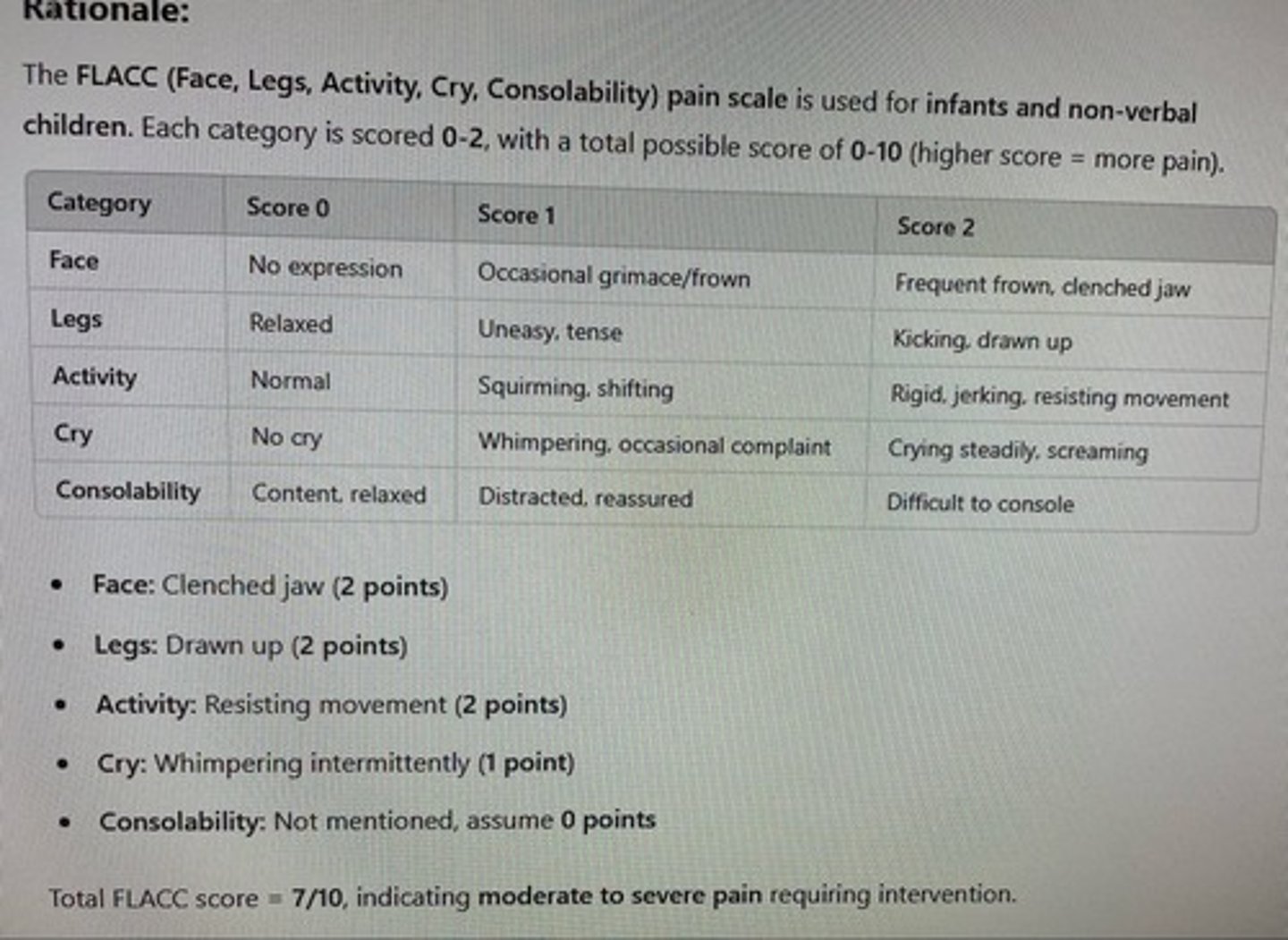
4-month-old infant is crying, has legs pulled toward the abdomen, shows a tense face, and is resisting comfort. What is the FLACC pain score?Rationale: FLACC (Face, Legs, Activity, Cry, Consolability) pain scale scores each category from 0 to 2:
Face: 2 (grimace, clenched jaw)
Legs: 2 (kicking, tense)
Activity: 0 (calm)
Cry: 1 (moaning, whimpering)
Consolability: 1 (resists comfort)
Total Score = 6 (moderate pain)
6
A 28-year-old postpartum mother (G2P2) who is 3 weeks postpartum presents to the clinic with breast pain, swelling, redness, and flu-like symptoms. She reports that she has been breastfeeding exclusively but skipping feedings due to pain and fatigue. Her temperature is 101.5°F (38.6°C), and her left breast is tender, warm, and erythematous.
Which assessment finding is most indicative of mastitis?
localized, painful, reddened area on the breast with fever
A 28-year-old postpartum mother (G2P2) who is 3 weeks postpartum presents to the clinic with breast pain, swelling, redness, and flu-like symptoms. She reports that she has been breastfeeding exclusively but skipping feedings due to pain and fatigue. Her temperature is 101.5°F (38.6°C), and her left breast is tender, warm, and erythematous.
Which interventions are appropriate for an HIV-positive mother and her newborn?
Administer antiretroviral therapy (ART) during pregnancy.Schedule a C-section at 38 weeks if viral load is high. No breastfeeding.Administer zidovudine (AZT) to the newborn within 6–12 hours of birth.
A 28-year-old postpartum mother (G2P2) who is 3 weeks postpartum presents to the clinic with breast pain, swelling, redness, and flu-like symptoms. She reports that she has been breastfeeding exclusively but skipping feedings due to pain and fatigue. Her temperature is 101.5°F (38.6°C), and her left breast is tender, warm, and erythematous.
Which factors in the client’s history likely contributed to the development of mastitis?
Skipping feedings,Improper latching technique,Nipple trauma or cracks.
A 28-year-old postpartum mother (G2P2) who is 3 weeks postpartum presents to the clinic with breast pain, swelling, redness, and flu-like symptoms. She reports that she has been breastfeeding exclusively but skipping feedings due to pain and fatigue. Her temperature is 101.5°F (38.6°C), and her left breast is tender, warm, and erythematous.
Which nursing interventions are appropriate for this client?
Encourage continued breastfeeding or pumping from the affected breast. Apply warm compresses before breastfeedingAdminister prescribed antibiotics
A 28-year-old postpartum mother (G2P2) who is 3 weeks postpartum presents to the clinic with breast pain, swelling, redness, and flu-like symptoms. She reports that she has been breastfeeding exclusively but skipping feedings due to pain and fatigue. Her temperature is 101.5°F (38.6°C), and her left breast is tender, warm, and erythematous.
If left untreated, mastitis can lead to which complications?
Rationale:
Breastfeeding should continue to relieve engorgement and prevent further complications.Good latch & alternating positions help prevent recurrence.
Breast abscess,Sepsis,Chronic mastitis
A 28-year-old postpartum mother (G2P2) who is 3 weeks postpartum presents to the clinic with breast pain, swelling, redness, and flu-like symptoms. She reports that she has been breastfeeding exclusively but skipping feedings due to pain and fatigue. Her temperature is 101.5°F (38.6°C), and her left breast is tender, warm, and erythematous.
Which antibiotic is most commonly prescribed for mastitis in a breastfeeding mother?
Rationale: Dicloxacillin or cephalexin are first-line treatments for Staphylococcus aureus, the most common cause of mastitis. Doxycycline and ciprofloxacin are avoided in breastfeeding.
Dicloxacillin
A 28-year-old postpartum mother (G2P2) who is 3 weeks postpartum presents to the clinic with breast pain, swelling, redness, and flu-like symptoms. She reports that she has been breastfeeding exclusively but skipping feedings due to pain and fatigue. Her temperature is 101.5°F (38.6°C), and her left breast is tender, warm, and erythematous.If left untreated, mastitis can lead to which complications?
"I need to stop breastfeeding from the infected breast until I feel better."
A nurse is educating a pregnant client who is on methadone maintenance therapy for opioid use disorder. Which statements are true regarding methadone use in pregnancy?
Methadone is preferred over heroin use during pregnancy.Methadone crosses the placenta and may cause neonatal withdrawal.Methadone use is associated with an increased risk of stillbirth.Methadone increases the risk of preterm labor and low birth weight.
A newborn whose mother was on methadone during pregnancy is being assessed for NAS. What symptoms would indicate withdrawal?
High-pitched cry.Poor feeding and excessive sucking. Hypertonia and tremors.Increased respiratory rate.Increased respiratory rate.
A pregnant client receiving methadone maintenance therapy asks if she should stop taking it. What is the best response by the nurse?
Methadone should be continued because withdrawal could harm both you and your baby.
A newborn is diagnosed with NAS due to in-utero methadone exposure. What are priority nursing interventions?
Swaddle the infant tightly.Minimize environmental stimuli (low lights, quiet room).Encourage frequent skin-to-skin contact. Offer pacifiers for non-nutritive sucking.
A mother taking methadone asks if she can breastfeed her baby. What is the best nursing response?
Rationale:
Methadone is present in breast milk in small amounts but does not cause harm.Breastfeeding may actually help reduce NAS severity.
Dose limits are not a contraindication.
Breastfeeding is encouraged, as methadone levels in breast milk are low and may ease withdrawal symptoms.
A pregnant woman at 12 weeks gestation is diagnosed with rubella (German measles). Which complications should the nurse monitor for?
Congenital heart defects.Sensorineural hearing loss in the newborn.Cataracts in the newborn.
A pregnant woman at 28 weeks gestation presents with flank pain, fever, and nausea. What other signs and symptoms would indicate pyelonephritis?
Rationale:
CVA tenderness suggests kidney infection.
Chills, fever, and rigors are systemic signs.
Dysuria, urgency, and frequency indicate a UTI.
Oligohydramnios is not a direct symptom of pyelonephritis.
Costovertebral angle (CVA) tenderness.Chills and rigors. Dysuria.
A pregnant woman at 36 weeks gestation tests positive for GBS. What is the recommended intervention?
Rationale: IV Penicillin G during labor prevents neonatal GBS sepsis. Oral antibiotics are ineffective for preventing vertical transmission.
Administer IV Penicillin G during labor
A pregnant woman at 26 weeks gestation has a UTI. What interventions should the nurse implement?
Encourage increased fluid intake. Administer prescribed antibiotics. Advise complete emptying of the bladder. Recommend cranberry juice or supplements.
What is the first-line treatment for chorioamnionitis in a laboring woman?Rationale: Broad-spectrum antibiotics (Ampicillin + Gentamicin) are the first-line treatment for intra-amniotic infection.
IV Ampicillin and Gentamicin
A pregnant woman at 39 weeks gestation is diagnosed with chorioamnionitis( amonotic fluid infection)Which clinical findings would the nurse expect?
Maternal fever.Foul-smelling amniotic fluid.Uterine tenderness.Decreased fetal heart rate variability
Which factors increase a pregnant woman's risk for developing infections?
Gestational diabetes,Prolonged rupture of membranes (>18 hours),Urinary stasis due to hormonal changes
Which pain medication is preferred for a breastfeeding mother with a postpartum infection?
Rationale: Ibuprofen is the safest NSAID for pain and inflammation in breastfeeding mothers.
Ibuprofen
Which medications are commonly used to treat mastitis?
Rationale:
Dicloxacillin or Clindamycin treats mastitis caused by Staphylococcus aureus.
Ibuprofen and acetaminophen help reduce pain and inflammation.
Vancomycin is only used for MRSA-related cases, which are less common.
Dicloxacillin,Ibuprofen,Acetaminophen,Clindamycin
Which teaching points should be included for a postpartum woman at risk for infection?
Change perineal pads frequently. Avoid douching or inserting anything into the vagina. Take all prescribed antibiotics, even if symptoms improve.Report any fever, foul-smelling discharge, or severe pain.
A 28-year-old primiparous woman, 3 days postpartum following a C-section, presents to the emergency department with fever (102°F), chills, increased abdominal pain, and foul-smelling lochia. She also reports burning with urination and pain at the incision site.ital Signs:
Temp: 102°F (38.9°C)
HR: 120 bpm
BP: 110/70 mmHg
RR: 22 breaths/min
Pain: 7/10 (abdomen, incision site, burning with urination)
Which assessment finding is the most concerning?
Fever of 102°F and increased abdominal pain
A 28-year-old primiparous woman, 3 days postpartum following a C-section, presents to the emergency department with fever (102°F), chills, increased abdominal pain, and foul-smelling lochia. She also reports burning with urination and pain at the incision site.ital Signs:
Temp: 102°F (38.9°C)
HR: 120 bpm
BP: 110/70 mmHg
RR: 22 breaths/min
Pain: 7/10 (abdomen, incision site, burning with urination)
Which assessment finding isBased on the patient’s symptoms, which postpartum infections should the nurse suspect?
Endometritis(Infection uterine lining)& mastitis(breast abscess)
Which IV antibiotic regimen is most appropriate for treating postpartum endometritis?
Rationale: Clindamycin + Gentamicin is the first-line IV antibiotic therapy for postpartum endometritis.
Clindamycin + Gentamicin
A premature neonate is admitted to the NICU with a temperature of 97°F (36.1°C) and poor feeding. The nurse assesses the baby’s cold stress symptoms.
Place the neonate in an incubator.Ensure the baby is dressed in layers of clothing.Monitor the neonate’s temperature frequently.Administer warm IV fluids to help raise body temperature.
A 3-year-old with hemophilia is admitted after falling and hitting his knee. The child has extensive bruising and pain in the joint.Which of the following should the nurse prioritize in the care of this child with hemophilia? (Select all that apply)
Administer clotting factor therapy.Apply pressure to any bleeding areas.Avoid using aspirin or NSAIDs for pain relief. Monitor for any signs of spontaneous bleeding
A 3-year-old is admitted to the hospital with respiratory distress. The child is observed to be breathing rapidly with noticeable nasal flaring, intercostal retractions, and grunting.
Which of the following are signs of respiratory distress in children? (Select all that apply)
Nasal flaring,Tachypnea,Grunting,Retractions
Which of the following are signs and symptoms of epiglottitis in children?
Sudden onset of fever, Stridor (high-pitched, noisy breathing), Drooling and difficulty swallowing
he patient returns 48 hours later despite antibiotic treatment for mastitis. She now has a fluctuant, swollen lump in the breast with worsening pain. What is the most likely complication?
Mastitis
Which discharge instructions should the nurse provide for the patient recovering from endometritis?
Finish the full course of prescribed antibiotics.Monitor for signs of worsening infection (fever, abdominal pain).Avoid inserting anything into the vagina until cleared by the provider. Increase daily hydration and rest frequently.
Which interventions help prevent heat loss in a newborn?
Drying the infant immediately after birthB. Placing the infant under a radiant warmer.Using a hat to cover the infant's head. Swaddling the infant.
At 28 weeks’ gestation, the nurse expects the fundal height to measure approximately:
28 cm
Which interventions are appropriate for treating acute otitis media(ear infection) in children?
Administer amoxicillin as prescribed. Apply warm compresses to the ear.Avoid bottle propping during feedings.Monitor for hearing loss with recurrent infections.
A nurse is assessing an infant with Tetralogy of Fallot. Which findings are expected?SATA
Cyanosis that worsens with cryingB. Boot-shaped heart on X-ray,Tet spells relieved by squatting or knee-chest positionE. Loud holosystolic murmur at the left sternal border.
Which interventions help relieve miliaria (heat rash or prickly heat rash)in infants?
Keep the skin cool and dry.Apply topical corticosteroids.Use loose cotton clothing.Unwrap baby/Child.Provide plenty of fluids to prevent dehydration.
A nurse is reviewing immunization orders for a postpartum mother. Which vaccines can be safely administered?Rationale no live vaccines
MMRB,Tdap,Varicella,Influenza (inactivated)
Which developmental milestones are expected for a 12-month-old infant?
Walks with support or independently,Says 3-5 words,Follows simple one-step commands
Which beverage is best for a child with sickle cell disease?
Lemonade
A 38-week pregnant woman has active genital herpes lesions. What is the priority intervention?
Prepare for a cesarean section
What is the primary purpose of administering oxytocin(Pitocin) in the labor and delivery setting?
Stimulate uterine contractions
Which of the following medications are used to promote fetal lung maturity, prevent postpartum hemorrhage, and relieve maternal pain in the labor and delivery setting? (SATA)
Betamethasone,Oxytocin,Carboprost tromethamine (Hemabate), Fentanyl,Misoprostol (Cytotec)
Betamethasone
Purpose: Corticosteroid given to stimulate fetal lung surfactant production in preterm labor (before 34 weeks gestation)
Oxytocin →
Purpose: Stimulates uterine contractions to help with labor induction and postpartum hemorrhage prevention
Carboprost tromethamine (Hemabate)
prostaglandin used to control postpartum hemorrhage (PPH) due to uterine atony
Fentanyl →
short-acting IV opioid analgesic used for pain relief in labor
Magnesium sulfate
Used to prevent seizures in preeclampsia/eclampsia and neuroprotection for preterm infants
A parent brings their 2-month-old infant to the clinic, concerned about a red, bumpy rash that appears on the baby’s neck and chest. The parent reports that the infant has been sweating excessively due to hot weather. The nurse assesses the rash and determines that it is likely Miliaria(heat rash). Which statement by the nurse is most appropriate?
"This is a heat rash caused by blocked sweat glands. Keeping the baby cool and dry will help."
A nurse is educating the parent of a 6-month-old infant diagnosed with miliaria (heat rash or prickly heat) on appropriate management and treatment. Which interventions and medications should be included in the teaching? (Select all that apply.)
Keep the infant’s skin cool and dry.Apply a low-potency topical corticosteroid, such as hydrocortisone 1%, to reduce inflammation. Dress the infant in loose cotton or moisture-wicking clothing to prevent sweating. Give cool baths or showers to soothe the skin and remove sweat buildup. Encourage adequate fluid intake to prevent dehydration. Apply calamine lotion to relieve itching.
A nurse is reviewing the differences between gestational hypertension and HELLP syndrome with a group of nursing students. Which of the following statements are true regarding these conditions? (Select all that apply.)
Gestational hypertension is diagnosed when blood pressure is elevated after 20 weeks of gestation without proteinuria or signs of end-organ damage.HELLP syndrome is a severe form of preeclampsia characterized by hemolysis, elevated liver enzymes, and low platelet count.HELLP syndrome increases the risk of complications such as liver rupture, stroke, and disseminated intravascular coagulation (DIC). Women with gestational hypertension are at increased risk for developing preeclampsia.
A nurse is caring for a 6-week-old infant diagnosed with biliary atresia. The parent asks about the condition and its management. Which statements by the nurse are accurate? (Select all that apply.)
"Biliary atresia is a congenital condition in which bile ducts are blocked or absent, leading to liver damage."If untreated, biliary atresia can lead to liver failure."The Kasai procedure is performed to help restore bile flow and delay the need for a liver transplant."Jaundice that persists beyond two weeks of age may be an early sign of biliary atresia."
A nurse is caring for an infant diagnosed with Tetralogy of Fallot. The parent asks about the condition and its management. Which statements by the nurse are accurate? (Select all that apply.)
"Tetralogy of Fallot is a congenital heart defect that includes four structural abnormalities."A characteristic symptom of ToF is cyanosis, which worsens with crying or feeding.""Children with ToF may have 'tet spells,' which are episodes of increased cyanosis and difficulty breathing."During a 'tet spell,' placing the child in a knee-chest position can help improve oxygenation. "Surgical correction is typically required, usually within the first year of life."
A nurse is educating a group of nursing students on congenital heart defects (CHDs) and their clinical manifestations. Which of the following statements are accurate? (Select all that apply.)
Cyanotic heart defects cause decreased pulmonary blood flow, leading to hypoxia and central cyanosis. "Acyanotic heart defects typically result in left-to-right shunting, leading to pulmonary congestion and heart failure symptoms."Patent ductus arteriosus (PDA) can cause a continuous 'machine-like' murmur. "Transposition of the great arteries (TGA) is a cyanotic defect requiring immediate intervention after birth. "Coarctation of the aorta may present with upper extremity hypertension and weak lower extremity pulses."
A 14-year-old boy arrives at the emergency department with sudden onset of severe scrotal pain and swelling. The nurse suspects testicular torsion. Which actions and assessments are correct? (Select all that apply.)
"Testicular torsion is a medical emergency that requires immediate surgical intervention."This condition occurs due to twisting of the spermatic cord, which cuts off blood flow to the testicle. "The cremasteric reflex (testicle rising when the inner thigh is stroked) is typically absent in testicular torsion."Testicular torsion is most common in neonates and post-pubertal males."If treated within 6 hours, testicular function can usually be preserved."
A nurse is monitoring a fetal heart rate (FHR) tracing during labor and notices variable decelerations. Based on the VEAL CHOP mnemonic, which nursing interventions should the nurse implement? (Select all that apply.)
Reposition the mother to relieve cord compression. Administer oxygen via face mask at 10 L/min.Discontinue oxytocin if decelerations persist.Perform a sterile vaginal exam to assess for cord prolapse.
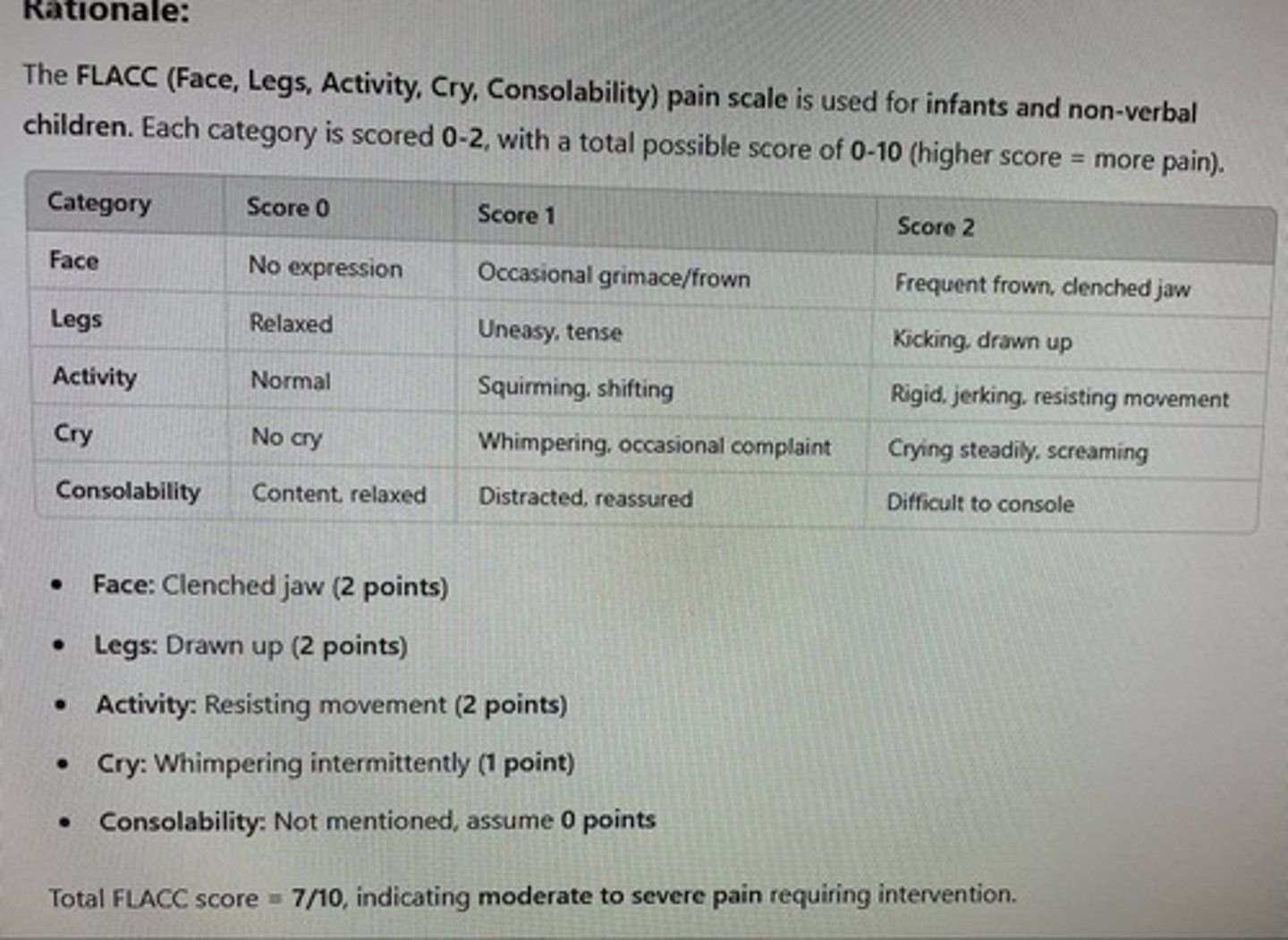
A nurse is assessing the pain level of a 2-year-old child post-operatively using the FLACC scale. The child is whimpering intermittently, has a tense body, is resisting movement, and is clenching their jaw while keeping their legs drawn up. What is the child's FLACC pain score?
Rationale:
Face: Clenched jaw (2 points)
Legs: Drawn up (2 points)
Activity: Resisting movement (2 points)
Cry: Whimpering intermittently (1 point)
Consolability: Not mentioned, assume 0 points
Total FLACC score = 7/10, indicating moderate to severe pain requiring intervention.
7
A school nurse witnesses a child having a tonic-clonic seizure in the classroom. Which actions should the nurse take? (Select all that apply.)
Turn the child to their side to maintain airway patency. Time the duration of the seizure and observe characteristics.. Loosen restrictive clothing and remove nearby objects.Administer oxygen if needed after the seizure ends.
Post-Seizure (Postictal Phase) Nursing Actions:
Assess airway, breathing, circulation (ABC).
Monitor level of consciousness (LOC) and reorient the child.
Check for injuries.
Document seizure characteristics.
Administer anti-seizure medications as prescribed (e.g., lorazepam for prolonged seizures).
A child with a newly applied cast for a tibia fracture reports increasing pain and tingling in the toes. What should the nurse assess for?
Capillary refill in the toes.Warmth and color of the extremity.Ability to move the toes.Presence of pedal pulses.
A nurse is assessing the fundal height of a pregnant client at 28 weeks gestation. Where should the fundus be located?
Rationale:
At 20 weeks, the fundus is at the umbilicus.
From 20-36 weeks, fundal height in cm = gestational age in weeks (±2 cm).
At 28 weeks, the fundus should be between the umbilicus and xiphoid process.
At 36 weeks, the fundus is at the xiphoid process.
Between the umbilicus and xiphoid process
A nurse is measuring a client’s fundal height at 32 weeks gestation and finds it to be 26 cm. What is the priority action?
Rationale:
Fundal height should match gestational age in cm (±2 cm).
A measurement more than 2 cm below expected suggests IUGR, oligohydramnios, or fetal anomalies.
Immediate provider notification is needed to evaluate fetal growth.
Notify the provider of possible intrauterine growth restriction (IUGR).
A mother brings her newborn to the pediatric clinic for a routine check-up. She expresses concern about her baby's immune system and asks the nurse how the infant is protected from infections in the first few months of life.Which response by the nurse is correct?
"Passive immunity is transferred from the mother through the placenta and breast milk."
Which of the following can cause fundal height to measure larger than expected? (SATA)
Polyhydramnios (excess amniotic fluid) increases fundal height.
Multiple gestation (twins/triplets) causes excessive fundal height.
Maternal obesity can make fundal height appear larger due to subcutaneous fat.
A patient taking antibiotics states, "I feel better now, so I'm going to stop taking them." What is the best nursing response?
"You should always finish the full course to prevent bacterial resistance and ensure complete eradication of the infection."
A nurse is educating a patient about common side effects of antibiotics. Which of the following should be included in the teaching? (Select all that apply.)
Diarrhea
Nausea, vomiting
Fungal infections (thrush, yeast infections)
Photosensitivity (tetracyclines, fluoroquinolones),Hearing loss (aminoglycosides),
Orange urine (rifampin)
Bishop Score isused to assess cervical readiness for labor and determine the likelihood of successful induction. It evaluates:
Score ≥ 8: Indicates the cervix is favorable for induction.
Score < 6: Suggests cervical ripening is needed before labor induction.
The nurse is educating a group of parents about infant feeding readiness. Which signs indicate that a baby is ready to start eating solid foods,while being on formula? (Select all that apply.)
The baby shows interest in food when others are eating.
The baby can move food to the back of the mouth and swallow.The baby has good head and neck control.The baby can sit with minimal support.
Which medication is commonly used for cervical ripening when a patient has a low Bishop Score?
Misoprostol
A nurse is caring for a patient with a Bishop Score of 4 who requires labor induction. Which interventions should the nurse anticipate? (Select all that apply.)
Administration of misoprostol (Cytotec),Administration of dinoprostone (Cervidil),Reassessment of Bishop Score after cervical ripening
Which factors contribute to a lower Bishop Score, making induction less likely to succeed? (Select all that apply.)
Firm cervical consistency.Posterior cervical position.Cervical dilation of 1 cm.
A pregnant client is diagnosed with pyelonephritis. What signs/symptoms should the nurse monitor for? (SATA)
Flank pain,Fever and chills,Urinary frequency and dysuria,Hypotension and tachycardia.
What should the nurse do if shoulder dystocia occurs? (SATA)
Apply suprapubic pressure.Perform McRoberts maneuver.Call for help