Attitudes and Stereotypes
 Call Kai
 Learn
Learn Practice Test
 Spaced Repetition
 Match
Match Flashcards
 Knowt Play
1/14

There's no tags or description
Looks like no tags are added yet.
Name | Mastery | Learn | Test | Matching | Spaced | Call with Kai | Chat |
|---|
No analytics yet
Send a link to your students to track their progress
15 Terms
Define Attitude
Long-lasting evaluations made up of the feelings, beliefs and behaviours towards ourselves, other people, objects, events and issues.
• Can be said to be positive, negative or neutral (directional).
‘• Vary in intensity
• Impact our actions
Attitude Object
The target of judgment related to an attitude, such as an object, person, event or social group.
Explicit Attitude
Conscious judgements held toward an attitude object.
Measured by self-reports tests (rating scales, surveys)

Implicit Attitudes
Unconscious judgments held toward an attitude object.
More likely to produce true and consistent responses.
Unconsciously influenced by various factors, such as culture associations, personal experiences and stereotypes
didn’t know they existed
TRIPARTITE MODEL (ABC)
1. Affect (feelings and emotion)
• “I am scared of spiders”.
2. Behaviour (actions)
• “I will avoid spiders and scream if I see one”.
3. Cognition (thoughts and beliefs)
• “I believe spiders are dangerous”.
implicit bias
consciously rejects stereotypes
holds negative associations unconsciously
How to reduce bias
Learn about bias
Learn about people
Form deep relationships
Cognitive Dissonance
A feeling of mental discomfort when contradictory information is perceived by a person
Cognitive dissonance is the mental discomfort experienced when a person holds two conflicting beliefs or when their actions don’t align with their beliefs.
Effect of Cognitive Dissonance on Behaviour
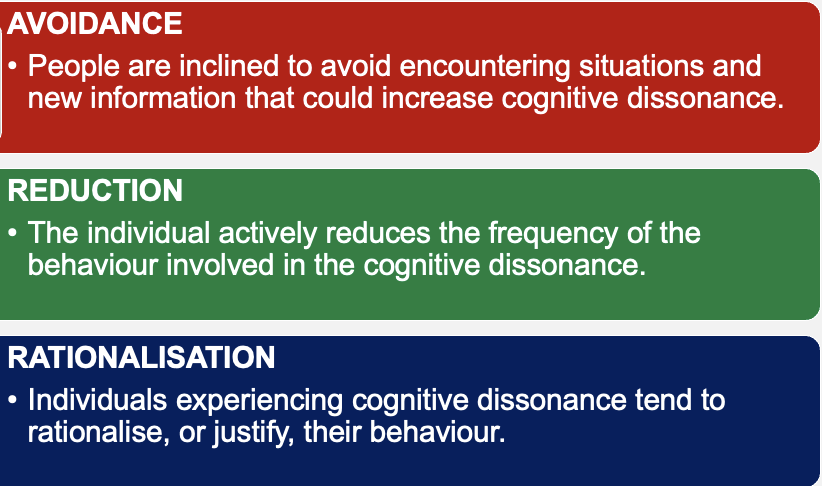
Magnitude as a factor affecting cognitive dissonance (CD)
•Magnitude is a subjective measure of the level of discomfort an individual feels when they experience CD.
•The greater the magnitude of dissonance, the greater the pressure felt to reduce it.
•There are TWO factors that predict the amount of discomfort felt due to CD.
1.The more value an individual places on either of the two conflicting cognitions, the greater the magnitude of the dissonance.
2.The maximum level of dissonance an individual can manage before needing to reduce the discomfort.
What causes cognitive dissonance?
1.Forced Compliance Behaviour
2.Decision Making
3.Effort
What causes cognitive dissonance?
2.Decision Making
•People have several ways to reduce dissonance that is aroused by making a decision (Festinger, 1964).
•One thing they can do is to change the behaviour. As noted earlier, this is often very difficult, so people frequently employ a variety of mental manoeuvres.
•A common way to reduce dissonance is to increase the attractiveness of the chosen alternative and to decrease the attractiveness of the rejected alternative.
What causes cognitive dissonance?
1.Forced Compliance Behaviour
When someone is forced to do something (publicly) they (privately) really do not want to do, dissonance is created between their cognition (I didn’t want to do this) and their behaviour (I did it).
Forced compliance occurs when an individual performs an action that is inconsistent with their own beliefs.
The behaviour cannot be changed – it is already in the past, so dissonance is reduced by re-evaluating their attitudes to what they have done.
What causes cognitive dissonance?
3.Effort
•It also seems to be the case that we value most highly those goals or items which have required considerable effort to achieve.
•This is probably because dissonance would be caused if we spent a great effort to achieve something and then evaluated it negatively.
•We could, of course, spend years of effort into achieving something which turns out to be a load of rubbish and then, in order to avoid the dissonance that produces, try to convince ourselves that we didn't really spend years of effort, or that the effort was really quite enjoyable, or that it wasn't really a lot of effort.
Method